battery CHEVROLET EXPRESS CARGO VAN 2007 1.G Owner's Manual
[x] Cancel search | Manufacturer: CHEVROLET, Model Year: 2007, Model line: EXPRESS CARGO VAN, Model: CHEVROLET EXPRESS CARGO VAN 2007 1.GPages: 458, PDF Size: 2.62 MB
Page 332 of 458
4. Open the hoods and locate the positive (+)
and negative (−) terminal locations of the
other vehicle.
Your vehicle has a remote positive (+) jump
starting terminal and a remote negative (−)
jump starting terminal. You should always
use these remote terminals instead of
the terminals on the battery.
The remote positive (+) terminal is located
behind a red plastic cover near the engine
accessory drive bracket on the driver’s side of
the engine compartment, below the alternator.
To uncover the remote positive (+) terminal,
open the red plastic cover.
The remote negative (−) terminal is located on
the engine drive bracket on all V8 engines
and is marked GND (Ground).
On V6 engines the remote negative (−)
terminal is located on a tab attached to
the engine accessory drive bracket and is
marked GND (Ground).
{CAUTION:
Using a match near a battery can cause
battery gas to explode. People have been
hurt doing this, and some have been
blinded. Use a ashlight if you need
more light.
Be sure the battery has enough water.
You do not need to add water to the battery
installed in your new vehicle. But if a
battery has ller caps, be sure the right
amount of uid is there. If it is low, add
water to take care of that rst. If you do
not, explosive gas could be present.
Battery uid contains acid that can
burn you. Do not get it on you. If you
accidentally get it in your eyes or on your
skin, ush the place with water and get
medical help immediately.
332
Page 333 of 458
{CAUTION:
Fans or other moving engine parts can
injure you badly. Keep your hands away
from moving parts once the engine is
running.
5. Check that the jumper cables do not have
loose or missing insulation. If they do, you
could get a shock. The vehicles could
be damaged too.
Before you connect the cables, here are some
basic things you should know. Positive (+)
will go to positive (+) or to a remote
positive (+) terminal if the vehicle has one.
Negative (−) will go to a heavy, unpainted
metal engine part or to a remote negative (−)
terminal if the vehicle has one.
Do not connect positive (+) to negative (−)
or you will get a short that would damage
the battery and maybe other parts too.
And do not connect the negative (−) cable
to the negative (−) terminal on the dead
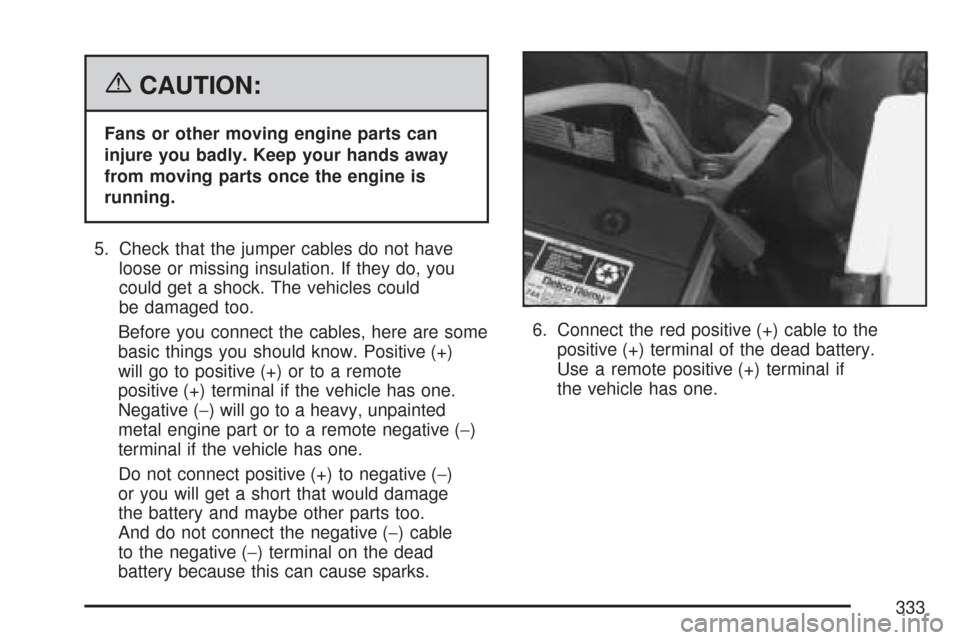
battery because this can cause sparks.6. Connect the red positive (+) cable to the
positive (+) terminal of the dead battery.
Use a remote positive (+) terminal if
the vehicle has one.
333
Page 334 of 458
7. Do not let the other end touch metal.
Connect it to the positive (+) terminal of the
good battery. Use a remote positive (+)
terminal if the vehicle has one.
8. Now connect the black negative (−) cable to
the negative (−) terminal of the good battery.
Use a remote negative (−) terminal if the
vehicle has one.
Do not let the other end touch anything until the
next step. The other end of the negative (−)
cable does not go to the dead battery. It goes to
a heavy, unpainted metal engine part or to a
remote negative (−) terminal on the vehicle
with the dead battery.9. Connect the other end of the negative (−)
cable to the negative (−) terminal location
on the vehicle with the dead battery.
Your vehicle has a remote negative (−)
terminal for this purpose. It is marked GND.
10. Now start the vehicle with the good battery
and run the engine for a while.
11. Try to start the vehicle that had the dead
battery. If it will not start after a few tries,
it probably needs service.
Notice:If the jumper cables are connected or
removed in the wrong order, electrical shorting
may occur and damage the vehicle. The repairs
would not be covered by your warranty. Always
connect and remove the jumper cables in the
correct order, making sure that the cables do
not touch each other or other metal.
334
Page 335 of 458
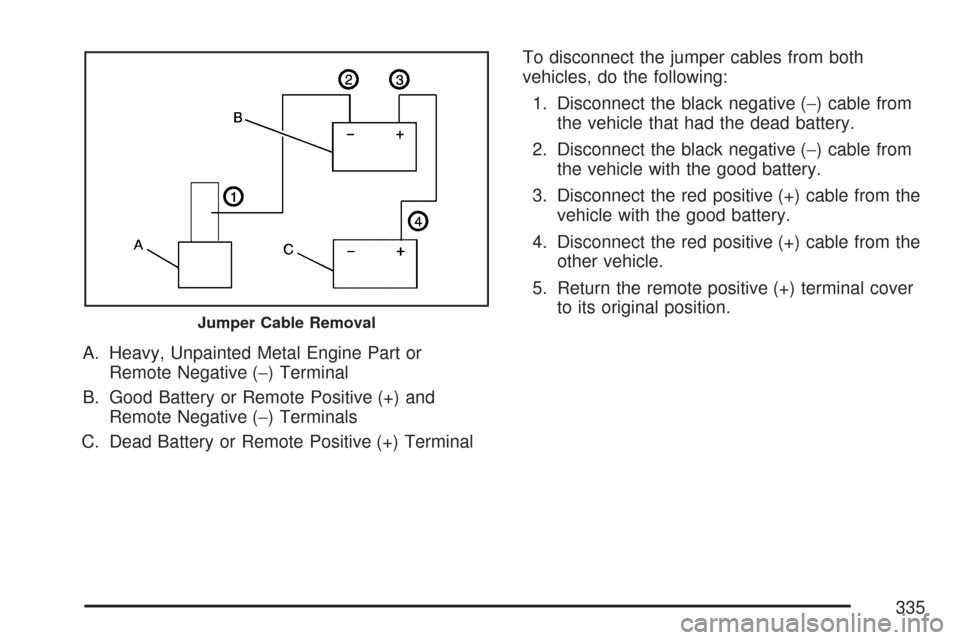
A. Heavy, Unpainted Metal Engine Part or
Remote Negative (−) Terminal
B. Good Battery or Remote Positive (+) and
Remote Negative (−) Terminals
C. Dead Battery or Remote Positive (+) TerminalTo disconnect the jumper cables from both
vehicles, do the following:
1. Disconnect the black negative (−) cable from
the vehicle that had the dead battery.
2. Disconnect the black negative (−) cable from
the vehicle with the good battery.
3. Disconnect the red positive (+) cable from the
vehicle with the good battery.
4. Disconnect the red positive (+) cable from the
other vehicle.
5. Return the remote positive (+) terminal cover
to its original position.
Jumper Cable Removal
335
Page 395 of 458
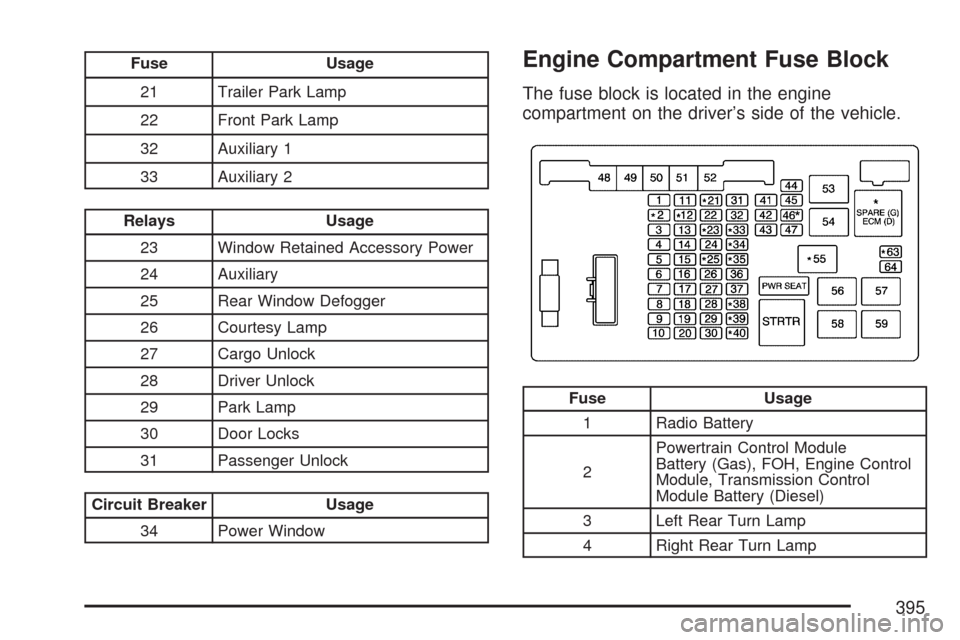
Fuse Usage
21 Trailer Park Lamp
22 Front Park Lamp
32 Auxiliary 1
33 Auxiliary 2
Relays Usage
23 Window Retained Accessory Power
24 Auxiliary
25 Rear Window Defogger
26 Courtesy Lamp
27 Cargo Unlock
28 Driver Unlock
29 Park Lamp
30 Door Locks
31 Passenger Unlock
Circuit Breaker Usage
34 Power Window
Engine Compartment Fuse Block
The fuse block is located in the engine
compartment on the driver’s side of the vehicle.
Fuse Usage
1 Radio Battery
2Powertrain Control Module
Battery (Gas), FOH, Engine Control
Module, Transmission Control
Module Battery (Diesel)
3 Left Rear Turn Lamp
4 Right Rear Turn Lamp
395
Page 431 of 458
•Jump Start:No-start occurrences which
require a battery jump start will be covered
at no charge.
•Trip Routing Service (Canada only):Upon
request, Roadside Assistance will send you
detailed, computer personalized maps,
highlighting your choice of either the most
direct route or the most scenic route to your
destination, anywhere in North America,
along with helpful travel information pertaining
to your trip.
We will make every attempt to send your
personalized trip routing as quickly as
possible, but it is best to allow three weeks
before your planned departure date.
Trip routing requests will be limited to
six per calendar year.
•Trip Interruption Benets and Assistance
(Canada only):In the event of a warranty
related vehicle disablement, while en route and
over 250 kilometres from original point of
departure, you may qualify for trip interruption
expense assistance. This assistance covers
reasonable reimbursement of up to a
maximum of $500 (Canadian) for (A) meals
(maximum of $50/day), (B) lodging (maximumof $100/night) and (C) alternate ground
transportation (maximum of $40/day). This
benefit is to assist you with some of the
unplanned expense you may incur while
waiting for your vehicle to be repaired.
Pre-authorization, original detailed receipts
and a copy of the repair order are required.
Once authorization has been given, your
advisor will help you make any necessary
arrangements and explain how to claim for trip
interruption expense assistance.
•Alternative Service (Canada only):There
may be times, when Roadside Assistance
cannot provide timely assistance. Your advisor
may authorize you to secure local emergency
road service, and you will be reimbursed
up to $100 upon submission of the original
receipt to Roadside Assistance.
In many instances, mechanical failures are covered
under Chevrolet’s Bumper-to-Bumper warranty, for
U.S. customers, and the duration of the Base
Warranty Coverage of the New Vehicle Limited
Warranty, for Canadian customers. However, any
cost for parts and labor for non-warranty repairs are
the responsibility of the driver.
431
Page 446 of 458
Audio System.............................................. 187
AM-FM Radio.......................................... 190
Care of Your Cassette Tape Player.......... 224
Care of Your CD Player........................... 226
Care of Your CDs.................................... 225
Chime Level Adjustment........................... 226
Fixed Mast Antenna................................. 226
Radio with Cassette and CD.................... 198
Radio with CD......................................... 193
Radio with Six-Disc CD............................ 211
Setting the Time with Radio Data
Systems (RDS)..................................... 189
Setting the Time without Radio Data
Systems (RDS)..................................... 189
Theft-Deterrent Feature............................ 223
Understanding Radio Reception............... 224
Automatic Transmission
Fluid........................................................ 309
Operation................................................. 125
B
Battery........................................................ 329
Run-Down Protection............................... 158
Before Leaving on a Long Trip.................... 252Brake
Emergencies............................................ 235
Parking.................................................... 128
Brakes........................................................ 325
System Warning Light.............................. 175
Braking....................................................... 232
Braking in Emergencies............................... 235
Break-In, New Vehicle................................. 119
Bulb Replacement....................................... 340
Center High-Mounted Stoplamp
(CHMSL).............................................. 342
Front Turn Signal, Sidemarker and
Parking Lamps..................................... 342
Halogen Bulbs......................................... 340
Headlamps............................................... 340
Replacement Bulbs.................................. 344
Taillamps.................................................. 343
Buying New Tires........................................ 358
C
Calibration................................................... 134
California Fuel............................................. 293
California Proposition 65 Warning................ 291
Canadian Owners........................................... 3
446