check engine CHEVROLET EXPRESS CARGO VAN 2007 1.G Owner's Manual
[x] Cancel search | Manufacturer: CHEVROLET, Model Year: 2007, Model line: EXPRESS CARGO VAN, Model: CHEVROLET EXPRESS CARGO VAN 2007 1.GPages: 458, PDF Size: 2.62 MB
Page 284 of 458
Turn Signals When Towing a Trailer
When you tow a trailer, your vehicle has to have
extra wiring and a heavy-duty turn signal
flasher (included in the optional trailering package).
The arrows on your instrument panel will flash
whenever you signal a turn or lane change.
Properly hooked up, the trailer lamps will also
flash, telling other drivers you’re about to
turn, change lanes or stop.
When towing a trailer, the arrows on your
instrument panel will flash for turns even if the bulbs
on the trailer are burned out. Thus, you may think
drivers behind you are seeing your signal when
they are not. It’s important to check occasionally to
be sure the trailer bulbs are still working.
Driving On Grades
Reduce speed and shift to a lower gearbefore
you start down a long or steep downgrade. If you
don’t shift down, you might have to use your
brakes so much that they would get hot and no
longer work well.
You can tow in DRIVE (D). You may want to shift
the transmission to THIRD (3) or a lower gear
under heavy loads and/or hilly conditions.
When towing at high altitude on steep uphill
grades, consider the following: Engine coolant will
boil at a lower temperature than at normal
altitudes. If you turn your engine off immediately
after towing at high altitude on steep uphill grades,
your vehicle may show signs similar to engine
overheating. To avoid this, let the engine run while
parked (preferably on level ground) with the
automatic transmission in PARK (P) for a few
minutes before turning the engine off. If you do get
the overheat warning, seeEngine Overheating
on page 315.
284
Page 286 of 458
Maintenance When Trailer Towing
Your vehicle will need service more often when
you’re pulling a trailer. See the Maintenance
Schedule for more on this. Things that are
especially important in trailer operation are
automatic transmission fluid (don’t overfill), engine
oil, axle lubricant, belt, cooling system and
brake system. Each of these is covered in this
manual, and the Index will help you find them
quickly. If you’re trailering, it’s a good idea
to review these sections before you start your trip.
Check periodically to see that all hitch nuts and
bolts are tight.
Trailer Wiring Harness
The optional heavy-duty trailer wiring package
includes a seven-wire harness assembly at the rear
of the vehicle and a four-wire harness assembly
under the left hand side of the instrument panel.
The seven-wire harness assembly is taped together
and located in a frame pocket at the driver side rear
left corner of the frame. The seven-wire harness
includes a 30-amp feed wire.Both harnesses come without connectors and
should be wired by a qualified electrical technician.
The technician can use the following color code
chart when connecting the wiring harness to your
trailer and trailer brake controller.
Seven-Wire Harness
•Light Green: Back-up lamps
•Brown: Parking lamps
•Yellow: Left stoplamp and turn signal
•Dark Green: Right stoplamp and turn signal
•Dark Blue: Use for electric trailer brakes
•Red/Black Stripe: Trailer accessory
•White (heavy gage): Ground wire
Four-Wire Harness (Trailer Brake Controller)
•Black: Ground
•Red/White Stripe: Fused Battery
•Dark Blue: Trailer Brake Feed
•Light Blue: Fused Stoplamp/CHMSL
286
Page 287 of 458
Service........................................................ 290
Accessories and Modifications................... 290
California Proposition 65 Warning.............. 291
Doing Your Own Service Work.................. 291
Adding Equipment to the Outside of
Your Vehicle.......................................... 292
Fuel............................................................. 292
Gasoline Octane........................................ 293
Gasoline Specifications.............................. 293
California Fuel........................................... 293
Additives................................................... 294
Fuel E85 (85% Ethanol)............................ 295
Fuels in Foreign Countries........................ 296
Filling the Tank......................................... 297
Filling a Portable Fuel Container............... 299
Checking Things Under the Hood.............. 300
Hood Release........................................... 300
Engine Compartment Overview.................. 302
Engine Oil (Gasoline Engine).................... 303
Engine Oil Life System
(Gasoline Engine).................................. 306
Engine Air Cleaner/Filter............................ 308
Automatic Transmission Fluid.................... 309
Engine Coolant.......................................... 312Radiator Pressure Cap.............................. 315
Engine Overheating................................... 315
Cooling System......................................... 317
Engine Fan Noise..................................... 323
Power Steering Fluid................................. 323
Windshield Washer Fluid........................... 324
Brakes...................................................... 325
Battery...................................................... 329
Jump Starting............................................ 330
All-Wheel Drive........................................... 336
Rear Axle.................................................... 337
Front Axle................................................... 338
Noise Control System................................. 338
Tampering with Noise Control System
Prohibited.............................................. 338
Bulb Replacement....................................... 340
Halogen Bulbs........................................... 340
Headlamps................................................ 340
Front Turn Signal, Sidemarker and
Parking Lamps....................................... 342
Center High-Mounted Stoplamp (CHMSL) ... 342
Taillamps................................................... 343
Replacement Bulbs................................... 344
Section 5 Service and Appearance Care
287
Page 292 of 458
Adding Equipment to the Outside
of Your Vehicle
Things you might add to the outside of your
vehicle can affect the airflow around it. This may
cause wind noise and affect windshield washer
performance. Check with your dealer before
adding equipment to the outside of your vehicle.
Fuel
If your vehicle has a diesel engine, see
“Diesel Fuel Requirements and Fuel System”
in the DURAMAX
®Diesel Supplement.
For vehicles with gasoline engines, please
read this.
Gasoline
Use of the recommended fuel is an important
part of the proper maintenance of your vehicle.
To help keep the engine clean and maintain
optimum vehicle performance, GM recommends
the use of gasoline advertised as TOP TIER
Detergent Gasoline.
The 8th digit of the Vehicle Identification
Number (VIN) shows the code letter or number
that identifies your vehicle’s engine. The VIN
is at the top left of the instrument panel.
SeeVehicle Identication Number (VIN)
on page 392.
If your vehicle has the 5.3L V8 engine
(VIN Code Z), you can use either regular
unleaded gasoline or ethanol fuel containing
up to 85% ethanol (E85); also seeFuel E85
(85% Ethanol) on page 295. In all other gasoline
engines, use only regular unleaded gasoline.
292
Page 293 of 458
Gasoline Octane
Use regular unleaded gasoline with a posted
octane rating of 87 or higher. If the octane rating
is less than 87, you might notice an audible
knocking noise when you drive, commonly referred
to as spark knock. If this occurs, use a gasoline
rated at 87 octane or higher as soon as possible.
If you are using gasoline rated at 87 octane or
higher and you hear heavy knocking, the engine
needs service.
Gasoline Specications
At a minimum, gasoline should meet ASTM
specification D 4814 in the United States or
CAN/CGSB-3.5 in Canada. Some gasolines may
contain an octane-enhancing additive called
methylcyclopentadienyl manganese tricarbonyl
(MMT). General Motors recommends against the
use of gasolines containing MMT. SeeAdditives
on page 294for additional information.
California Fuel
If your vehicle is certified to meet California
Emissions Standards, it is designed to operate
on fuels that meet California specifications.
See the underhood emission control label.
If this fuel is not available in states adopting
California emissions standards, your vehicle will
operate satisfactorily on fuels meeting federal
specifications, but emission control system
performance may be affected. The malfunction
indicator lamp may turn on and your vehicle may
fail a smog-check test. SeeMalfunction Indicator
Lamp on page 178. If this occurs, return to
your authorized GM dealer for diagnosis. If it is
determined that the condition is caused by the
type of fuel used, repairs may not be covered
by your warranty.
293
Page 295 of 458
Fuel E85 (85% Ethanol)
The 8th digit of the Vehicle Identification
Number (VIN) shows the code letter or number
that identifies your vehicle’s engine. The VIN is
at the top left of the instrument panel. See
Vehicle Identication Number (VIN) on page 392.
If your vehicle has the 5.3L V8 engine (VIN Code Z
only), you can use either regular unleaded gasoline
or ethanol fuel containing up to 85% ethanol (E85);
also seeFuel on page 292. In all other engines,
use only the unleaded gasoline described under
Gasoline Octane on page 293.
Only vehicles that have the 5.3L V8 engine
(VIN Code Z) can use 85% ethanol fuel (E85).
We encourage the use of E85 in vehicles that
are designed to use it. The ethanol in E85
is a “renewable” fuel, meaning it is made from
renewable sources such as corn and other crops.
Many service stations will not have an 85% ethanol
fuel (E85) pump available. The U. S. Department
of Energy has an alternative fuels website
(www.eere.energy.gov/afdc/infrastructure/
locator.html) that can help you find E85 fuel.
Those stations that do have E85 should have a
label indicating ethanol content. Do not use the
fuel if the ethanol content is greater than 85%.At a minimum, E85 should meet ASTM
Specification D 5798. By definition, this means
that fuel labeled E85 will have an ethanol content
between 70% and 85%. Filling the fuel tank
with fuel mixtures that do not meet ASTM
specifications can affect driveability and could
cause the check engine light to come on.
To ensure quick starts in the wintertime, the
E85 fuel must be formulated properly for your
climate according to ASTM specification D 5798.
If you have trouble starting on E85, it could
be because the E85 fuel is not properly formulated
for your climate. If this happens, switching to
gasoline or adding gasoline to the fuel tank can
improve starting. For good starting and heater
efficiency below 32°F (0°C), the fuel mix in the fuel
tank should contain no more than 70% ethanol.
It is best not to alternate repeatedly between
gasoline and E85. If you do switch fuels, it
is recommended that you add as much fuel as
possible — do not add less than three gallons
(11 L) when refueling. You should drive the
vehicle immediately after refueling for at least
seven miles (11 km) to allow the vehicle to adapt
to the change in ethanol concentration.
295
Page 300 of 458
Checking Things
Under the Hood
{CAUTION:
Things that burn can get on hot engine or
fuel operated heater (FOH) parts and start a
re. These include liquids like fuel, oil,
coolant, brake uid, windshield washer and
other uids, and plastic or rubber. You or
others could be burned. Be careful not to
drop or spill things that will burn onto a
hot engine or fuel operated heater (FOH).
Hood Release
To open the hood, do the following:
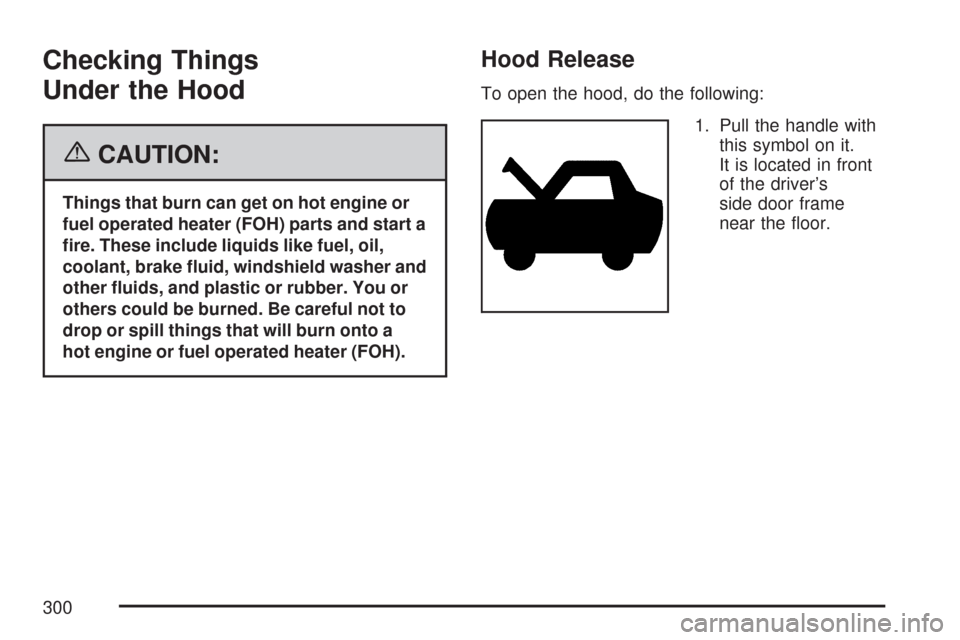
1. Pull the handle with
this symbol on it.
It is located in front
of the driver’s
side door frame
near the floor.
300
Page 303 of 458
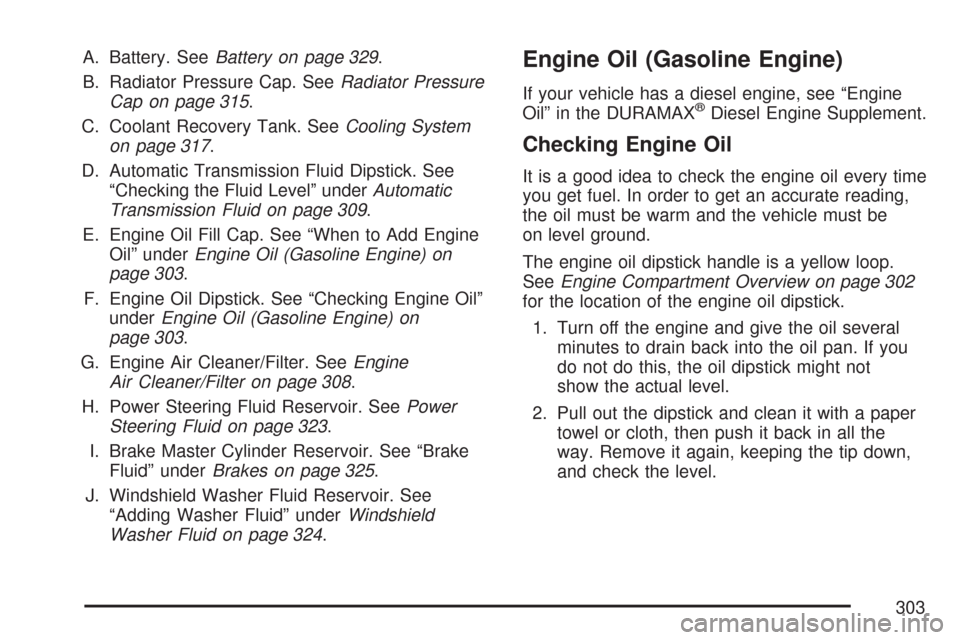
A. Battery. SeeBattery on page 329.
B. Radiator Pressure Cap. SeeRadiator Pressure
Cap on page 315.
C. Coolant Recovery Tank. SeeCooling System
on page 317.
D. Automatic Transmission Fluid Dipstick. See
“Checking the Fluid Level” underAutomatic
Transmission Fluid on page 309.
E. Engine Oil Fill Cap. See “When to Add Engine
Oil” underEngine Oil (Gasoline Engine) on
page 303.
F. Engine Oil Dipstick. See “Checking Engine Oil”
underEngine Oil (Gasoline Engine) on
page 303.
G. Engine Air Cleaner/Filter. SeeEngine
Air Cleaner/Filter on page 308.
H. Power Steering Fluid Reservoir. SeePower
Steering Fluid on page 323.
I. Brake Master Cylinder Reservoir. See “Brake
Fluid” underBrakes on page 325.
J. Windshield Washer Fluid Reservoir. See
“Adding Washer Fluid” underWindshield
Washer Fluid on page 324.Engine Oil (Gasoline Engine)
If your vehicle has a diesel engine, see “Engine
Oil” in the DURAMAX®Diesel Engine Supplement.
Checking Engine Oil
It is a good idea to check the engine oil every time
you get fuel. In order to get an accurate reading,
the oil must be warm and the vehicle must be
on level ground.
The engine oil dipstick handle is a yellow loop.
SeeEngine Compartment Overview on page 302
for the location of the engine oil dipstick.
1. Turn off the engine and give the oil several
minutes to drain back into the oil pan. If you
do not do this, the oil dipstick might not
show the actual level.
2. Pull out the dipstick and clean it with a paper
towel or cloth, then push it back in all the
way. Remove it again, keeping the tip down,
and check the level.
303
Page 306 of 458
If you are in an area of extreme cold, where the
temperature falls below−20°F (−29°C), it is
recommended that you use either an SAE 5W-30
synthetic oil or an SAE 0W-30 oil. Both provide
easier cold starting and better protection for
the engine at extremely low temperatures.
Engine Oil Additives
Do not add anything to the oil. The recommended
oils with the starburst symbol that meet GM
Standard GM6094M are all you need for good
performance and engine protection.
Engine Oil Life System
(Gasoline Engine)
When to Change Engine Oil
Your vehicle has a computer system that lets you
know when to change the engine oil and filter.
This is based on engine revolutions and engine
temperature, and not on mileage. Based on driving
conditions, the mileage at which an oil change
will be indicated can vary considerably. For the oil
life system to work properly, you must reset the
system every time the oil is changed.When the system has calculated that oil life has
been diminished, it will indicate that an oil change is
necessary. A change engine oil light will come on.
SeeChange Engine Oil Light on page 183. Change
the oil as soon as possible within the next 600 miles
(1 000 km). It is possible that, if you are driving
under the best conditions, the oil life system might
not indicate that an oil change is necessary for over
a year. However, the engine oil and filter must be
changed at least once a year and at this time the
system must be reset. Your dealer/retailer has
trained service people who will perform this work
using genuine parts and reset the system. It is also
important to check the oil regularly and keep it at
the proper level.
If the system is ever reset accidentally, you must
change the oil at 3,000 miles (5 000 km) since
your last oil change. Remember to reset the oil life
system whenever the oil is changed.
306
Page 309 of 458
3. Clean the engine air cleaner/filter housing.
4. Inspect or replace the engine air cleaner/filter.
Make sure that the filter fits properly into the
housing.
5. Reinstall the cover and fasten the
retaining clips.
{CAUTION:
Operating the engine with the air cleaner/
lter off can cause you or others to be
burned. The air cleaner not only cleans the
air; it helps to stop ames if the engine
backres. If it is not there and the engine
backres, you could be burned. Do not
drive with it off, and be careful working on
the engine with the air cleaner/lter off.
Notice:If the air cleaner/lter is off, a backre
can cause a damaging engine re. And, dirt
can easily get into your engine, which will
damage it. Always have the air cleaner/lter
in place when you are driving.
Automatic Transmission Fluid
If your vehicle has the DURAMAX®Diesel engine,
see the DURAMAX®Diesel manual for more
information.
When to Check and Change
Automatic Transmission Fluid
A good time to check your automatic transmission
fluid level is when the engine oil is changed.
Change the fluid and filter at the intervals listed in
Additional Required Services (Gasoline Engine)
on page 408, and be sure to use the transmission
fluid listed inRecommended Fluids and
Lubricants on page 415.
309