lock CHEVROLET EXPRESS CARGO VAN 2007 1.G Manual PDF
[x] Cancel search | Manufacturer: CHEVROLET, Model Year: 2007, Model line: EXPRESS CARGO VAN, Model: CHEVROLET EXPRESS CARGO VAN 2007 1.GPages: 458, PDF Size: 2.62 MB
Page 307 of 458
How to Reset the Engine Oil
Life System
The Engine Oil Life System calculates when to
change the engine oil and filter based on vehicle
use. Anytime the oil is changed, reset the
system so it can calculate when the next oil
change is required. If a situation occurs where you
change the oil prior to a change engine oil light
being turned on, reset the system.
To reset the change engine oil light:
1. Turn the ignition key to RUN with the
engine off.
2. Fully press and release the accelerator pedal
slowly three times within five seconds.
3. If the Change Engine Oil light flashes for
five seconds, the system is reset.
4. Turn the key to LOCK.
If the change engine oil light comes back on when
you start your vehicle, the engine oil life system
has not reset. Repeat the procedure. If it still does
not reset, see your dealer/retailer for service.
SeeChange Engine Oil Light on page 183.
What to Do with Used Oil
Used engine oil contains certain elements that can
be unhealthy for your skin and could even cause
cancer. Do not let used oil stay on your skin for very
long. Clean your skin and nails with soap and
water, or a good hand cleaner. Wash or properly
dispose of clothing or rags containing used engine
oil. See the manufacturer’s warnings about the use
and disposal of oil products.
Used oil can be a threat to the environment.
If you change your own oil, be sure to drain all
the oil from the filter before disposal. Never
dispose of oil by putting it in the trash, pouring it
on the ground, into sewers, or into streams or
bodies of water. Instead, recycle it by taking it
to a place that collects used oil. If you have
a problem properly disposing of used oil, ask
your dealer/retailer, a service station, or a local
recycling center for help.
307
Page 311 of 458
Checking the Fluid Level
Prepare your vehicle as follows:
1. Park your vehicle on a level place. Keep the
engine running.
2. With the parking brake applied, place the shift
lever in PARK (P).
3. With your foot on the brake pedal, move the
shift lever through each gear range, pausing
for about three seconds in each range.
Then, position the shift lever in PARK (P).
4. Let the engine run at idle for three minutes
or more.
Then, without shutting off the engine, follow
these steps:
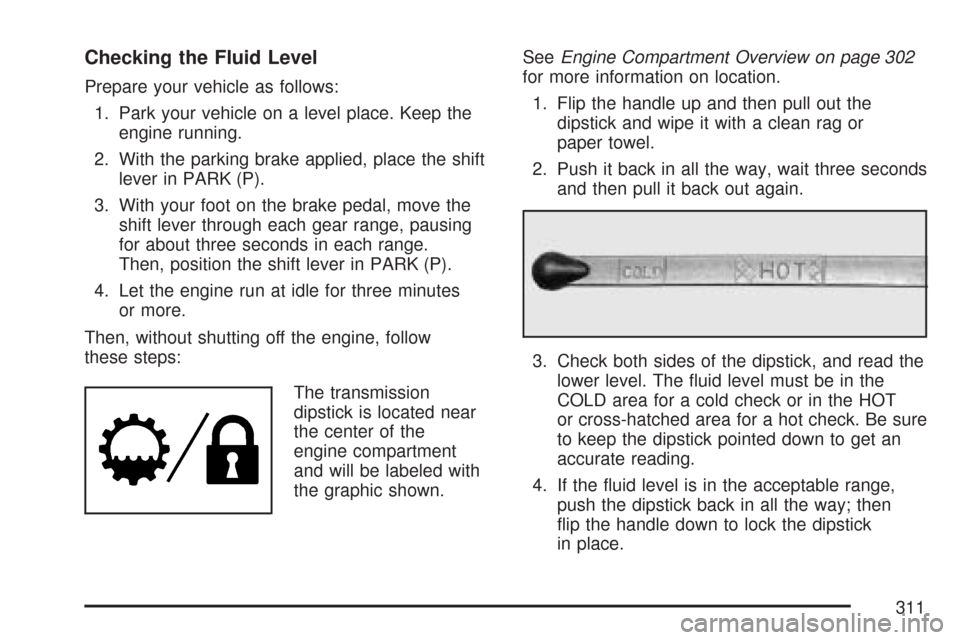
The transmission
dipstick is located near
the center of the
engine compartment
and will be labeled with
the graphic shown.SeeEngine Compartment Overview on page 302
for more information on location.
1. Flip the handle up and then pull out the
dipstick and wipe it with a clean rag or
paper towel.
2. Push it back in all the way, wait three seconds
and then pull it back out again.
3. Check both sides of the dipstick, and read the
lower level. The fluid level must be in the
COLD area for a cold check or in the HOT
or cross-hatched area for a hot check. Be sure
to keep the dipstick pointed down to get an
accurate reading.
4. If the fluid level is in the acceptable range,
push the dipstick back in all the way; then
flip the handle down to lock the dipstick
in place.
311
Page 312 of 458
How to Add Automatic
Transmission Fluid
Refer to the Maintenance Schedule to determine
what kind of transmission fluid to use. See
Recommended Fluids and Lubricants on page 415.
Using a funnel, add fluid down the transmission
dipstick tube only after checking the transmission
fluid while it is hot. A cold check is used only
as a reference. If the fluid level is low, add only
enough of the proper fluid to bring the level up to
the HOT area for a hot check. It does not take
much fluid, generally less than one pint (0.5 L).
Do not overfill.
Notice:Use of the incorrect automatic
transmission uid may damage your vehicle,
and the damages may not be covered by
your warranty. Always use the automatic
transmission uid listed inRecommended
Fluids and Lubricants on page 415.
•After adding fluid, recheck the fluid level as
described under “How to Check Automatic
Transmission Fluid,” earlier in this section.
•When the correct fluid level is obtained, push
the dipstick back in all the way; then flip the
handle down to lock the dipstick in place.
Engine Coolant
If your vehicle has the DURAMAX®Diesel engine,
see the DURAMAX®Diesel manual for more
information.
The cooling system in your vehicle is filled with
DEX-COOL
®engine coolant. This coolant is
designed to remain in your vehicle for five years
or 150,000 miles (240 000 km), whichever
occurs first, if you add only DEX-COOL
®
extended life coolant.
The following explains your cooling system and
how to add coolant when it is low. If you have
a problem with engine overheating, seeEngine
Overheating on page 315.
A 50/50 mixture of clean, drinkable water and
DEX-COOL
®coolant will:
•Give freezing protection down to−34°F (−37°C).
•Give boiling protection up to 265°F (129°C).
•Protect against rust and corrosion.
•Help keep the proper engine temperature.
•Let the warning lights and gages work as
they should.
312
Page 321 of 458
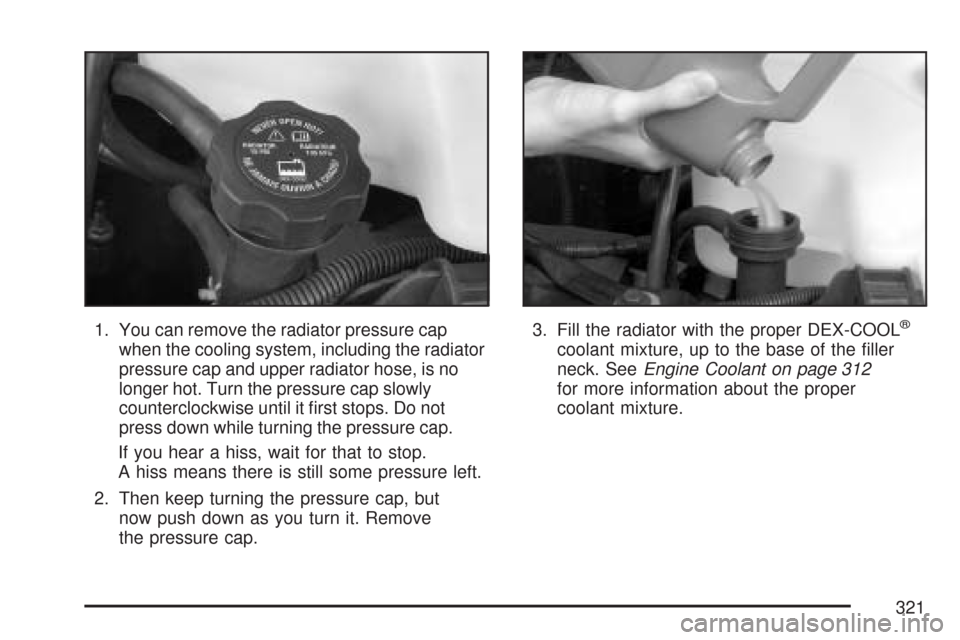
1. You can remove the radiator pressure cap
when the cooling system, including the radiator
pressure cap and upper radiator hose, is no
longer hot. Turn the pressure cap slowly
counterclockwise until it first stops. Do not
press down while turning the pressure cap.
If you hear a hiss, wait for that to stop.
A hiss means there is still some pressure left.
2. Then keep turning the pressure cap, but
now push down as you turn it. Remove
the pressure cap.3. Fill the radiator with the proper DEX-COOL®
coolant mixture, up to the base of the filler
neck. SeeEngine Coolant on page 312
for more information about the proper
coolant mixture.
321
Page 340 of 458
Bulb Replacement
For the proper type of replacement bulbs, see
Replacement Bulbs on page 344.
For any bulb changing procedure not listed in
this section, contact your dealer.
Halogen Bulbs
{CAUTION:
Halogen bulbs have pressurized gas
inside and can burst if you drop or
scratch the bulb. You or others could be
injured. Be sure to read and follow the
instructions on the bulb package.
Headlamps
To remove the headlamp assembly from the
vehicle and access the bulbs:
1. Open the hood. SeeHood Release on
page 300for more information.
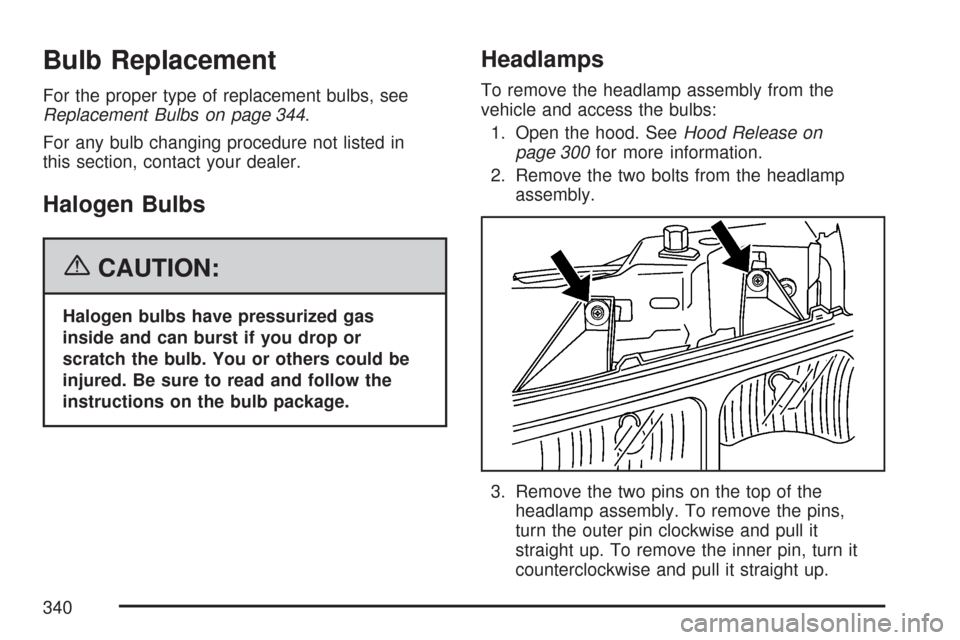
2. Remove the two bolts from the headlamp
assembly.
3. Remove the two pins on the top of the
headlamp assembly. To remove the pins,
turn the outer pin clockwise and pull it
straight up. To remove the inner pin, turn it
counterclockwise and pull it straight up.
340
Page 341 of 458
4. Lift the inboard side of the headlamp to
release the inboard tab from the radiator
support.
5. Lift the outboard side of the headlamp to
release the outboard tab from the radiator
support.
6. Lower the headlamp to allow the vertical
adjustor to clear the tie bar.
7. Turn the headlamp forward and upward to
remove it from the grille.
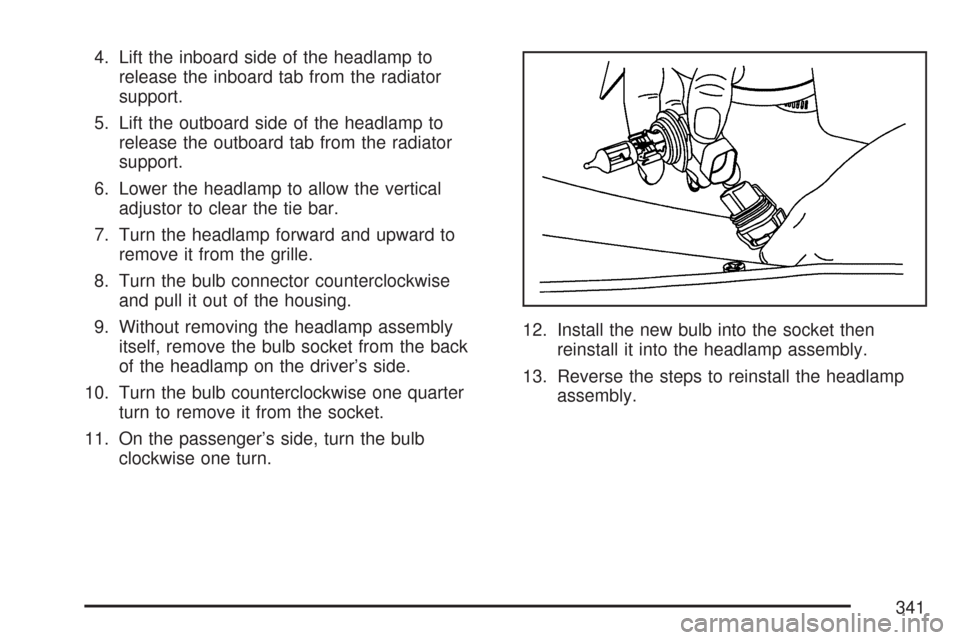
8. Turn the bulb connector counterclockwise
and pull it out of the housing.
9. Without removing the headlamp assembly
itself, remove the bulb socket from the back
of the headlamp on the driver’s side.
10. Turn the bulb counterclockwise one quarter
turn to remove it from the socket.
11. On the passenger’s side, turn the bulb
clockwise one turn.12. Install the new bulb into the socket then
reinstall it into the headlamp assembly.
13. Reverse the steps to reinstall the headlamp
assembly.
341
Page 342 of 458
Front Turn Signal, Sidemarker and
Parking Lamps
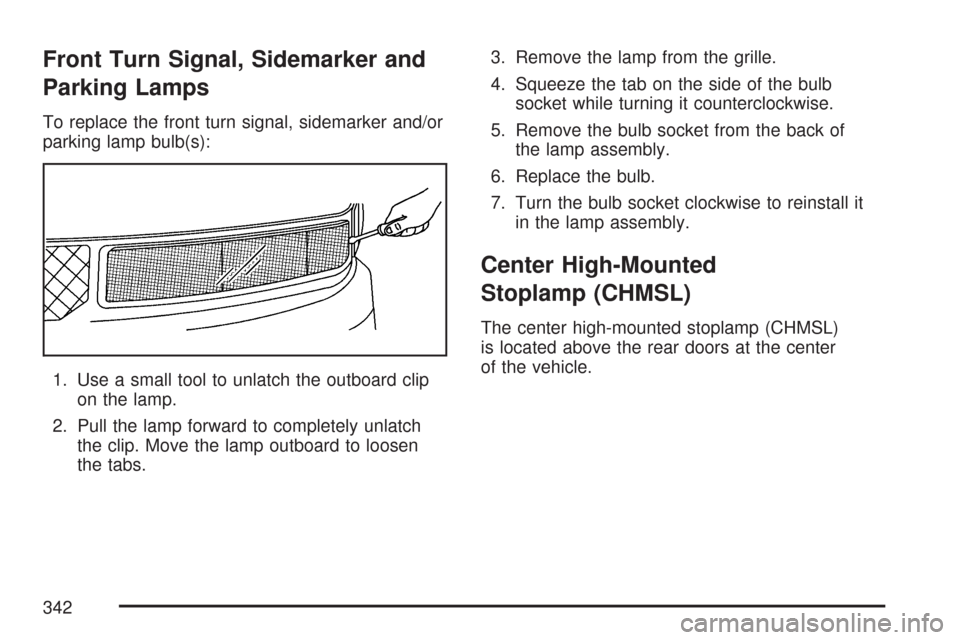
To replace the front turn signal, sidemarker and/or
parking lamp bulb(s):
1. Use a small tool to unlatch the outboard clip
on the lamp.
2. Pull the lamp forward to completely unlatch
the clip. Move the lamp outboard to loosen
the tabs.3. Remove the lamp from the grille.
4. Squeeze the tab on the side of the bulb
socket while turning it counterclockwise.
5. Remove the bulb socket from the back of
the lamp assembly.
6. Replace the bulb.
7. Turn the bulb socket clockwise to reinstall it
in the lamp assembly.
Center High-Mounted
Stoplamp (CHMSL)
The center high-mounted stoplamp (CHMSL)
is located above the rear doors at the center
of the vehicle.
342
Page 343 of 458
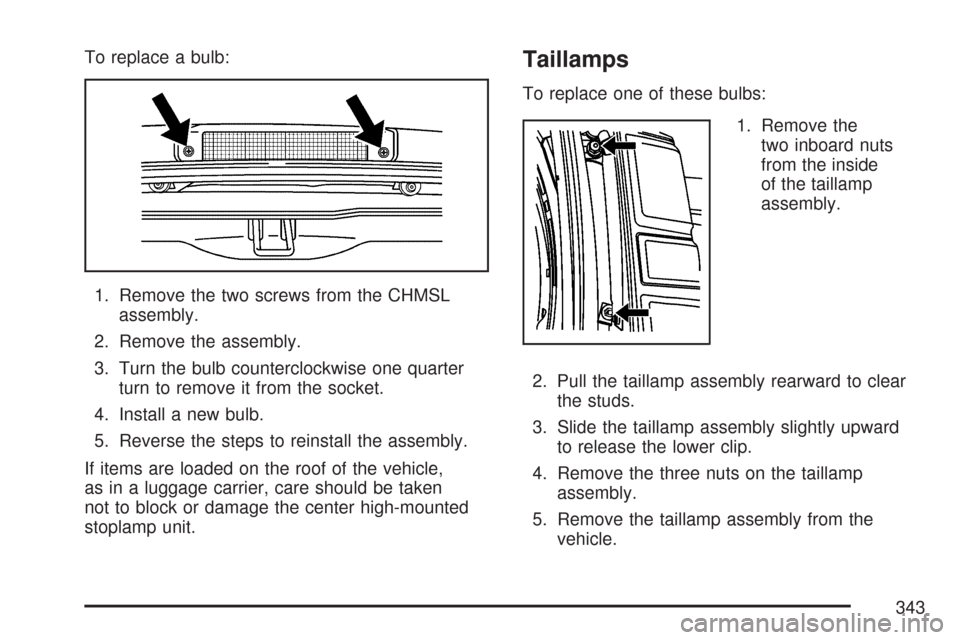
To replace a bulb:
1. Remove the two screws from the CHMSL
assembly.
2. Remove the assembly.
3. Turn the bulb counterclockwise one quarter
turn to remove it from the socket.
4. Install a new bulb.
5. Reverse the steps to reinstall the assembly.
If items are loaded on the roof of the vehicle,
as in a luggage carrier, care should be taken
not to block or damage the center high-mounted
stoplamp unit.Taillamps
To replace one of these bulbs:
1. Remove the
two inboard nuts
from the inside
of the taillamp
assembly.
2. Pull the taillamp assembly rearward to clear
the studs.
3. Slide the taillamp assembly slightly upward
to release the lower clip.
4. Remove the three nuts on the taillamp
assembly.
5. Remove the taillamp assembly from the
vehicle.
343
Page 344 of 458
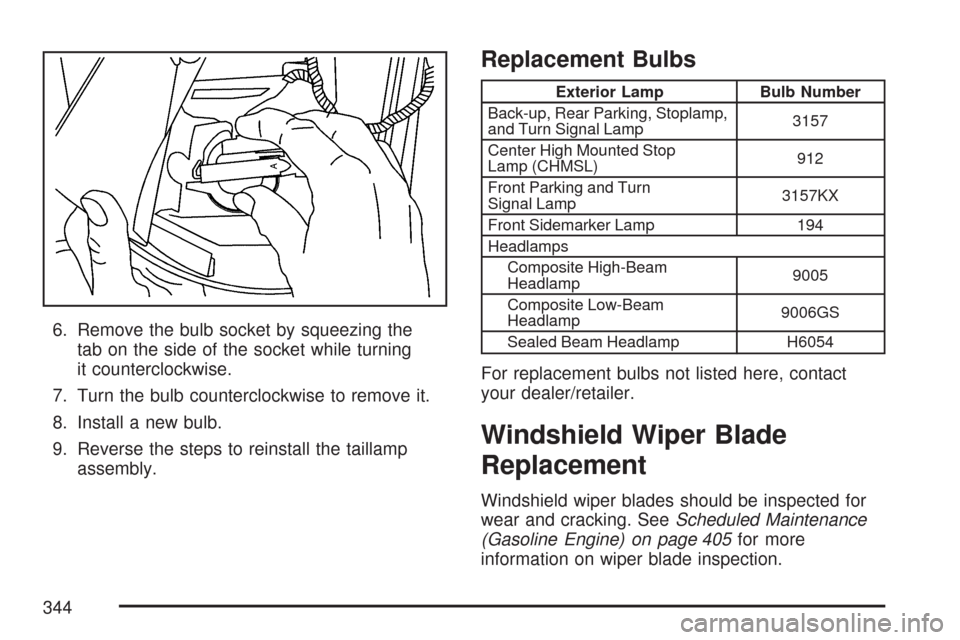
6. Remove the bulb socket by squeezing the
tab on the side of the socket while turning
it counterclockwise.
7. Turn the bulb counterclockwise to remove it.
8. Install a new bulb.
9. Reverse the steps to reinstall the taillamp
assembly.
Replacement Bulbs
Exterior Lamp Bulb Number
Back-up, Rear Parking, Stoplamp,
and Turn Signal Lamp3157
Center High Mounted Stop
Lamp (CHMSL)912
Front Parking and Turn
Signal Lamp3157KX
Front Sidemarker Lamp 194
Headlamps
Composite High-Beam
Headlamp9005
Composite Low-Beam
Headlamp9006GS
Sealed Beam Headlamp H6054
For replacement bulbs not listed here, contact
your dealer/retailer.
Windshield Wiper Blade
Replacement
Windshield wiper blades should be inspected for
wear and cracking. SeeScheduled Maintenance
(Gasoline Engine) on page 405for more
information on wiper blade inspection.
344
Page 345 of 458
Replacement blades come in different types
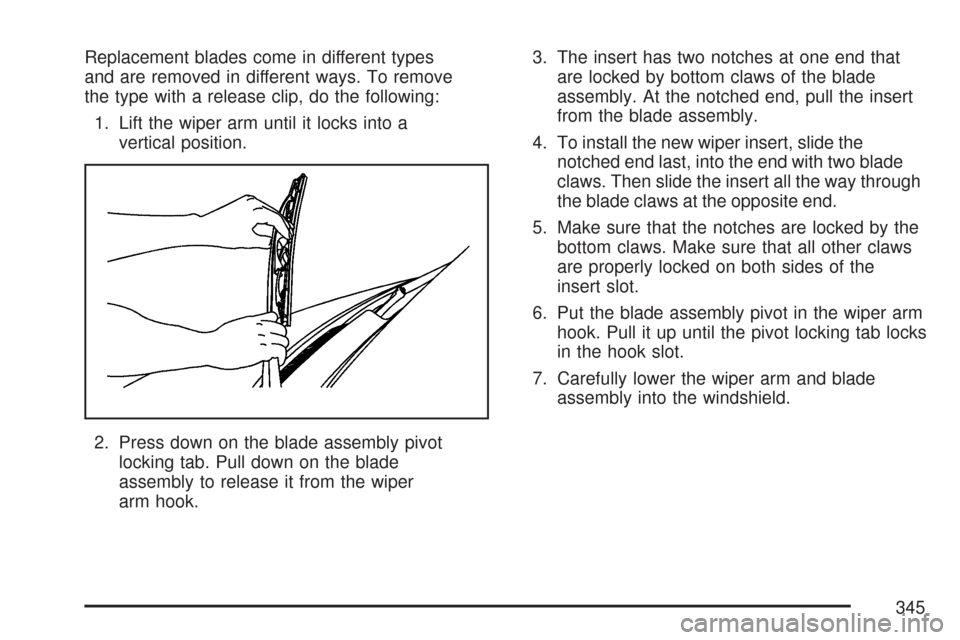
and are removed in different ways. To remove
the type with a release clip, do the following:
1. Lift the wiper arm until it locks into a
vertical position.
2. Press down on the blade assembly pivot
locking tab. Pull down on the blade
assembly to release it from the wiper
arm hook.3. The insert has two notches at one end that
are locked by bottom claws of the blade
assembly. At the notched end, pull the insert
from the blade assembly.
4. To install the new wiper insert, slide the
notched end last, into the end with two blade
claws. Then slide the insert all the way through
the blade claws at the opposite end.
5. Make sure that the notches are locked by the
bottom claws. Make sure that all other claws
are properly locked on both sides of the
insert slot.
6. Put the blade assembly pivot in the wiper arm
hook. Pull it up until the pivot locking tab locks
in the hook slot.
7. Carefully lower the wiper arm and blade
assembly into the windshield.
345