trailer CHEVROLET EXPRESS CARGO VAN 2009 1.G Owner's Guide
[x] Cancel search | Manufacturer: CHEVROLET, Model Year: 2009, Model line: EXPRESS CARGO VAN, Model: CHEVROLET EXPRESS CARGO VAN 2009 1.GPages: 408, PDF Size: 2.36 MB
Page 276 of 408
If Steam Is Coming From The Engine
Compartment
{CAUTION:
Steam from an overheated engine can burn you
badly, even if you just open the hood. Stay away
from the engine if you see or hear steam coming
from it. Just turn it off and get everyone away
from the vehicle until it cools down. Wait until
there is no sign of steam or coolant before you
open the hood.
If you keep driving when your engine is
overheated, the liquids in it can catch fire. You or
others could be badly burned. Stop your engine if
it overheats, and get out of the vehicle until the
engine is cool.
If No Steam Is Coming From The
Engine Compartment
If an engine overheat warning is displayed but no steam
can be seen or heard, the problem may not be too
serious. Sometimes the engine can get a little too hot
when the vehicle:
•Climbs a long hill on a hot day.
•Stops after high-speed driving.
•Idles for long periods in traffic.
•Tows a trailer. See “Driving on Grades” under
Towing a Trailer on page 4-27.
If the overheat warning is displayed with no sign of
steam:
1. Turn the air off.
2. Turn the heater on to the highest temperature and
to the highest fan speed. Open the windows as
necessary.
3. In heavy traffic, let the engine idle in N (Neutral)
while stopped. If it is safe to do so, pull off the
road, shift to P (Park) or N (Neutral) and let
the engine idle.
5-32
Page 277 of 408
If the temperature overheat gage is no longer in the
overheat zone or an overheat warning no longer
displays, the vehicle can be driven. Continue to drive
the vehicle slow for about 10 minutes. Keep a safe
vehicle distance from the car in front of you. If the
warning does not come back on, continue to drive
normally.
If the warning continues, pull over, stop, and park the
vehicle right away.
If there is still no sign of steam, push down the
accelerator until the engine speed is about twice as
fast as normal idle speed for at least three minutes while
you are parked. If you still have the warning, turn off the
engine until it cools down.
You may decide not to lift the hood but to get service
help right away.Engine Fan Noise
Your vehicle has a clutched engine cooling fan.
When the clutch is engaged, the fan spins faster to
provide more air to cool the engine. In most everyday
driving conditions, the fan is spinning slower and the
clutch is not fully engaged. This improves fuel economy
and reduces fan noise. Under heavy vehicle loading,
trailer towing, and/or high outside temperatures, the fan
speed increases as the clutch more fully engages, so you
may hear an increase in fan noise. This is normal and
should not be mistaken as the transmission slipping or
making extra shifts. It is merely the cooling system
functioning properly. The fan will slow down when
additional cooling is not required and the clutch partially
disengages.
You may also hear this fan noise when you start the
engine. It will go away as the fan clutch partially
disengages.
5-33
Page 350 of 408
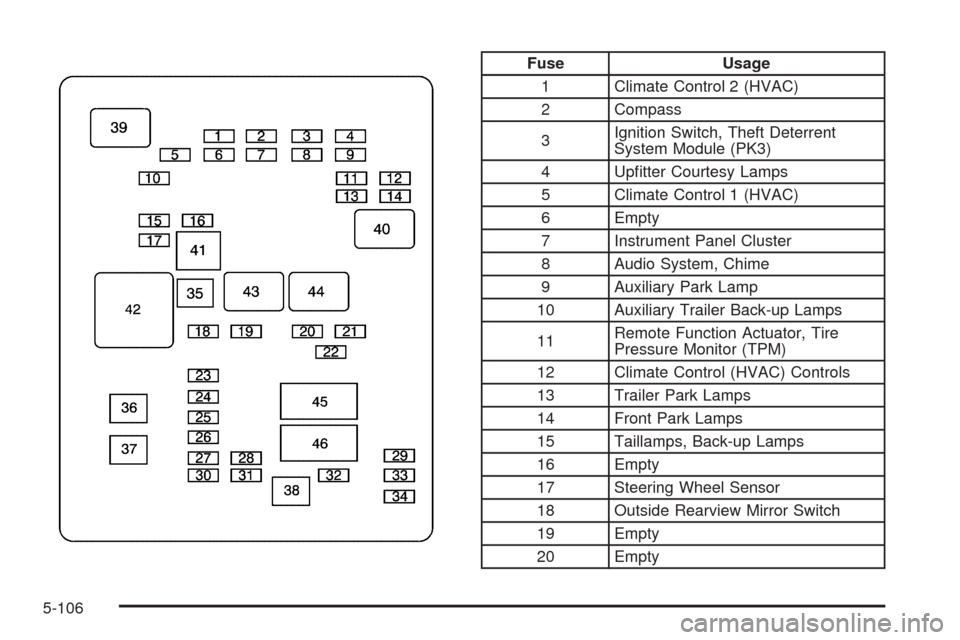
Fuse Usage
1 Climate Control 2 (HVAC)
2 Compass
3Ignition Switch, Theft Deterrent
System Module (PK3)
4 Upfitter Courtesy Lamps
5 Climate Control 1 (HVAC)
6 Empty
7 Instrument Panel Cluster
8 Audio System, Chime
9 Auxiliary Park Lamp
10 Auxiliary Trailer Back-up Lamps
11Remote Function Actuator, Tire
Pressure Monitor (TPM)
12 Climate Control (HVAC) Controls
13 Trailer Park Lamps
14 Front Park Lamps
15 Taillamps, Back-up Lamps
16 Empty
17 Steering Wheel Sensor
18 Outside Rearview Mirror Switch
19 Empty
20 Empty
5-106
Page 352 of 408
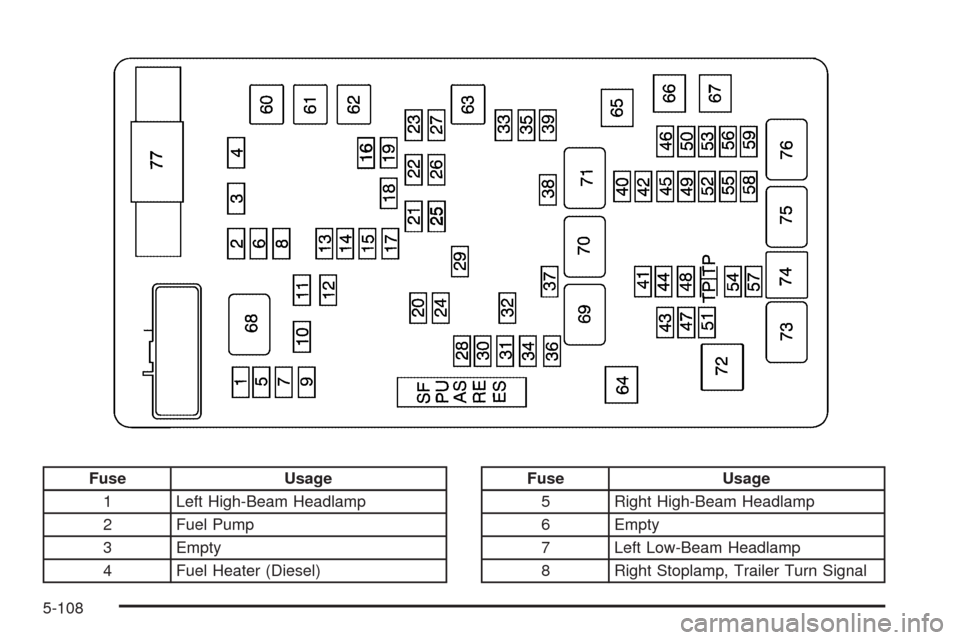
Fuse Usage
1 Left High-Beam Headlamp
2 Fuel Pump
3 Empty
4 Fuel Heater (Diesel)Fuse Usage
5 Right High-Beam Headlamp
6 Empty
7 Left Low-Beam Headlamp
8 Right Stoplamp, Trailer Turn Signal
5-108
Page 353 of 408
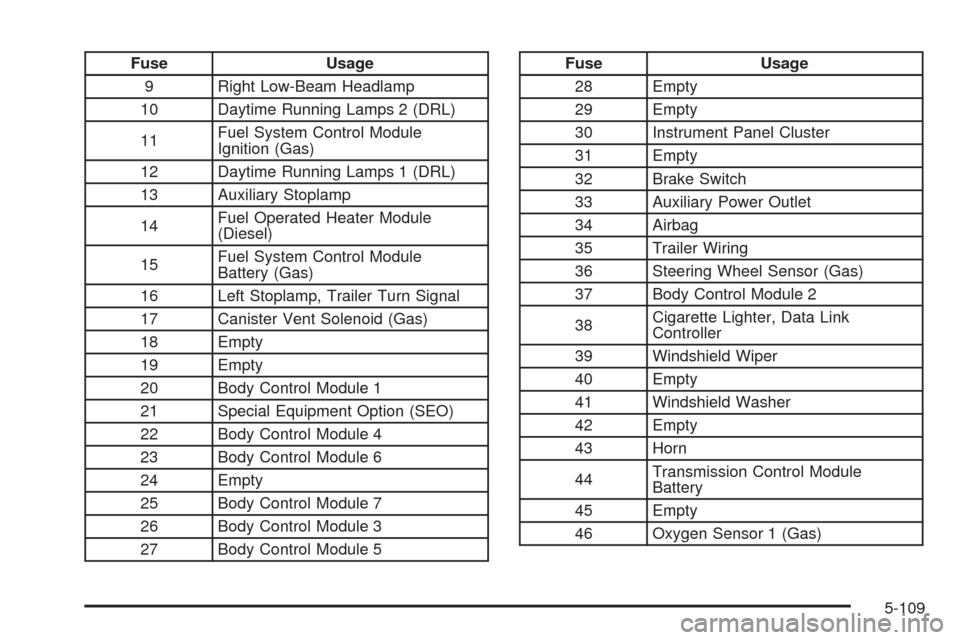
Fuse Usage
9 Right Low-Beam Headlamp
10 Daytime Running Lamps 2 (DRL)
11Fuel System Control Module
Ignition (Gas)
12 Daytime Running Lamps 1 (DRL)
13 Auxiliary Stoplamp
14Fuel Operated Heater Module
(Diesel)
15Fuel System Control Module
Battery (Gas)
16 Left Stoplamp, Trailer Turn Signal
17 Canister Vent Solenoid (Gas)
18 Empty
19 Empty
20 Body Control Module 1
21 Special Equipment Option (SEO)
22 Body Control Module 4
23 Body Control Module 6
24 Empty
25 Body Control Module 7
26 Body Control Module 3
27 Body Control Module 5Fuse Usage
28 Empty
29 Empty
30 Instrument Panel Cluster
31 Empty
32 Brake Switch
33 Auxiliary Power Outlet
34 Airbag
35 Trailer Wiring
36 Steering Wheel Sensor (Gas)
37 Body Control Module 2
38Cigarette Lighter, Data Link
Controller
39 Windshield Wiper
40 Empty
41 Windshield Washer
42 Empty
43 Horn
44Transmission Control Module
Battery
45 Empty
46 Oxygen Sensor 1 (Gas)
5-109
Page 354 of 408
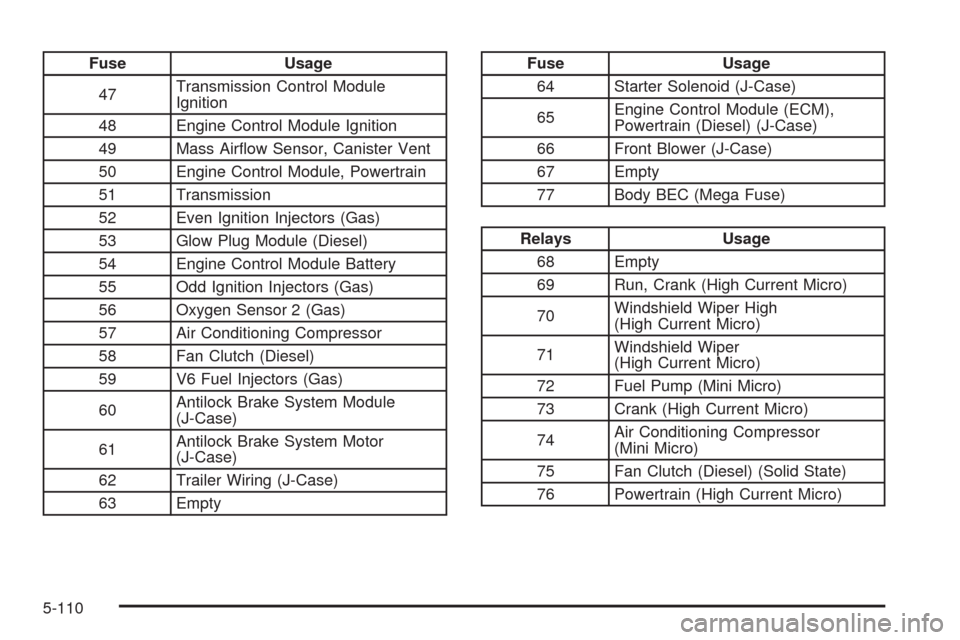
Fuse Usage
47Transmission Control Module
Ignition
48 Engine Control Module Ignition
49 Mass Airflow Sensor, Canister Vent
50 Engine Control Module, Powertrain
51 Transmission
52 Even Ignition Injectors (Gas)
53 Glow Plug Module (Diesel)
54 Engine Control Module Battery
55 Odd Ignition Injectors (Gas)
56 Oxygen Sensor 2 (Gas)
57 Air Conditioning Compressor
58 Fan Clutch (Diesel)
59 V6 Fuel Injectors (Gas)
60Antilock Brake System Module
(J-Case)
61Antilock Brake System Motor
(J-Case)
62 Trailer Wiring (J-Case)
63 EmptyFuse Usage
64 Starter Solenoid (J-Case)
65Engine Control Module (ECM),
Powertrain (Diesel) (J-Case)
66 Front Blower (J-Case)
67 Empty
77 Body BEC (Mega Fuse)
Relays Usage
68 Empty
69 Run, Crank (High Current Micro)
70Windshield Wiper High
(High Current Micro)
71Windshield Wiper
(High Current Micro)
72 Fuel Pump (Mini Micro)
73 Crank (High Current Micro)
74Air Conditioning Compressor
(Mini Micro)
75 Fan Clutch (Diesel) (Solid State)
76 Powertrain (High Current Micro)
5-110
Page 365 of 408
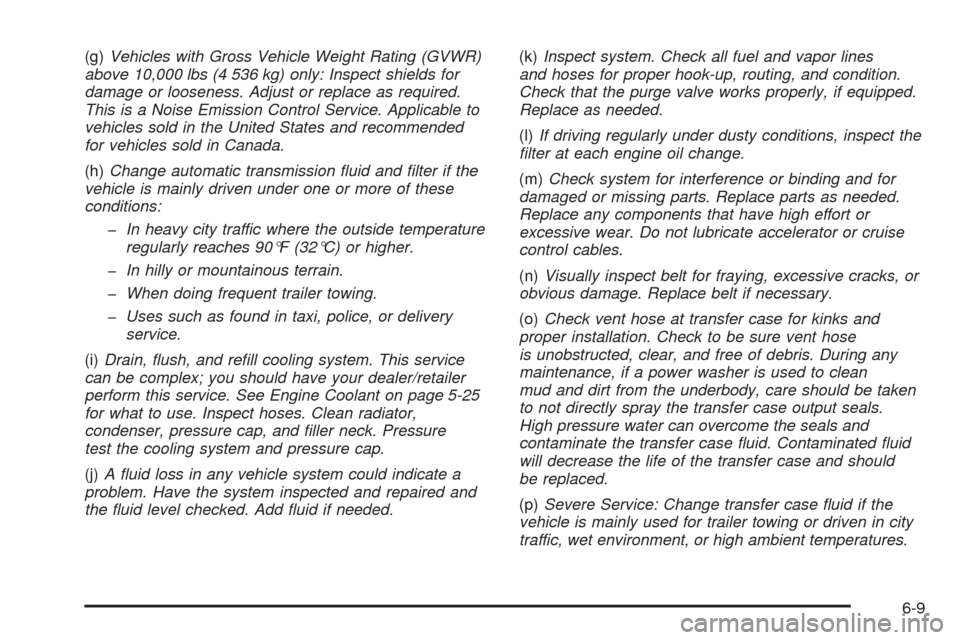
(g)Vehicles with Gross Vehicle Weight Rating (GVWR)
above 10,000 lbs (4 536 kg) only: Inspect shields for
damage or looseness. Adjust or replace as required.
This is a Noise Emission Control Service. Applicable to
vehicles sold in the United States and recommended
for vehicles sold in Canada.
(h)Change automatic transmission fluid and filter if the
vehicle is mainly driven under one or more of these
conditions:
-In heavy city traffic where the outside temperature
regularly reaches 90°F (32°C) or higher.
-In hilly or mountainous terrain.
-When doing frequent trailer towing.
-Uses such as found in taxi, police, or delivery
service.
(i)Drain, flush, and refill cooling system. This service
can be complex; you should have your dealer/retailer
perform this service. See Engine Coolant on page 5-25
for what to use. Inspect hoses. Clean radiator,
condenser, pressure cap, and filler neck. Pressure
test the cooling system and pressure cap.
(j)A fluid loss in any vehicle system could indicate a
problem. Have the system inspected and repaired and
the fluid level checked. Add fluid if needed.(k)Inspect system. Check all fuel and vapor lines
and hoses for proper hook-up, routing, and condition.
Check that the purge valve works properly, if equipped.
Replace as needed.
(l)If driving regularly under dusty conditions, inspect the
filter at each engine oil change.
(m)Check system for interference or binding and for
damaged or missing parts. Replace parts as needed.
Replace any components that have high effort or
excessive wear. Do not lubricate accelerator or cruise
control cables.
(n)Visually inspect belt for fraying, excessive cracks, or
obvious damage. Replace belt if necessary.
(o)Check vent hose at transfer case for kinks and
proper installation. Check to be sure vent hose
is unobstructed, clear, and free of debris. During any
maintenance, if a power washer is used to clean
mud and dirt from the underbody, care should be taken
to not directly spray the transfer case output seals.
High pressure water can overcome the seals and
contaminate the transfer case fluid. Contaminated fluid
will decrease the life of the transfer case and should
be replaced.
(p)Severe Service: Change transfer case fluid if the
vehicle is mainly used for trailer towing or driven in city
traffic, wet environment, or high ambient temperatures.
6-9
Page 407 of 408
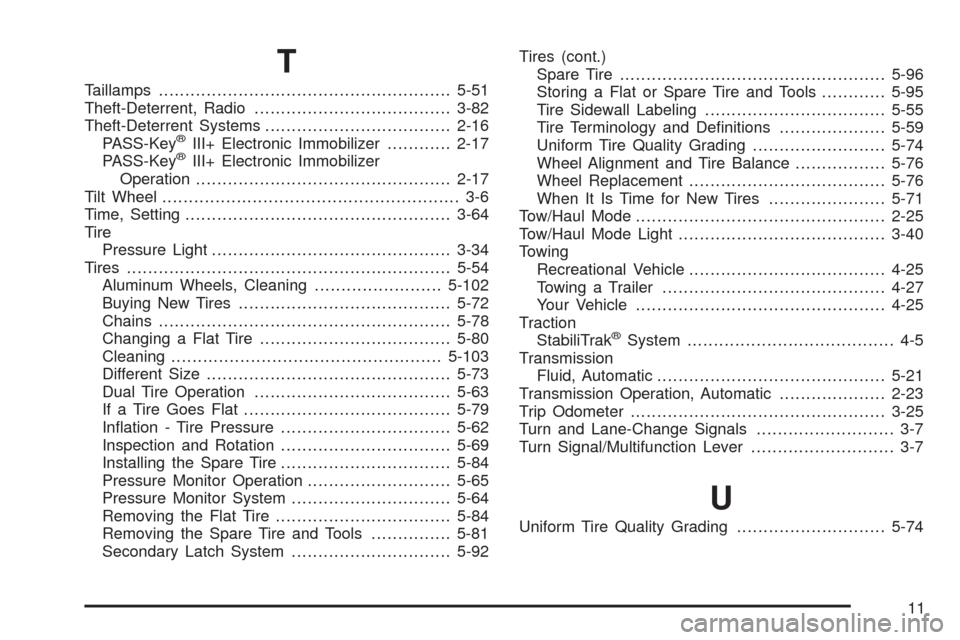
T
Taillamps.......................................................5-51
Theft-Deterrent, Radio.....................................3-82
Theft-Deterrent Systems...................................2-16
PASS-Key
®III+ Electronic Immobilizer............2-17
PASS-Key®III+ Electronic Immobilizer
Operation................................................2-17
Tilt Wheel........................................................ 3-6
Time, Setting..................................................3-64
Tire
Pressure Light.............................................3-34
Tires.............................................................5-54
Aluminum Wheels, Cleaning........................5-102
Buying New Tires........................................5-72
Chains.......................................................5-78
Changing a Flat Tire....................................5-80
Cleaning...................................................5-103
Different Size..............................................5-73
Dual Tire Operation.....................................5-63
If a Tire Goes Flat.......................................5-79
Inflation - Tire Pressure................................5-62
Inspection and Rotation................................5-69
Installing the Spare Tire................................5-84
Pressure Monitor Operation...........................5-65
Pressure Monitor System..............................5-64
Removing the Flat Tire.................................5-84
Removing the Spare Tire and Tools...............5-81
Secondary Latch System..............................5-92Tires (cont.)
Spare Tire..................................................5-96
Storing a Flat or Spare Tire and Tools............5-95
Tire Sidewall Labeling..................................5-55
Tire Terminology and Definitions....................5-59
Uniform Tire Quality Grading.........................5-74
Wheel Alignment and Tire Balance.................5-76
Wheel Replacement.....................................5-76
When It Is Time for New Tires......................5-71
Tow/Haul Mode ...............................................2-25
Tow/Haul Mode Light.......................................3-40
Towing
Recreational Vehicle.....................................4-25
Towing a Trailer..........................................4-27
Your Vehicle...............................................4-25
Traction
StabiliTrak
®System....................................... 4-5
Transmission
Fluid, Automatic...........................................5-21
Transmission Operation, Automatic....................2-23
Trip Odometer................................................3-25
Turn and Lane-Change Signals.......................... 3-7
Turn Signal/Multifunction Lever........................... 3-7
U
Uniform Tire Quality Grading............................5-74
11