tow CHEVROLET EXPRESS CARGO VAN 2009 1.G Repair Manual
[x] Cancel search | Manufacturer: CHEVROLET, Model Year: 2009, Model line: EXPRESS CARGO VAN, Model: CHEVROLET EXPRESS CARGO VAN 2009 1.GPages: 408, PDF Size: 2.36 MB
Page 339 of 408
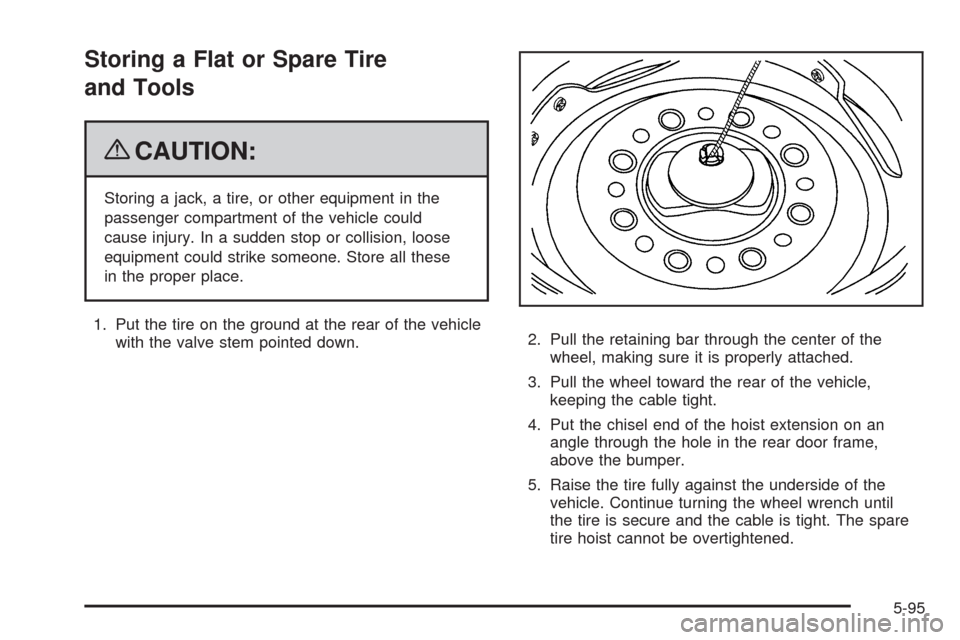
Storing a Flat or Spare Tire
and Tools
{CAUTION:
Storing a jack, a tire, or other equipment in the
passenger compartment of the vehicle could
cause injury. In a sudden stop or collision, loose
equipment could strike someone. Store all these
in the proper place.
1. Put the tire on the ground at the rear of the vehicle
with the valve stem pointed down.2. Pull the retaining bar through the center of the
wheel, making sure it is properly attached.
3. Pull the wheel toward the rear of the vehicle,
keeping the cable tight.
4. Put the chisel end of the hoist extension on an
angle through the hole in the rear door frame,
above the bumper.
5. Raise the tire fully against the underside of the
vehicle. Continue turning the wheel wrench until
the tire is secure and the cable is tight. The spare
tire hoist cannot be overtightened.
5-95
Page 342 of 408
Do not clean the vehicle using:
•A knife or any other sharp object to remove a soil
from any interior surface.
•A stiff brush. It can cause damage to the vehicle’s
interior surfaces.
•Heavy pressure or aggressive rubbing with a
cleaning cloth. Use of heavy pressure can damage
the interior and does not improve the effectiveness
of soil removal.
•Laundry detergents or dishwashing soaps with
degreasers can leave residue that streaks and
attracts dirt. For liquid cleaners, about 20 drops
per gallon (3.78 L) of water is a good guide.
Use only mild, neutral-pH soaps.
•Too much cleaner that saturates the upholstery.
•Organic solvents such as naptha, alcohol, etc. that
can damage the vehicle’s interior.
Fabric/Carpet
Use a vacuum cleaner with a soft brush attachment
frequently to remove dust and loose dirt. A canister
vacuum with a beater bar in the nozzle may only
be used on floor carpet and carpeted floor mats.
For any soil, always try to remove it first with plain
water or club soda. Before cleaning, gently remove as
much of the soil as possible using one of the following
techniques:
•For liquids: gently blot the remaining soil with a
paper towel. Allow the soil to absorb into the
paper towel until no more can be removed.
•For solid dry soils: remove as much as possible
and then vacuum.
5-98
Page 343 of 408
To clean:
1. Saturate a lint-free, clean white cloth with water or
club soda.
2. Wring the cloth to remove excess moisture.
3. Start on the outside edge of the soil and gently rub
toward the center. Continue cleaning, using a clean
area of the cloth each time it becomes soiled.
4. Continue to gently rub the soiled area until the
cleaning cloth remains clean.
5. If the soil is not completely removed, use a mild
soap solution and repeat the cleaning process
that was used with plain water.
If any of the soil remains, a commercial fabric cleaner
or spot lifter may be necessary. When a commercial
upholstery cleaner or spot lifter is to be used, test
a small hidden area for colorfastness first. If the
locally cleaned area gives any impression that a
ring formation may result, clean the entire surface.
After the cleaning process has been completed, a paper
towel can be used to blot excess moisture from the
fabric or carpet.Instrument Panel, Vinyl, and Other
Plastic Surfaces
A soft cloth dampened with water may be used to
remove dust. If a more thorough cleaning is necessary,
a clean soft cloth dampened with a mild soap solution
can be used to gently remove dust and dirt. Never use
spot lifters or removers on plastic surfaces. Many
commercial cleaners and coatings that are sold to
preserve and protect soft plastic surfaces may
permanently change the appearance and feel of the
interior and are not recommended. Do not use silicone
or wax-based products, or those containing organic
solvents to clean the vehicle’s interior because they
can alter the appearance by increasing the gloss in a
non-uniform manner.
Some commercial products may increase gloss on the
instrument panel. The increase in gloss may cause
annoying reflections in the windshield and even make
it difficult to see through the windshield under certain
conditions.
5-99
Page 344 of 408
Care of Safety Belts
Keep belts clean and dry.
{CAUTION:
Do not bleach or dye safety belts. It may severely
weaken them. In a crash, they might not be able
to provide adequate protection. Clean safety belts
only with mild soap and lukewarm water.
Weatherstrips
Silicone grease on weatherstrips will make them last
longer, seal better, and not stick or squeak. Apply
silicone grease with a clean cloth. During very cold,
damp weather frequent application may be required.
SeeRecommended Fluids and Lubricants on page 6-13.
Washing Your Vehicle
The best way to preserve the vehicle’s finish is to keep
it clean by washing it often.
Notice:Certain cleaners contain chemicals that can
damage the emblems or nameplates on the vehicle.
Check the cleaning product label. If it states that
it should not be used on plastic parts, do not use it
on the vehicle or damage may occur and it would
not be covered by the warranty.
Do not wash the vehicle in direct sunlight. Use a car
washing soap. Do not use cleaning agents that are
petroleum based or that contain acid or abrasives,
as they can damage the paint, metal or plastic on the
vehicle. Approved cleaning products can be obtained
from your dealer/retailer. Follow all manufacturers’
directions regarding correct product usage, necessary
safety precautions and appropriate disposal of any
vehicle care product.
Rinse the vehicle well, before washing and after to
remove all cleaning agents completely. If they are
allowed to dry on the surface, they could stain.
Dry the finish with a soft, clean chamois or an all-cotton
towel to avoid surface scratches and water spotting.
5-100
Page 346 of 408
Windshield and Wiper Blades
Clean the outside of the windshield with glass cleaner.
Clean the rubber blades using a lint free cloth or
paper towel soaked with windshield washer fluid or
a mild detergent. Wash the windshield thoroughly when
cleaning the blades. Bugs, road grime, sap, and a
buildup of vehicle wash/wax treatments may cause
wiper streaking. Replace the wiper blades if they are
worn or damaged.
Wipers can be damaged by:
•Extreme dusty conditions
•Sand and salt
•Heat and sun
•Snow and ice, without proper removal
Aluminum Wheels
Notice:Using strong soaps, chemicals, abrasive
polishes, cleaners, brushes, or cleaners that contain
acid on aluminum or chrome-plated wheels, could
damage the surface of the wheel(s). The repairs
would not be covered by the warranty. Use
only approved cleaners on aluminum or
chrome-plated wheels.Keep the wheels clean using a soft clean cloth with mild
soap and water. Rinse with clean water. After rinsing
thoroughly, dry with a soft clean towel. A wax may then
be applied.
Notice:Using chrome polish on aluminum wheels
could damage the wheels. The repairs would not
be covered by the warranty. Use chrome polish
on chrome wheels only.
The surface of these wheels is similar to the painted
surface of the vehicle. Do not use strong soaps,
chemicals, abrasive polishes, abrasive cleaners,
cleaners with acid, or abrasive cleaning brushes
on them because the surface could be damaged.
Do not use chrome polish on aluminum wheels.
Notice:Driving the vehicle through an automatic
car wash that has silicone carbide tire cleaning
brushes, could damage the aluminum or
chrome-plated wheels. The repairs would not be
covered by the warranty. Never drive a vehicle
equipped with aluminum or chrome-plated wheels
through an automatic car wash that uses silicone
carbide tire cleaning brushes.
5-102
Page 365 of 408
(g)Vehicles with Gross Vehicle Weight Rating (GVWR)
above 10,000 lbs (4 536 kg) only: Inspect shields for
damage or looseness. Adjust or replace as required.
This is a Noise Emission Control Service. Applicable to
vehicles sold in the United States and recommended
for vehicles sold in Canada.
(h)Change automatic transmission fluid and filter if the
vehicle is mainly driven under one or more of these
conditions:
-In heavy city traffic where the outside temperature
regularly reaches 90°F (32°C) or higher.
-In hilly or mountainous terrain.
-When doing frequent trailer towing.
-Uses such as found in taxi, police, or delivery
service.
(i)Drain, flush, and refill cooling system. This service
can be complex; you should have your dealer/retailer
perform this service. See Engine Coolant on page 5-25
for what to use. Inspect hoses. Clean radiator,
condenser, pressure cap, and filler neck. Pressure
test the cooling system and pressure cap.
(j)A fluid loss in any vehicle system could indicate a
problem. Have the system inspected and repaired and
the fluid level checked. Add fluid if needed.(k)Inspect system. Check all fuel and vapor lines
and hoses for proper hook-up, routing, and condition.
Check that the purge valve works properly, if equipped.
Replace as needed.
(l)If driving regularly under dusty conditions, inspect the
filter at each engine oil change.
(m)Check system for interference or binding and for
damaged or missing parts. Replace parts as needed.
Replace any components that have high effort or
excessive wear. Do not lubricate accelerator or cruise
control cables.
(n)Visually inspect belt for fraying, excessive cracks, or
obvious damage. Replace belt if necessary.
(o)Check vent hose at transfer case for kinks and
proper installation. Check to be sure vent hose
is unobstructed, clear, and free of debris. During any
maintenance, if a power washer is used to clean
mud and dirt from the underbody, care should be taken
to not directly spray the transfer case output seals.
High pressure water can overcome the seals and
contaminate the transfer case fluid. Contaminated fluid
will decrease the life of the transfer case and should
be replaced.
(p)Severe Service: Change transfer case fluid if the
vehicle is mainly used for trailer towing or driven in city
traffic, wet environment, or high ambient temperatures.
6-9
Page 385 of 408
Services Provided
•Emergency Fuel Delivery:Delivery of enough fuel
for the vehicle to get to the nearest service station.
•Lock-Out Service:Service is provided to unlock the
vehicle if you are locked out. A remote unlock may be
available if you have OnStar
®. For security reasons,
the driver must present identification before this
service is given.
•Emergency Tow From a Public Road or Highway:
Tow to the nearest Chevrolet dealer for warranty
service, or if the vehicle was in a crash and cannot
be driven. Assistance is also given when the vehicle
is stuck in the sand, mud, or snow.
•Flat Tire Change:Service is provided to change a
flat tire with the spare tire. The spare tire, if equipped,
must be in good condition and properly inflated.
It is the owner’s responsibility for the repair or
replacement of the tire if it is not covered by the
warranty.
•Battery Jump Start:Service is provided to jump
start a dead battery.
•Trip Interruption Benets and Assistance:If your
trip is interrupted due to a warranty failure, incidental
expenses may be reimbursed during the 5 years/
100,000 miles (160 000 km) Powertrain warranty
period. Items considered are hotel, meals, and
rental car.
Services Not Included in Roadside
Assistance
•Impound towing caused by violation of any laws.
•Legal fines.
•Mounting, dismounting or changing of snow tires,
chains, or other traction devices.
•Towing or services for vehicles driven on a
non-public road or highway.
Services Specic to Canadian
Purchased Vehicles
•Fuel delivery:Reimbursement is approximately
$5 Canadian. Diesel fuel delivery may be restricted.
Propane and other fuels are not provided through
this service.
•Lock-Out Service:Vehicle registration is required.
•Trip Routing Service:Detailed maps of North
America are provided when requested either with
the most direct route or the most scenic route. There
is a limit of six requests per year. Additional travel
information is also available. Allow three weeks for
delivery.
7-9
Page 389 of 408
Insuring Your Vehicle
Protect your investment in your GM vehicle with
comprehensive and collision insurance coverage.
There are significant differences in the quality of
coverage afforded by various insurance policy terms.
Many insurance policies provide reduced protection to
your GM vehicle by limiting compensation for damage
repairs by using aftermarket collision parts. Some
insurance companies will not specify aftermarket collision
parts. When purchasing insurance, we recommend that
you assure your vehicle will be repaired with GM original
equipment collision parts. If such insurance coverage
is not available from your current insurance carrier,
consider switching to another insurance carrier.
If your vehicle is leased, the leasing company may
require you to have insurance that assures repairs with
Genuine GM Original Equipment Manufacturer (OEM)
parts or Genuine Manufacturer replacement parts. Read
your lease carefully, as you may be charged at the
end of your lease for poor quality repairs.
If a Crash Occurs
Here is what to do if you are involved in a crash.
•Check to make sure that you are all right. If you
are uninjured, make sure that no one else in
your vehicle, or the other vehicle, is injured.
•If there has been an injury, call emergency services
for help. Do not leave the scene of a crash until all
matters have been taken care of. Move your vehicle
only if its position puts you in danger or you are
instructed to move it by a police officer.
•Give only the necessary and requested information
to police and other parties involved in the crash.
Do not discuss your personal condition, mental frame
of mind, or anything unrelated to the crash. This will
help guard against post-crash legal action.
•If you need roadside assistance, call GM Roadside
Assistance. SeeRoadside Assistance Program on
page 7-7for more information.
•If your vehicle cannot be driven, know where the
towing service will be taking it. Get a card from the
tow truck operator or write down the driver’s name,
the service’s name, and the phone number.
•Remove any valuables from your vehicle before it is
towed away. Make sure this includes your insurance
information and registration if you keep these items
in your vehicle.
7-13
Page 390 of 408
•Gather the important information you will need from
the other driver. Things like name, address, phone
number, driver’s license number, vehicle license
plate, vehicle make, model and model year, Vehicle
Identification Number (VIN), insurance company and
policy number, and a general description of the
damage to the other vehicle.
•If possible, call your insurance company from
the scene of the crash. They will walk you through
the information they will need. If they ask for a
police report, phone or go to the police department
headquarters the next day and you can get a copy of
the report for a nominal fee. In some states/provinces
with “no fault” insurance laws, a report may not be
necessary. This is especially true if there are no
injuries and both vehicles are driveable.
•Choose a reputable collision repair facility for your
vehicle. Whether you select a dealer/retailer or a
private collision repair facility to fix the damage,
make sure you are comfortable with them.
Remember, you will have to feel comfortable
with their work for a long time.
•Once you have an estimate, read it carefully and
make sure you understand what work will be
performed on your vehicle. If you have a question,
ask for an explanation. Reputable shops welcome
this opportunity.
Managing the Vehicle Damage Repair
Process
In the event that your vehicle requires damage repairs,
GM recommends that you take an active role in its
repair. If you have a pre-determined repair facility of
choice, take your vehicle there, or have it towed there.
Specify to the facility that any required replacement
collision parts be original equipment parts, either new
Genuine GM parts or recycled original GM parts.
Remember, recycled parts will not be covered by your
GM vehicle warranty.
Insurance pays the bill for the repair, but you must
live with the repair. Depending on your policy limits,
your insurance company may initially value the repair
using aftermarket parts. Discuss this with your repair
professional, and insist on Genuine GM parts. Remember
if your vehicle is leased you may be obligated to have the
vehicle repaired with Genuine GM parts, even if your
insurance coverage does not pay the full cost.
If another party’s insurance company is paying for
the repairs, you are not obligated to accept a repair
valuation based on that insurance company’s collision
policy repair limits, as you have no contractual limits with
that company. In such cases, you can have control of
the repair and parts choices as long as cost stays within
reasonable limits.
7-14
Page 403 of 408
Light (cont.)
Brake System Warning.................................3-31
Charging System.........................................3-30
Cruise Control.............................................3-39
Highbeam On.............................................3-39
Oil Pressure...............................................3-38
Passenger Airbag Status Indicator..................3-29
Safety Belt Reminders..................................3-26
Security.....................................................3-39
StabiliTrak
®Indicator....................................3-33
Tire Pressure..............................................3-34
Tow/Haul Mode ...........................................3-40
Lighting
Entry/Exit...................................................3-16
Lights
Exterior Lamps............................................3-12
Flash-to-Pass............................................... 3-8
High/Low Beam Changer................................ 3-8
On Reminder..............................................3-14
Loading Your Vehicle.......................................4-19
Locking Rear Axle............................................ 4-8
Lockout Protection............................................ 2-9
Locks
Automatic Door Lock..................................... 2-8
Automatic Door Unlock.................................. 2-8
Cargo Door Relocking.................................... 2-7
Delayed Locking........................................... 2-7
Door ........................................................... 2-6
Lockout Protection......................................... 2-9Locks (cont.)
Power Door .................................................. 2-6
Programmable Automatic Door Locks............... 2-7
Rear Door Security Locks............................... 2-8
Loss of Control...............................................4-11
Lower Anchors and Tethers for Children.............1-41M
Maintenance Schedule
Additional Required Services........................... 6-6
At Each Fuel Fill.........................................6-10
At Least Once a Month................................6-11
At Least Once a Year..................................6-11
At the First 100, 1,000 and 6,000 Miles
(160, 1 600 and 10 000 km)......................6-10
Introduction.................................................. 6-2
Maintenance Footnotes.................................. 6-8
Maintenance Record....................................6-17
Maintenance Replacement Parts....................6-15
Maintenance Requirements............................. 6-2
Owner Checks and Services.........................6-10
Recommended Fluids and Lubricants.............6-13
Scheduled Maintenance................................. 6-4
Using.......................................................... 6-3
Your Vehicle and the Environment................... 6-2
Malfunction Indicator Lamp...............................3-34
Manual Seats................................................... 1-2
Manual Windows............................................2-14
7