lock CHEVROLET EXPRESS CARGO VAN 2012 1.G Owners Manual
[x] Cancel search | Manufacturer: CHEVROLET, Model Year: 2012, Model line: EXPRESS CARGO VAN, Model: CHEVROLET EXPRESS CARGO VAN 2012 1.GPages: 430, PDF Size: 6.35 MB
Page 347 of 430
Black plate (83,1)Chevrolet Express Owner Manual - 2012
Vehicle Care 10-83
Secondary Latch System
This vehicle has an
underbody-mounted tire hoist
assembly equipped with a
secondary latch system. It is
designed to stop the spare tire from
suddenly falling off the vehicle if the
cable holding the spare tire is
damaged. For the secondary latch
to work, the tire must be stowed
with the valve stem pointing down.
See“Storing a Flat or Spare Tire
and Tools” underTire Changing on
page 10‑74 for instructions on
storing the spare tire correctly.
{WARNING
Before beginning this procedure
read all the instructions. Failure to
read and follow the instructions
could damage the hoist assembly
and you and others could get
hurt. Read and follow the
instructions listed next. To release the spare tire from the
secondary latch:
{WARNING
Someone standing too close
during the procedure could be
injured by the jack. If the spare
tire does not slide off the jack
completely, make sure no one is
behind you or on either side of
you as you pull the jack out from
under the spare.
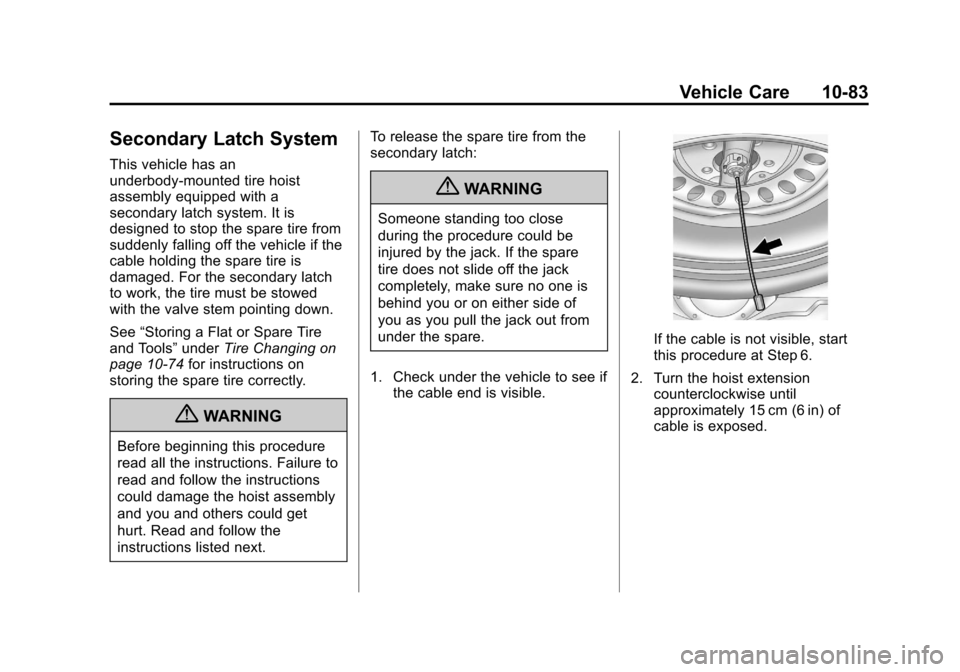
1. Check under the vehicle to see if the cable end is visible.
If the cable is not visible, start
this procedure at Step 6.
2. Turn the hoist extension counterclockwise until
approximately 15 cm (6 in) of
cable is exposed.
Page 348 of 430
Black plate (84,1)Chevrolet Express Owner Manual - 2012
10-84 Vehicle Care
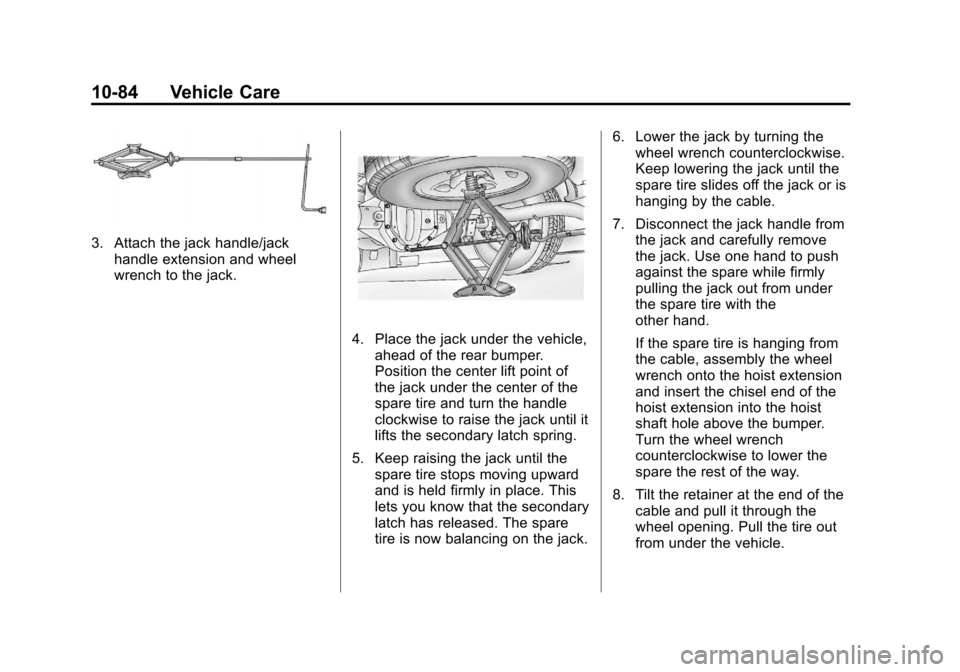
3. Attach the jack handle/jackhandle extension and wheel
wrench to the jack.
4. Place the jack under the vehicle,ahead of the rear bumper.
Position the center lift point of
the jack under the center of the
spare tire and turn the handle
clockwise to raise the jack until it
lifts the secondary latch spring.
5. Keep raising the jack until the spare tire stops moving upward
and is held firmly in place. This
lets you know that the secondary
latch has released. The spare
tire is now balancing on the jack. 6. Lower the jack by turning the
wheel wrench counterclockwise.
Keep lowering the jack until the
spare tire slides off the jack or is
hanging by the cable.
7. Disconnect the jack handle from the jack and carefully remove
the jack. Use one hand to push
against the spare while firmly
pulling the jack out from under
the spare tire with the
other hand.
If the spare tire is hanging from
the cable, assembly the wheel
wrench onto the hoist extension
and insert the chisel end of the
hoist extension into the hoist
shaft hole above the bumper.
Turn the wheel wrench
counterclockwise to lower the
spare the rest of the way.
8. Tilt the retainer at the end of the cable and pull it through the
wheel opening. Pull the tire out
from under the vehicle.
Page 349 of 430
Black plate (85,1)Chevrolet Express Owner Manual - 2012
Vehicle Care 10-85
Notice:If you drive away before
the spare tire or secondary latch
system cable has been
reinstalled, you could damage the
vehicle. Always reinstall this
cable before driving the vehicle.
9. If the cable is hanging under the
vehicle, turn the wheel wrench in
the hoist shaft hole in the
bumper clockwise to raise the
cable back up.
Have the hoist assembly inspected
as soon as you can. You will not be
able to store a spare or flat tire
using the hoist assembly until it has
been repaired or replaced.
To continue changing the flat tire,
return to Step 4 of “Storing a Flat or
Spare Tire and Tools” underTire
Changing on page 10‑74.Full-Size Spare Tire
This vehicle, when new, may have
had a fully-inflated spare tire.
A spare tire may lose air over time,
so check its inflation pressure
regularly. See Tire Pressure on
page 10‑56 andVehicle Load Limits
on page 9‑11 for information
regarding proper tire inflation and
loading the vehicle. For instruction
on how to remove, install or store a
spare tire, see “Removing the Flat
Tire and Installing the Spare Tire”
and “Storing a Flat or Spare Tire
and Tools” underTire Changing on
page 10‑74. After installing the spare tire on the
vehicle, you should stop as soon as
possible and make sure the spare is
correctly inflated. The spare tire is
made to perform well at speeds up
to 112 km/h (70 mph) at the
recommended inflation pressure, so
you can finish your trip.
Have the damaged or flat road tire
repaired or replaced as soon as you
can and installed back onto the
vehicle. This way, a spare tire will
be available in case you need it
again. Do not mix tires and wheels
of different sizes, because they will
not fit. Keep the spare tire and its
wheel together.
Page 356 of 430
Black plate (92,1)Chevrolet Express Owner Manual - 2012
10-92 Vehicle Care
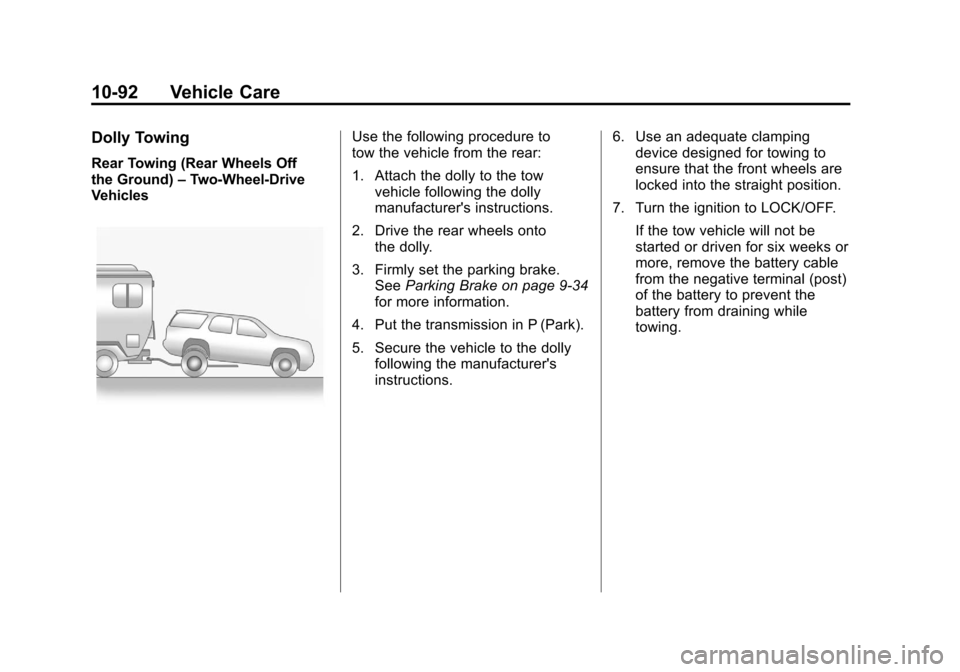
Dolly Towing
Rear Towing (Rear Wheels Off
the Ground)–Two‐Wheel‐Drive
Vehicles
Use the following procedure to
tow the vehicle from the rear:
1. Attach the dolly to the tow
vehicle following the dolly
manufacturer's instructions.
2. Drive the rear wheels onto the dolly.
3. Firmly set the parking brake. See Parking Brake on page 9‑34
for more information.
4. Put the transmission in P (Park).
5. Secure the vehicle to the dolly following the manufacturer's
instructions. 6. Use an adequate clamping
device designed for towing to
ensure that the front wheels are
locked into the straight position.
7. Turn the ignition to LOCK/OFF. If the tow vehicle will not be
started or driven for six weeks or
more, remove the battery cable
from the negative terminal (post)
of the battery to prevent the
battery from draining while
towing.
Page 360 of 430
Black plate (96,1)Chevrolet Express Owner Manual - 2012
10-96 Vehicle Care
Steering, Suspension, and
Chassis Components
Visually inspect front and rear
suspension and steering system for
damaged, loose, or missing parts or
signs of wear. Inspect power
steering lines and hoses for proper
hook-up, binding, leaks, cracks,
chafing, etc. Visually check constant
velocity joints, rubber boots, and
axle seals for leaks.
Body Component Lubrication
Lubricate all key lock cylinders,
hood hinges, liftgate hinges, and
steel fuel door hinge unless the
components are plastic. Applying
silicone grease on weatherstrips
with a clean cloth will make them
last longer, seal better, and not stick
or squeak.
Underbody Maintenance
Use plain water to flush dirt and
debris from the vehicle's underbody.
Your dealer or an underbody car
washing system can do this. If not
removed, rust and corrosion can
develop.
Sheet Metal Damage
If the vehicle is damaged and
requires sheet metal repair or
replacement, make sure the body
repair shop applies anti-corrosion
material to parts repaired or
replaced to restore corrosion
protection.
Original manufacturer replacement
parts will provide the corrosion
protection while maintaining the
vehicle warranty.
Finish Damage
Quickly repair minor chips and
scratches with touch-up materials
available from your dealer to avoid
corrosion. Larger areas of finish
damage can be corrected in your
dealer's body and paint shop.
Chemical Paint Spotting
Airborne pollutants can fall upon
and attack painted vehicle surfaces
causing blotchy, ring-shaped
discolorations, and small, irregular
dark spots etched into the paint
surface.
Page 368 of 430
Black plate (4,1)Chevrolet Express Owner Manual - 2012
11-4 Service and Maintenance
Tire Rotation and Required
Services Every 12 000 km/
7,500 mi
Rotate the tires, if recommended for
the vehicle, and perform the
following services. SeeTire
Rotation on page 10‑62.
.Check engine oil level and oil
life percentage. If needed,
change engine oil and filter, and
reset oil life system. See Engine
Oil on page 10‑7 andEngine Oil
Life System on page 10‑10.
.Check engine coolant level. See
Engine Coolant on page 10‑18.
.Check windshield washer fluid
level. See Washer Fluid on
page 10‑25.
.Visually inspect windshield wiper
blades for wear, cracking,
or contamination. See Exterior
Care on page 10‑93. Replace
worn or damaged wiper blades.
See Wiper Blade Replacement
on page 10‑34.
.Check tire inflation pressures.
See Tire Pressure on
page 10‑56.
.Inspect tire wear. See Tire
Inspection on page 10‑62.
.Visually check for fluid leaks.
.Inspect engine air cleaner filter.
See Engine Air Cleaner/Filter on
page 10‑16.
.Inspect brake system.
.Visually inspect steering,
suspension, and chassis
components for damaged, loose,
or missing parts or signs of
wear. See Exterior Care on
page 10‑93.
.Check restraint system
components. See Safety System
Check on page 3‑16.
.Visually inspect fuel system for
damage or leaks.
.Visually inspect exhaust system
and nearby heat shields for
loose or damaged parts.
.Lubricate body components.
See Exterior Care on
page 10‑93.
.Check starter switch. See Starter
Switch Check on page 10‑33.
.Check automatic transmission
shift lock control function. See
Automatic Transmission Shift
Lock Control Function Check on
page 10‑33.
.Check ignition transmission lock.
See Ignition Transmission Lock
Check on page 10‑33.
.Check parking brake and
automatic transmission park
mechanism. See Park Brake and
P (Park) Mechanism Check on
page 10‑34.
.Check accelerator pedal for
damage, high effort, or binding.
Replace if needed.
.Visually inspect gas strut for
signs of wear, cracks, or other
damage. Check the hold open
ability of the strut. See your
dealer if service is required.
Page 376 of 430
Black plate (12,1)Chevrolet Express Owner Manual - 2012
11-12 Service and Maintenance
Recommended Fluids, Lubricants, and Parts
Recommended Fluids and Lubricants
This maintenance section applies to vehicles with a gasoline engine. If the vehicle has a diesel engine, see the
maintenance schedule section in the Duramax Diesel Supplement.
Fluids and lubricants identified below by name, part number, or specification can be obtained from your dealer.Usage Fluid/Lubricant
Engine Oil Use only engine oil licensed to the dexos1 specfication, or equivalent, of
the proper SAE viscosity grade. ACDelco dexos1 Synthetic Blend is
recommended. See
Engine Oil on page 10‑7.
Engine Coolant 50/50 mixture of clean, drinkable water and use only DEX-COOL Coolant.
See
Engine Coolant on page 10‑18.
Hydraulic Brake System DOT 3 Hydraulic Brake Fluid (GM Part No. 12377967, in
Canada 89021320).
Windshield Washer Optikleen
®Washer Solvent.
Parking Brake Cable Guides Chassis Lubricant (GM Part No. 12377985, in Canada 88901242) or
lubricant meeting requirements of NLGI #2, Category LB or GC-LB.
Power Steering System GM Power Steering Fluid (GM Part No. 89021184, in Canada 89021186).
Automatic Transmission DEXRON
®‐VI Automatic Transmission Fluid.
Key Lock Cylinders Multi-Purpose Lubricant, Superlube (GM Part No. 12346241, in
Canada 10953474).
Page 397 of 430
Black plate (9,1)Chevrolet Express Owner Manual - 2012
Customer Information 13-9
Chevrolet and General Motors of
Canada Limited reserve the right to
limit services or payment to an
owner or driver if they decide
the claims are made too often,
or the same type of claim is made
many times.
Services Provided
.Emergency Fuel Delivery:
Delivery of enough fuel for the
vehicle to get to the nearest
service station.
.Lock‐Out Service:Service to
unlock the vehicle if you are
locked out. A remote unlock may
be available if you have OnStar.
For security reasons, the driver
must present identification
before this service is given.
.Emergency Tow From a Public
Road or Highway: Tow to the
nearest Chevrolet dealer for
warranty service, or if the vehicle
was in a crash and cannot be
driven. Assistance is also given
when the vehicle is stuck in the
sand, mud, or snow.
.Flat Tire Change: Service to
change a flat tire with the spare
tire. The spare tire, if equipped,
must be in good condition and
properly inflated. It is the owner's
responsibility for the repair or
replacement of the tire if it is not
covered by the warranty.
.Battery Jump Start: Service to
jump start a dead battery.
Services Not Included in
Roadside Assistance
.Impound towing caused by
violation of any laws.
.Legal fines.
.Mounting, dismounting,
or changing of snow tires,
chains, or other traction devices.
.Towing or services for vehicles
driven on a non-public road or
highway.
Services Specific to Canadian
Purchased Vehicles
.Fuel Delivery: Reimbursement
is approximately $5 Canadian.
Diesel fuel delivery may be
restricted. Propane and other
fuels are not provided through
this service.
.Lock-Out Service: Vehicle
registration is required.
.Trip Routing Service: Detailed
maps of North America are
provided when requested either
with the most direct route or the
most scenic route. There is a
limit of six requests per year.
Additional travel information is
also available. Allow three
weeks for delivery.
Page 399 of 430

Black plate (11,1)Chevrolet Express Owner Manual - 2012
Customer Information 13-11
.Emergency Fuel Delivery:
Delivery of enough fuel for the
vehicle to get to the nearest
service station.
.Lock-Out Service: Service to
unlock the vehicle if you are
locked out.
.Battery Jump Start: Service to
jump start a dead battery.
.*Emergency Messages:
Transmission of urgent phone
messages.
.*Emergency Calls: Call for
emergency services.
.*Dealership Location
Assistance: Information
regarding addresses and
telephone numbers for
Chevrolet dealers.
.Emergency Towing: Tow to the
nearest dealer for warranty
service if the vehicle cannot
be driven.
If the vehicle is involved in an
accident during the commission
of a crime, administrativeviolation, or breach of traffic
regulations, Roadside
Assistance will not provide
service. When the vehicle is not
accessible to be towed, all
maneuvers required to access it
will be at the owner's expense.
If the vehicle is in another city
outside of your residence,
Roadside Assistance is limited
to moving the vehicle to the
nearest dealer. If you would like
the vehicle moved to a different
dealer, you will be asked to
cover the difference in cost at
the time of the move.
If the vehicle cannot be received
by the nearest Chevrolet dealer
due to scheduling conflicts, the
vehicle will be taken to a safe
place where it will remain for up
to 48 hours until it can be taken
to the dealer. If the storage costs
exceed the amount authorized,
the owner is responsible to pay
the difference at the time of
service. Contact Roadside
Assistance for more information
on authorized amounts.
.*Trip Interruption: This service
is provided if you are prevented
from further usage of your
vehicle while traveling and it is
not possible for the nearest
Chevrolet dealership to repair
the vehicle the same day,
requiring the vehicle to stay at
the dealership for a night or
more. If this happens, in addition
to the previously listed services
and prior to confirmation by the
dealership, you are entitled to
choose one of the following
alternatives, within the limits of
existing Roadside Assistance
program guidelines. If the costs
exceed the amount authorized
for these services, you must pay
the difference at the time of
service.
Roadside Assistance will
coordinate hotel
accommodations for all vehicle
travelers for up to two nights.
Page 408 of 430
Black plate (20,1)Chevrolet Express Owner Manual - 2012
13-20 Customer Information
Reporting Safety Defects
to General Motors
In addition to notifying NHTSA
(or Transport Canada) in a situation
like this, notify General Motors.
Call 1-800-222-1020, or write:
Chevrolet Motor Division
Chevrolet Customer
Assistance Center
P.O. Box 33170
Detroit, MI 48232-5170
In Canada, call
1-800-263-3777 (English) or
1-800-263-7854 (French), or write:
General Motors of Canada Limited
Customer Care Centre,
Mail Code: CA1-163-005
1908 Colonel Sam Drive
Oshawa, Ontario L1H 8P7
Vehicle Data
Recording and
Privacy
This GM vehicle has a number of
sophisticated computers that record
information about the vehicle’s
performance and how it is driven.
For example, the vehicle uses
computer modules to monitor and
control engine and transmission
performance, to monitor the
conditions for airbag deployment
and deploy airbags in a crash, and,
if so equipped, to provide antilock
braking to help the driver control the
vehicle. These modules may store
data to help your dealer technician
service the vehicle. Some modules
may also store data about how you
operate the vehicle, such as rate of
fuel consumption or average speed.
These modules may also retain the
owner’s personal preferences, such
as radio presets, seat positions, and
temperature settings.
Event Data Recorders
This vehicle has an Event Data
Recorder (EDR). The main purpose
of an EDR is to record, in certain
crash or near crash-like situations,
such as an airbag deployment or
hitting a road obstacle, data that will
assist in understanding how a
vehicle's systems performed. The
EDR is designed to record data
related to vehicle dynamics and
safety systems for a short period of
time, typically 30 seconds or less.
The EDR in this vehicle is designed
to record such data as:
.How various systems in the
vehicle were operating.
.Whether or not the driver and
passenger safety belts were
buckled/fastened.
.How far, if at all, the driver was
pressing the accelerator and/or
brake pedal.
.How fast the vehicle was
traveling.