weight CHEVROLET EXPRESS CARGO VAN 2017 1.G User Guide
[x] Cancel search | Manufacturer: CHEVROLET, Model Year: 2017, Model line: EXPRESS CARGO VAN, Model: CHEVROLET EXPRESS CARGO VAN 2017 1.GPages: 346, PDF Size: 6.54 MB
Page 208 of 346
Chevrolet Express Owner Manual (GMNA-Localizing-U.S./Canada/Mexico-9967827) - 2017 - crc - 5/6/16
Driving and Operating 207
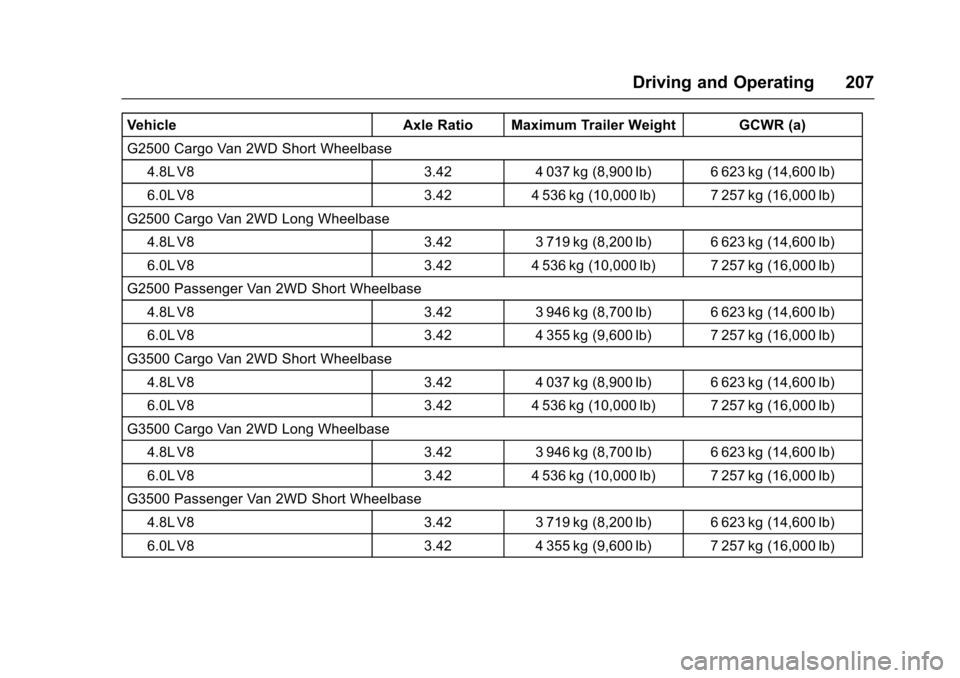
VehicleAxle Ratio Maximum Trailer Weight GCWR (a)
G2500 Cargo Van 2WD Short Wheelbase
4.8L V83.424037kg (8,900lb) 6623kg (14,600lb)
6.0L V83.424536kg (10,000lb) 7257kg (16,000lb)
G2500 Cargo Van 2WD Long Wheelbase
4.8L V83.423719kg (8,200lb) 6623kg (14,600lb)
6.0L V83.424536kg (10,000lb) 7257kg (16,000lb)
G2500 Passenger Van 2WD Short Wheelbase
4.8L V83.423946kg (8,700lb) 6623kg (14,600lb)
6.0L V83.424355kg (9,600lb) 7257kg (16,000lb)
G3500 Cargo Van 2WD Short Wheelbase
4.8L V83.424037kg (8,900lb) 6623kg (14,600lb)
6.0L V83.424536kg (10,000lb) 7257kg (16,000lb)
G3500 Cargo Van 2WD Long Wheelbase
4.8L V83.423946kg (8,700lb) 6623kg (14,600lb)
6.0L V83.424536kg (10,000lb) 7257kg (16,000lb)
G3500 Passenger Van 2WD Short Wheelbase
4.8L V83.423719kg (8,200lb) 6623kg (14,600lb)
6.0L V83.424355kg (9,600lb) 7257kg (16,000lb)
Page 209 of 346
Chevrolet Express Owner Manual (GMNA-Localizing-U.S./Canada/Mexico-9967827) - 2017 - crc - 5/6/16
208 Driving and Operating
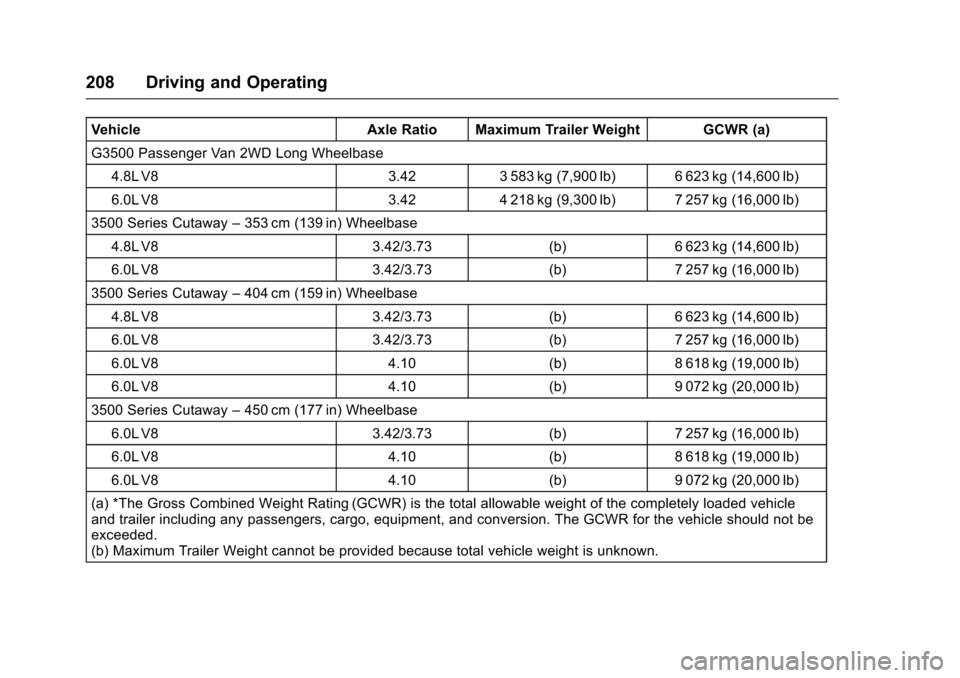
VehicleAxle Ratio Maximum Trailer Weight GCWR (a)
G3500 Passenger Van 2WD Long Wheelbase
4.8L V83.423583kg (7,900lb) 6623kg (14,600lb)
6.0L V83.424218kg (9,300lb) 7257kg (16,000lb)
3500 Series Cutaway–353 cm (139 in) Wheelbase
4.8L V83.42/3.73(b)6623kg (14,600lb)
6.0L V83.42/3.73(b)7257kg (16,000lb)
3500 Series Cutaway–404 cm (159 in) Wheelbase
4.8L V83.42/3.73(b)6623kg (14,600lb)
6.0L V83.42/3.73(b)7257kg (16,000lb)
6.0L V84.10(b)8618kg (19,000lb)
6.0L V84.10(b)9072kg (20,000lb)
3500 Series Cutaway–450 cm (177 in) Wheelbase
6.0L V83.42/3.73(b)7257kg (16,000lb)
6.0L V84.10(b)8618kg (19,000lb)
6.0L V84.10(b)9072kg (20,000lb)
(a) *The Gross Combined Weight Rating (GCWR) is the total allowable weight of the completely loaded vehicleand trailer including any passengers, cargo, equipment, and conversion. The GCWR for the vehicle should not beexceeded.(b) Maximum Trailer Weight cannot be provided because total vehicle weight is unknown.
Page 210 of 346
Chevrolet Express Owner Manual (GMNA-Localizing-U.S./Canada/Mexico-9967827) - 2017 - crc - 5/6/16
Driving and Operating 209
Ask your dealer for traileringinformation or advice.
Weight of the Trailer Tongue
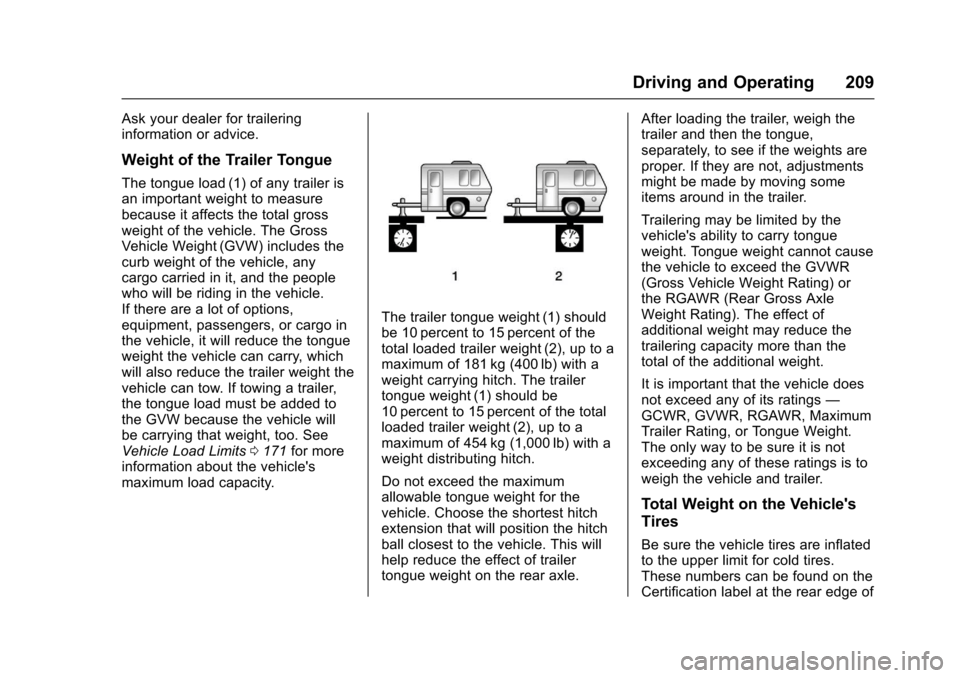
The tongue load (1) of any trailer isan important weight to measurebecause it affects the total grossweight of the vehicle. The GrossVehicle Weight (GVW) includes thecurb weight of the vehicle, anycargo carried in it, and the peoplewho will be riding in the vehicle.If there are a lot of options,equipment, passengers, or cargo inthe vehicle, it will reduce the tongueweight the vehicle can carry, whichwill also reduce the trailer weight thevehicle can tow. If towing a trailer,the tongue load must be added tothe GVW because the vehicle willbe carrying that weight, too. SeeVehicle Load Limits0171for moreinformation about the vehicle'smaximum load capacity.
The trailer tongue weight (1) shouldbe 10 percent to 15 percent of thetotal loaded trailer weight (2), up to amaximum of 181 kg (400 lb) with aweight carrying hitch. The trailertongue weight (1) should be10 percent to 15 percent of the totalloaded trailer weight (2), up to amaximum of 454 kg (1,000 lb) with aweight distributing hitch.
Do not exceed the maximumallowable tongue weight for thevehicle. Choose the shortest hitchextension that will position the hitchball closest to the vehicle. This willhelp reduce the effect of trailertongue weight on the rear axle.
After loading the trailer, weigh thetrailer and then the tongue,separately, to see if the weights areproper. If they are not, adjustmentsmight be made by moving someitems around in the trailer.
Trailering may be limited by thevehicle's ability to carry tongueweight. Tongue weight cannot causethe vehicle to exceed the GVWR(Gross Vehicle Weight Rating) orthe RGAWR (Rear Gross AxleWeight Rating). The effect ofadditional weight may reduce thetrailering capacity more than thetotal of the additional weight.
It is important that the vehicle doesnot exceed any of its ratings—GCWR, GVWR, RGAWR, MaximumTrailer Rating, or Tongue Weight.The only way to be sure it is notexceeding any of these ratings is toweigh the vehicle and trailer.
Total Weight on the Vehicle's
Tires
Be sure the vehicle tires are inflatedto the upper limit for cold tires.These numbers can be found on theCertification label at the rear edge of
Page 211 of 346
Chevrolet Express Owner Manual (GMNA-Localizing-U.S./Canada/Mexico-9967827) - 2017 - crc - 5/6/16
210 Driving and Operating
the driver door, or seeVehicle LoadLimits0171.Makesurenottogoover the GVW limit for the vehicle,or the GAWR, including the weightof the trailer tongue. If using aweight distributing hitch, make surenot to go over the rear axle limitbefore applying the weightdistribution spring bars.
Towing Equipment
Hitches
The correct hitch equipment helpsmaintain combination control. Manytrailers can be towed with aweight-carrying hitch which simplyfeatures a coupler latched to thehitch ball, or a tow eye latched to apintle hook. Other trailers mayrequire a weight-distributing hitchthat uses spring bars to distributethe trailer tongue weight among thetwo vehicle and trailer axles. See“Weight of the Trailer Tongue”underTr a i l e r To w i n g0205for rating limitswith various hitch types.
Consider using sway controls withany trailer. Ask a traileringprofessional about sway controls orrefer to the trailer manufacturer'srecommendations and instructions.
Weight-Distributing Hitches
and Weight Carrying Hitches
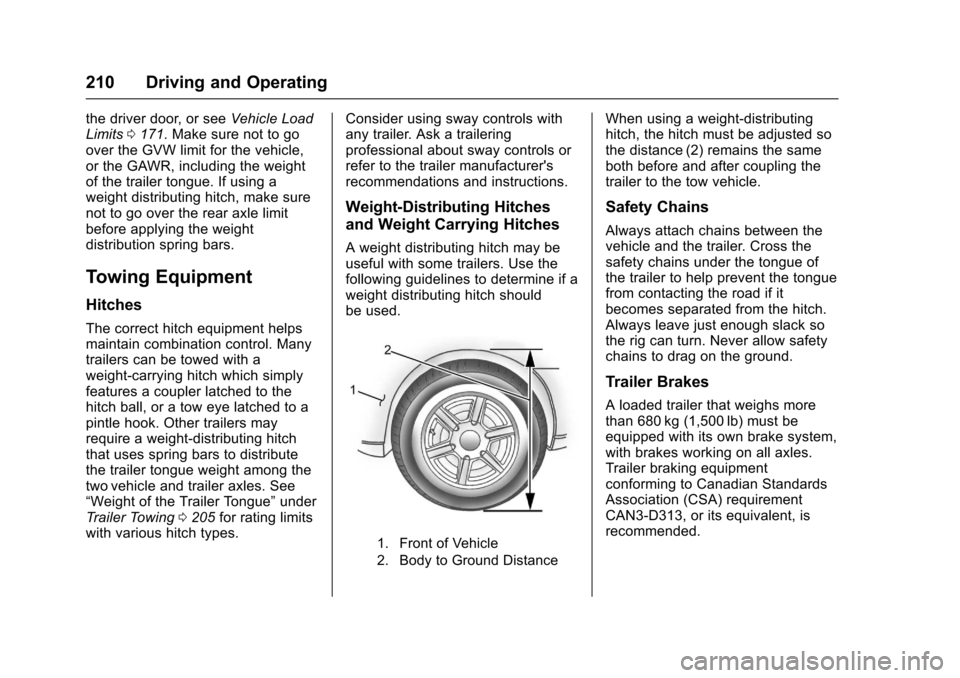
Aweightdistributinghitchmaybeuseful with some trailers. Use thefollowing guidelines to determine if aweight distributing hitch shouldbe used.
1. Front of Vehicle
2. Body to Ground Distance
When using a weight-distributinghitch, the hitch must be adjusted sothe distance (2) remains the sameboth before and after coupling thetrailer to the tow vehicle.
Safety Chains
Always attach chains between thevehicle and the trailer. Cross thesafety chains under the tongue ofthe trailer to help prevent the tonguefrom contacting the road if itbecomes separated from the hitch.Always leave just enough slack sothe rig can turn. Never allow safetychains to drag on the ground.
Trailer Brakes
Aloadedtrailerthatweighsmorethan 680 kg (1,500 lb) must beequipped with its own brake system,with brakes working on all axles.Trailer braking equipmentconforming to Canadian StandardsAssociation (CSA) requirementCAN3-D313, or its equivalent, isrecommended.
Page 213 of 346
Chevrolet Express Owner Manual (GMNA-Localizing-U.S./Canada/Mexico-9967827) - 2017 - crc - 5/6/16
212 Driving and Operating
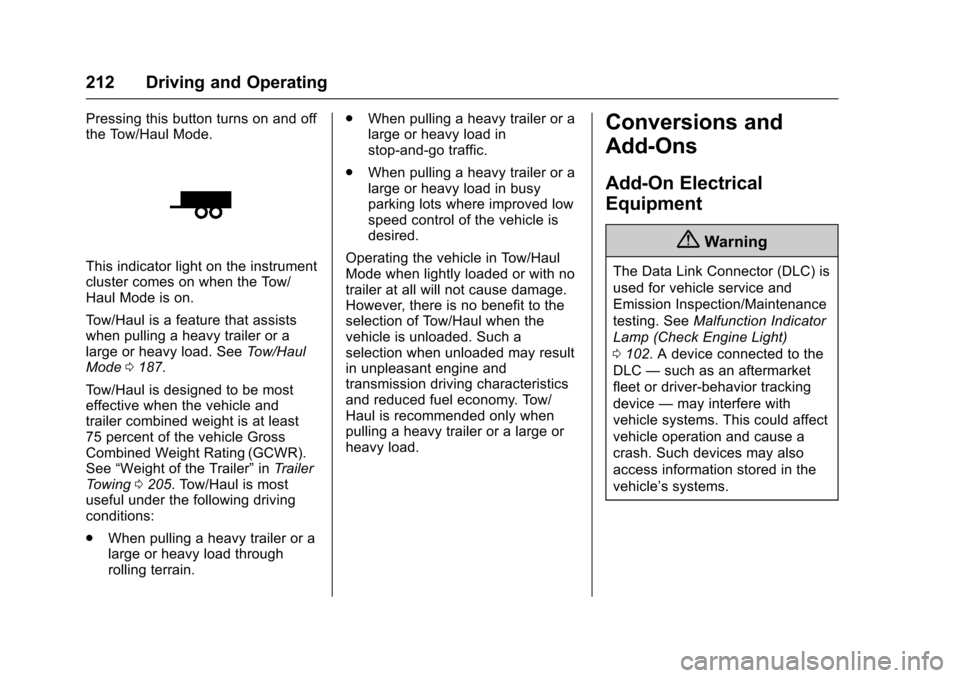
Pressing this button turns on and offthe Tow/Haul Mode.
This indicator light on the instrumentcluster comes on when the Tow/Haul Mode is on.
To w / H a u l i s a f e a t u r e t h a t a s s i s t swhen pulling a heavy trailer or alarge or heavy load. SeeTo w / H a u lMode0187.
To w / H a u l i s d e s i g n e d t o b e m o s teffective when the vehicle andtrailer combined weight is at least75 percent of the vehicle GrossCombined Weight Rating (GCWR).See“Weight of the Trailer”inTr a i l e rTo w i n g0205.Tow/Haulismostuseful under the following drivingconditions:
.When pulling a heavy trailer or alarge or heavy load throughrolling terrain.
.When pulling a heavy trailer or alarge or heavy load instop-and-go traffic.
.When pulling a heavy trailer or alarge or heavy load in busyparking lots where improved lowspeed control of the vehicle isdesired.
Operating the vehicle in Tow/HaulMode when lightly loaded or with notrailer at all will not cause damage.However, there is no benefit to theselection of Tow/Haul when thevehicle is unloaded. Such aselection when unloaded may resultin unpleasant engine andtransmission driving characteristicsand reduced fuel economy. Tow/Haul is recommended only whenpulling a heavy trailer or a large orheavy load.
Conversions and
Add-Ons
Add-On Electrical
Equipment
{Warning
The Data Link Connector (DLC) is
used for vehicle service and
Emission Inspection/Maintenance
testing. SeeMalfunction Indicator
Lamp (Check Engine Light)
0102.Adeviceconnectedtothe
DLC—such as an aftermarket
fleet or driver-behavior tracking
device—may interfere with
vehicle systems. This could affect
vehicle operation and cause a
crash. Such devices may also
access information stored in the
vehicle’ssystems.
Page 238 of 346
Chevrolet Express Owner Manual (GMNA-Localizing-U.S./Canada/Mexico-9967827) - 2017 - crc - 5/2/16
Vehicle Care 237
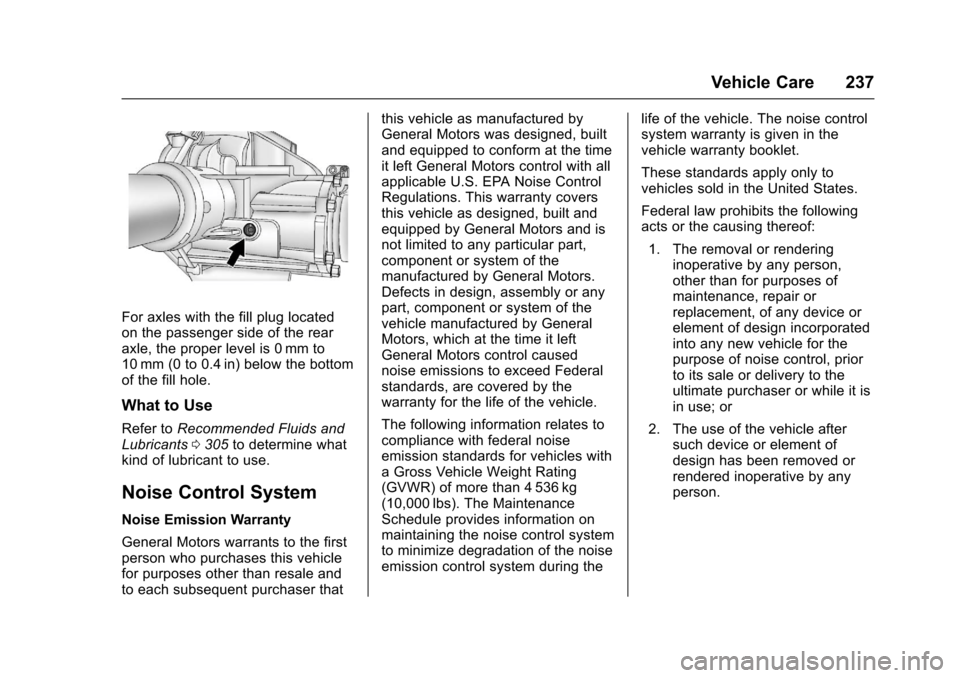
For axles with the fill plug locatedon the passenger side of the rearaxle, the proper level is 0 mm to10 mm (0 to 0.4 in) below the bottomof the fill hole.
What to Use
Refer toRecommended Fluids andLubricants0305to determine whatkind of lubricant to use.
Noise Control System
Noise Emission Warranty
General Motors warrants to the firstperson who purchases this vehiclefor purposes other than resale andto each subsequent purchaser that
this vehicle as manufactured byGeneral Motors was designed, builtand equipped to conform at the timeit left General Motors control with allapplicable U.S. EPA Noise ControlRegulations. This warranty coversthis vehicle as designed, built andequipped by General Motors and isnot limited to any particular part,component or system of themanufactured by General Motors.Defects in design, assembly or anypart, component or system of thevehicle manufactured by GeneralMotors, which at the time it leftGeneral Motors control causednoise emissions to exceed Federalstandards, are covered by thewarranty for the life of the vehicle.
The following information relates tocompliance with federal noiseemission standards for vehicles withaGrossVehicleWeightRating(GVWR) of more than 4 536 kg(10,000 lbs). The MaintenanceSchedule provides information onmaintaining the noise control systemto minimize degradation of the noiseemission control system during the
life of the vehicle. The noise controlsystem warranty is given in thevehicle warranty booklet.
These standards apply only tovehicles sold in the United States.
Federal law prohibits the followingacts or the causing thereof:
1. The removal or renderinginoperative by any person,other than for purposes ofmaintenance, repair orreplacement, of any device orelement of design incorporatedinto any new vehicle for thepurpose of noise control, priorto its sale or delivery to theultimate purchaser or while it isin use; or
2. The use of the vehicle aftersuch device or element ofdesign has been removed orrendered inoperative by anyperson.
Page 258 of 346
Chevrolet Express Owner Manual (GMNA-Localizing-U.S./Canada/Mexico-9967827) - 2017 - crc - 5/2/16
Vehicle Care 257
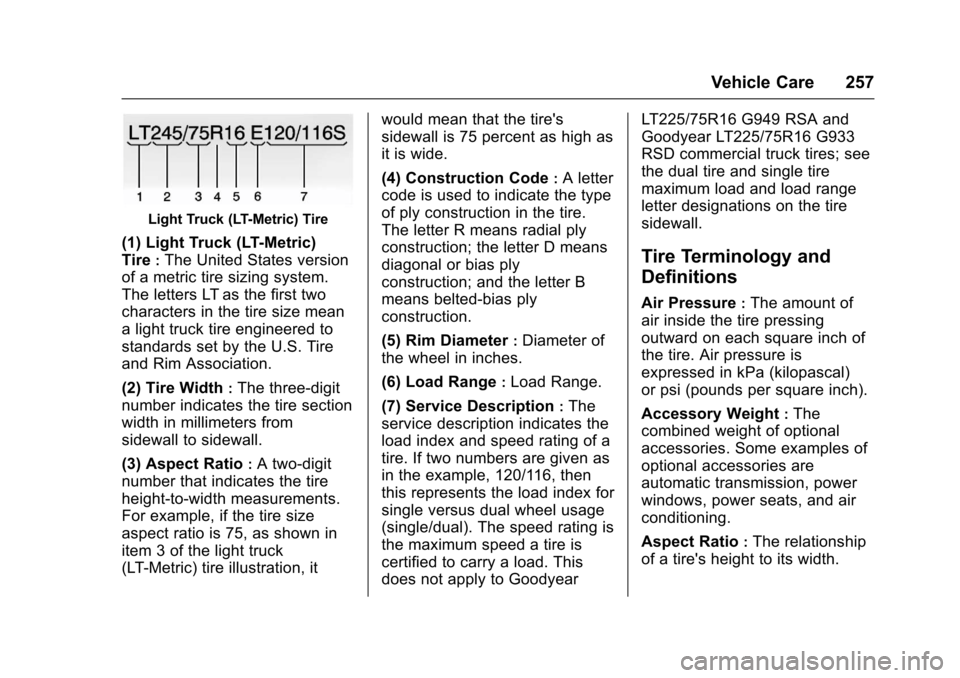
Light Truck (LT-Metric) Tire
(1) Light Truck (LT-Metric)
Tire:The United States version
of a metric tire sizing system.
The letters LT as the first two
characters in the tire size mean
alighttrucktireengineeredto
standards set by the U.S. Tire
and Rim Association.
(2) Tire Width:The three-digit
number indicates the tire section
width in millimeters from
sidewall to sidewall.
(3) Aspect Ratio:Atwo-digit
number that indicates the tire
height-to-width measurements.
For example, if the tire size
aspect ratio is 75, as shown in
item 3 of the light truck
(LT-Metric) tire illustration, it
would mean that the tire's
sidewall is 75 percent as high as
it is wide.
(4) Construction Code:Aletter
code is used to indicate the type
of ply construction in the tire.
The letter R means radial ply
construction; the letter D means
diagonal or bias ply
construction; and the letter B
means belted-bias ply
construction.
(5) Rim Diameter:Diameter of
the wheel in inches.
(6) Load Range:Load Range.
(7) Service Description:The
service description indicates the
load index and speed rating of a
tire. If two numbers are given as
in the example, 120/116, then
this represents the load index for
single versus dual wheel usage
(single/dual). The speed rating is
the maximum speed a tire is
certified to carry a load. This
does not apply to Goodyear
LT 2 2 5 / 7 5 R 1 6 G 9 4 9 R S A a n d
Goodyear LT225/75R16 G933
RSD commercial truck tires; see
the dual tire and single tire
maximum load and load range
letter designations on the tire
sidewall.
Tire Terminology and
Definitions
Air Pressure:The amount of
air inside the tire pressing
outward on each square inch of
the tire. Air pressure is
expressed in kPa (kilopascal)
or psi (pounds per square inch).
Accessory Weight:The
combined weight of optional
accessories. Some examples of
optional accessories are
automatic transmission, power
windows, power seats, and air
conditioning.
Aspect Ratio:The relationship
of a tire's height to its width.
Page 259 of 346
Chevrolet Express Owner Manual (GMNA-Localizing-U.S./Canada/Mexico-9967827) - 2017 - crc - 5/2/16
258 Vehicle Care
Belt:Arubbercoatedlayerof
cords between the plies and the
tread. Cords may be made from
steel or other reinforcing
materials.
Bead:The tire bead contains
steel wires wrapped by steel
cords that hold the tire onto
the rim.
Bias Ply Tire:Apneumatictire
in which the plies are laid at
alternate angles less than
90 degrees to the centerline of
the tread.
Cold Tire Pressure:The
amount of air pressure in a tire,
measured in kPa (kilopascal)
or psi (pounds per square inch)
before a tire has built up heat
from driving. SeeTire
Pressure0260.
Curb Weight:The weight of a
motor vehicle with standard and
optional equipment including the
maximum capacity of fuel, oil,
and coolant, but without
passengers and cargo.
DOT Markings:Acodemolded
into the sidewall of a tire
signifying that the tire is in
compliance with the U.S.
Department of Transportation
(DOT) Motor Vehicle Safety
Standards. The DOT code
includes the Tire Identification
Number (TIN), an alphanumeric
designator which can also
identify the tire manufacturer,
production plant, brand, and
date of production.
GVWR:Gross Vehicle Weight
Rating. SeeVehicle Load
Limits0171.
GAWR FRT:Gross Axle Weight
Rating for the front axle. See
Vehicle Load Limits0171.
GAWR RR:Gross Axle Weight
Rating for the rear axle. See
Vehicle Load Limits0171.
Intended Outboard Sidewall:
The side of an asymmetrical tire
that must always face outward
when mounted on a vehicle.
Kilopascal (kPa):The metric
unit for air pressure.
Light Truck (LT-Metric) Tire:A
tire used on light duty trucks and
some multipurpose passenger
vehicles.
Load Index:An assigned
number ranging from 1 to 279
that corresponds to the load
carrying capacity of a tire.
Maximum Inflation Pressure:
The maximum air pressure to
which a cold tire can be inflated.
The maximum air pressure is
molded onto the sidewall.
Maximum Load Rating:The
load rating for a tire at the
maximum permissible inflation
pressure for that tire.
Page 260 of 346
Chevrolet Express Owner Manual (GMNA-Localizing-U.S./Canada/Mexico-9967827) - 2017 - crc - 5/2/16
Vehicle Care 259
Maximum Loaded Vehicle
Weight:The sum of curb
weight, accessory weight,
vehicle capacity weight, and
production options weight.
Normal Occupant Weight:The
number of occupants a vehicle
is designed to seat multiplied by
68 kg (150 lb). SeeVehicle Load
Limits0171.
Occupant Distribution:
Designated seating positions.
Outward Facing Sidewall:The
side of an asymmetrical tire that
has a particular side that faces
outward when mounted on a
vehicle. The side of the tire that
contains a whitewall, bears
white lettering, or bears
manufacturer, brand, and/or
model name molding that is
higher or deeper than the same
moldings on the other sidewall
of the tire.
Passenger (P-Metric) Tire:A
tire used on passenger cars and
some light duty trucks and
multipurpose vehicles.
Recommended Inflation
Pressure:Vehicle
manufacturer's recommended
tire inflation pressure as shown
on the tire placard. SeeTire
Pressure0260andVehicle
Load Limits0171.
Radial Ply Tire:Apneumatic
tire in which the ply cords that
extend to the beads are laid at
90 degrees to the centerline of
the tread.
Rim:Ametalsupportforatire
and upon which the tire beads
are seated.
Sidewall:The portion of a tire
between the tread and the bead.
Speed Rating:An
alphanumeric code assigned to
atireindicatingthemaximum
speed at which a tire can
operate.
Traction:The friction between
the tire and the road surface.
The amount of grip provided.
Tread:The portion of a tire that
comes into contact with
the road.
Treadwear Indicators:Narrow
bands, sometimes called wear
bars, that show across the tread
of a tire when only 1.6 mm (1/
16 in) of tread remains. See
When It Is Time for New
Tires0267.
UTQGS (Uniform Tire Quality
Grading Standards):Atire
information system that provides
consumers with ratings for a
tire's traction, temperature, and
treadwear. Ratings are
determined by tire
manufacturers using
government testing procedures.
The ratings are molded into the
sidewall of the tire. SeeUniform
Tire Quality Grading0270.
Page 261 of 346
Chevrolet Express Owner Manual (GMNA-Localizing-U.S./Canada/Mexico-9967827) - 2017 - crc - 5/2/16
260 Vehicle Care
Vehicle Capacity Weight:The
number of designated seating
positions multiplied by
68 kg (150 lb) plus the rated
cargo load. SeeVehicle Load
Limits0171.
Vehicle Maximum Load on the
Tire:Load on an individual tire
due to curb weight, accessory
weight, occupant weight, and
cargo weight.
Vehicle Placard:Alabel
permanently attached to a
vehicle showing the vehicle
capacity weight and the original
equipment tire size and
recommended inflation pressure.
See“Tire and Loading
Information Label”underVehicle
Load Limits0171.
Tire Pressure
Tires need the correct amount of
air pressure to operate
effectively.
Caution
Neither tire underinflation nor
overinflation is good.
Underinflated tires, or tires
that do not have enough air,
can result in:
.Tire overloading and
overheating which could
lead to a blowout.
.Premature or
irregular wear.
.Poor handling.
.Reduced fuel economy.
Overinflated tires, or tires that
have too much air, can
result in:
.Unusual wear.
(Continued)
Caution (Continued)
.Poor handling.
.Rough ride.
.Needless damage from
road hazards.
The Tire and Loading
Information label on the vehicle
indicates the original equipment
tires and the correct cold tire
inflation pressures. The
recommended pressure is the
minimum air pressure needed to
support the vehicle's maximum
load carrying capacity.
For additional information
regarding how much weight the
vehicle can carry, and an
example of the Tire and Loading
Information label, seeVehicle
Load Limits0171.Howthe
vehicle is loaded affects vehicle
handling and ride comfort. Never