clock CHEVROLET EXPRESS PASSANGER 2006 1.G User Guide
[x] Cancel search | Manufacturer: CHEVROLET, Model Year: 2006, Model line: EXPRESS PASSANGER, Model: CHEVROLET EXPRESS PASSANGER 2006 1.GPages: 406, PDF Size: 2.51 MB
Page 304 of 406
5. Lift the outboard side of the headlamp to release
the outboard tab from the radiator support.
6. Lower the headlamp to allow the vertical adjustor to
clear the tie bar.
7. Turn the headlamp forward and upward to remove
it from the grille.
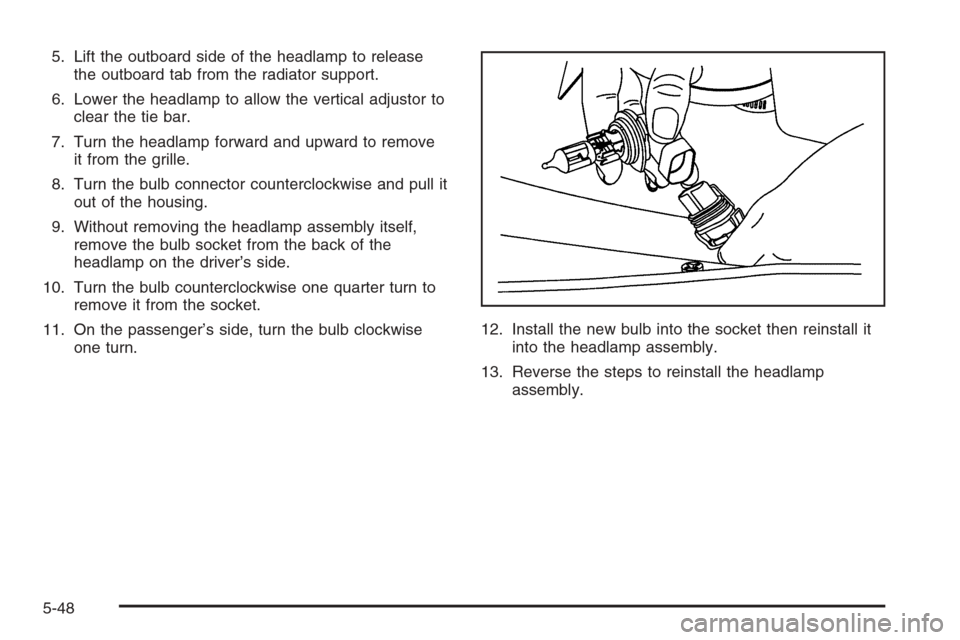
8. Turn the bulb connector counterclockwise and pull it
out of the housing.
9. Without removing the headlamp assembly itself,
remove the bulb socket from the back of the
headlamp on the driver’s side.
10. Turn the bulb counterclockwise one quarter turn to
remove it from the socket.
11. On the passenger’s side, turn the bulb clockwise
one turn.12. Install the new bulb into the socket then reinstall it
into the headlamp assembly.
13. Reverse the steps to reinstall the headlamp
assembly.
5-48
Page 305 of 406
Front Turn Signal, Sidemarker and
Parking Lamps
To replace the front turn signal, sidemarker and/or
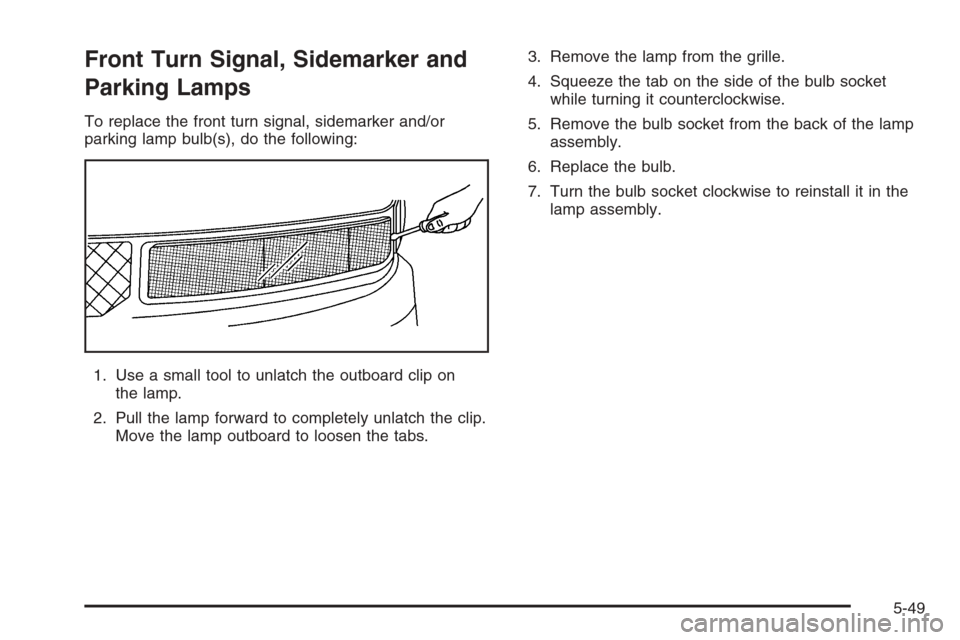
parking lamp bulb(s), do the following:
1. Use a small tool to unlatch the outboard clip on
the lamp.
2. Pull the lamp forward to completely unlatch the clip.
Move the lamp outboard to loosen the tabs.3. Remove the lamp from the grille.
4. Squeeze the tab on the side of the bulb socket
while turning it counterclockwise.
5. Remove the bulb socket from the back of the lamp
assembly.
6. Replace the bulb.
7. Turn the bulb socket clockwise to reinstall it in the
lamp assembly.
5-49
Page 306 of 406
Center High-Mounted Stoplamp
(CHMSL)
The center high-mounted stoplamp (CHMSL) is located
above the rear doors at the center of the vehicle.
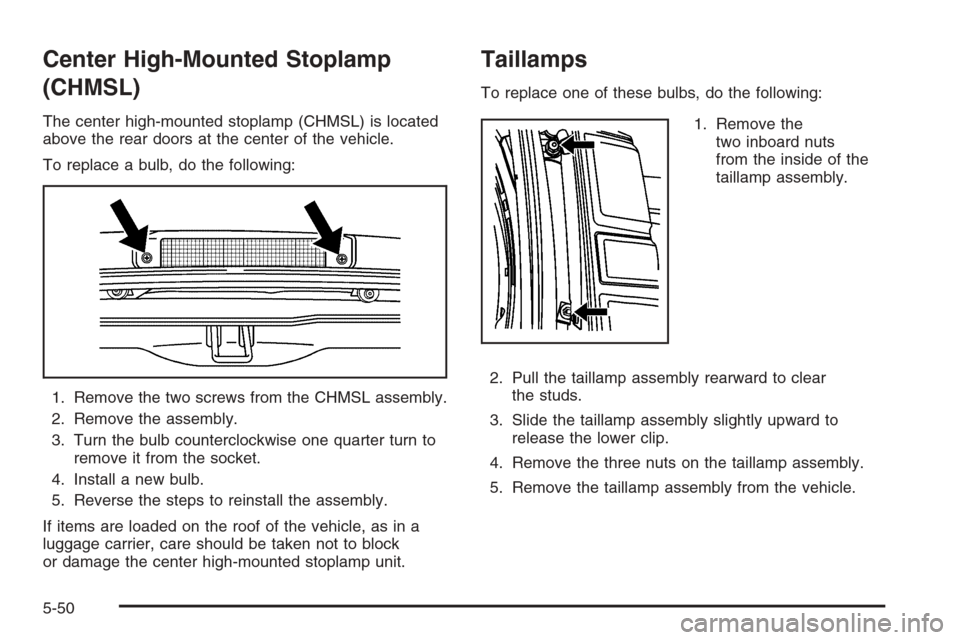
To replace a bulb, do the following:
1. Remove the two screws from the CHMSL assembly.
2. Remove the assembly.
3. Turn the bulb counterclockwise one quarter turn to
remove it from the socket.
4. Install a new bulb.
5. Reverse the steps to reinstall the assembly.
If items are loaded on the roof of the vehicle, as in a
luggage carrier, care should be taken not to block
or damage the center high-mounted stoplamp unit.
Taillamps
To replace one of these bulbs, do the following:
1. Remove the
two inboard nuts
from the inside of the
taillamp assembly.
2. Pull the taillamp assembly rearward to clear
the studs.
3. Slide the taillamp assembly slightly upward to
release the lower clip.
4. Remove the three nuts on the taillamp assembly.
5. Remove the taillamp assembly from the vehicle.
5-50
Page 307 of 406
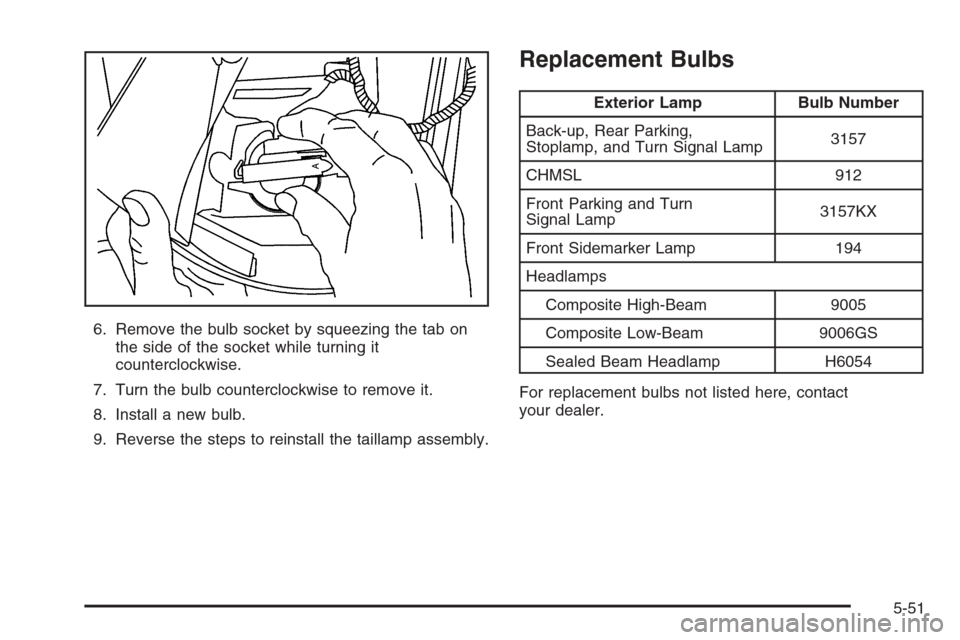
6. Remove the bulb socket by squeezing the tab on
the side of the socket while turning it
counterclockwise.
7. Turn the bulb counterclockwise to remove it.
8. Install a new bulb.
9. Reverse the steps to reinstall the taillamp assembly.
Replacement Bulbs
Exterior Lamp Bulb Number
Back-up, Rear Parking,
Stoplamp, and Turn Signal Lamp3157
CHMSL 912
Front Parking and Turn
Signal Lamp3157KX
Front Sidemarker Lamp 194
Headlamps
Composite High-Beam 9005
Composite Low-Beam 9006GS
Sealed Beam Headlamp H6054
For replacement bulbs not listed here, contact
your dealer.
5-51
Page 330 of 406
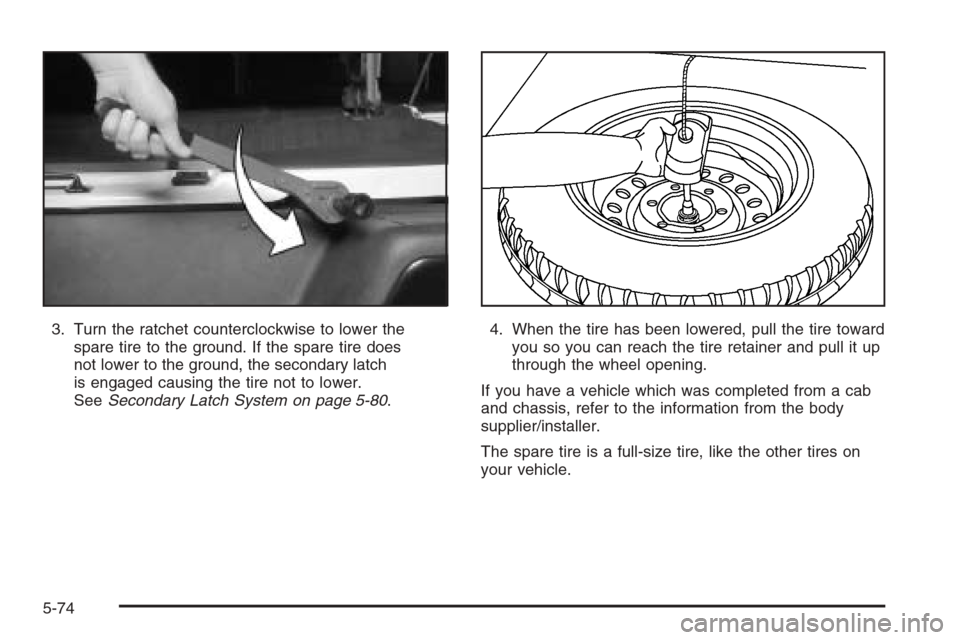
3. Turn the ratchet counterclockwise to lower the
spare tire to the ground. If the spare tire does
not lower to the ground, the secondary latch
is engaged causing the tire not to lower.
SeeSecondary Latch System on page 5-80.4. When the tire has been lowered, pull the tire toward
you so you can reach the tire retainer and pull it up
through the wheel opening.
If you have a vehicle which was completed from a cab
and chassis, refer to the information from the body
supplier/installer.
The spare tire is a full-size tire, like the other tires on
your vehicle.
5-74
Page 331 of 406
Removing the Flat Tire and
Installing the Spare Tire
If your vehicle has plastic wheel nut caps, loosen
them by turning the wheel wrench counterclockwise.
The wheel nut caps are designed to remain with
the center cap. Remove the center cap.
If the wheel has a smooth center piece, place the chisel
end of the wheel wrench in the slot on the wheel and
gently pry it out.
1. With the DOWN side facing you, use the ratchet
and wheel wrench to loosen all the wheel nuts.
Do not remove them yet.
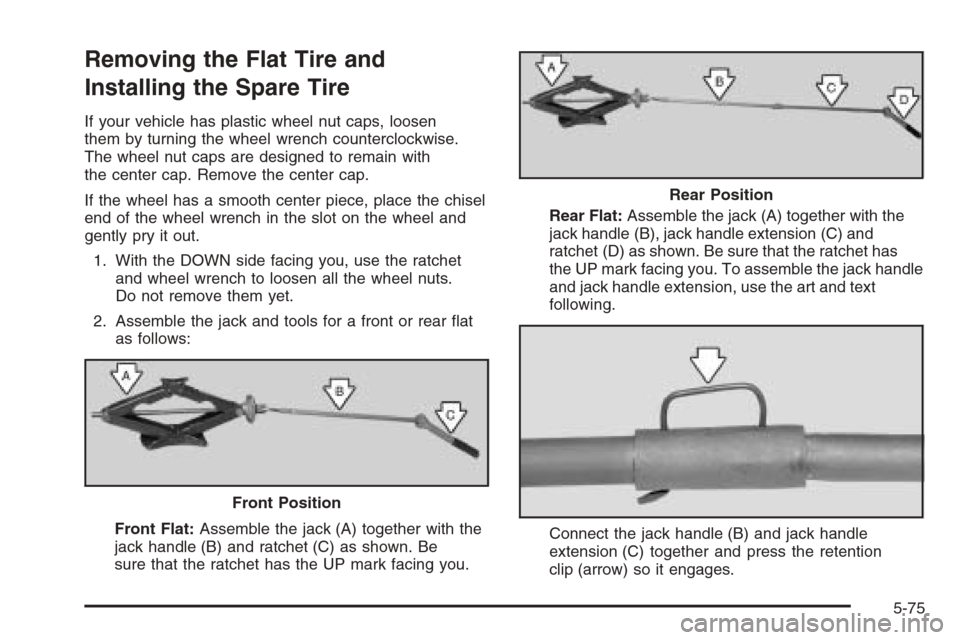
2. Assemble the jack and tools for a front or rear flat
as follows:
Front Flat:Assemble the jack (A) together with the
jack handle (B) and ratchet (C) as shown. Be
sure that the ratchet has the UP mark facing you.Rear Flat:Assemble the jack (A) together with the
jack handle (B), jack handle extension (C) and
ratchet (D) as shown. Be sure that the ratchet has
the UP mark facing you. To assemble the jack handle
and jack handle extension, use the art and text
following.
Connect the jack handle (B) and jack handle
extension (C) together and press the retention
clip (arrow) so it engages. Front Position
Rear Position
5-75
Page 333 of 406
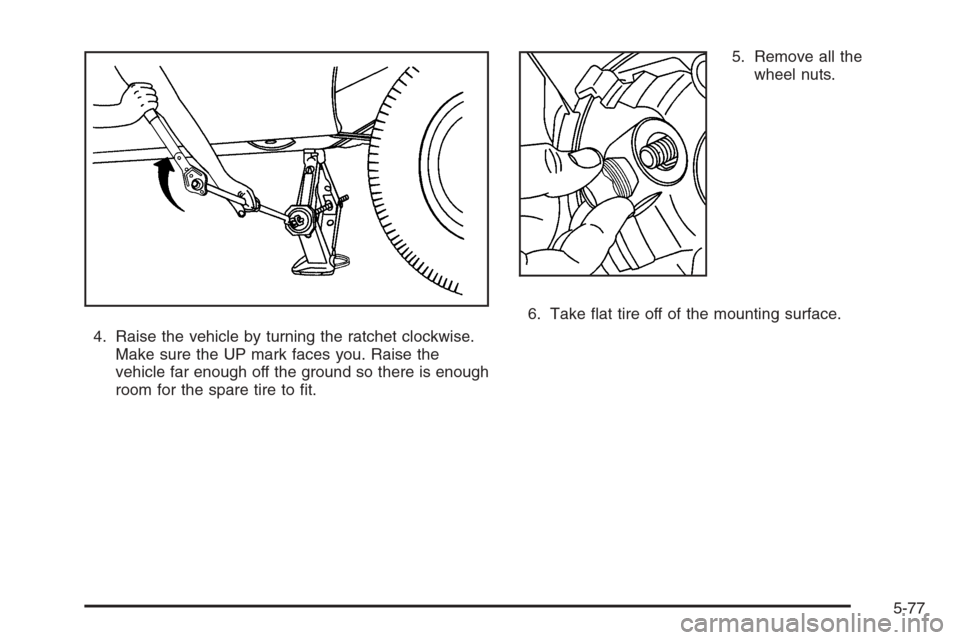
4. Raise the vehicle by turning the ratchet clockwise.
Make sure the UP mark faces you. Raise the
vehicle far enough off the ground so there is enough
room for the spare tire to fit.5. Remove all the
wheel nuts.
6. Take flat tire off of the mounting surface.
5-77
Page 334 of 406
{CAUTION:
Rust or dirt on the wheel, or on the parts to
which it is fastened, can make the wheel nuts
become loose after a time. The wheel could
come off and cause an accident. When you
change a wheel, remove any rust or dirt from
the places where the wheel attaches to the
vehicle. In an emergency, you can use a cloth
or a paper towel to do this; but be sure to use
a scraper or wire brush later, if needed, to get
all the rust or dirt off.
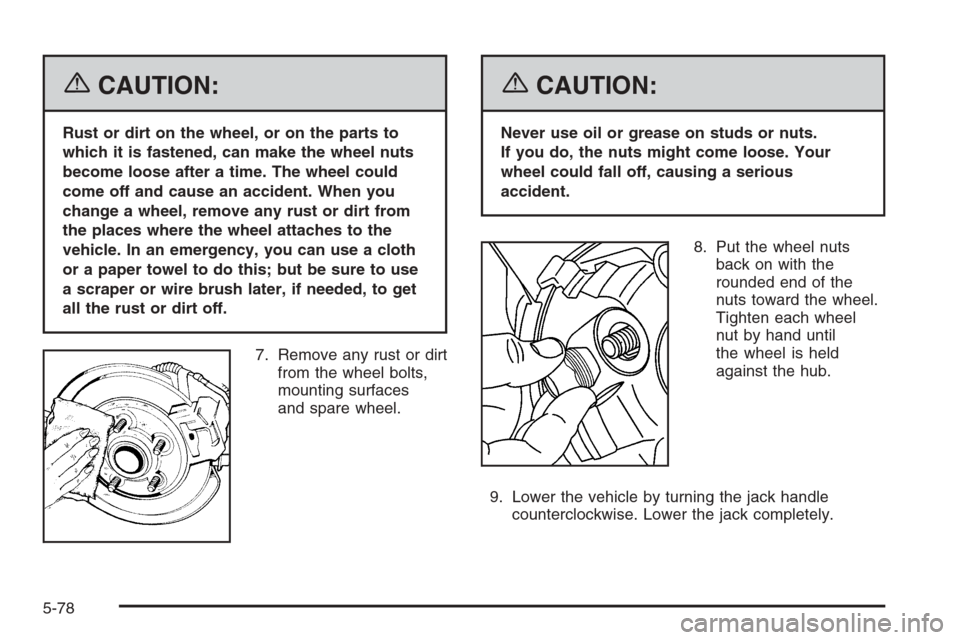
7. Remove any rust or dirt
from the wheel bolts,
mounting surfaces
and spare wheel.
{CAUTION:
Never use oil or grease on studs or nuts.
If you do, the nuts might come loose. Your
wheel could fall off, causing a serious
accident.
8. Put the wheel nuts
back on with the
rounded end of the
nuts toward the wheel.
Tighten each wheel
nut by hand until
the wheel is held
against the hub.
9. Lower the vehicle by turning the jack handle
counterclockwise. Lower the jack completely.
5-78
Page 335 of 406
{CAUTION:
Incorrect wheel nuts or improperly tightened
wheel nuts can cause the wheel to come loose
and even come off. This could lead to an
accident. Be sure to use the correct wheel
nuts. If you have to replace them, be sure to
get new GM original equipment wheel nuts.
Stop somewhere as soon as you can and have
the nuts tightened with a torque wrench to the
proper torque specication. SeeCapacities
and Specifications on page 5-99for wheel nut
torque specication.Notice:Improperly tightened wheel nuts can lead
to brake pulsation and rotor damage. To avoid
expensive brake repairs, evenly tighten the wheel
nuts in the proper sequence and to the proper
torque specication. SeeCapacities and
Specifications on page 5-99for the wheel nut
torque specication.
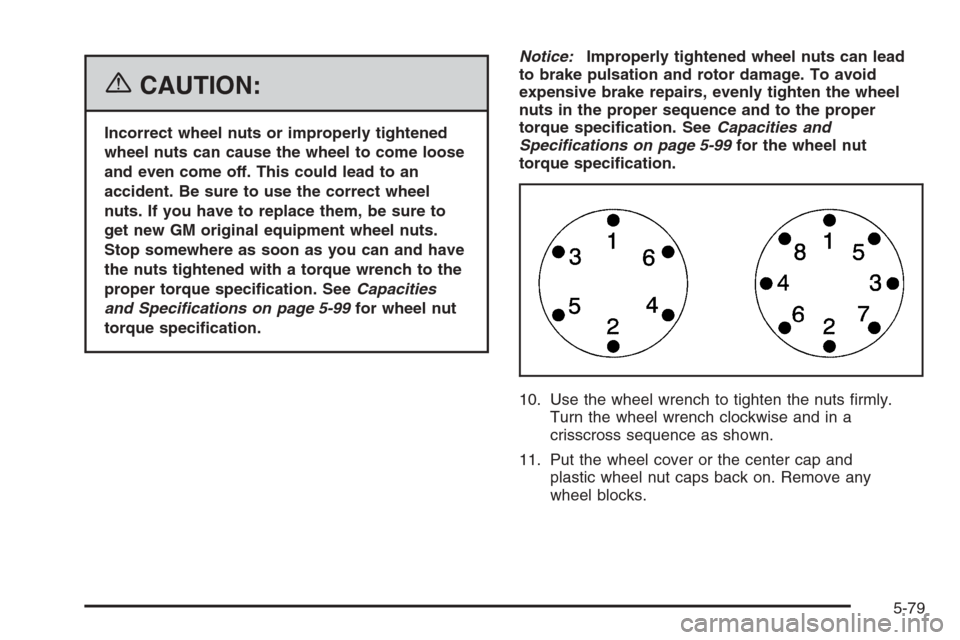
10. Use the wheel wrench to tighten the nuts firmly.
Turn the wheel wrench clockwise and in a
crisscross sequence as shown.
11. Put the wheel cover or the center cap and
plastic wheel nut caps back on. Remove any
wheel blocks.
5-79
Page 337 of 406
2. Turn the wrench counterclockwise until
approximately 6 inches (15 cm) of cable is exposed.
3. Connect the jack handle (C) and jack handle
extension (B) together and press the retention
clip (arrow) so it engages.
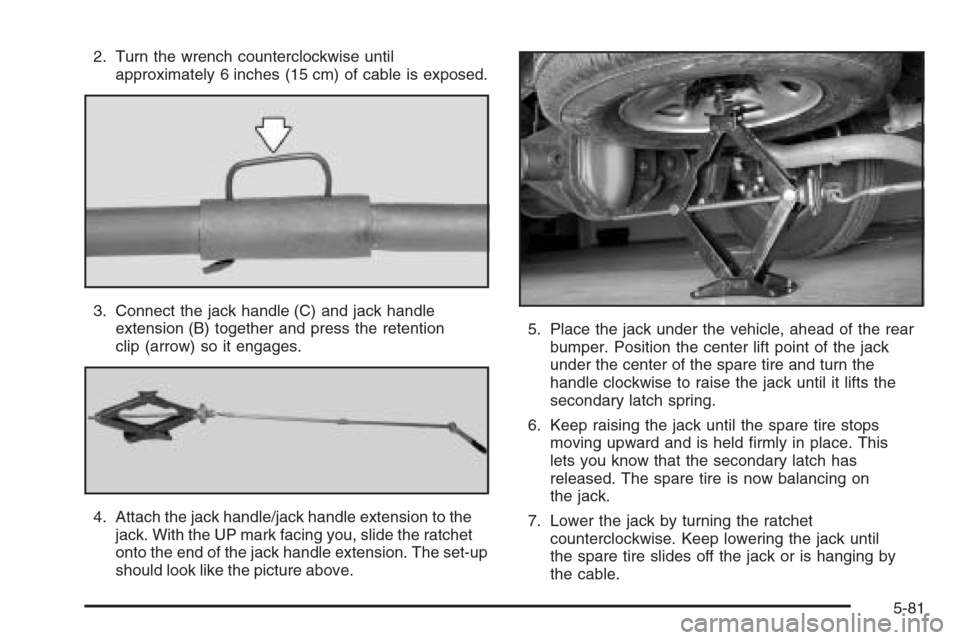
4. Attach the jack handle/jack handle extension to the
jack. With the UP mark facing you, slide the ratchet
onto the end of the jack handle extension. The set-up
should look like the picture above.5. Place the jack under the vehicle, ahead of the rear
bumper. Position the center lift point of the jack
under the center of the spare tire and turn the
handle clockwise to raise the jack until it lifts the
secondary latch spring.
6. Keep raising the jack until the spare tire stops
moving upward and is held firmly in place. This
lets you know that the secondary latch has
released. The spare tire is now balancing on
the jack.
7. Lower the jack by turning the ratchet
counterclockwise. Keep lowering the jack until
the spare tire slides off the jack or is hanging by
the cable.
5-81