radiator CHEVROLET EXPRESS PASSANGER 2006 1.G User Guide
[x] Cancel search | Manufacturer: CHEVROLET, Model Year: 2006, Model line: EXPRESS PASSANGER, Model: CHEVROLET EXPRESS PASSANGER 2006 1.GPages: 406, PDF Size: 2.51 MB
Page 303 of 406
Halogen Bulbs
{CAUTION:
Halogen bulbs have pressurized gas inside
and can burst if you drop or scratch the bulb.
You or others could be injured. Be sure to read
and follow the instructions on the bulb
package.
Headlamps
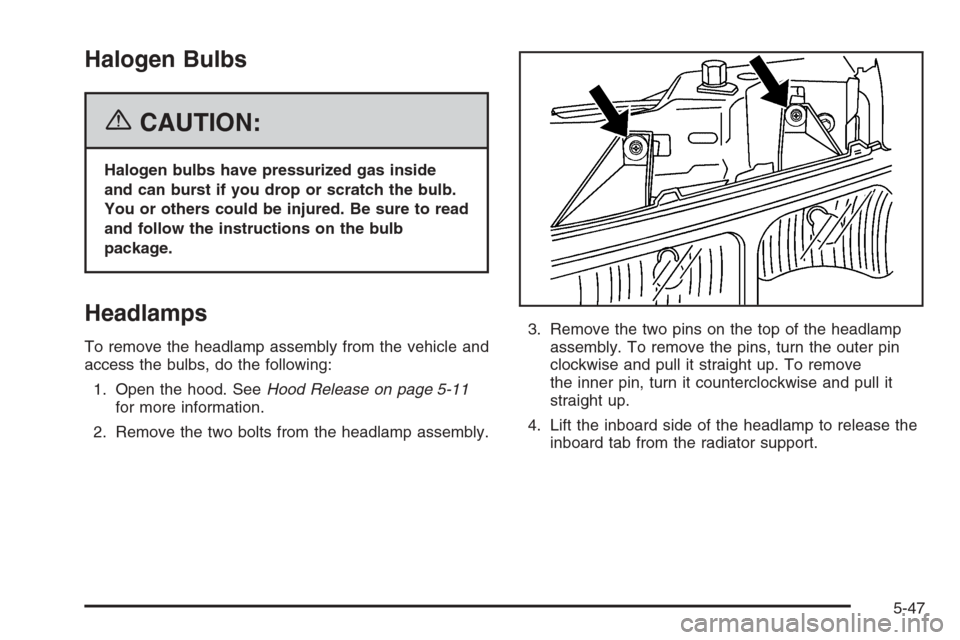
To remove the headlamp assembly from the vehicle and
access the bulbs, do the following:
1. Open the hood. SeeHood Release on page 5-11
for more information.
2. Remove the two bolts from the headlamp assembly.3. Remove the two pins on the top of the headlamp
assembly. To remove the pins, turn the outer pin
clockwise and pull it straight up. To remove
the inner pin, turn it counterclockwise and pull it
straight up.
4. Lift the inboard side of the headlamp to release the
inboard tab from the radiator support.
5-47
Page 304 of 406
5. Lift the outboard side of the headlamp to release
the outboard tab from the radiator support.
6. Lower the headlamp to allow the vertical adjustor to
clear the tie bar.
7. Turn the headlamp forward and upward to remove
it from the grille.
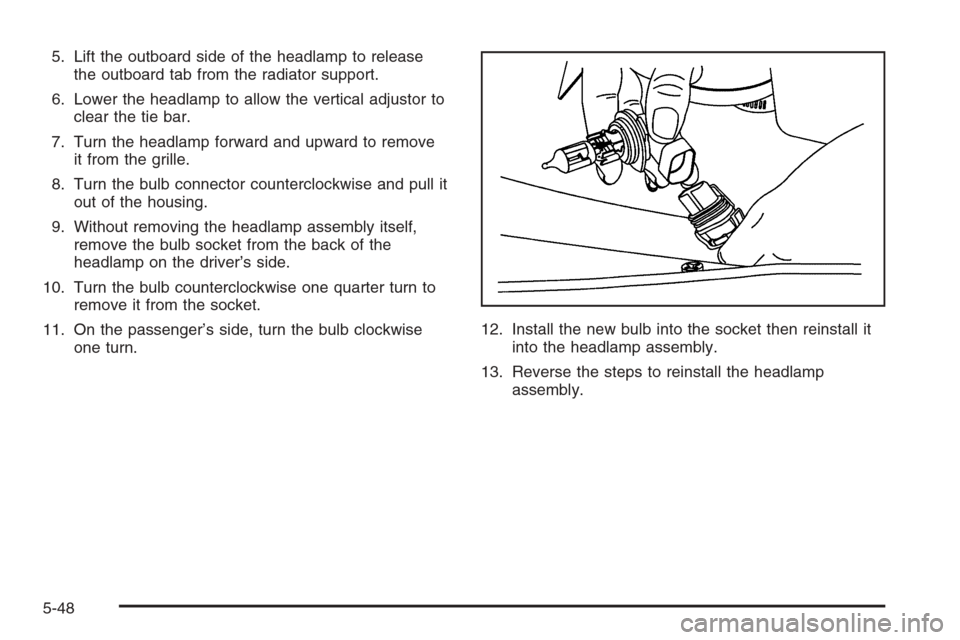
8. Turn the bulb connector counterclockwise and pull it
out of the housing.
9. Without removing the headlamp assembly itself,
remove the bulb socket from the back of the
headlamp on the driver’s side.
10. Turn the bulb counterclockwise one quarter turn to
remove it from the socket.
11. On the passenger’s side, turn the bulb clockwise
one turn.12. Install the new bulb into the socket then reinstall it
into the headlamp assembly.
13. Reverse the steps to reinstall the headlamp
assembly.
5-48
Page 364 of 406
(b)Visually inspect front and rear suspension and
steering system for damaged, loose, or missing parts,
signs of wear, or lack of lubrication. Inspect power
steering lines and hoses for proper hook-up, binding,
leaks, cracks, chang, etc.
(c)Visually inspect hoses and have them replaced
if they are cracked, swollen, or deteriorated. Inspect
all pipes, ttings, and clamps; replace with genuine
GM parts as needed. To help ensure proper operation,
a pressure test of the cooling system and pressure
cap and cleaning the outside of the radiator and
air conditioning condenser is recommended at least
once a year.
(d)Visually inspect wiper blades for wear or cracking.
Replace wiper blades that appear worn or damaged
or that streak or miss areas of the windshield.
(e)Make sure the safety belt reminder light and all your
belts, buckles, latch plates, retractors, and anchorages
are working properly. Look for any other loose or
damaged safety belt system parts. If you see anything
that might keep a safety belt system from doing its
job, have it repaired. Have any torn or frayed safety belts
replaced. Also look for any opened or broken airbag
coverings, and have them repaired or replaced.
The airbag system does not need regular maintenance.(f)Lubricate all key lock cylinders, hood hinges, hood
prop rod pivot, hood latch assembly, secondary
latch, pivots, spring anchor, release pawl, rear
compartment hinges, latches, locks, fuel door hinge,
and any moving seat hardware. More frequent
lubrication may be required when exposed to a corrosive
environment. Applying silicone grease on weatherstrips
with a clean cloth will make them last longer, seal
better, and not stick or squeak.
(g)Vehicles with Gross Vehicle Weight Rating (GVWR)
above 10,000 lbs (4 536 kg) only: Inspect shields for
damage or looseness. Adjust or replace as required.
This is a Noise Emission Control Service. Applicable to
vehicles sold in the United States and recommended
for vehicles sold in Canada.
(h)Change automatic transmission uid and lter if the
vehicle is mainly driven under one or more of these
conditions:
-In heavy city traffic where the outside temperature
regularly reaches 90°F (32°C) or higher.
-In hilly or mountainous terrain.
-When doing frequent trailer towing.
-Uses such as found in taxi, police, or
delivery service.
6-8
Page 365 of 406
(i)Drain, ush, and rell cooling system. This service
can be complex; you should have your dealer perform
this service. See Engine Coolant on page 5-22 for
what to use. Inspect hoses. Clean radiator, condenser,
pressure cap, and ller neck. Pressure test the
cooling system and pressure cap.
(j)A uid loss in any vehicle system could indicate a
problem. Have the system inspected and repaired and
the uid level checked. Add uid if needed.
(k)Inspect system. Check all fuel and vapor lines and
hoses for proper hook-up, routing, and condition. Check
that the purge valve works properly, if equipped.
Replace as needed.
(l)If you drive regularly under dusty conditions, inspect
the lter at each engine oil change.
(m)Check system for interference or binding and for
damaged or missing parts. Replace parts as needed.
Replace any components that have high effort or
excessive wear. Do not lubricate accelerator or cruise
control cables.
(n)Visually inspect belt for fraying, excessive cracks,
or obvious damage. Replace belt if necessary.Owner Checks and Services
These owner checks and services should be performed
at the intervals specified to help ensure the safety,
dependability, and emission control performance of your
vehicle. Your GM Goodwrench
®dealer can assist you
with these checks and services.
Be sure any necessary repairs are completed at once.
Whenever any fluids or lubricants are added to your
vehicle, make sure they are the proper ones, as shown
inRecommended Fluids and Lubricants (Gasoline
Engine) on page 6-13.
At the First 100, 1,000 and 6,000 Miles
(160, 1 600 and 10 000 km)
For vehicles with dual wheels, check dual wheel nut
torque. For proper torque, seeCapacities and
Specications on page 5-99.
6-9
Page 402 of 406
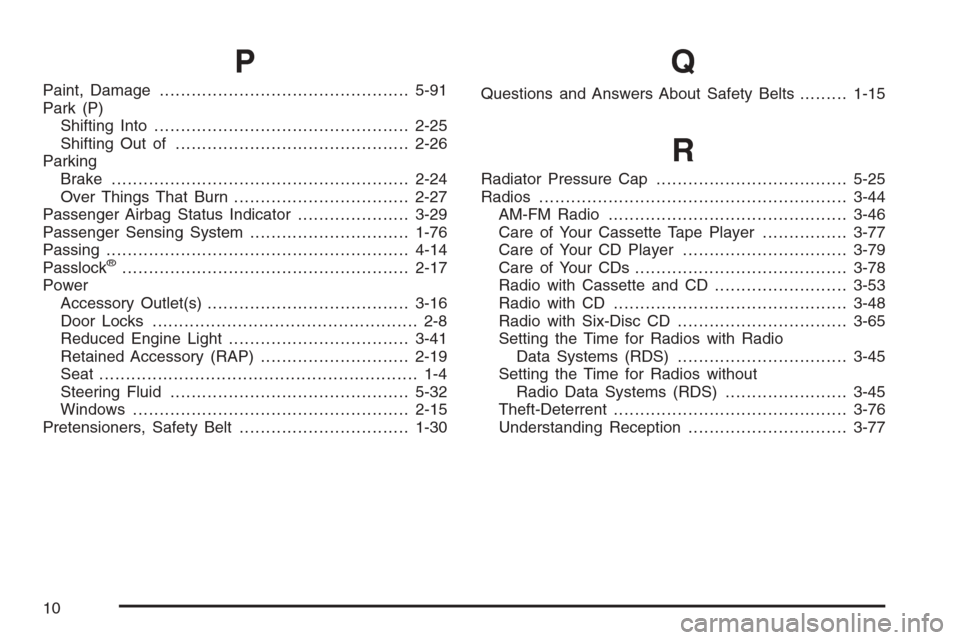
P
Paint, Damage...............................................5-91
Park (P)
Shifting Into................................................2-25
Shifting Out of............................................2-26
Parking
Brake........................................................2-24
Over Things That Burn.................................2-27
Passenger Airbag Status Indicator.....................3-29
Passenger Sensing System..............................1-76
Passing.........................................................4-14
Passlock
®......................................................2-17
Power
Accessory Outlet(s)......................................3-16
Door Locks.................................................. 2-8
Reduced Engine Light..................................3-41
Retained Accessory (RAP)............................2-19
Seat ............................................................ 1-4
Steering Fluid.............................................5-32
Windows....................................................2-15
Pretensioners, Safety Belt................................1-30
Q
Questions and Answers About Safety Belts.........1-15
R
Radiator Pressure Cap....................................5-25
Radios..........................................................3-44
AM-FM Radio.............................................3-46
Care of Your Cassette Tape Player................3-77
Care of Your CD Player...............................3-79
Care of Your CDs ........................................3-78
Radio with Cassette and CD.........................3-53
Radio with CD............................................3-48
Radio with Six-Disc CD................................3-65
Setting the Time for Radios with Radio
Data Systems (RDS)................................3-45
Setting the Time for Radios without
Radio Data Systems (RDS).......................3-45
Theft-Deterrent............................................3-76
Understanding Reception..............................3-77
10