mirror CHEVROLET EXPRESS PASSANGER 2007 1.G User Guide
[x] Cancel search | Manufacturer: CHEVROLET, Model Year: 2007, Model line: EXPRESS PASSANGER, Model: CHEVROLET EXPRESS PASSANGER 2007 1.GPages: 458, PDF Size: 2.62 MB
Page 244 of 458
Of course, traction is reduced when water, snow,
ice, gravel, or other material is on the road. For
safety, you want to slow down and adjust your
driving to these conditions. It is important to slow
down on slippery surfaces because stopping
distance is longer and vehicle control more limited.
While driving on a surface with reduced traction, try
your best to avoid sudden steering, acceleration, or
braking, including reducing vehicle speed by
shifting to a lower gear. Any sudden changes could
cause the tires to slide. You might not realize the
surface is slippery until your vehicle is skidding.
Learn to recognize warning clues — such as
enough water, ice, or packed snow on the road to
make a mirrored surface — and slow down when
you have any doubt.
Remember: Any Anti-Lock Brake System (ABS)
helps avoid only the braking skid.Driving at Night
Night driving is more dangerous than day driving.
One reason is that some drivers are likely to
be impaired — by alcohol or drugs, with night
vision problems, or by fatigue.
Here are some tips on night driving.
•Drive defensively.
•Do not drink and drive.
•Adjust the inside rearview mirror to reduce the
glare from headlamps behind you.
•Since you cannot see as well, slow down and
keep more space between you and other
vehicles.
•Slow down, especially on higher speed roads.
Your vehicle’s headlamps can light up only so
much road ahead.
•In remote areas, watch for animals.
•If you are tired, pull off the road in a safe
place and rest.
244
Page 251 of 458
The most important advice on freeway driving
is: Keep up with traffic and keep to the right.
Drive at the same speed most of the other
drivers are driving. Too-fast or too-slow driving
breaks a smooth traffic flow. Treat the left lane
on a freeway as a passing lane.
At the entrance, there is usually a ramp that leads
to the freeway. If you have a clear view of the
freeway as you drive along the entrance ramp, you
should begin to check traffic. Try to determine
where you expect to blend with the flow. Try to
merge into the gap at close to the prevailing speed.
Switch on your turn signal, check your mirrors, and
glance over your shoulder as often as necessary.
Try to blend smoothly with the traffic flow.
Once you are on the freeway, adjust your speed
to the posted limit or to the prevailing rate if it
is slower. Stay in the right lane unless you want
to pass.Before changing lanes, check your mirrors.
Then use your turn signal.
Just before you leave the lane, glance quickly
over your shoulder to make sure there is not
another vehicle in your blind spot.
Once you are moving on the freeway, make
certain you allow a reasonable following distance.
Expect to move slightly slower at night.
When you want to leave the freeway, move to the
proper lane well in advance. If you miss your
exit, do not, under any circumstances, stop and
back up. Drive on to the next exit.
The exit ramp can be curved, sometimes quite
sharply. The exit speed is usually posted.
Reduce your speed according to your
speedometer, not to your sense of motion.
After driving for any distance at higher speeds,
you may tend to think you are going slower
than you actually are.
251
Page 253 of 458
Highway Hypnosis
Is there actually such a condition as highway
hypnosis? Or is it just plain falling asleep at the
wheel? Call it highway hypnosis, lack of
awareness, or whatever.
There is something about an easy stretch of road
with the same scenery, along with the hum of
the tires on the road, the drone of the engine,
and the rush of the wind against the vehicle that
can make you sleepy. Do not let it happen to you!
If it does, your vehicle can leave the road in
less than a second, and you could crash and be
injured.
What can you do about highway hypnosis?
First, be aware that it can happen.Then here are some tips:•Make sure your vehicle is well ventilated, with
a comfortably cool interior.
•Keep your eyes moving. Scan the road ahead
and to the sides. Check your vehicle’s mirrors
and instruments frequently.
•If you get sleepy, pull off the road into a rest,
service, or parking area and take a nap, get
some exercise, or both. For safety, treat
drowsiness on the highway as an emergency.
253
Page 282 of 458
Driving with a Trailer
{CAUTION:
If you have a rear-most window open and
you pull a trailer with your vehicle, carbon
monoxide (CO) could come into your
vehicle. You can not see or smell CO. It
can cause unconsciousness or death. See
Engine Exhaust on page 132. To maximize
your safety when towing a trailer:
Have your exhaust system inspected
for leaks, and make necessary repairs
before starting on your trip.
Keep the rear-most windows closed.
If exhaust does come into your vehicle
through a window in the rear or another
opening, drive with your front, main
heating or cooling system on and with
the fan on any speed. This will bring
fresh, outside air into your vehicle.
CAUTION: (Continued)
CAUTION: (Continued)
Do not use the climate control
setting for maximum air because it
only recirculates the air inside your
vehicle. See Climate Control System
in the Index.
Towing a trailer requires a certain amount of
experience. Before setting out for the open road,
you’ll want to get to know your rig. Acquaint
yourself with the feel of handling and braking with
the added weight of the trailer. And always
keep in mind that the vehicle you are driving is
now a good deal longer and not nearly as
responsive as your vehicle is by itself.
Before you start, check all trailer hitch parts and
attachments, safety chains, electrical connector,
lamps, tires and mirror adjustment. If the trailer has
electric brakes, start your vehicle and trailer
moving and then apply the trailer brake controller
by hand to be sure the brakes are working.
This lets you check your electrical connection at
the same time.
282
Page 394 of 458
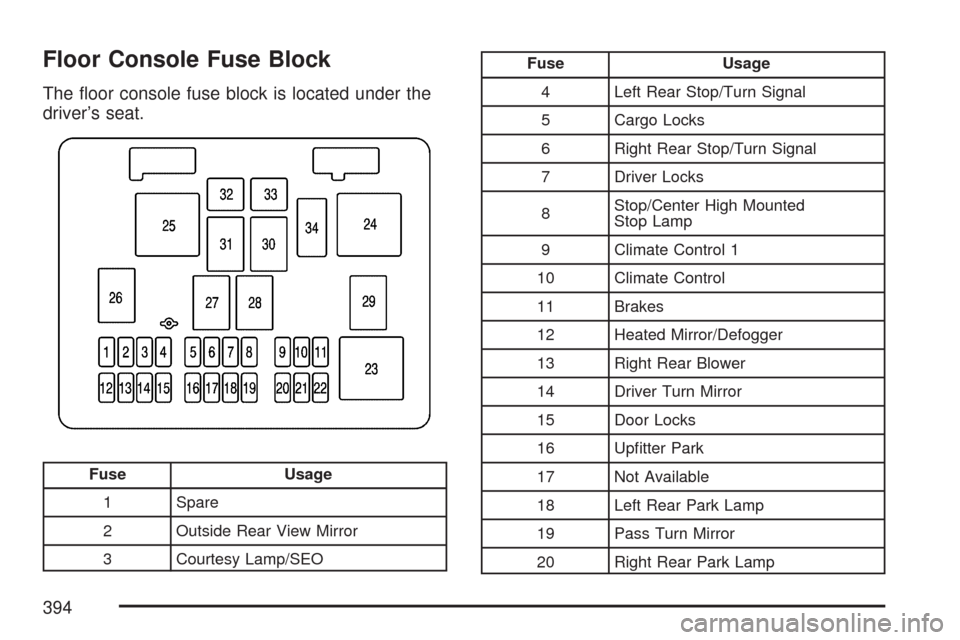
Floor Console Fuse Block
The floor console fuse block is located under the
driver’s seat.
Fuse Usage
1 Spare
2 Outside Rear View Mirror
3 Courtesy Lamp/SEO
Fuse Usage
4 Left Rear Stop/Turn Signal
5 Cargo Locks
6 Right Rear Stop/Turn Signal
7 Driver Locks
8Stop/Center High Mounted
Stop Lamp
9 Climate Control 1
10 Climate Control
11 Brakes
12 Heated Mirror/Defogger
13 Right Rear Blower
14 Driver Turn Mirror
15 Door Locks
16 Upfitter Park
17 Not Available
18 Left Rear Park Lamp
19 Pass Turn Mirror
20 Right Rear Park Lamp
394
Page 396 of 458
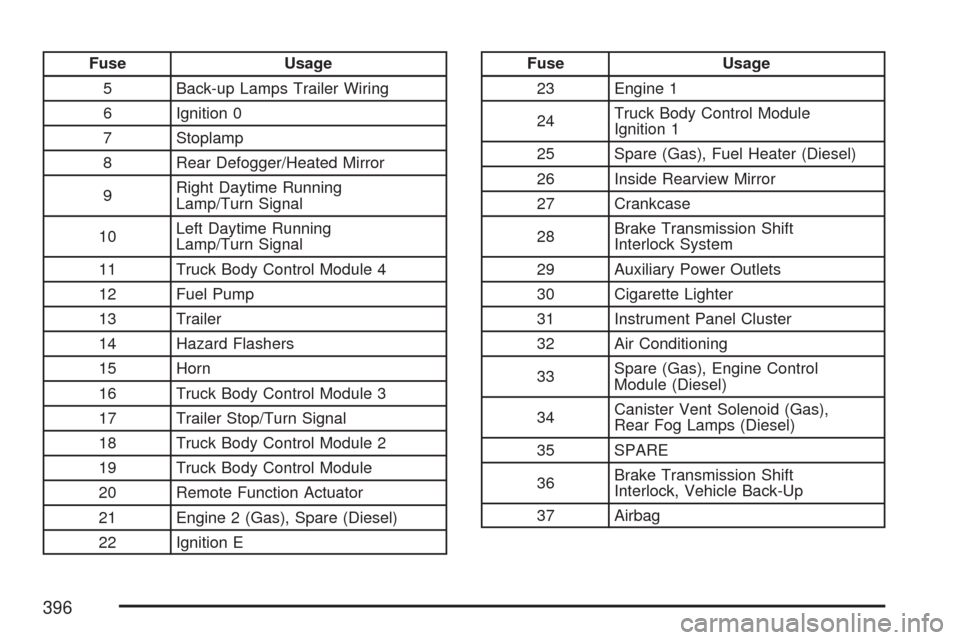
Fuse Usage
5 Back-up Lamps Trailer Wiring
6 Ignition 0
7 Stoplamp
8 Rear Defogger/Heated Mirror
9Right Daytime Running
Lamp/Turn Signal
10Left Daytime Running
Lamp/Turn Signal
11 Truck Body Control Module 4
12 Fuel Pump
13 Trailer
14 Hazard Flashers
15 Horn
16 Truck Body Control Module 3
17 Trailer Stop/Turn Signal
18 Truck Body Control Module 2
19 Truck Body Control Module
20 Remote Function Actuator
21 Engine 2 (Gas), Spare (Diesel)
22 Ignition EFuse Usage
23 Engine 1
24Truck Body Control Module
Ignition 1
25 Spare (Gas), Fuel Heater (Diesel)
26 Inside Rearview Mirror
27 Crankcase
28Brake Transmission Shift
Interlock System
29 Auxiliary Power Outlets
30 Cigarette Lighter
31 Instrument Panel Cluster
32 Air Conditioning
33Spare (Gas), Engine Control
Module (Diesel)
34Canister Vent Solenoid (Gas),
Rear Fog Lamps (Diesel)
35 SPARE
36Brake Transmission Shift
Interlock, Vehicle Back-Up
37 Airbag
396
Page 453 of 458
Manual Windows......................................... 115
Mirrors
Automatic Dimming Rearview with
Compass and Temperature Display....... 134
Manual Rearview Mirror........................... 134
Outside Camper-Type Mirrors................... 136
Outside Convex Mirror............................. 138
Outside Heated Mirrors............................ 139
Outside Manual Mirror.............................. 136
Outside Power Mirrors............................. 138
MyGMLink.com............................................ 427
N
Navigation System, Privacy......................... 443
New Vehicle Break-In.................................. 119
Noise Control System, Tampering................ 338
Normal Maintenance Replacement Parts..... 417
O
Odometer.................................................... 168
Odometer, Trip............................................ 168
Off-Road Recovery...................................... 241
Oil
Change Engine Oil Light.......................... 183
Engine..................................................... 303Oil (cont.)
Pressure Gage......................................... 182
Oil, Engine Oil Life System......................... 306
Older Children, Restraints............................. 41
Online Owner Center................................... 427
OnStar, Privacy........................................... 443
Other Warning Devices................................ 146
Outlet Adjustment........................................ 162
Outlets
Accessory Power..................................... 158
Outside
Camper-Type Mirrors................................ 136
Convex Mirror.......................................... 138
Heated Mirrors......................................... 139
Manual Mirror.......................................... 136
Power Mirrors.......................................... 138
Owner Checks and Services....................... 411
Owners, Canadian.......................................... 3
P
Paint, Damage............................................ 389
Park (P)
Shifting Into............................................. 129
Shifting Out of......................................... 130
453
Page 455 of 458
Rear Outside Passenger Positions, Safety
Belts.......................................................... 34
Rear Safety Belt Comfort Guides.................. 37
Rear Seat Operation..................................... 13
Rearview Mirror, Automatic Dimming with
Compass and Temperature Display.......... 134
Rearview Mirrors......................................... 134
Reclining Seatbacks...................................... 10
Recommended Fluids and Lubricants.......... 415
Recreational Vehicle Towing........................ 266
Reduced Engine Power Light...................... 184
Remote Keyless Entry (RKE) System.......... 104
Remote Keyless Entry (RKE) System,
Operation................................................. 105
Removing the Flat Tire and Installing the
Spare Tire................................................ 370
Removing the Spare Tire and Tools............ 367
Replacement Bulbs..................................... 344
Reporting Safety Defects
Canadian Government............................. 439
General Motors........................................ 439
United States Government....................... 438
Restraint System Check
Checking the Restraint Systems................. 98
Replacing Restraint System Parts After
a Crash.................................................. 98Retained Accessory Power (RAP)................ 121
Right Front Passenger Position, Safety
Belts.......................................................... 32
Roadside
Assistance Program................................. 430
Rocking Your Vehicle to Get it Out.............. 260
Routing, Engine Drive Belt.......................... 418
Running the Engine While Parked............... 133
S
Safety Belt
Passenger Reminder Light....................... 169
Pretensioners............................................. 40
Reminder Light........................................ 168
Safety Belts
Care of.................................................... 385
Center Passenger Position.................. 33, 34
Driver Position........................................... 23
How to Wear Safety Belts Properly............ 22
Questions and Answers About Safety
Belts....................................................... 21
Rear Outside Passenger Positions............. 34
Rear Safety Belt Comfort Guides............... 37
Right Front Passenger Position.................. 32
Safety Belt Extender.................................. 40
455