automatic transmission CHEVROLET EXPRESS PASSANGER 2008 1.G Owner's Manual
[x] Cancel search | Manufacturer: CHEVROLET, Model Year: 2008, Model line: EXPRESS PASSANGER, Model: CHEVROLET EXPRESS PASSANGER 2008 1.GPages: 414, PDF Size: 2.34 MB
Page 371 of 414
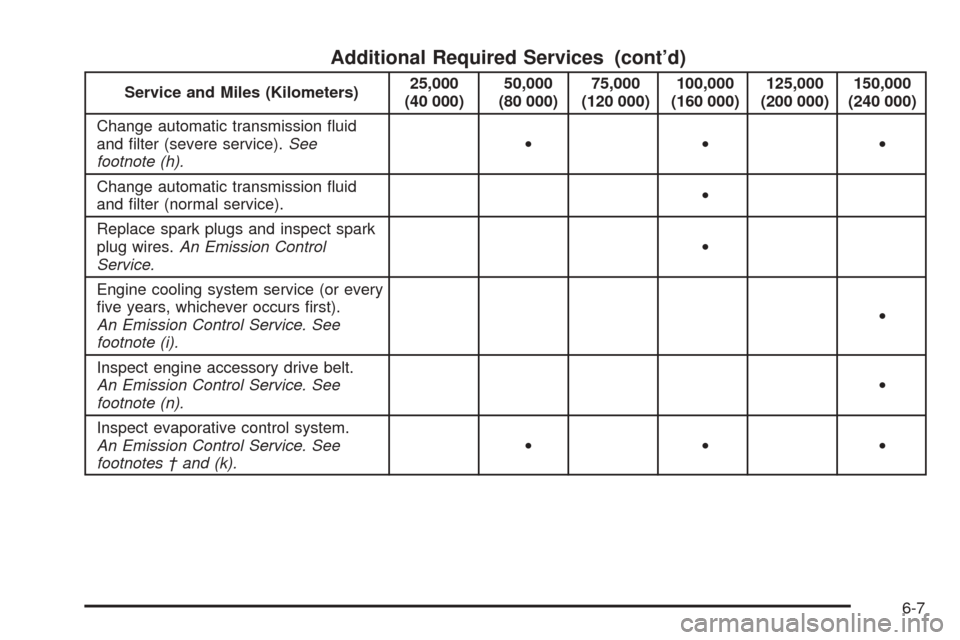
Additional Required Services (cont’d)
Service and Miles (Kilometers)25,000
(40 000)50,000
(80 000)75,000
(120 000)100,000
(160 000)125,000
(200 000)150,000
(240 000)
Change automatic transmission fluid
and filter (severe service).See
footnote (h).•••
Change automatic transmission fluid
and filter (normal service).•
Replace spark plugs and inspect spark
plug wires.An Emission Control
Service.•
Engine cooling system service (or every
five years, whichever occurs first).
An Emission Control Service. See
footnote (i).•
Inspect engine accessory drive belt.
An Emission Control Service. See
footnote (n).•
Inspect evaporative control system.
An Emission Control Service. See
footnotes † and (k).•••
6-7
Page 373 of 414
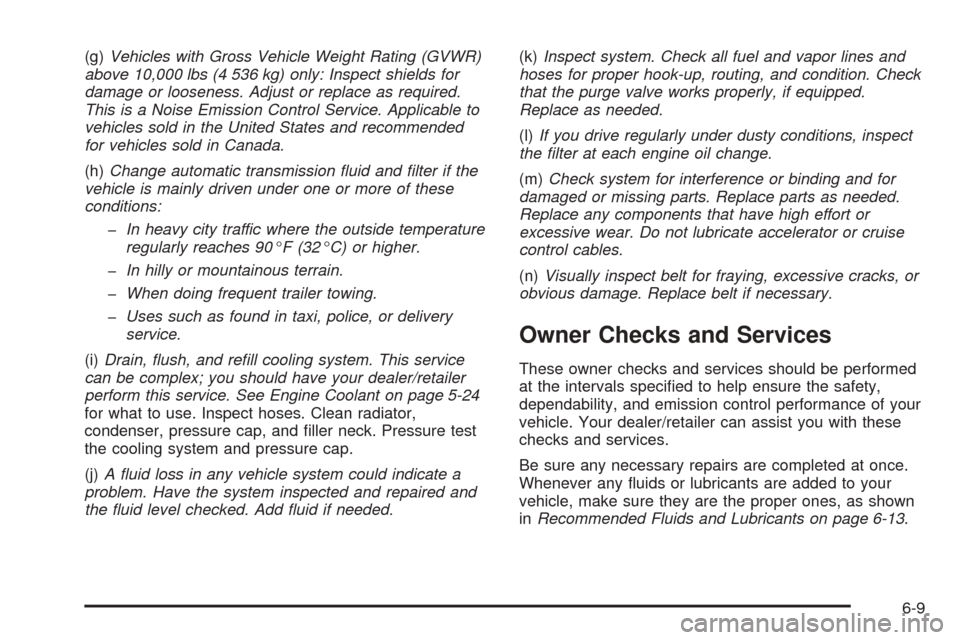
(g)Vehicles with Gross Vehicle Weight Rating (GVWR)
above 10,000 lbs (4 536 kg) only: Inspect shields for
damage or looseness. Adjust or replace as required.
This is a Noise Emission Control Service. Applicable to
vehicles sold in the United States and recommended
for vehicles sold in Canada.
(h)Change automatic transmission fluid and filter if the
vehicle is mainly driven under one or more of these
conditions:
-In heavy city traffic where the outside temperature
regularly reaches 90°F (32°C) or higher.
-In hilly or mountainous terrain.
-When doing frequent trailer towing.
-Uses such as found in taxi, police, or delivery
service.
(i)Drain, flush, and refill cooling system. This service
can be complex; you should have your dealer/retailer
perform this service. See Engine Coolant on page 5-24
for what to use. Inspect hoses. Clean radiator,
condenser, pressure cap, and filler neck. Pressure test
the cooling system and pressure cap.
(j)A fluid loss in any vehicle system could indicate a
problem. Have the system inspected and repaired and
the fluid level checked. Add fluid if needed.(k)Inspect system. Check all fuel and vapor lines and
hoses for proper hook-up, routing, and condition. Check
that the purge valve works properly, if equipped.
Replace as needed.
(l)If you drive regularly under dusty conditions, inspect
the filter at each engine oil change.
(m)Check system for interference or binding and for
damaged or missing parts. Replace parts as needed.
Replace any components that have high effort or
excessive wear. Do not lubricate accelerator or cruise
control cables.
(n)Visually inspect belt for fraying, excessive cracks, or
obvious damage. Replace belt if necessary.
Owner Checks and Services
These owner checks and services should be performed
at the intervals specified to help ensure the safety,
dependability, and emission control performance of your
vehicle. Your dealer/retailer can assist you with these
checks and services.
Be sure any necessary repairs are completed at once.
Whenever any fluids or lubricants are added to your
vehicle, make sure they are the proper ones, as shown
inRecommended Fluids and Lubricants on page 6-13.
6-9
Page 375 of 414
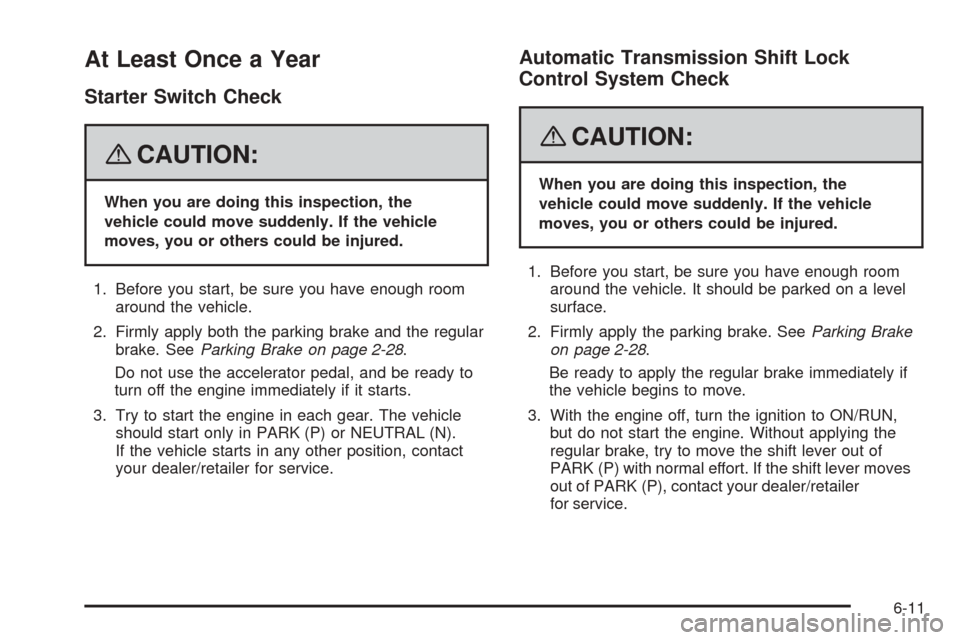
At Least Once a Year
Starter Switch Check
{CAUTION:
When you are doing this inspection, the
vehicle could move suddenly. If the vehicle
moves, you or others could be injured.
1. Before you start, be sure you have enough room
around the vehicle.
2. Firmly apply both the parking brake and the regular
brake. SeeParking Brake on page 2-28.
Do not use the accelerator pedal, and be ready to
turn off the engine immediately if it starts.
3. Try to start the engine in each gear. The vehicle
should start only in PARK (P) or NEUTRAL (N).
If the vehicle starts in any other position, contact
your dealer/retailer for service.
Automatic Transmission Shift Lock
Control System Check
{CAUTION:
When you are doing this inspection, the
vehicle could move suddenly. If the vehicle
moves, you or others could be injured.
1. Before you start, be sure you have enough room
around the vehicle. It should be parked on a level
surface.
2. Firmly apply the parking brake. SeeParking Brake
on page 2-28.
Be ready to apply the regular brake immediately if
the vehicle begins to move.
3. With the engine off, turn the ignition to ON/RUN,
but do not start the engine. Without applying the
regular brake, try to move the shift lever out of
PARK (P) with normal effort. If the shift lever moves
out of PARK (P), contact your dealer/retailer
for service.
6-11
Page 376 of 414
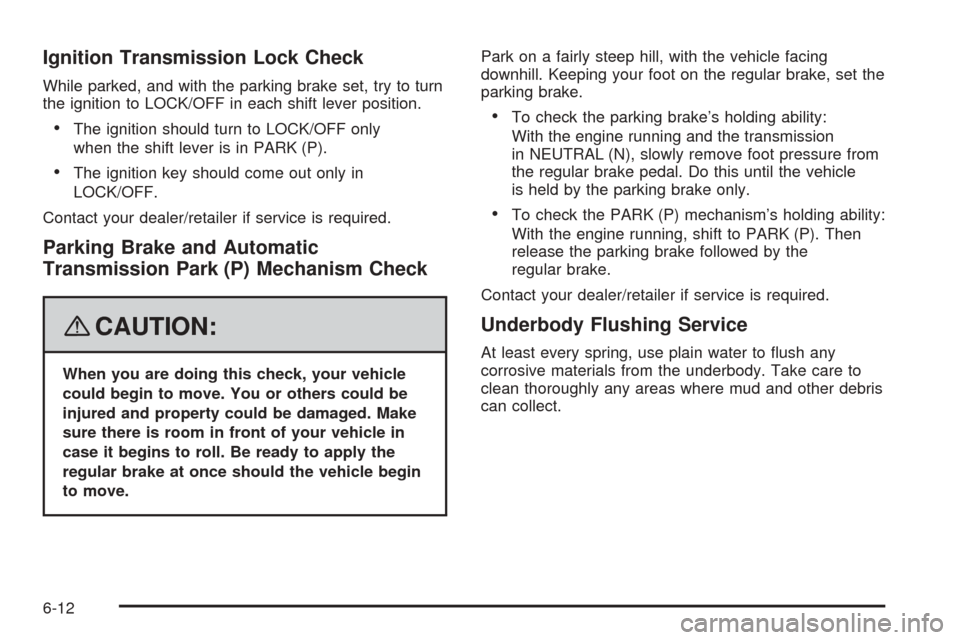
Ignition Transmission Lock Check
While parked, and with the parking brake set, try to turn
the ignition to LOCK/OFF in each shift lever position.
•The ignition should turn to LOCK/OFF only
when the shift lever is in PARK (P).
•The ignition key should come out only in
LOCK/OFF.
Contact your dealer/retailer if service is required.
Parking Brake and Automatic
Transmission Park (P) Mechanism Check
{CAUTION:
When you are doing this check, your vehicle
could begin to move. You or others could be
injured and property could be damaged. Make
sure there is room in front of your vehicle in
case it begins to roll. Be ready to apply the
regular brake at once should the vehicle begin
to move.Park on a fairly steep hill, with the vehicle facing
downhill. Keeping your foot on the regular brake, set the
parking brake.
•To check the parking brake’s holding ability:
With the engine running and the transmission
in NEUTRAL (N), slowly remove foot pressure from
the regular brake pedal. Do this until the vehicle
is held by the parking brake only.
•To check the PARK (P) mechanism’s holding ability:
With the engine running, shift to PARK (P). Then
release the parking brake followed by the
regular brake.
Contact your dealer/retailer if service is required.
Underbody Flushing Service
At least every spring, use plain water to flush any
corrosive materials from the underbody. Take care to
clean thoroughly any areas where mud and other debris
can collect.
6-12
Page 377 of 414
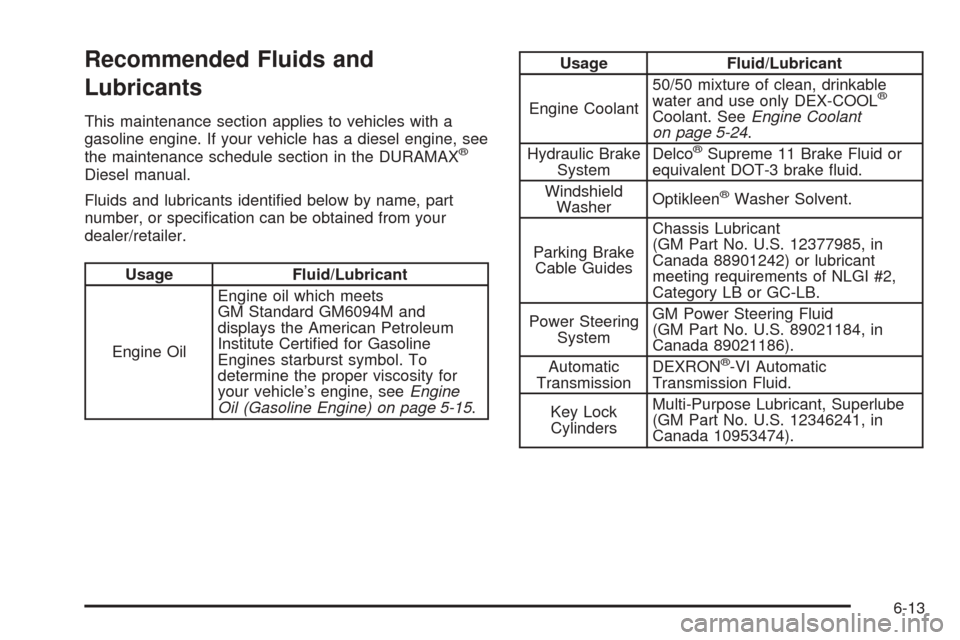
Recommended Fluids and
Lubricants
This maintenance section applies to vehicles with a
gasoline engine. If your vehicle has a diesel engine, see
the maintenance schedule section in the DURAMAX
®
Diesel manual.
Fluids and lubricants identified below by name, part
number, or specification can be obtained from your
dealer/retailer.
Usage Fluid/Lubricant
Engine OilEngine oil which meets
GM Standard GM6094M and
displays the American Petroleum
Institute Certified for Gasoline
Engines starburst symbol. To
determine the proper viscosity for
your vehicle’s engine, seeEngine
Oil (Gasoline Engine) on page 5-15.
Usage Fluid/Lubricant
Engine Coolant50/50 mixture of clean, drinkable
water and use only DEX-COOL
®
Coolant. SeeEngine Coolant
on page 5-24.
Hydraulic Brake
SystemDelco
®Supreme 11 Brake Fluid or
equivalent DOT-3 brake fluid.
Windshield
WasherOptikleen
®Washer Solvent.
Parking Brake
Cable GuidesChassis Lubricant
(GM Part No. U.S. 12377985, in
Canada 88901242) or lubricant
meeting requirements of NLGI #2,
Category LB or GC-LB.
Power Steering
SystemGM Power Steering Fluid
(GM Part No. U.S. 89021184, in
Canada 89021186).
Automatic
TransmissionDEXRON
®-VI Automatic
Transmission Fluid.
Key Lock
CylindersMulti-Purpose Lubricant, Superlube
(GM Part No. U.S. 12346241, in
Canada 10953474).
6-13
Page 404 of 414
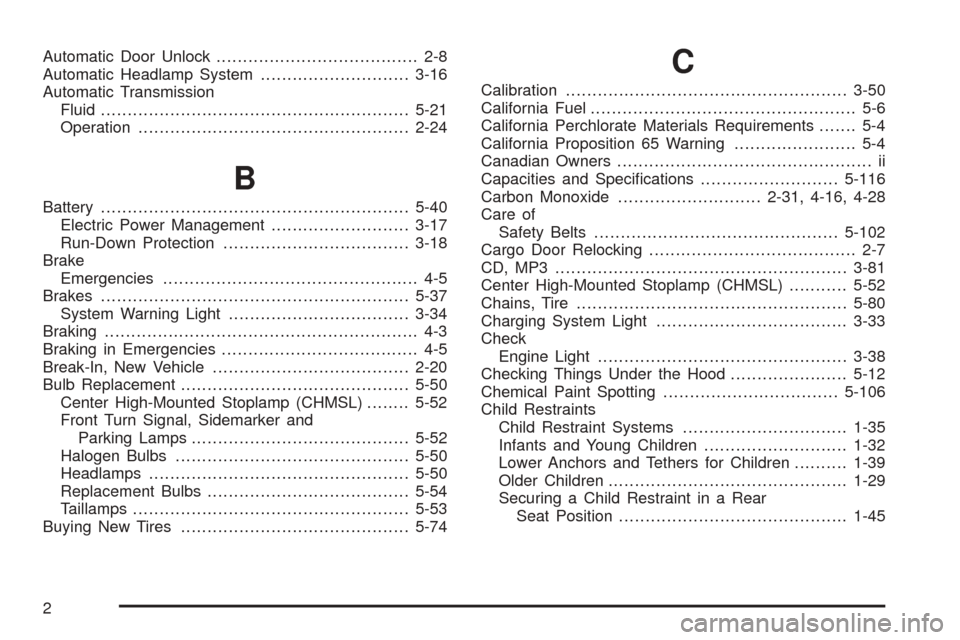
Automatic Door Unlock...................................... 2-8
Automatic Headlamp System............................3-16
Automatic Transmission
Fluid..........................................................5-21
Operation...................................................2-24
B
Battery..........................................................5-40
Electric Power Management..........................3-17
Run-Down Protection...................................3-18
Brake
Emergencies................................................ 4-5
Brakes..........................................................5-37
System Warning Light..................................3-34
Braking........................................................... 4-3
Braking in Emergencies..................................... 4-5
Break-In, New Vehicle.....................................2-20
Bulb Replacement...........................................5-50
Center High-Mounted Stoplamp (CHMSL)........5-52
Front Turn Signal, Sidemarker and
Parking Lamps.........................................5-52
Halogen Bulbs............................................5-50
Headlamps.................................................5-50
Replacement Bulbs......................................5-54
Taillamps....................................................5-53
Buying New Tires...........................................5-74
C
Calibration.....................................................3-50
California Fuel.................................................. 5-6
California Perchlorate Materials Requirements....... 5-4
California Proposition 65 Warning....................... 5-4
Canadian Owners................................................ ii
Capacities and Specifications..........................5-116
Carbon Monoxide...........................2-31, 4-16, 4-28
Care of
Safety Belts..............................................5-102
Cargo Door Relocking....................................... 2-7
CD, MP3 .......................................................3-81
Center High-Mounted Stoplamp (CHMSL)...........5-52
Chains, Tire...................................................5-80
Charging System Light....................................3-33
Check
Engine Light...............................................3-38
Checking Things Under the Hood......................5-12
Chemical Paint Spotting.................................5-106
Child Restraints
Child Restraint Systems...............................1-35
Infants and Young Children...........................1-32
Lower Anchors and Tethers for Children..........1-39
Older Children.............................................1-29
Securing a Child Restraint in a Rear
Seat Position...........................................1-45
2
Page 413 of 414
T
Taillamps.......................................................5-53
Theft-Deterrent, Radio.....................................3-86
Theft-Deterrent Systems...................................2-17
PASS-Key
®III+...........................................2-18
PASS-Key®III+ Operation.............................2-18
Tilt Wheel........................................................ 3-6
Time, Setting..................................................3-68
Tire
Pressure Light.............................................3-37
Tires.............................................................5-56
Aluminum Wheels, Cleaning........................5-104
Buying New Tires........................................5-74
Chains.......................................................5-80
Changing a Flat Tire....................................5-82
Cleaning...................................................5-105
Different Size..............................................5-75
Dual Tire Operation.....................................5-65
If a Tire Goes Flat.......................................5-81
Inflation - Tire Pressure................................5-64
Inspection and Rotation................................5-71
Installing the Spare Tire................................5-86
Pressure Monitor Operation...........................5-67
Pressure Monitor System..............................5-66
Removing the Flat Tire.................................5-86Tires (cont.)
Removing the Spare Tire and Tools...............5-83
Secondary Latch System..............................5-93
Spare Tire..................................................5-99
Storing a Flat or Spare Tire and Tools............5-97
Tire Sidewall Labeling..................................5-56
Tire Terminology and Definitions....................5-61
Uniform Tire Quality Grading.........................5-76
Wheel Alignment and Tire Balance.................5-78
Wheel Replacement.....................................5-78
When It Is Time for New Tires......................5-73
Tow/Haul Mode...............................................2-27
Tow/Haul Mode Light.......................................3-43
Towing
Recreational Vehicle.....................................4-26
Towing a Trailer..........................................4-28
Your Vehicle...............................................4-25
Traction
StabiliTrak
®System....................................... 4-5
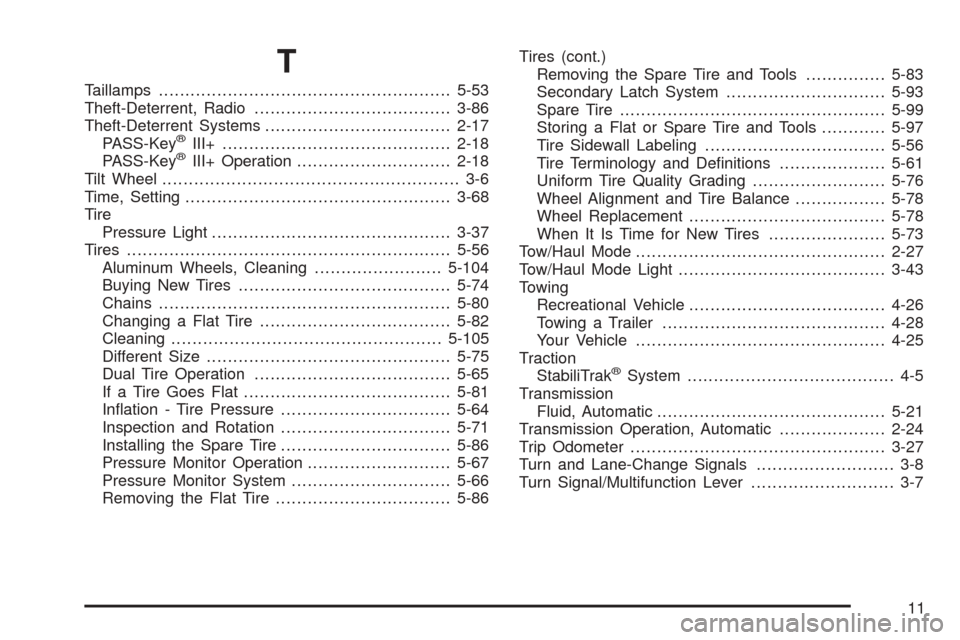
Transmission
Fluid, Automatic...........................................5-21
Transmission Operation, Automatic....................2-24
Trip Odometer................................................3-27
Turn and Lane-Change Signals.......................... 3-8
Turn Signal/Multifunction Lever........................... 3-7
11