air condition CHEVROLET EXPRESS PASSANGER 2012 1.G Owners Manual
[x] Cancel search | Manufacturer: CHEVROLET, Model Year: 2012, Model line: EXPRESS PASSANGER, Model: CHEVROLET EXPRESS PASSANGER 2012 1.GPages: 430, PDF Size: 6.35 MB
Page 5 of 430
Black plate (5,1)Chevrolet Express Owner Manual - 2012
Introduction v
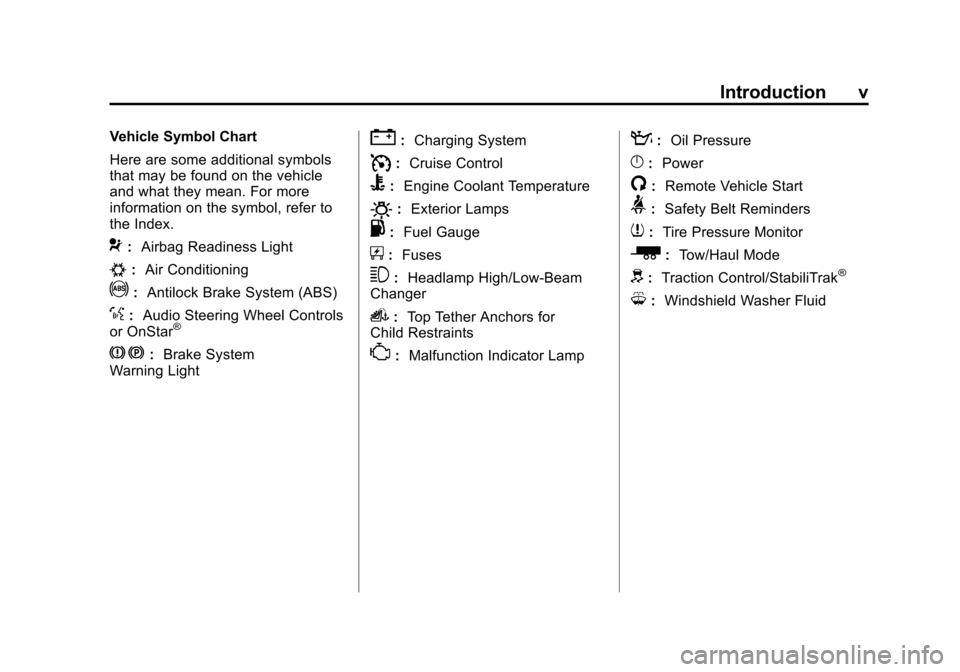
Vehicle Symbol Chart
Here are some additional symbols
that may be found on the vehicle
and what they mean. For more
information on the symbol, refer to
the Index.
9:Airbag Readiness Light
#:Air Conditioning
!:Antilock Brake System (ABS)
%:Audio Steering Wheel Controls
or OnStar®
J: Brake System
Warning Light
": Charging System
I:Cruise Control
B: Engine Coolant Temperature
O:Exterior Lamps
.:Fuel Gauge
+:Fuses
3: Headlamp High/Low-Beam
Changer
i: Top Tether Anchors for
Child Restraints
*: Malfunction Indicator Lamp
::Oil Pressure
}:Power
/:Remote Vehicle Start
>:Safety Belt Reminders
7:Tire Pressure Monitor
_: Tow/Haul Mode
d:Traction Control/StabiliTrak®
M:Windshield Washer Fluid
Page 15 of 430
Black plate (9,1)Chevrolet Express Owner Manual - 2012
In Brief 1-9
Passenger Sensing
System
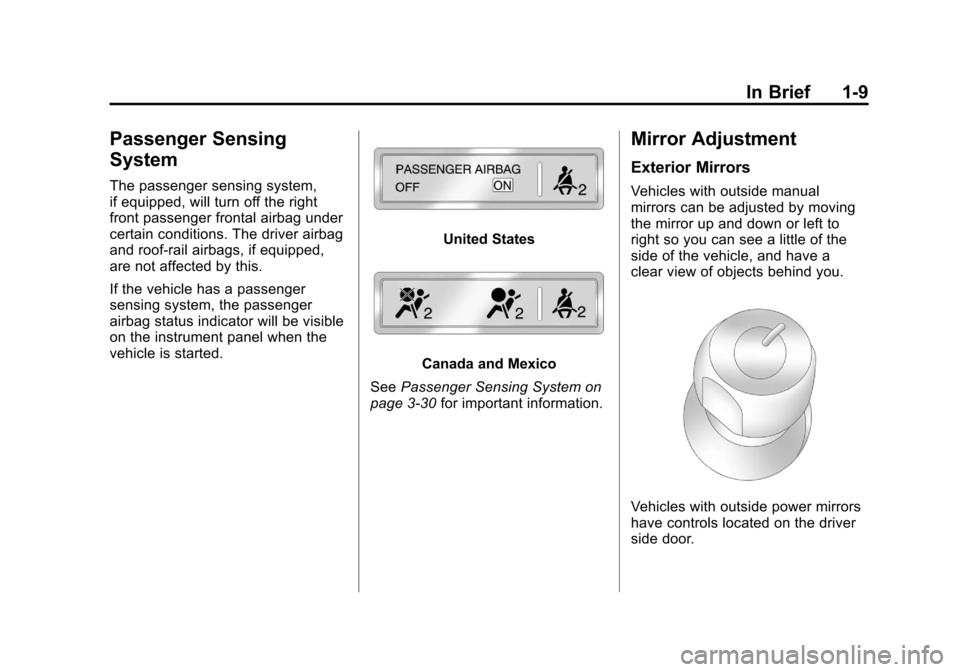
The passenger sensing system,
if equipped, will turn off the right
front passenger frontal airbag under
certain conditions. The driver airbag
and roof‐rail airbags, if equipped,
are not affected by this.
If the vehicle has a passenger
sensing system, the passenger
airbag status indicator will be visible
on the instrument panel when the
vehicle is started.
United States
Canada and Mexico
See Passenger Sensing System on
page 3‑30 for important information.
Mirror Adjustment
Exterior Mirrors
Vehicles with outside manual
mirrors can be adjusted by moving
the mirror up and down or left to
right so you can see a little of the
side of the vehicle, and have a
clear view of objects behind you.
Vehicles with outside power mirrors
have controls located on the driver
side door.
Page 19 of 430
Black plate (13,1)Chevrolet Express Owner Manual - 2012
In Brief 1-13
Windshield Wiper/Washer
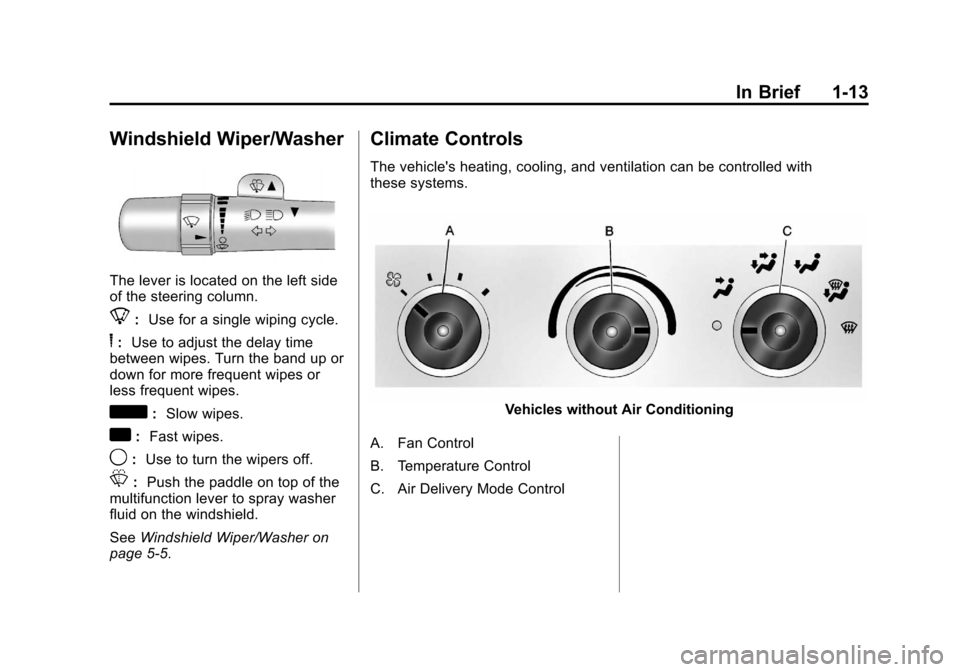
The lever is located on the left side
of the steering column.
8:Use for a single wiping cycle.
6:Use to adjust the delay time
between wipes. Turn the band up or
down for more frequent wipes or
less frequent wipes.
d: Slow wipes.
a:Fast wipes.
9:Use to turn the wipers off.
L: Push the paddle on top of the
multifunction lever to spray washer
fluid on the windshield.
See Windshield Wiper/Washer on
page 5‑5.
Climate Controls
The vehicle's heating, cooling, and ventilation can be controlled with
these systems.
Vehicles without Air Conditioning
A. Fan Control
B. Temperature Control
C. Air Delivery Mode Control
Page 20 of 430
Black plate (14,1)Chevrolet Express Owner Manual - 2012
1-14 In Brief
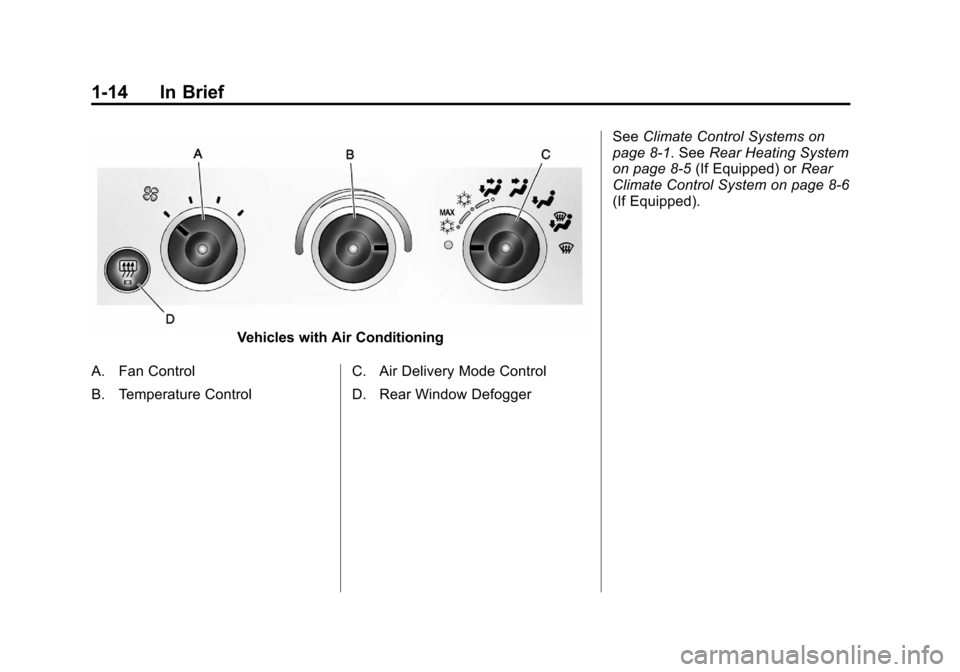
Vehicles with Air Conditioning
A. Fan Control
B. Temperature Control C. Air Delivery Mode Control
D. Rear Window DefoggerSee
Climate Control Systems on
page 8‑1. See Rear Heating System
on page 8‑5 (If Equipped) or Rear
Climate Control System on page 8‑6
(If Equipped).
Page 33 of 430
Black plate (5,1)Chevrolet Express Owner Manual - 2012
Keys, Doors, and Windows 2-5
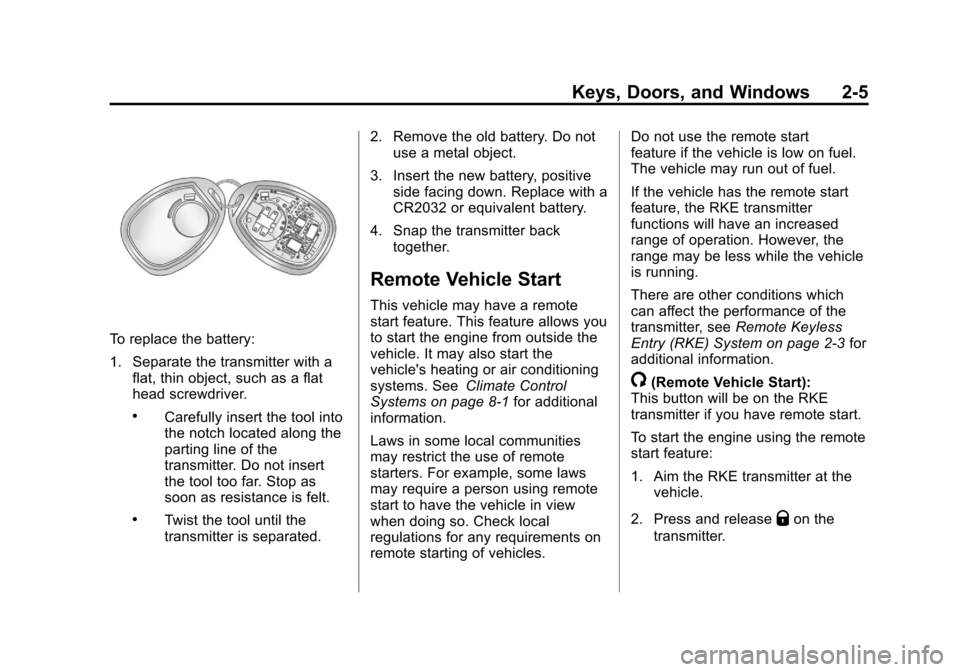
To replace the battery:
1. Separate the transmitter with aflat, thin object, such as a flat
head screwdriver.
.Carefully insert the tool into
the notch located along the
parting line of the
transmitter. Do not insert
the tool too far. Stop as
soon as resistance is felt.
.Twist the tool until the
transmitter is separated. 2. Remove the old battery. Do not
use a metal object.
3. Insert the new battery, positive side facing down. Replace with a
CR2032 or equivalent battery.
4. Snap the transmitter back together.
Remote Vehicle Start
This vehicle may have a remote
start feature. This feature allows you
to start the engine from outside the
vehicle. It may also start the
vehicle's heating or air conditioning
systems. See Climate Control
Systems on page 8‑1 for additional
information.
Laws in some local communities
may restrict the use of remote
starters. For example, some laws
may require a person using remote
start to have the vehicle in view
when doing so. Check local
regulations for any requirements on
remote starting of vehicles. Do not use the remote start
feature if the vehicle is low on fuel.
The vehicle may run out of fuel.
If the vehicle has the remote start
feature, the RKE transmitter
functions will have an increased
range of operation. However, the
range may be less while the vehicle
is running.
There are other conditions which
can affect the performance of the
transmitter, see
Remote Keyless
Entry (RKE) System on page 2‑3 for
additional information.
/(Remote Vehicle Start):
This button will be on the RKE
transmitter if you have remote start.
To start the engine using the remote
start feature:
1. Aim the RKE transmitter at the vehicle.
2. Press and release
Qon the
transmitter.
Page 61 of 430
Black plate (13,1)Chevrolet Express Owner Manual - 2012
Seats and Restraints 3-13
Safety Belt Height Adjuster
The vehicle has a safety belt height
adjuster for the driver and right front
passenger positions.
Adjust the height so the shoulder
portion of the belt is on the shoulder
and not falling off of it. The belt
should be close to, but not
contacting, the neck. Improper
shoulder belt height adjustment
could reduce the effectiveness of
the safety belt in a crash. SeeHow
to Wear Safety Belts Properly on
page 3‑10.
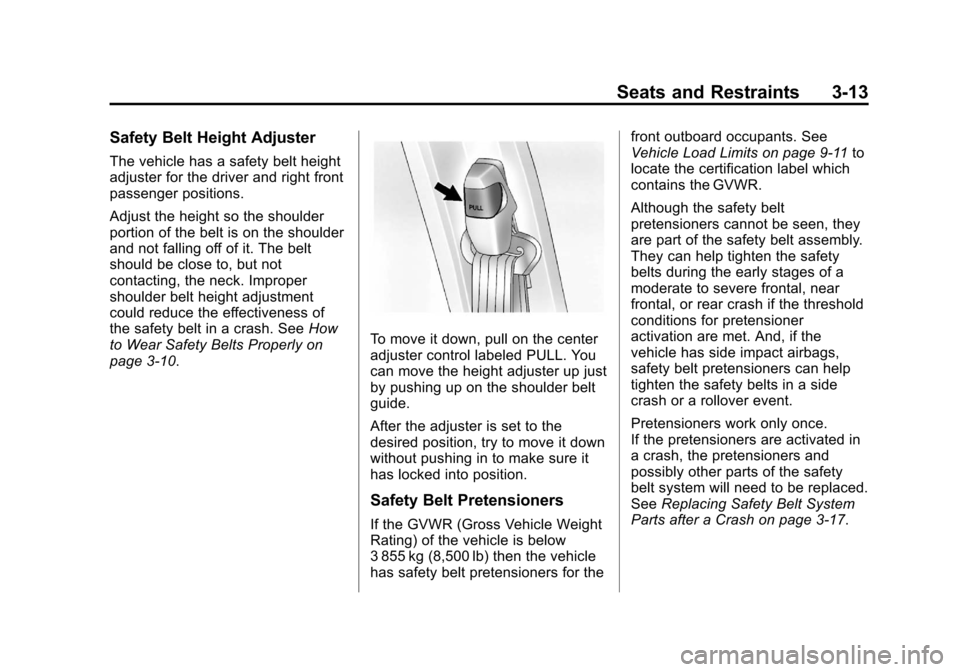
To move it down, pull on the center
adjuster control labeled PULL. You
can move the height adjuster up just
by pushing up on the shoulder belt
guide.
After the adjuster is set to the
desired position, try to move it down
without pushing in to make sure it
has locked into position.
Safety Belt Pretensioners
If the GVWR (Gross Vehicle Weight
Rating) of the vehicle is below
3 855 kg (8,500 lb) then the vehicle
has safety belt pretensioners for the front outboard occupants. See
Vehicle Load Limits on page 9‑11
to
locate the certification label which
contains the GVWR.
Although the safety belt
pretensioners cannot be seen, they
are part of the safety belt assembly.
They can help tighten the safety
belts during the early stages of a
moderate to severe frontal, near
frontal, or rear crash if the threshold
conditions for pretensioner
activation are met. And, if the
vehicle has side impact airbags,
safety belt pretensioners can help
tighten the safety belts in a side
crash or a rollover event.
Pretensioners work only once.
If the pretensioners are activated in
a crash, the pretensioners and
possibly other parts of the safety
belt system will need to be replaced.
See Replacing Safety Belt System
Parts after a Crash on page 3‑17.
Page 74 of 430
Black plate (26,1)Chevrolet Express Owner Manual - 2012
3-26 Seats and Restraints
Airbag On-Off Switch
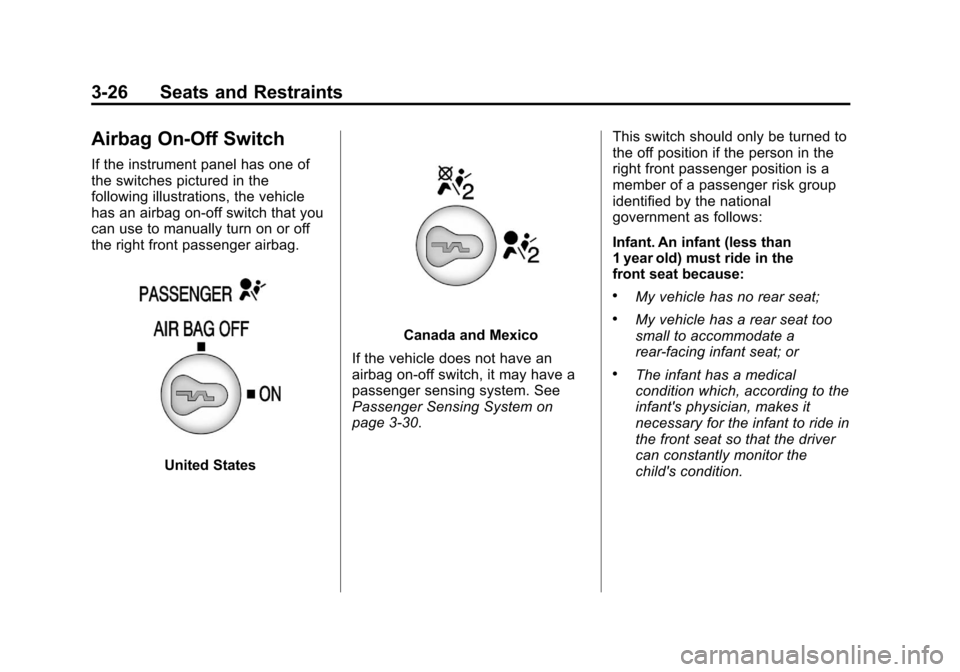
If the instrument panel has one of
the switches pictured in the
following illustrations, the vehicle
has an airbag on-off switch that you
can use to manually turn on or off
the right front passenger airbag.
United States
Canada and Mexico
If the vehicle does not have an
airbag on-off switch, it may have a
passenger sensing system. See
Passenger Sensing System on
page 3‑30. This switch should only be turned to
the off position if the person in the
right front passenger position is a
member of a passenger risk group
identified by the national
government as follows:
Infant. An infant (less than
1 year old) must ride in the
front seat because:
.My vehicle has no rear seat;
.My vehicle has a rear seat too
small to accommodate a
rear-facing infant seat; or
.The infant has a medical
condition which, according to the
infant's physician, makes it
necessary for the infant to ride in
the front seat so that the driver
can constantly monitor the
child's condition.
Page 75 of 430
Black plate (27,1)Chevrolet Express Owner Manual - 2012
Seats and Restraints 3-27
Child age 1 to 12. A child
age 1 to 12 must ride in the
front seat because:
.My vehicle has no rear seat;
.Although children ages 1 to 12
ride in the rear seat(s) whenever
possible, children ages 1 to 12
sometimes must ride in the front
because no space is available in
the rear seat(s) of my vehicle; or
.The child has a medical
condition which, according to the
child's physician, makes it
necessary for the child to ride in
the front seat so that the driver
can constantly monitor the
child's condition.Medical Condition. A passenger
has a medical condition which,
according to his or her physician:
.Causes the passenger airbag to
pose a special risk for the
passenger; and
.Makes the potential harm from
the passenger airbag in a crash
greater than the potential harm
from turning off the airbag and
allowing the passenger, even if
belted, to hit the instrument
panel or windshield in a crash.
{WARNING
If the right front passenger airbag
is turned off for a person who is
not in a risk group identified by
the national government, that
person will not have the extra
protection of an airbag. In a
crash, the airbag will not be able
to inflate and help protect the
person sitting there.
Do not turn off the passenger
airbag unless the person sitting
there is in a risk group.
Page 78 of 430
Black plate (30,1)Chevrolet Express Owner Manual - 2012
3-30 Seats and Restraints
Passenger Sensing
System
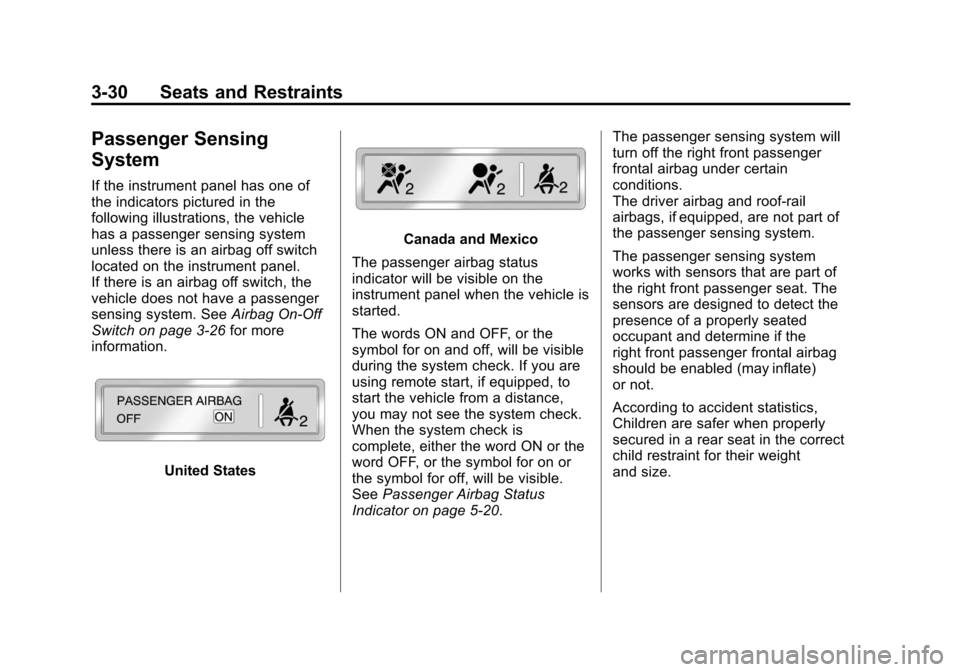
If the instrument panel has one of
the indicators pictured in the
following illustrations, the vehicle
has a passenger sensing system
unless there is an airbag off switch
located on the instrument panel.
If there is an airbag off switch, the
vehicle does not have a passenger
sensing system. SeeAirbag On-Off
Switch on page 3‑26 for more
information.
United States
Canada and Mexico
The passenger airbag status
indicator will be visible on the
instrument panel when the vehicle is
started.
The words ON and OFF, or the
symbol for on and off, will be visible
during the system check. If you are
using remote start, if equipped, to
start the vehicle from a distance,
you may not see the system check.
When the system check is
complete, either the word ON or the
word OFF, or the symbol for on or
the symbol for off, will be visible.
See Passenger Airbag Status
Indicator on page 5‑20. The passenger sensing system will
turn off the right front passenger
frontal airbag under certain
conditions.
The driver airbag and roof-rail
airbags, if equipped, are not part of
the passenger sensing system.
The passenger sensing system
works with sensors that are part of
the right front passenger seat. The
sensors are designed to detect the
presence of a properly seated
occupant and determine if the
right front passenger frontal airbag
should be enabled (may inflate)
or not.
According to accident statistics,
Children are safer when properly
secured in a rear seat in the correct
child restraint for their weight
and size.
Page 103 of 430
Black plate (55,1)Chevrolet Express Owner Manual - 2012
Seats and Restraints 3-55
Securing Child Restraints
(Front Seat-Passenger
Sensing System)
This vehicle has airbags. A rear
seat is a safer place to secure a
forward-facing child restraint.
SeeWhere to Put the Restraint on
page 3‑45.
On vehicles with a passenger
sensing system, the system is
designed to turn off the right front
passenger frontal airbag under
certain conditions. See Passenger
Sensing System on page 3‑30 and
Passenger Airbag Status Indicator
on page 5‑20 for more information,
including important safety
information.
A label on the sun visor says,
“Never put a rear-facing child seat in
the front.” This is because the risk to
the rear-facing child is so great,
if the airbag deploys.
{WARNING
A child in a rear-facing child
restraint can be seriously injured
or killed if the right front
passenger airbag inflates.
This is because the back of the
rear-facing child restraint would
be very close to the inflating
airbag. A child in a forward-facing
child restraint can be seriously
injured or killed if the right front
passenger airbag inflates and the
passenger seat is in a forward
position.
Even if the passenger sensing
system has turned off the right
front passenger frontal airbag, no
system is fail-safe. No one can
guarantee that an airbag will not
deploy under some unusual
circumstance, even though it is
turned off.
(Continued)
WARNING (Continued)
Secure rear-facing child restraints
in a rear seat, even if the
airbag is off. If you secure a
forward-facing child restraint in
the right front seat, always move
the front passenger seat as far
back as it will go. It is better to
secure the child restraint in a
rear seat.
SeePassenger Sensing System
on page 3‑30 for additional
information.
If the vehicle does not have a
rear seat that will accommodate
a rear-facing child restraint, a
rear-facing child restraint should not
be installed in the vehicle, even if
the airbag is off.