child restraint CHEVROLET HHR 2006 1.G Owner's Guide
[x] Cancel search | Manufacturer: CHEVROLET, Model Year: 2006, Model line: HHR, Model: CHEVROLET HHR 2006 1.GPages: 394, PDF Size: 2.33 MB
Page 74 of 394
The passenger sensing system will turn off the right
front passenger’s frontal airbag under certain conditions.
The driver’s airbag and the side airbags (if equipped)
are not part of the passenger sensing system.
The passenger sensing system works with sensors that
are part of the right front passenger’s seat and safety
belt. The sensors are designed to detect the presence
of a properly-seated occupant and determine if
the passenger’s frontal airbag should be enabled
(may inate) or not.
Accident statistics show that children are safer if they
are restrained in the rear rather than the front seat.
General Motors recommends that child restraints
be secured in a rear seat, including an infant riding in a
rear-facing infant seat, a child riding in a forward-facing
child seat and an older child riding in a booster seat.
If your vehicle has a rear seat that will accommodate a
rear-facing child restraint, a label on your sun visor
says, “Never put a rear-facing child seat in the front.”
This is because the risk to the rear-facing child is
so great, if the airbag deploys.
{CAUTION:
A child in a rear-facing child restraint can be
seriously injured or killed if the right front
passenger’s airbag inates. This is because
the back of the rear-facing child restraint
would be very close to the inating airbag.
Even though the passenger sensing system is
designed to turn off the passenger’s frontal
airbag if the system detects a rear-facing child
restraint, no system is fail-safe, and no one
can guarantee that an airbag will not deploy
under some unusual circumstance, even
though it is turned off. We recommend that
rear-facing child restraints be secured in the
rear seat, even if the airbag is off.
If you need to secure a forward-facing child
restraint in the right front seat, always move
the front passenger seat as far back as it will
go. It is better to secure the child restraint in a
rear seat.
1-68
Page 75 of 394
If your vehicle does not have a rear seat that will
accommodate a rear-facing child restraint, never put a
child in a rear-facing child restraint in the right front
passenger seat unless the passenger airbag status
indicator shows off. Never put a rear facing child
restraint in the right front passenger seat unless the
airbag is off. Here is why:
{CAUTION:
A child in a rear-facing child restraint can be
seriously injured or killed if the right front
passenger’s airbag inates. This is because the
back of the rear-facing child restraint would be
very close to the inating airbag. Be sure the
airbag is off before using a rear-facing child
restraint in the right front seat position.
CAUTION: (Continued)
CAUTION: (Continued)
Even though the passenger sensing system is
designed to turn off the passenger’s frontal
airbag if the system detects a rear-facing child
restraint, no system is fail-safe, and no one
can guarantee that an airbag will not deploy
under some unusual circumstance, even
though it is turned off. We recommend that
rear-facing child restraints be transported
in vehicles with a rear seat that will
accommodate a rear-facing child restraint,
whenever possible.
If you need to secure a forward-facing child
restraint in the right front seat, always move
the front passenger seat as far back as it will
go. It is better to secure the child restraint in a
rear seat.
1-69
Page 76 of 394
The passenger sensing system is designed to turn off
the right front passenger’s frontal airbag if:
the right front passenger seat is unoccupied
the system determines that an infant is present in a
rear-facing infant seat
the system determines that a small child is present
in a forward-facing child restraint
the system determines that a small child is present
in a booster seat
a right front passenger takes his/her weight off of
the seat for a period of time
the right front passenger seat is occupied by a
smaller person, such as a child who has outgrown
child restraints
or if there is a critical problem with the airbag
system or the passenger sensing system.
When the passenger sensing system has turned off
the passenger’s frontal airbag, the off indicator on the
instrument panel will light and stay lit to remind you that
the airbag is off.
If a child restraint has been installed and the on
indicator is lit, turn the vehicle off. Remove the child
restraint from the vehicle and reinstall the child restraint
following the child restraint manufacturer’s directions
and refer toSecuring a Child Restraint in the Right Front
Seat Position on page 1-54.If after reinstalling the child restraint and restarting the
vehicle, the on indicator is still lit, check to make
sure that the vehicle’s seatback is not pressing the child
restraint into the seat cushion. If this happens, slightly
recline the vehicle’s seatback and adjust the seat
cushion if possible. Also make sure the child restraint is
not trapped under the vehicle head restraint. If this
happens, adjust the head restraint.
If the on indicator is still lit, secure the child in the
child restraint in a rear seat position in the vehicle and
check with your dealer.
The passenger sensing system is designed to enable
(may inate) the right front passenger’s frontal airbag
anytime the system senses that a person of adult size
is sitting properly in the right front passenger’s seat.
When the passenger sensing system has allowed
the airbag to be enabled, the on indicator will light and
stay lit to remind you that the airbag is active.
For some children who have outgrown child restraints
and for very small adults, the passenger sensing system
may or may not turn off the right front passenger’s
frontal airbag, depending upon the person’s seating
posture and body build. Everyone in your vehicle who
has outgrown child restraints should wear a safety
belt properly — whether or not there is an airbag for
that person.
1-70
Page 161 of 394
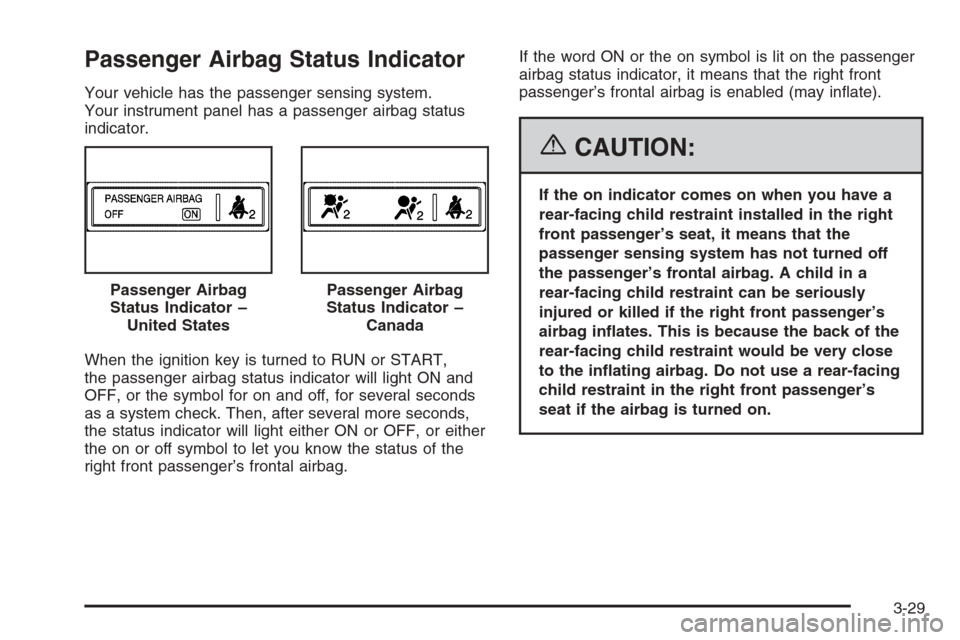
Passenger Airbag Status Indicator
Your vehicle has the passenger sensing system.
Your instrument panel has a passenger airbag status
indicator.
When the ignition key is turned to RUN or START,
the passenger airbag status indicator will light ON and
OFF, or the symbol for on and off, for several seconds
as a system check. Then, after several more seconds,
the status indicator will light either ON or OFF, or either
the on or off symbol to let you know the status of the
right front passenger’s frontal airbag.If the word ON or the on symbol is lit on the passenger
airbag status indicator, it means that the right front
passenger’s frontal airbag is enabled (may inate).
{CAUTION:
If the on indicator comes on when you have a
rear-facing child restraint installed in the right
front passenger’s seat, it means that the
passenger sensing system has not turned off
the passenger’s frontal airbag. A child in a
rear-facing child restraint can be seriously
injured or killed if the right front passenger’s
airbag inates. This is because the back of the
rear-facing child restraint would be very close
to the inating airbag. Do not use a rear-facing
child restraint in the right front passenger’s
seat if the airbag is turned on. Passenger Airbag
Status Indicator –
United States
Passenger Airbag
Status Indicator –
Canada
3-29
Page 162 of 394
If your vehicle has a rear seat that will accommodate a
rear-facing child restraint, a label on your sun visor
says, “Never put a rear-facing child seat in the front.”
This is because the risk to the rear-facing child is
so great, if the airbag deploys.
{CAUTION:
Even though the passenger sensing system is
designed to turn off the passenger’s frontal
airbag if the system detects a rear-facing child
restraint, no system is failsafe, and no one can
guarantee that an airbag will not deploy under
some unusual circumstance, even though it is
turned off. We recommend that rear-facing
child restraints be secured in the rear seat,
even if the airbag is off.If your vehicle does not have a rear seat that will
accommodate a rear-facing child restraint, never put a
child in a rear-facing child restraint in the right front
passenger seat the unless passenger airbag status
indicator shows off. Never put a rear facing child
restraint in the right front passenger seat unless the
airbag is off. Here is why:{CAUTION:
Even though the passenger sensing system is
designed to turn off the passenger’s frontal
airbag if the system detects a rear-facing child
restraint, no system is fail-safe, and no one
can guarantee that an airbag will not deploy
under some unusual circumstance, even
though it is turned off. We recommend that
rear-facing child restraints be transported in
vehicles with a rear seat that will
accommodate a rear-facing child restraint,
whenever possible.
3-30
Page 248 of 394
The Certication/Tire label also tells you the maximum
weights for the front and rear axles, called the Gross
Axle Weight Rating (GAWR). To nd out the actual loads
on your front and rear axles, you need to go to a
weigh station and weigh your vehicle. Your dealer can
help you with this. Be sure to spread out your load
equally on both sides of the centerline.
Never exceed the GVWR for your vehicle or the GAWR
for either the front or rear axle.
{CAUTION:
Do not load your vehicle any heavier than the
Gross Vehicle Weight Rating (GVWR), or either
the maximum front or rear Gross Axle Weight
Rating (GAWR). If you do, parts on your
vehicle can break, and it can change the way
your vehicle handles. These could cause you
to lose control and crash. Also, overloading
can shorten the life of your vehicle.
Notice:Overloading your vehicle may cause
damage. Repairs would not be covered by your
warranty. Do not overload your vehicle.If you put things inside your vehicle — like suitcases,
tools, packages, or anything else — they will go as fast
as the vehicle goes. If you have to stop or turn
quickly, or if there is a crash, they will keep going.
{CAUTION:
Things you put inside your vehicle can strike
and injure people in a sudden stop or turn, or
in a crash.
Put things in the cargo area of your
vehicle. Try to spread the weight evenly.
Never stack heavier things, like suitcases,
inside the vehicle so that some of them
are above the tops of the seats.
Do not leave an unsecured child restraint
in your vehicle.
When you carry something inside the
vehicle, secure it whenever you can.
Do not leave a seat folded down unless
you need to.
4-36
Page 383 of 394
Child Restraints
Child Restraint Systems...............................1-39
Infants and Young Children...........................1-36
Lower Anchors and Tethers for Children..........1-45
Older Children.............................................1-34
Securing a Child Restraint in a
Rear Seat Position...................................1-52
Securing a Child Restraint in the
Right Front Seat Position..........................1-54
Where to Put the Restraint...........................1-43
Cigarette Lighter.............................................3-18
Cleaning
Aluminum or Chrome-Plated Wheels..............5-79
Exterior Lamps/Lenses.................................5-77
Fabric/Carpet..............................................5-75
Finish Care.................................................5-77
Inside of Your Vehicle..................................5-74
Instrument Panel, Vinyl, and Other Plastic
Surfaces.................................................5-76
Tires..........................................................5-79
Underbody Maintenance...............................5-80
Washing Your Vehicle...................................5-77
Weatherstrips..............................................5-76
Windshield and Wiper Blades........................5-78
Climate Control System...................................3-19
Air Filter, Passenger Compartment.................3-22
Outlet Adjustment........................................3-22Clutch, Hydraulic.............................................5-20
Collision Damage Repair..................................7-10
Comfort Guides, Rear Safety Belt.....................1-30
Compact Spare Tire........................................5-73
Content Theft-Deterrent....................................2-18
Control of a Vehicle.......................................... 4-6
Convenience Net............................................2-49
Coolant
Engine Temperature Gage............................3-35
Engine Temperature Warning Light.................3-34
Heater, Engine............................................2-26
Cooling System..............................................5-25
Cruise Control................................................3-11
Cupholder(s)..................................................2-45
Customer Assistance Information
Courtesy Transportation.................................. 7-7
Customer Assistance for Text
Telephone (TTY) Users............................... 7-4
Customer Assistance Offices........................... 7-4
Customer Satisfaction Procedure..................... 7-2
GM Mobility Reimbursement Program............... 7-5
Reporting Safety Defects to General Motors....7-14
Reporting Safety Defects to the
Canadian Government..............................7-14
Reporting Safety Defects to the
United States Government.........................7-13
Roadside Assistance Program......................... 7-6
Service Publications Ordering Information........7-14
3
Page 386 of 394
H
Hazard Warning Flashers................................... 3-6
Head Restraints............................................... 1-7
Headlamp
Aiming .......................................................5-38
Headlamp Wiring............................................5-83
Headlamps....................................................3-14
Automatic Headlamp System.........................3-15
Bulb Replacement.......................................5-41
Daytime Running Lamps...............................3-15
Flash-to-Pass............................................... 3-8
Halogen Bulbs............................................5-41
Headlamps, Front Turn Signal, and
Parking Lamps.........................................5-42
High/Low Beam Changer................................ 3-8
On Reminder..............................................3-15
Wiper Activated...........................................3-14
Heated Seats................................................... 1-4
Heater...........................................................3-19
Height Adjuster, Driver Seat............................... 1-3
Highbeam On Light.........................................3-39
Highway Hypnosis...........................................4-24
Hill and Mountain Roads..................................4-24
Hood
Checking Things Under................................5-10
Release.....................................................5-11Horn ............................................................... 3-6
How to Use This Manual...................................... ii
How to Wear Safety Belts Properly...................1-18
Hydraulic Clutch.............................................5-20
I
Ignition Positions.............................................2-22
Infants and Young Children, Restraints...............1-36
Ination - Tire Pressure...................................5-52
Instrument Panel
Overview..................................................... 3-4
Storage Area..............................................2-45
Instrument Panel (I/P)
Brightness..................................................3-16
Cluster.......................................................3-25
J
Jump Starting.................................................5-33
K
Keyless Entry System....................................... 2-4
Keys............................................................... 2-3
6
Page 387 of 394
L
Labeling, Tire Sidewall.....................................5-47
Lamps
Battery Run-Down Protection.........................3-17
Dome ........................................................3-17
Fog ...........................................................3-16
Mirror Reading............................................3-17
Rear Reading.............................................3-17
LATCH System
Child Restraints...........................................1-45
Liftgate..........................................................2-13
Light
Airbag Readiness........................................3-28
Anti-Lock Brake System Warning...................3-33
Brake System Warning.................................3-32
Charging System.........................................3-31
Engine Coolant Temperature Warning.............3-34
Enhanced Traction System (ETS)
Warning Light..........................................3-34
Fog Lamp ..................................................3-39
Highbeam On.............................................3-39
Malfunction Indicator....................................3-35Light (cont.)
Oil Pressure...............................................3-38
Passenger Airbag Status Indicator..................3-29
Passenger Safety Belt Reminder....................3-27
Safety Belt Reminder...................................3-27
Security.....................................................3-39
Up-Shift.....................................................3-32
Lighting
Entry/Exit...................................................3-17
Loading Your Vehicle.......................................4-32
Lockout Protection..........................................2-12
Locks
Automatic Door Lock....................................2-11
Delayed Locking..........................................2-11
Door ..........................................................2-10
Lockout Protection.......................................2-12
Power Door ................................................2-10
Programmable Automatic Door Unlock............2-11
Rear Door Security Locks.............................2-12
Loss of Control...............................................4-16
Lumbar
Power Controls............................................. 1-4
7
Page 389 of 394
O
Odometer......................................................3-26
Off-Road Recovery..........................................4-14
Oil
Engine.......................................................5-13
Pressure Light.............................................3-38
Oil, Engine Oil Life System..............................5-16
Older Children, Restraints................................1-34
Online Owner Center........................................ 7-3
OnStar
®System, see OnStar®Manual...............2-43
Other Warning Devices...................................... 3-6
Outlet Adjustment............................................3-22
Outlet(s), Accessory Power...............................3-18
Outside
Convex Mirror.............................................2-42
Power Mirrors.............................................2-42
Owner Checks and Services.............................. 6-8
Owners, Canadian............................................... ii
P
Paint, Damage...............................................5-80
Park (P)
Shifting Into................................................2-33
Shifting Out of............................................2-35
Parking
Brake........................................................2-32
Over Things That Burn.................................2-36
Parking Your Vehicle.......................................2-35
Passenger Airbag Status Indicator.....................3-29
Passenger Compartment Air Filter.....................3-22
Passenger Sensing System..............................1-67
Passing.........................................................4-14
PASS-Key
®III+..............................................2-19
PASS-Key®III+ Operation................................2-20
Power ............................................................. 1-3
Accessory Outlet(s)......................................3-18
Door Locks.................................................2-10
Electrical System.........................................5-83
Lumbar Controls........................................... 1-4
Retained Accessory (RAP)............................2-24
Windows....................................................2-17
Pressure Cap.................................................5-23
Pretensioners, Safety Belt................................1-33
Programmable Automatic Door Unlock...............2-11
9