display CHEVROLET IMPALA 2001 8.G Repair Manual
[x] Cancel search | Manufacturer: CHEVROLET, Model Year: 2001, Model line: IMPALA, Model: CHEVROLET IMPALA 2001 8.GPages: 392, PDF Size: 2.76 MB
Page 215 of 392

3-45
If your vehicle is equipped with the AM FM Stereo with
Cassette Tape and Compact Disc Player with Radio Data
System and Programmable Equalization:
1. Turn the ignition to ON or ACC.
2. Turn the radio off.
3. Press and hold the TAPE CD button for five seconds.
READY will appear on the display and a cassette
icon will flash for five seconds.
4. Insert the scrubbing action cleaning cassette.
5. Eject the cleaning cassette after the manufacturer's
recommended cleaning time.
When the cleaning cassette has been ejected, the cut tape
detection feature is active again.
You may also choose a non
-scrubbing action, wet-type
cleaner which uses a cassette with a fabric belt to clean
the tape head. This type of cleaning cassette will not
eject on its own. A non
-scrubbing action cleaner may
not clean as thoroughly as the scrubbing type cleaner.
The use of a non
-scrubbing action, dry-type cleaning
cassette is not recommended.After you clean the player, press and hold the cassette
eject symbol or EJT button for five seconds to reset the
CLEAN indicator. The radio will display CLEANED
or
--- to show the indicator was reset.
Cassettes are subject to wear and the sound quality
may degrade over time. Always make sure the cassette
tape is in good condition before you have your tape
player serviced.
Care of Your Compact Discs
Handle discs carefully. Store them in their original cases
or other protective cases and away from direct sunlight
and dust. If the surface of a disc is soiled, dampen a
clean, soft cloth in a mild, neutral detergent solution
and clean it, wiping from the center to the edge.
Be sure never to touch the side without writing when
handling discs. Pick up discs by grasping the outer edges
or the edge of the hole and the outer edge.
Care of Your Compact Disc Player
The use of CD lens cleaner discs is not advised, due to
the risk of contaminating the lens of the CD optics with
lubricants internal to the CD mechanism.
Page 216 of 392
3-46 Backglass Antenna
Your AM FM antenna is integrated with your rear
window defogger, located in the rear window. Be sure
that the inside surface of the rear window is not
scratched and that the lines on the glass are not
damaged. If the inside surface is damaged, it could
interfere with radio reception.
NOTICE:
Do not try to clear frost or other material from
the inside of the rear window with a razor blade
or anything else that is sharp. This may damage
the rear defogger grid and affect your radio's
ability to pick up stations clearly. The repairs
wouldn't be covered by your warranty.
Because this antenna is built into your rear window,
there is a reduced risk of damage caused by car washes
and vandals.If you choose to add a cellular telephone to your vehicle,
and the antenna needs to be attached to the glass, be sure
that you do not damage the grid lines for the AM FM
antenna. There is enough space between the lines to
attach a cellular telephone antenna without interfering
with radio reception.
Vehicle Customization Settings
Your audio system can be used to control vehicle
customization settings using the DISP button when
the radio is off. See ªVehicle Customization Settingsº
in the Index.
Chime Level Adjustment
The radio is the vehicle chime producer. To change the
volume level, press and hold pushbutton six with the
ignition on and the radio power off. The chime volume
level will change from the normal level to loud, and
LOUD will be displayed on the radio. To change back
to the default or normal setting, press and hold the
pushbutton six again. The chime level will change
from the loud level to normal, and NORMAL will be
displayed. Each time the chime volume is changed,
three chimes will sound as an example of the new
volume selected. Removing the radio and not replacing
it with a factory radio or chime module will disable
vehicle chimes.
Page 305 of 392

6-18
How to Reset the Change Engine Oil Message
After changing the engine oil, the system must be reset.
To reset the CHANGE ENGINE OIL message use one
of the following procedures:
Using the RDS Radio (If Equipped)
1. Turn the ignition to ACC or ON, with the radio off.
2. Press and hold the DISP button on the radio for at
least five seconds until SETTINGS is displayed.
3. Press the SEEK up or down arrow to scroll through
the main menu.
4. Scroll until OIL LIFE appears on the display.
5. Press the PREV or NEXT button to enter the
submenu. RESET will be displayed.
6. Press the DISP button to reset. A chime will be heard
to verify the new setting and DONE will be
displayed for one second.
7. Once the message has been reset, scroll until EXIT
appears on the display.
8. Press the DISP button to exit programming.
A chime will be heard to verify the exit.Using the Accelerator Pedal
1. Turn the ignition to ON, with the engine off.
2. Fully press and release the accelerator pedal three
times within five seconds. If the CHANGE ENGINE
OIL message flashes, the system is reset. However,
if it stays on, it did not reset. You'll need to repeat
the reset procedure.
What to Do with Used Oil
Did you know that used engine oil contains certain
elements that may be unhealthy for your skin and could
even cause cancer? Don't let used oil stay on your skin
for very long. Clean your skin and nails with soap and
water, or a good hand cleaner. Wash or properly throw
away clothing or rags containing used engine oil.
See the manufacturer's warnings about the use and
disposal of oil products.
Used oil can be a real threat to the environment. If you
change your own oil, be sure to drain all free
-flowing
oil from the filter before disposal. Don't ever dispose of
oil by putting it in the trash, pouring it on the ground,
into sewers, or into streams or bodies of water. Instead,
recycle it by taking it to a place that collects used oil.
If you have a problem properly disposing of your used
oil, ask your dealer, a service station or a local recycling
center for help.
Page 316 of 392
6-29 How to Check Power Steering Fluid
Turn the key off, let the engine compartment cool down,
wipe the cap and the top of the reservoir clean, then
unscrew the cap and wipe the dipstick with a clean rag.
Replace the cap and completely tighten it. Then remove
the cap again and look at the fluid level on the dipstick.
When the 3400 V6 engine compartment is hot, the level
should be at the ªHº mark. When it's cold, the level
should be at the ªCº mark. If the fluid is at the ADD
mark, you should add fluid.
For the 3800 V6 engine, the level should be at the
HOT mark when the engine compartment is hot.
If the fluid is at the ADD mark, you should add fluid.
What to Use
To determine what kind of fluid to use, see
ªRecommended Fluids and Lubricantsº in the Index.
Always use the proper fluid. Failure to use the proper
fluid can cause leaks and damage hoses and seals.
Windshield Washer Fluid
What to Use
When you need windshield washer fluid, be sure to read
the manufacturer's instructions before use. If you will be
operating your vehicle in an area where the temperature
may fall below freezing, use a fluid that has sufficient
protection against freezing.
Adding Washer Fluid
United States Canada
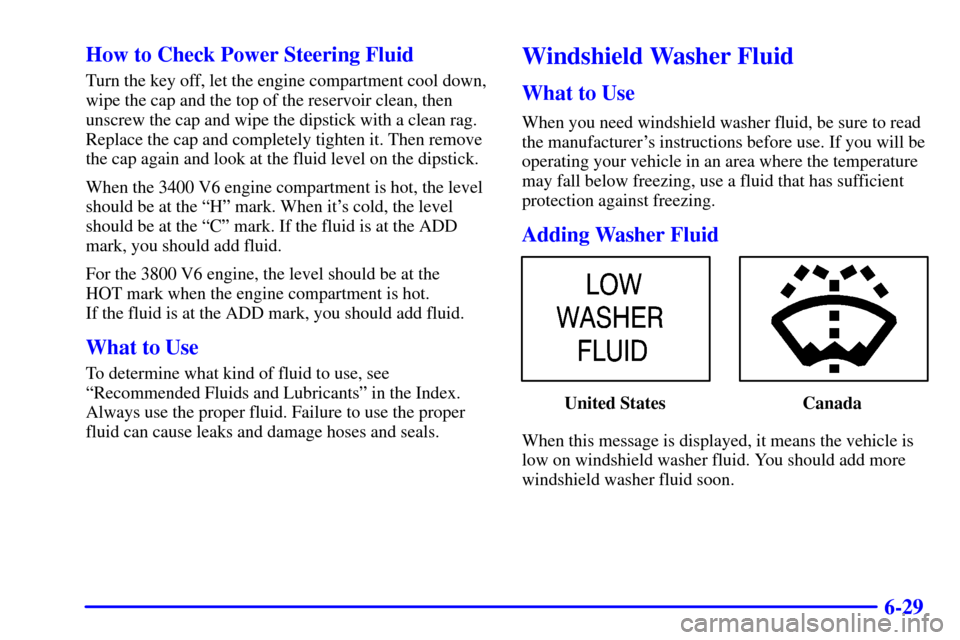
When this message is displayed, it means the vehicle is
low on windshield washer fluid. You should add more
windshield washer fluid soon.
Page 330 of 392

6-43 Tire Inflation Monitor System
(If Equipped)
The tire inflation monitor system can alert you to a large
change in the pressure of one tire. The system ªlearnsº
the pressure at each tire throughout the operating speed
range of your vehicle. The system normally takes
between 45 and 90 minutes of driving to learn the
tire pressures. This time may be longer depending on
your individual driving habits. Learning need not be
accumulated during a single trip. Once learned, the
system will remember the tire pressures until the
system is recalibrated.
After the system has learned tire pressures with properly
inflated tires, the LOW TIRE PRESSURE message
will come on if the pressure in one tire becomes
12 psi (83 kPa) lower than the other three tires.
The tire inflation monitor system won't alert you if the
pressure in more than one tire is low, if the system is
not properly calibrated, or if the vehicle is moving faster
than 70 mph (110 km/h).
The tire inflation monitor system detects differences
in tire rotation speeds that are caused by changes in
tire pressure. The system can alert you about a low
tire
-- but it doesn't replace normal tire maintenance.
See ªTiresº in the Index.When the LOW TIRE PRESSURE message comes on,
you should stop as soon as you can and check all your
tires for damage. (If a tire is flat, see ªIf a Tire Goes
Flatº in the Index.) Also check the tire pressure in all
four tires as soon as you can. See ªInflation
- Tire
Pressureº in the Index.
The LOW TIRE PRESSURE message will also be
displayed (while the ignition is on) until you reset
(calibrate) the system.
Don't reset the tire inflation monitor system without first
correcting the cause of the problem and checking and
adjusting the pressure in all four tires. If you reset the
system when the tire pressures are incorrect, the system
will not work properly and may not alert you when a
tire is low.
Any time you adjust a tire's pressure, rotate your tires,
or have one or more tires repaired or replaced, you'll
need to reset (calibrate) the tire inflation monitor
system. You'll also need to reset the system whenever
you buy new tires and whenever the vehicle's battery
has been disconnected.
Page 331 of 392

6-44
To reset (calibrate) the system: The tire inflation
monitor system can be reset by turning the exterior lamp
control from OFF to parking lamps three times while the
ignition is in ON. It can also be reset through the RDS
radio (if equipped) using the following steps:
1. Turn the ignition to ACC or ON and turn the
radio off.
2. Press and hold the DISP button on the radio for at
least five seconds until SETTINGS is displayed.
3. Press the SEEK up or down arrow to scroll through
the main menu.
4. Scroll until TIRE MON appears on the display.
5. Press the PREV or NEXT button to enter the
submenu. RESET will be displayed.
6. Press the DISP button to reset. A chime will be heard
to verify the new setting and DONE will be
displayed for one second.
7. Once the monitor has been reset, scroll until EXIT
appears on the display.
8. Press the DISP button to exit programming.
A chime will be heard to verify exit.
The system completes the calibration process
during driving.The system normally takes 15 to 20 minutes of driving
in each of three speed ranges to ªlearnº tire pressures.
The speed ranges are 15 to 40 mph (25 to 65 km/h),
40 to 65 mph (65 to 105 km/h) and above 65 mph
(105 km/h). When learning is complete, the system will
alert you after 2
-8 minutes if a tire is 12 psi (83 kPa)
different from the other three tires. Detection thresholds
may be higher and detection times may be longer on
rough roads, curves and at high speeds. The system
is not capable of detection at speeds greater than
70 mph (110 km/h).
Tire Inspection and Rotation
Tires should be rotated every 6,000 to 8,000 miles
(10 000 to 13 000 km). Any time you notice unusual
wear, rotate your tires as soon as possible and check
wheel alignment. Also check for damaged tires or
wheels. See ªWhen It's Time for New Tiresº and
ªWheel Replacementº later in this section for
more information.
The purpose of regular rotation is to achieve more
uniform wear for all tires on the vehicle. The first
rotation is the most important. See ªScheduled
Maintenance Servicesº in the Index for scheduled
rotation intervals.