seats CHEVROLET IMPALA 2003 8.G User Guide
[x] Cancel search | Manufacturer: CHEVROLET, Model Year: 2003, Model line: IMPALA, Model: CHEVROLET IMPALA 2003 8.GPages: 408, PDF Size: 2.75 MB
Page 37 of 408
Child Restraints
Older Children
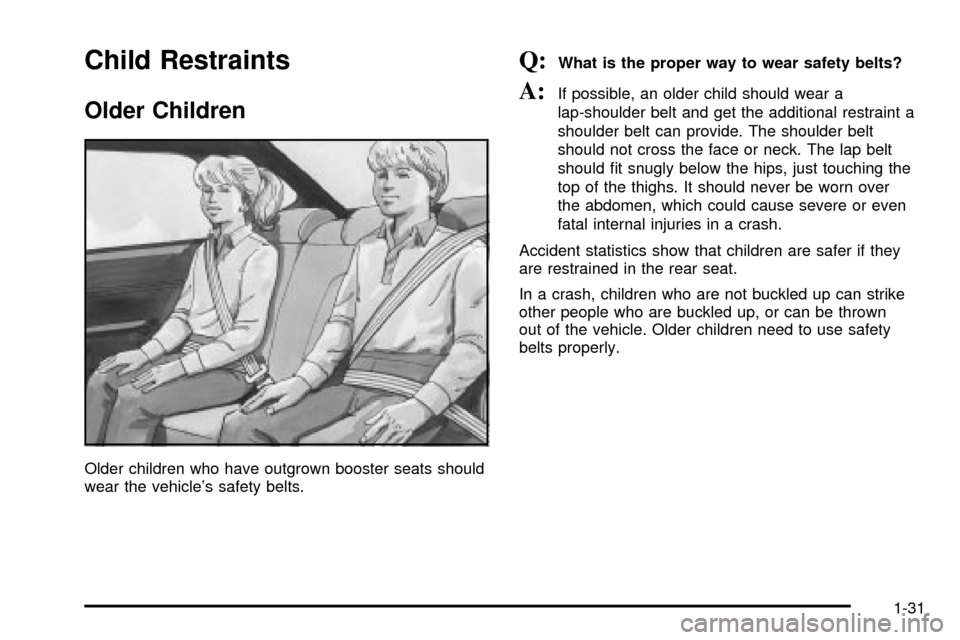
Older children who have outgrown booster seats should
wear the vehicle's safety belts.
Q:What is the proper way to wear safety belts?
A:If possible, an older child should wear a
lap-shoulder belt and get the additional restraint a
shoulder belt can provide. The shoulder belt
should not cross the face or neck. The lap belt
should ®t snugly below the hips, just touching the
top of the thighs. It should never be worn over
the abdomen, which could cause severe or even
fatal internal injuries in a crash.
Accident statistics show that children are safer if they
are restrained in the rear seat.
In a crash, children who are not buckled up can strike
other people who are buckled up, or can be thrown
out of the vehicle. Older children need to use safety
belts properly.
1-31
Page 45 of 408
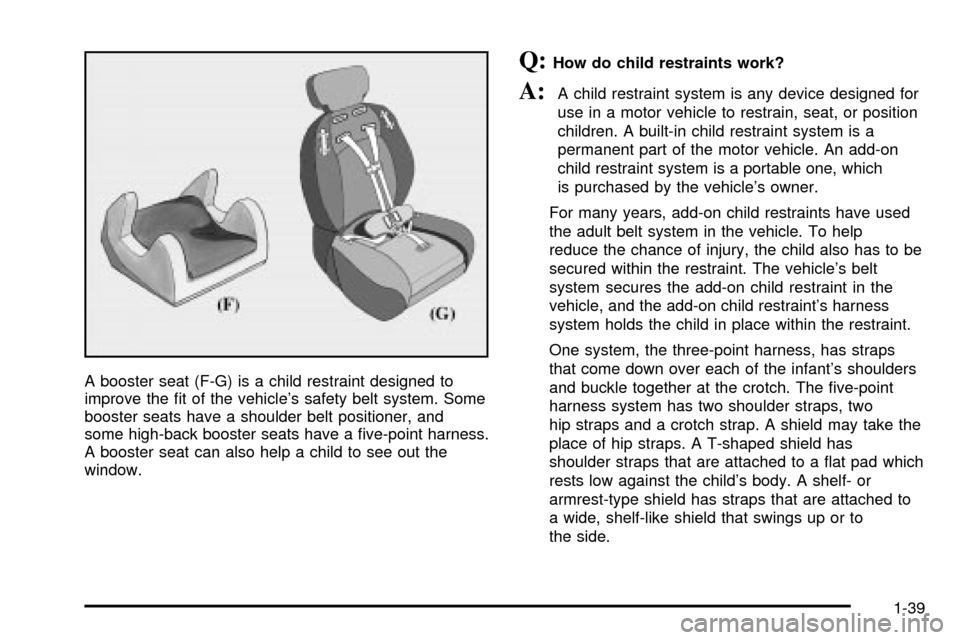
A booster seat (F-G) is a child restraint designed to
improve the ®t of the vehicle's safety belt system. Some
booster seats have a shoulder belt positioner, and
some high-back booster seats have a ®ve-point harness.
A booster seat can also help a child to see out the
window.
Q:How do child restraints work?
A:A child restraint system is any device designed for
use in a motor vehicle to restrain, seat, or position
children. A built-in child restraint system is a
permanent part of the motor vehicle. An add-on
child restraint system is a portable one, which
is purchased by the vehicle's owner.
For many years, add-on child restraints have used
the adult belt system in the vehicle. To help
reduce the chance of injury, the child also has to be
secured within the restraint. The vehicle's belt
system secures the add-on child restraint in the
vehicle, and the add-on child restraint's harness
system holds the child in place within the restraint.
One system, the three-point harness, has straps
that come down over each of the infant's shoulders
and buckle together at the crotch. The ®ve-point
harness system has two shoulder straps, two
hip straps and a crotch strap. A shield may take the
place of hip straps. A T-shaped shield has
shoulder straps that are attached to a ¯at pad which
rests low against the child's body. A shelf- or
armrest-type shield has straps that are attached to
a wide, shelf-like shield that swings up or to
the side.
1-39
Page 54 of 408
To remove the child restraint, just unbuckle the vehicle's
safety belt and let it go back all the way. The safety
belt will move freely again and be ready to work for an
adult or larger child passenger.
Securing a Child Restraint in the
Right Front Seat Position
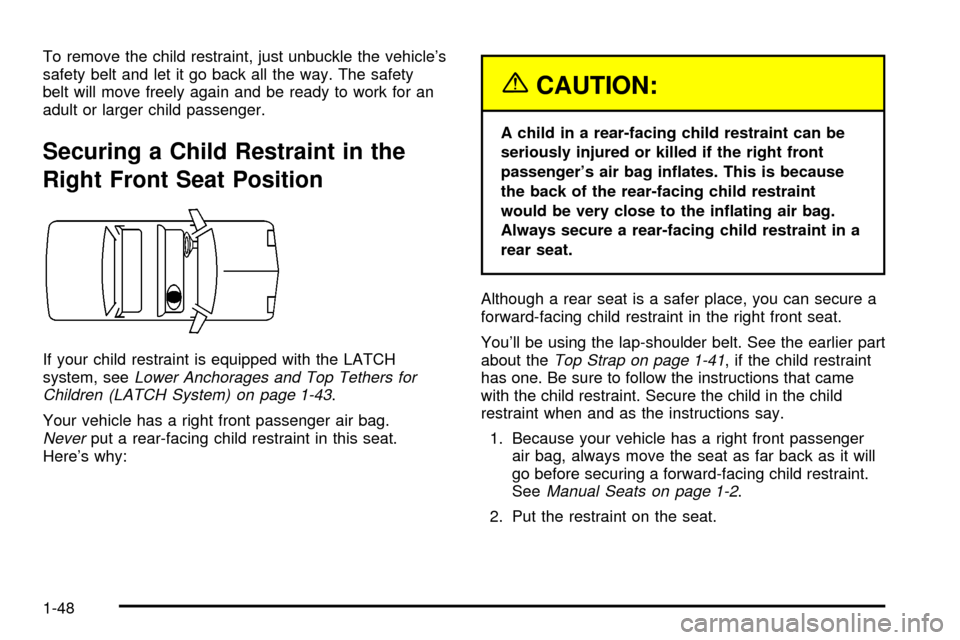
If your child restraint is equipped with the LATCH
system, seeLower Anchorages and Top Tethers for
Children (LATCH System) on page 1-43.
Your vehicle has a right front passenger air bag.
Neverput a rear-facing child restraint in this seat.
Here's why:
{CAUTION:
A child in a rear-facing child restraint can be
seriously injured or killed if the right front
passenger's air bag in¯ates. This is because
the back of the rear-facing child restraint
would be very close to the in¯ating air bag.
Always secure a rear-facing child restraint in a
rear seat.
Although a rear seat is a safer place, you can secure a
forward-facing child restraint in the right front seat.
You'll be using the lap-shoulder belt. See the earlier part
about the
Top Strap on page 1-41, if the child restraint
has one. Be sure to follow the instructions that came
with the child restraint. Secure the child in the child
restraint when and as the instructions say.
1. Because your vehicle has a right front passenger
air bag, always move the seat as far back as it will
go before securing a forward-facing child restraint.
See
Manual Seats on page 1-2.
2. Put the restraint on the seat.
1-48
Page 91 of 408
4. Before starting the engine, be sure to unplug and
store the cord as it was before to keep it away
from moving engine parts. If you don't, it could be
damaged.
How long should you keep the coolant heater plugged
in? The answer depends on the outside temperature, the
kind of oil you have, and some other things. Instead
of trying to list everything here, we ask that you contact
your dealer in the area where you'll be parking your
vehicle. The dealer can give you the best advice for that
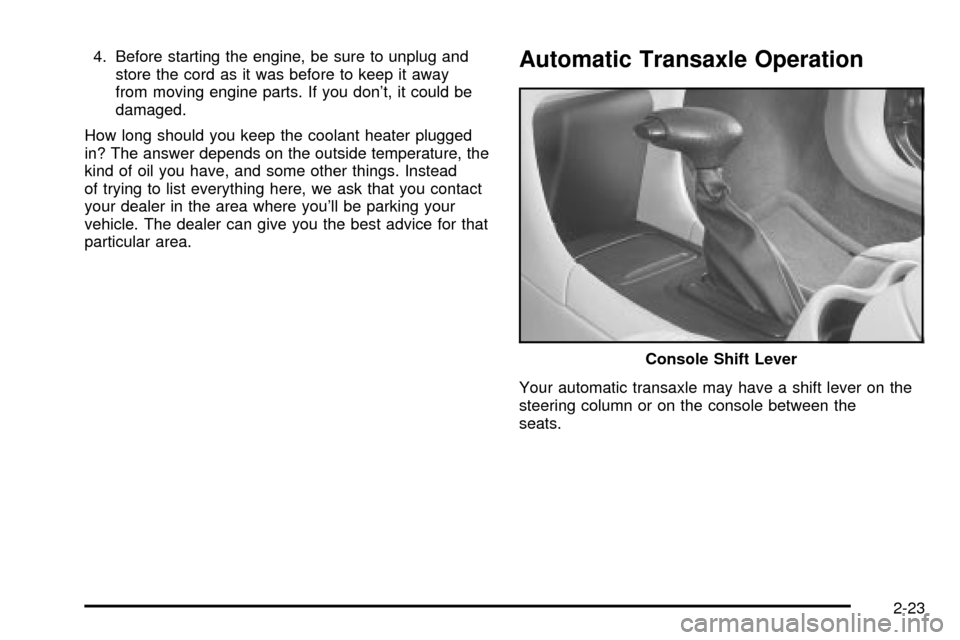
particular area.Automatic Transaxle Operation
Your automatic transaxle may have a shift lever on the
steering column or on the console between the
seats.Console Shift Lever
2-23
Page 148 of 408

Operation Tips
·Clear away any ice, snow or leaves from the air
inlets at the base of the windshield that may
block the ¯ow of air into your vehicle.
·Use of non-GM approved hood de¯ectors may
adversely affect the performance of the system.
·Keep the path under the front seats clear of objects
to help circulate the air inside your vehicle more
effectively.
·If the air¯ow seems low when the fan is at the
highest setting, the passenger compartment
air ®lter, if equipped, may need to replaced. For
more information, see
Passenger Compartment Air
Filter on page 3-26andPart A: Scheduled
Maintenance Services on page 6-4.
Passenger Compartment Air Filter
Your vehicle may be equipped with a passenger
compartment particulate air ®lter. It is located
underneath the hood just below the windshield wiper
arm on the passenger's side of the vehicle, underneath
the air inlet grille.
The ®lter traps most of the pollen from air entering the
Climate Control System. Like your engine's air
cleaner/®lter, it may need to be changed periodically to
insure system performance. For information on how
often to change the passenger compartment air
®lter, see
Scheduled Maintenance on page 6-5.
3-26
Page 250 of 408
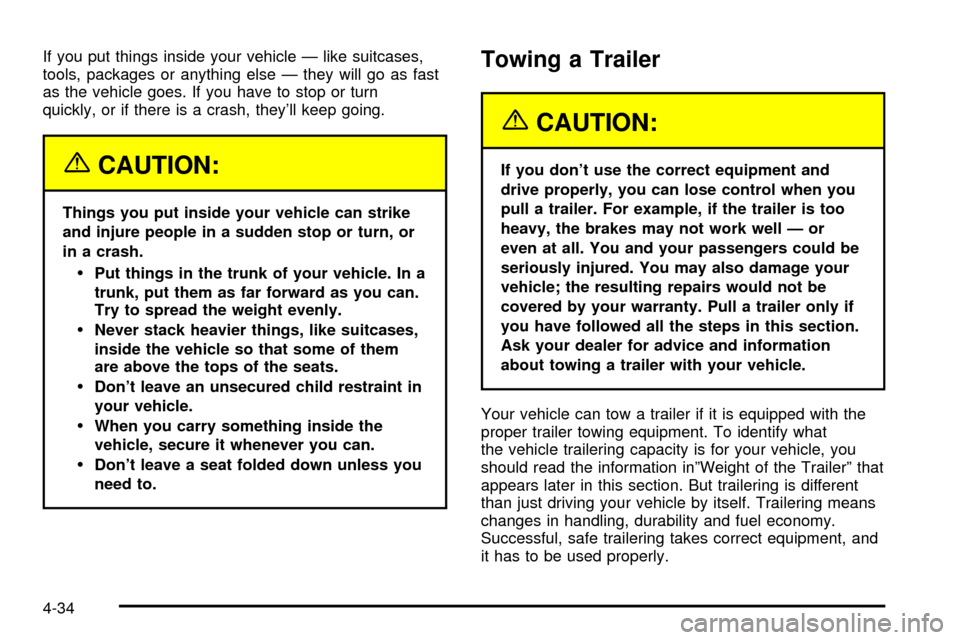
If you put things inside your vehicle Ð like suitcases,
tools, packages or anything else Ð they will go as fast
as the vehicle goes. If you have to stop or turn
quickly, or if there is a crash, they'll keep going.
{CAUTION:
Things you put inside your vehicle can strike
and injure people in a sudden stop or turn, or
in a crash.
·Put things in the trunk of your vehicle. In a
trunk, put them as far forward as you can.
Try to spread the weight evenly.
·Never stack heavier things, like suitcases,
inside the vehicle so that some of them
are above the tops of the seats.
·Don't leave an unsecured child restraint in
your vehicle.
·When you carry something inside the
vehicle, secure it whenever you can.
·Don't leave a seat folded down unless you
need to.
Towing a Trailer
{CAUTION:
If you don't use the correct equipment and
drive properly, you can lose control when you
pull a trailer. For example, if the trailer is too
heavy, the brakes may not work well Ð or
even at all. You and your passengers could be
seriously injured. You may also damage your
vehicle; the resulting repairs would not be
covered by your warranty. Pull a trailer only if
you have followed all the steps in this section.
Ask your dealer for advice and information
about towing a trailer with your vehicle.
Your vehicle can tow a trailer if it is equipped with the
proper trailer towing equipment. To identify what
the vehicle trailering capacity is for your vehicle, you
should read the information inºWeight of the Trailerº that
appears later in this section. But trailering is different
than just driving your vehicle by itself. Trailering means
changes in handling, durability and fuel economy.
Successful, safe trailering takes correct equipment, and
it has to be used properly.
4-34
Page 355 of 408
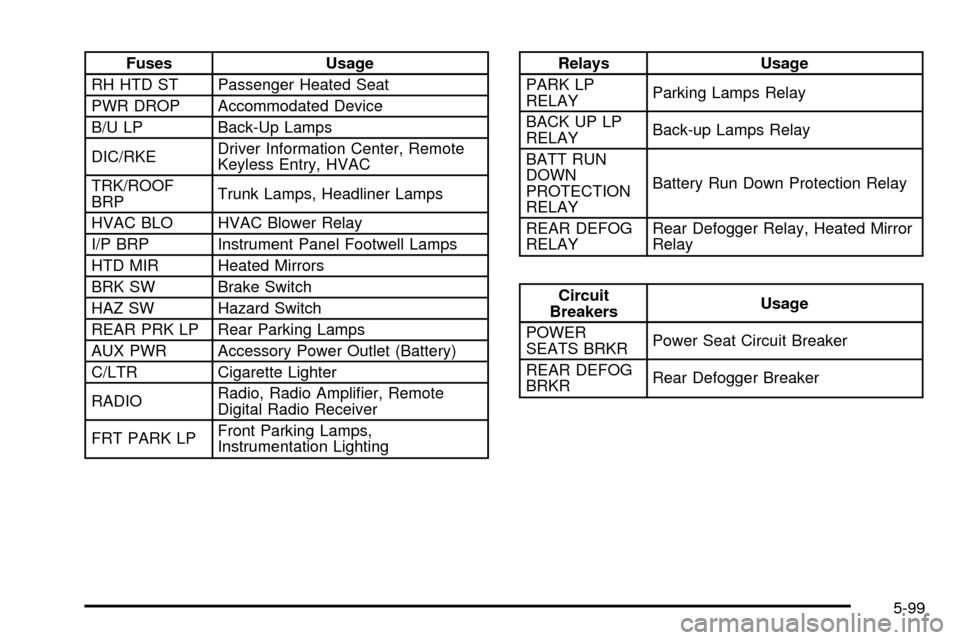
Fuses Usage
RH HTD ST Passenger Heated Seat
PWR DROP Accommodated Device
B/U LP Back-Up Lamps
DIC/RKEDriver Information Center, Remote
Keyless Entry, HVAC
TRK/ROOF
BRPTrunk Lamps, Headliner Lamps
HVAC BLO HVAC Blower Relay
I/P BRP Instrument Panel Footwell Lamps
HTD MIR Heated Mirrors
BRK SW Brake Switch
HAZ SW Hazard Switch
REAR PRK LP Rear Parking Lamps
AUX PWR Accessory Power Outlet (Battery)
C/LTR Cigarette Lighter
RADIORadio, Radio Ampli®er, Remote
Digital Radio Receiver
FRT PARK LPFront Parking Lamps,
Instrumentation LightingRelays Usage
PARK LP
RELAYParking Lamps Relay
BACK UP LP
RELAYBack-up Lamps Relay
BATT RUN
DOWN
PROTECTION
RELAYBattery Run Down Protection Relay
REAR DEFOG
RELAYRear Defogger Relay, Heated Mirror
Relay
Circuit
BreakersUsage
POWER
SEATS BRKRPower Seat Circuit Breaker
REAR DEFOG
BRKRRear Defogger Breaker
5-99
Page 399 of 408

H
Hazard Warning Flashers................................... 3-6
Head Restraints............................................... 1-6
Headlamp High/Low-Beam Changer.................... 3-8
Headlamp Wiring............................................5-94
Headlamp......................................................5-55
Aiming.......................................................5-55
Headlamps....................................................5-56
Bulb Replacement.......................................5-56
Halogen Bulbs............................................5-56
Headlamps, Front Turn Signal,
and Parking Lamps..................................5-56
Heated Outside Mirrors....................................2-36
Heated Seats................................................... 1-4
Highbeam Out Warning Message......................3-48
Highway Hypnosis...........................................4-23
Hill and Mountain Roads..................................4-23
Hitches..........................................................4-37
HomeLink Transmitter, Programming..................2-39
HomeLink
žTransmitter....................................2-39
Hood............................................................5-10
Checking Things Under................................5-10
Release.....................................................5-10
Horn............................................................... 3-7
Hot Coolant Temperature Warning Message........3-42
How to Add Coolant to the Coolant
Recovery Tank............................................5-35
How to Add Coolant to the Radiator..................5-38
How to Add Fluid............................................5-26How to Check Power Steering Fluid..................5-43
How to Check........................................5-24, 5-62
How to Inspect the Engine Air
Cleaner/Filter..............................................5-22
How to Use This Manual...................................... ii
How to Wear Safety Belts Properly...................1-14
Hydroplaning..................................................4-19
I
If No Steam Is Coming From Your Engine..........5-32
If Steam Is Coming From Your Engine...............5-31
If the Light Is Flashing.....................................3-38
If the Light Is on Steady..................................3-38
If You Are Stuck in Sand, Mud, Ice or Snow.......4-30
If You Do Decide To Pull A Trailer.....................4-35
If You're Caught in a Blizzard...........................4-28
Ignition Positions.............................................2-18
Ignition Transaxle Lock Check..........................6-13
Illumination on Remote Activation........................ 2-6
Infants and Young Children, Restraints...............1-33
In¯ation -- Tire Pressure..................................5-62
Inspection......................................................6-15
Brake System.............................................6-15
Engine Cooling System................................6-15
Exhaust System..........................................6-14
Fuel System...............................................6-15
Part C - Periodic Maintenance.......................6-14
Steering, Suspension and Front
Drive Axle Boot and Seal..........................6-14
7
Page 401 of 408

M
Maintenance, Normal Replacement Parts..........5-105
Maintenance Schedule.....................................6-10
At Each Fuel Fill.........................................6-10
At Least Once a Month................................6-10
At Least Once a Year..................................6-11
At Least Twice a Year..................................6-11
Brake System Inspection..............................6-15
Engine Cooling System Inspection.................6-15
Exhaust System Inspection...........................6-14
Fuel System Inspection................................6-15
How This Section is Organized....................... 6-3
Introduction.................................................. 6-2
Maintenance Requirements............................. 6-2
Part A - Scheduled Maintenance Services......... 6-4
Part B - Owner Checks and Services.............6-10
Part C - Periodic MaintenanceInspections......6-14
Part D - Recommended Fluids and Lubricants . 6-16
Part E - Maintenance Record........................6-17
Scheduled Maintenance................................. 6-5
Steering, Suspension and Front Drive Axle
Boot and Seal Inspection..........................6-14
Throttle System Inspection............................6-15
Using Your................................................... 6-4
Your Vehicle and the Environment................... 6-2
Maintenance When Trailer Towing.....................4-40Making Turns.................................................4-38
Malfunction Indicator Light................................3-37
Manual Lumbar Controls.................................... 1-3
Manual Operation...........................................3-22
Manual Seats................................................... 1-2
Matching Transmitter(s) to Your Vehicle............... 2-6
Message.......................................................3-42
Battery Warning..........................................3-42
Center.......................................................3-40
Change Engine Oil......................................3-44
Door Ajar Warning.......................................3-45
Highbeam Out Warning................................3-48
Hot Coolant Temperature Warning..................3-42
Low Brake Fluid Warning..............................3-47
Low Engine Oil Level...................................3-43
Low Fuel Warning.......................................3-47
Low Oil Pressure.........................................3-43
Low Tire .....................................................3-44
Low Washer Fluid Warning...........................3-46
Security.....................................................3-46
Service Traction System Warning...................3-41
Service Vehicle Soon...................................3-48
Traction Active............................................3-41
Trunk Ajar Warning......................................3-45
Mexico, Central America and Caribbean Islands/
Countries (Except Puerto Rico and U.S. Virgin
Islands) ± Customer Assistance....................... 7-5
9
Page 403 of 408

Passenger Compartment Air Filter.....................3-26
Passenger's Side Instrument Panel Fuse Block . . . 5-98
Passing.................................................4-13, 4-38
Passlock
ž......................................................2-17 .
ii
Plan Ahead When Possible................................ 7-8
Playing a Cassette Tape..........................3-62, 3-85
Playing a Compact Disc..........................3-73, 3-87
Playing the Radio...........................3-55, 3-65, 3-77
Power Steering...............................................4-10
Power...........................................................3-19
Accessory Outlets........................................3-19
Auxiliary Connection.....................................3-20
Door Locks.................................................. 2-9
Drop..........................................................3-20
Electrical System.........................................5-95
Six-Way Seats.............................................. 1-3
Steering Fluid.............................................5-43
Windows....................................................2-14
Programmable Automatic Door Locks.................. 2-9
Programmable Modes...............................2-9, 2-45
Programming the HomeLink Transmitter.............2-39
Q
Questions and Answers About Safety Belts.........1-13
R
Radiator Pressure Cap....................................5-30
Radio Data System (RDS)...............3-54, 3-64, 3-75
Radio Messages.............................3-59, 3-70, 3-82
Radios..........................................................3-53
Care of Your Cassette Tape Player................3-91
Care of Your CD Player...............................3-92
Care of Your CDs........................................3-92
Radio with Cassette and CD.........................3-75
Radio with Cassette.....................................3-54
Radio with CD............................................3-64
Setting the Time..........................................3-53
Theft-Deterrent............................................3-89
Understanding Reception..............................3-91
RDS Messages..............................3-58, 3-69, 3-81
Reading Lamps..............................................3-18
Rear Safety Belt Comfort Guides......................1-28
Rear Seat Passenger Positions.........................1-25
Rear Seat Passengers, Safety Belts..................1-25
Rear Storage Area..........................................2-43
Rear Window Defogger....................................3-25
Rearview Mirror, Automatic Dimming with
OnStar
ž.....................................................2-35
Rearview Mirror, Automatic Dimming..................2-34
Rearview Mirror with OnStar
ž...........................2-33
Rearview Mirrors.............................................2-33
11