trunk CHEVROLET IMPALA 2003 8.G Owner's Manual
[x] Cancel search | Manufacturer: CHEVROLET, Model Year: 2003, Model line: IMPALA, Model: CHEVROLET IMPALA 2003 8.GPages: 408, PDF Size: 2.75 MB
Page 250 of 408
If you put things inside your vehicle Ð like suitcases,
tools, packages or anything else Ð they will go as fast
as the vehicle goes. If you have to stop or turn
quickly, or if there is a crash, they'll keep going.
{CAUTION:
Things you put inside your vehicle can strike
and injure people in a sudden stop or turn, or
in a crash.
·Put things in the trunk of your vehicle. In a
trunk, put them as far forward as you can.
Try to spread the weight evenly.
·Never stack heavier things, like suitcases,
inside the vehicle so that some of them
are above the tops of the seats.
·Don't leave an unsecured child restraint in
your vehicle.
·When you carry something inside the
vehicle, secure it whenever you can.
·Don't leave a seat folded down unless you
need to.
Towing a Trailer
{CAUTION:
If you don't use the correct equipment and
drive properly, you can lose control when you
pull a trailer. For example, if the trailer is too
heavy, the brakes may not work well Ð or
even at all. You and your passengers could be
seriously injured. You may also damage your
vehicle; the resulting repairs would not be
covered by your warranty. Pull a trailer only if
you have followed all the steps in this section.
Ask your dealer for advice and information
about towing a trailer with your vehicle.
Your vehicle can tow a trailer if it is equipped with the
proper trailer towing equipment. To identify what
the vehicle trailering capacity is for your vehicle, you
should read the information inºWeight of the Trailerº that
appears later in this section. But trailering is different
than just driving your vehicle by itself. Trailering means
changes in handling, durability and fuel economy.
Successful, safe trailering takes correct equipment, and
it has to be used properly.
4-34
Page 253 of 408

Total Weight on Your Vehicle's Tires
Be sure your vehicle's tires are in¯ated to the upper
limit for cold tires. You'll ®nd these numbers on
the Tire-Loading Information label, located on the
inside of the trunk lid, or see
Loading Your Vehicle on
page 4-32. Then be sure you don't go over the
GVW limit for your vehicle, including the weight of
the trailer tongue.
Hitches
It's important to have the correct hitch equipment.
Crosswinds, large trucks going by and rough roads are
a few reasons why you'll need the right hitch. Here
are some rules to follow:
·The rear bumper on your vehicle is not intended for
hitches. Do not attach rental hitches or other
bumper-type hitches to it. Use only a frame-mounted
hitch that does not attach to the bumper.
·Will you have to make any holes in the body of your
vehicle when you install a trailer hitch? If you do, then
be sure to seal the holes later when you remove the
hitch. If you don't seal them, deadly carbon monoxide
(CO) from your exhaust can get into your vehicle.
See
Engine Exhaust on page 2-31in the Index. Dirt
and water can, too.
Safety Chains
You should always attach chains between your vehicle
and your trailer. Cross the safety chains under the
tongue of the trailer so that the tongue will not drop to
the road if it becomes separated from the hitch.
Instructions about safety chains may be provided by the
hitch manufacturer or by the trailer manufacturer.
Follow the manufacturer's recommendation for attaching
safety chains and do not attach them to the bumper.
Always leave just enough slack so you can turn
with your rig. And, never allow safety chains to drag on
the ground.
Trailer Brakes
Does your trailer have its own brakes? Be sure to read
and follow the instructions for the trailer brakes so
you'll be able to install, adjust and maintain them
properly.
·If your vehicle has anti-lock brakes, do not try to tap
into your vehicle's brake system. If you do, both
brake systems won't work well, or at all.
·Even if your vehicle doesn't have anti-lock brakes,
don't tap into your vehicle's brake system if the
trailer's brake system will use more than 0.02 cubic
inch (0.3 cc) of ¯uid from your vehicle's master
cylinder. If it does, both braking systems won't work
well. You could even lose your brakes.
4-37
Page 265 of 408
Notice:If you need a new fuel cap, be sure to get
the right type. Your dealer can get one for you.
If you get the wrong type, it may not ®t properly.
This may cause your malfunction indicator lamp to
light and may damage your fuel tank and emissions
system. See ªMalfunction Indicator Lampº in the
Index.Filling a Portable Fuel Container
{CAUTION:
Never ®ll a portable fuel container while it is in
your vehicle. Static electricity discharge from
the container can ignite the gasoline vapor.
You can be badly burned and your vehicle
damaged if this occurs. To help avoid injury to
you and others:
·Dispense gasoline only into approved
containers.
·Do not ®ll a container while it is inside a
vehicle, in a vehicle's trunk, pickup bed or
on any surface other than the ground.
·Bring the ®ll nozzle in contact with the
inside of the ®ll opening before operating
the nozzle. Contact should be maintained
until the ®lling is complete.
·Don't smoke while pumping gasoline.
5-9
Page 314 of 408
9. Install the new bulb by inserting the smallest tab on
the bulb base into the matching notch in the
retaining ring. Turn the bulb a quarter-turn clockwise
until it stops.
10. Reverse Steps 1 through 5 to reinstall the headlamp
assembly. Then, check the lamps.
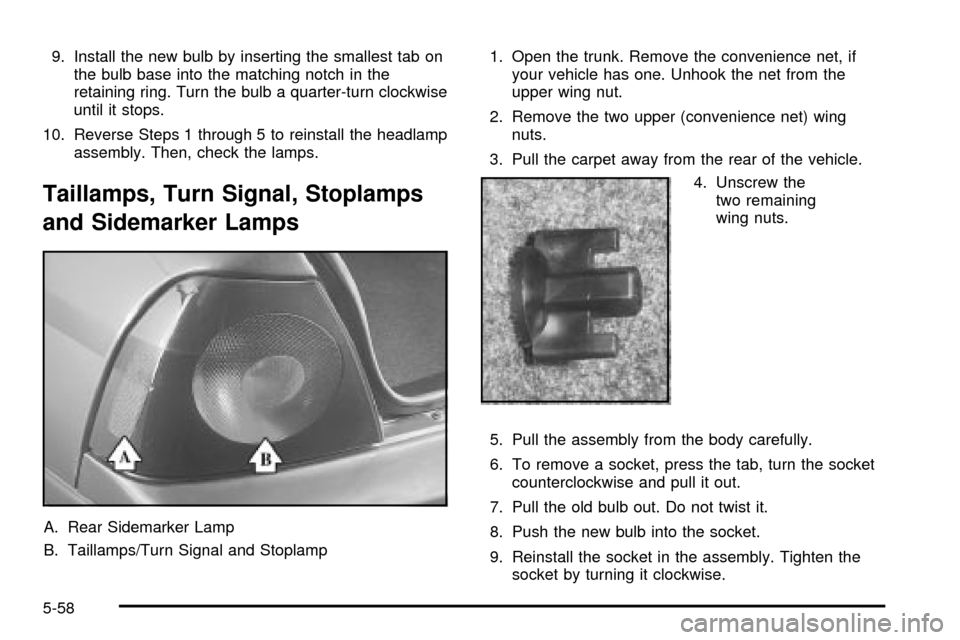
Taillamps, Turn Signal, Stoplamps
and Sidemarker Lamps
A. Rear Sidemarker Lamp
B. Taillamps/Turn Signal and Stoplamp1. Open the trunk. Remove the convenience net, if
your vehicle has one. Unhook the net from the
upper wing nut.
2. Remove the two upper (convenience net) wing
nuts.
3. Pull the carpet away from the rear of the vehicle.
4. Unscrew the
two remaining
wing nuts.
5. Pull the assembly from the body carefully.
6. To remove a socket, press the tab, turn the socket
counterclockwise and pull it out.
7. Pull the old bulb out. Do not twist it.
8. Push the new bulb into the socket.
9. Reinstall the socket in the assembly. Tighten the
socket by turning it clockwise.
5-58
Page 315 of 408
10. Reinstall the assembly and the two lower wing nuts.
11. Reinstall the carpeting.
12. Reinstall the upper (convenience net) wing nut and
convenience net, if equipped.
Back-Up Lamps
The back-up lamps are located in the applique on the
rear of the trunk lid.
1. Open the trunk.
2. Remove the nine wing nuts.
3. Pull the rear trunk applique away from the vehicle.
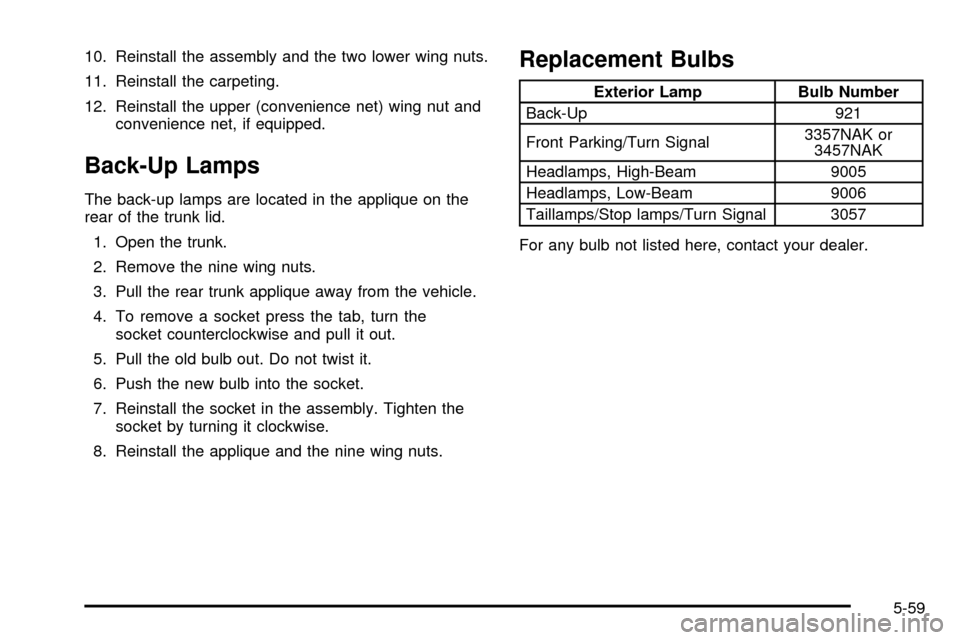
4. To remove a socket press the tab, turn the
socket counterclockwise and pull it out.
5. Pull the old bulb out. Do not twist it.
6. Push the new bulb into the socket.
7. Reinstall the socket in the assembly. Tighten the
socket by turning it clockwise.
8. Reinstall the applique and the nine wing nuts.
Replacement Bulbs
Exterior Lamp Bulb Number
Back-Up 921
Front Parking/Turn Signal3357NAK or
3457NAK
Headlamps, High-Beam 9005
Headlamps, Low-Beam 9006
Taillamps/Stop lamps/Turn Signal 3057
For any bulb not listed here, contact your dealer.
5-59
Page 318 of 408

In¯ation -- Tire Pressure
The Tire-Loading Information label, which is on the
inside of the trunk lid, shows the correct in¯ation
pressures for your tires when they're cold. ªColdº means
your vehicle has been sitting for at least three hours
or driven no more than 1 mile (1.6 km).
Notice:Don't let anyone tell you that underin¯ation
or overin¯ation is all right. It's not. If your tires
don't have enough air (underin¯ation), you can get
the following:
·Too much ¯exing
·Too much heat
·Tire overloading
·Bad wear
·Bad handling
·Bad fuel economy
If your tires have too much air (overin¯ation), you
can get the following:
·Unusual wear
·Bad handling
·Rough ride
·Needless damage from road hazards
When to Check
Check your tires once a month or more.
Don't forget your compact spare tire. It should be at
60 psi (420 kPa).
How to Check
Use a good quality pocket-type gage to check tire
pressure. You can't tell if your tires are properly in¯ated
simply by looking at them. Radial tires may look
properly in¯ated even when they're underin¯ated.
Be sure to put the valve caps back on the valve
stems. They help prevent leaks by keeping out dirt
and moisture.
5-62
Page 329 of 408
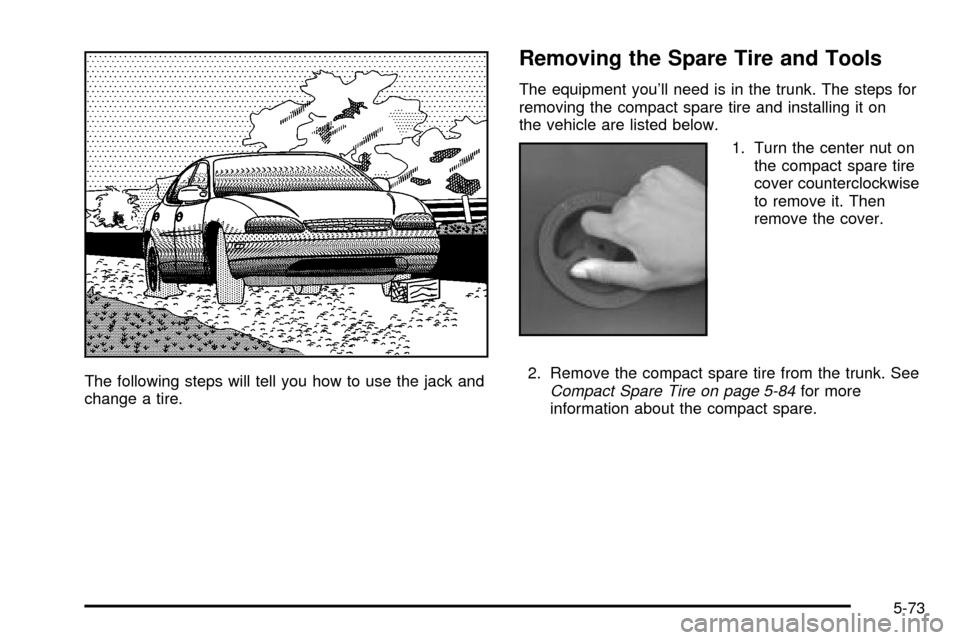
The following steps will tell you how to use the jack and
change a tire.
Removing the Spare Tire and Tools
The equipment you'll need is in the trunk. The steps for
removing the compact spare tire and installing it on
the vehicle are listed below.
1. Turn the center nut on
the compact spare tire
cover counterclockwise
to remove it. Then
remove the cover.
2. Remove the compact spare tire from the trunk. See
Compact Spare Tire on page 5-84for more
information about the compact spare.
5-73
Page 337 of 408
Notice:Improperly tightened wheel nuts can lead
to brake pulsation and rotor damage. To avoid
expensive brake repairs, evenly tighten the wheel
nuts in the proper sequence and to the proper
torque speci®cation. See ªCapacities and
Speci®cationsº in the index for the wheel nut torque
speci®cation.
Don't try to put the wheel cover on your compact spare
tire. It won't ®t. Store the wheel cover in the trunk
until you have the ¯at tire repaired or replaced.
Notice:Wheel covers won't ®t on your compact
spare. If you try to put a wheel cover on your
compact spare, you could damage the cover or the
spare.
Storing the Flat Tire and Tools
{CAUTION:
Storing a jack, a tire, or other equipment in the
passenger compartment of the vehicle could
cause injury. In a sudden stop or collision,
loose equipment could strike someone. Store
all these in the proper place.
5-81
Page 338 of 408
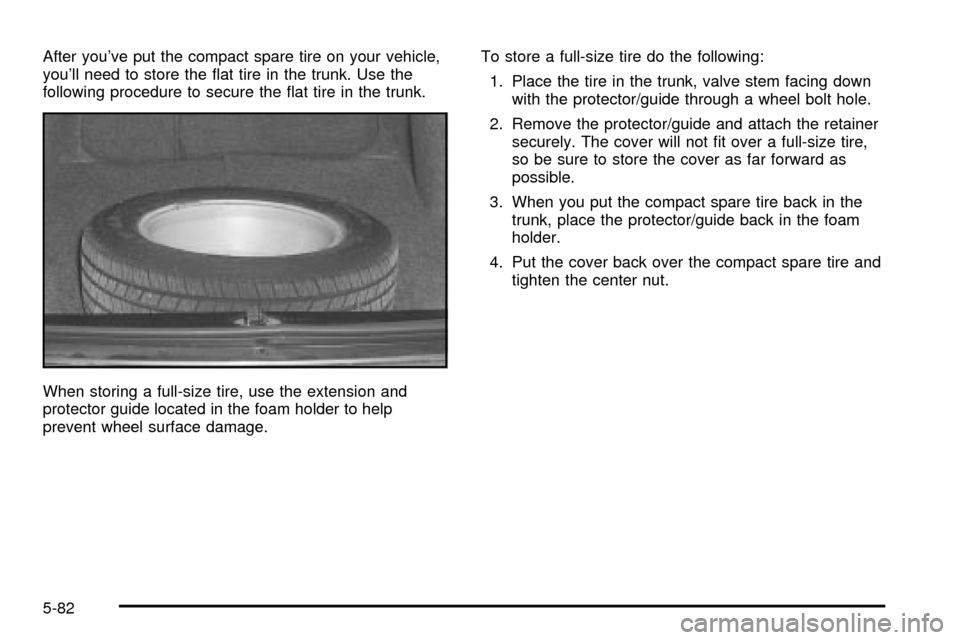
After you've put the compact spare tire on your vehicle,
you'll need to store the ¯at tire in the trunk. Use the
following procedure to secure the ¯at tire in the trunk.
When storing a full-size tire, use the extension and
protector guide located in the foam holder to help
prevent wheel surface damage.To store a full-size tire do the following:
1. Place the tire in the trunk, valve stem facing down
with the protector/guide through a wheel bolt hole.
2. Remove the protector/guide and attach the retainer
securely. The cover will not ®t over a full-size tire,
so be sure to store the cover as far forward as
possible.
3. When you put the compact spare tire back in the
trunk, place the protector/guide back in the foam
holder.
4. Put the cover back over the compact spare tire and
tighten the center nut.
5-82
Page 339 of 408
Storing the Spare Tire and Tools
{CAUTION:
Storing a jack, a tire, or other equipment in the
passenger compartment of the vehicle could
cause injury. In a sudden stop or collision,
loose equipment could strike someone. Store
all these in the proper place.
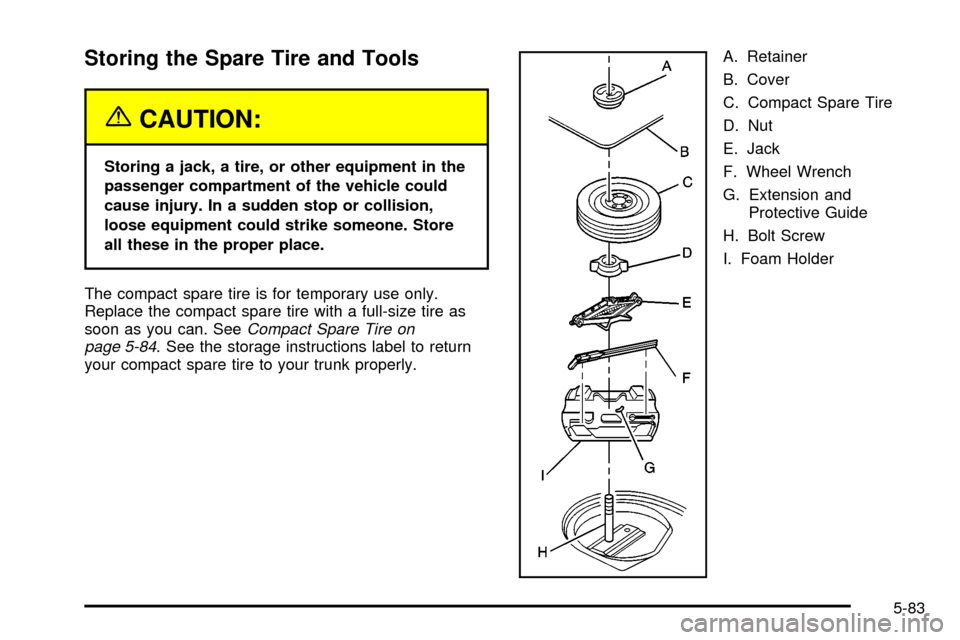
The compact spare tire is for temporary use only.
Replace the compact spare tire with a full-size tire as
soon as you can. See
Compact Spare Tire on
page 5-84. See the storage instructions label to return
your compact spare tire to your trunk properly.A. Retainer
B. Cover
C. Compact Spare Tire
D. Nut
E. Jack
F. Wheel Wrench
G. Extension and
Protective Guide
H. Bolt Screw
I. Foam Holder
5-83