battery CHEVROLET IMPALA 2004 8.G Owner's Manual
[x] Cancel search | Manufacturer: CHEVROLET, Model Year: 2004, Model line: IMPALA, Model: CHEVROLET IMPALA 2004 8.GPages: 420, PDF Size: 2.73 MB
Page 314 of 420

Notice:If the other vehicle’s system is not a 12-volt
system with a negative ground, both vehicles can
be damaged. Only use vehicles with 12-volt systems
with negative grounds to jump start your vehicle.
1. Check the other vehicle. It must have a 12-volt
battery with a negative ground system.
2. Get the vehicles close enough so the jumper cables
can reach, but be sure the vehicles aren’t touching
each other. If they are, it could cause a ground
connection you don’t want. You wouldn’t be able to
start your vehicle, and the bad grounding could
damage the electrical systems.
To avoid the possibility of the vehicles rolling, set the
parking brake rmly on both vehicles involved in the
jump start procedure. Put an automatic transaxle in
PARK (P) or a manual transaxle in NEUTRAL before
setting the parking brake.Notice:If you leave your radio or other accessories
on during the jump starting procedure, they could
be damaged. The repairs would not be covered
by your warranty. Always turn off your radio and
other accessories when jump starting your vehicle.
3. Turn off the ignition on both vehicles. Unplug
unnecessary accessories plugged into the cigarette
lighter or in the accessory power outlets. Turn off
the radio and all lamps that aren’t needed. This will
avoid sparks and help save both batteries. And it
could save your radio!
4. Open the hoods and locate the batteries. Find the
positive (+) and negative (−) terminal locations on
each vehicle.
You will not need to access your battery for jump
starting. Your vehicle has a remote positive (+) jump
starting terminal for that purpose. The remote
positive (+) terminal is located in the engine
compartment on the passenger’s side of the vehicle,
next to the upper underhood fuse block. See
Engine Compartment Overview on page 5-12for
more information on location.
5-52
Page 315 of 420
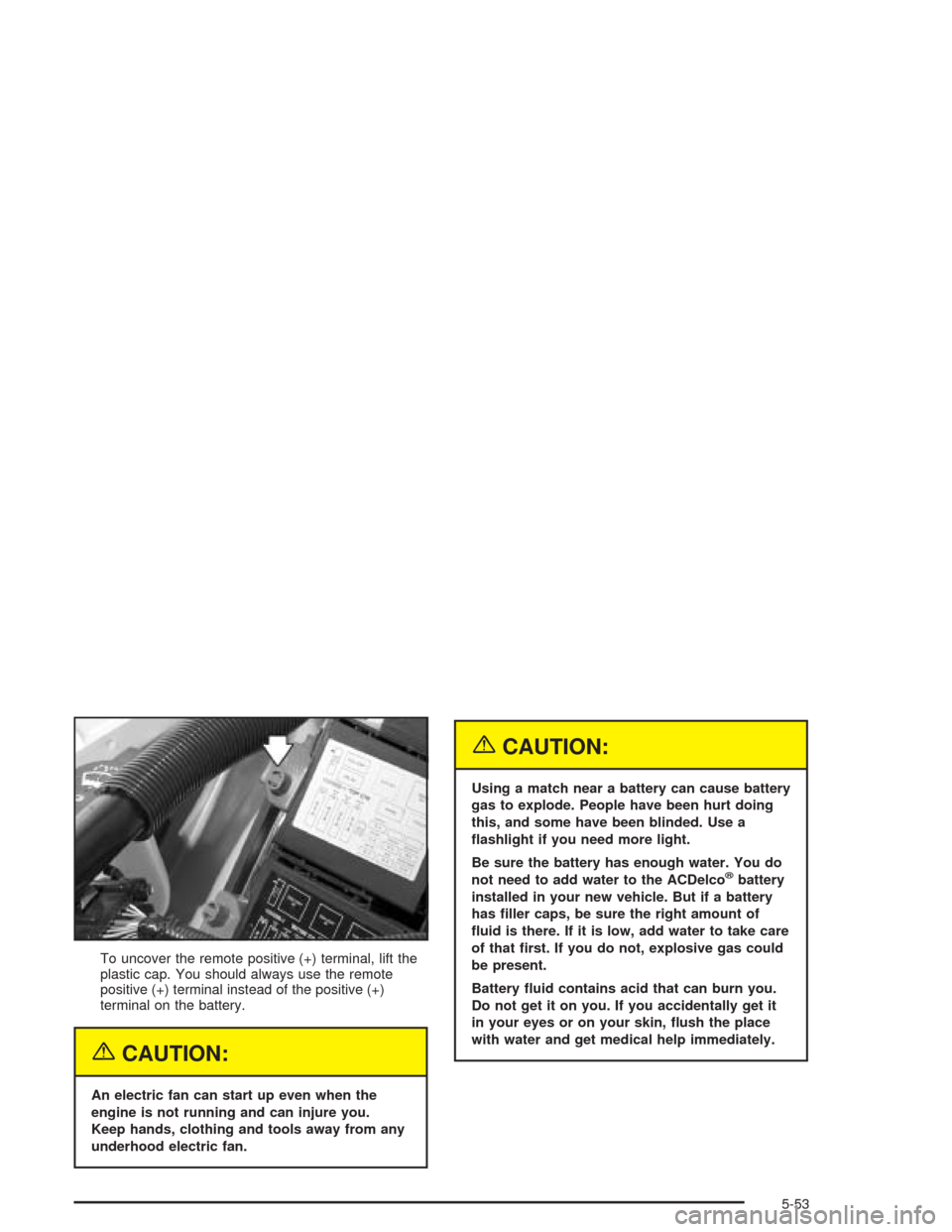
To uncover the remote positive (+) terminal, lift the
plastic cap. You should always use the remote
positive (+) terminal instead of the positive (+)
terminal on the battery.
{CAUTION:
An electric fan can start up even when the
engine is not running and can injure you.
Keep hands, clothing and tools away from any
underhood electric fan.
{CAUTION:
Using a match near a battery can cause battery
gas to explode. People have been hurt doing
this, and some have been blinded. Use a
ashlight if you need more light.
Be sure the battery has enough water. You do
not need to add water to the ACDelco
®battery
installed in your new vehicle. But if a battery
has ller caps, be sure the right amount of
uid is there. If it is low, add water to take care
of that rst. If you do not, explosive gas could
be present.
Battery uid contains acid that can burn you.
Do not get it on you. If you accidentally get it
in your eyes or on your skin, ush the place
with water and get medical help immediately.
5-53
Page 316 of 420
{CAUTION:
Fans or other moving engine parts can injure
you badly. Keep your hands away from moving
parts once the engine is running.
5. Check that the jumper cables don’t have loose or
missing insulation. If they do, you could get a
shock. The vehicles could be damaged, too.
Before you connect the cables, here are some
basic things you should know. Positive (+) will go to
positive (+) or to a remote positive (+) terminal if
the vehicle has one. Negative (−) will go to a heavy,
unpainted metal engine part or to a remote
negative (−) terminal if the vehicle has one.
Don’t connect positive (+) to negative (−), or you’ll
get a short that would damage the battery and
maybe other parts, too. And don’t connect
the negative (−) cable to the negative (−) terminal
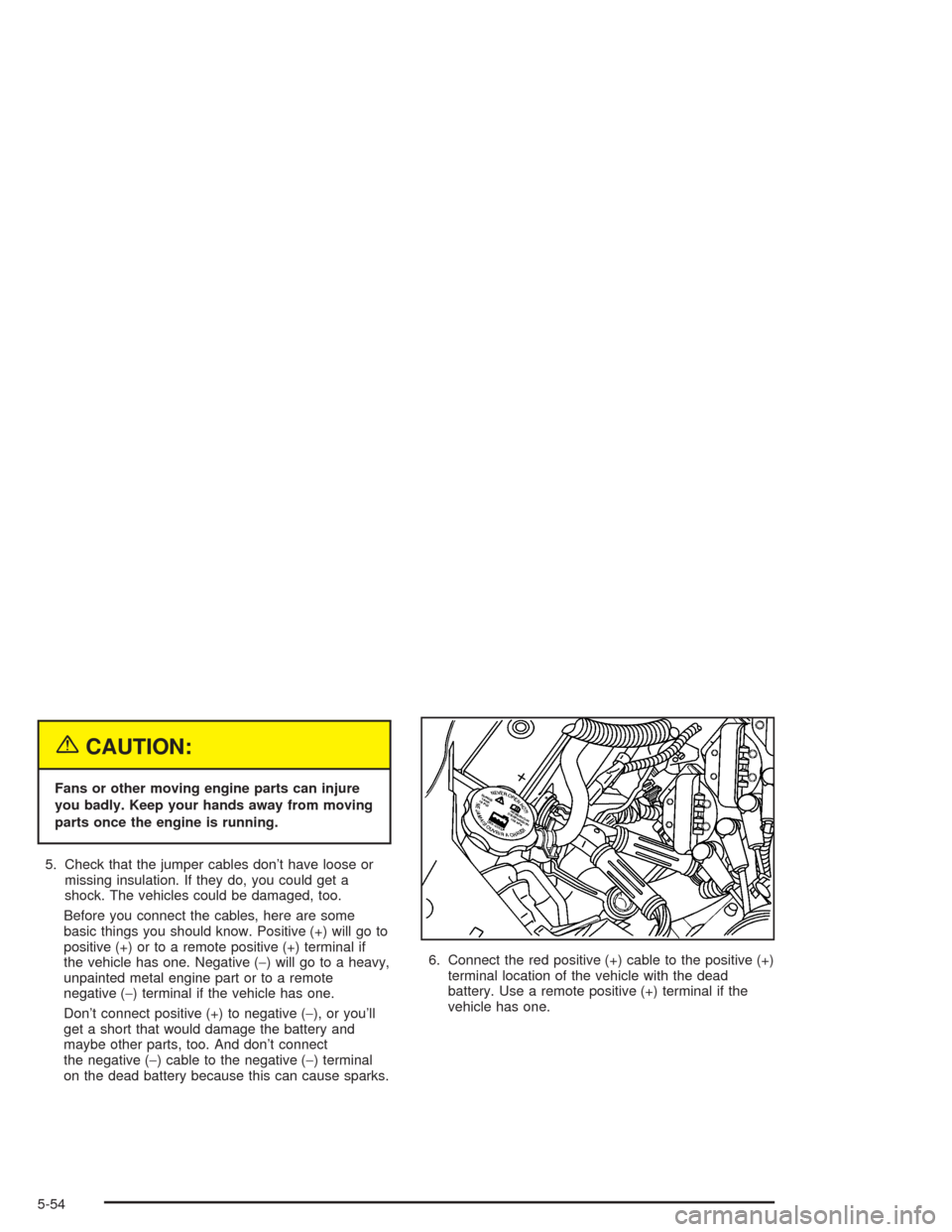
on the dead battery because this can cause sparks.6. Connect the red positive (+) cable to the positive (+)
terminal location of the vehicle with the dead
battery. Use a remote positive (+) terminal if the
vehicle has one.
5-54
Page 317 of 420
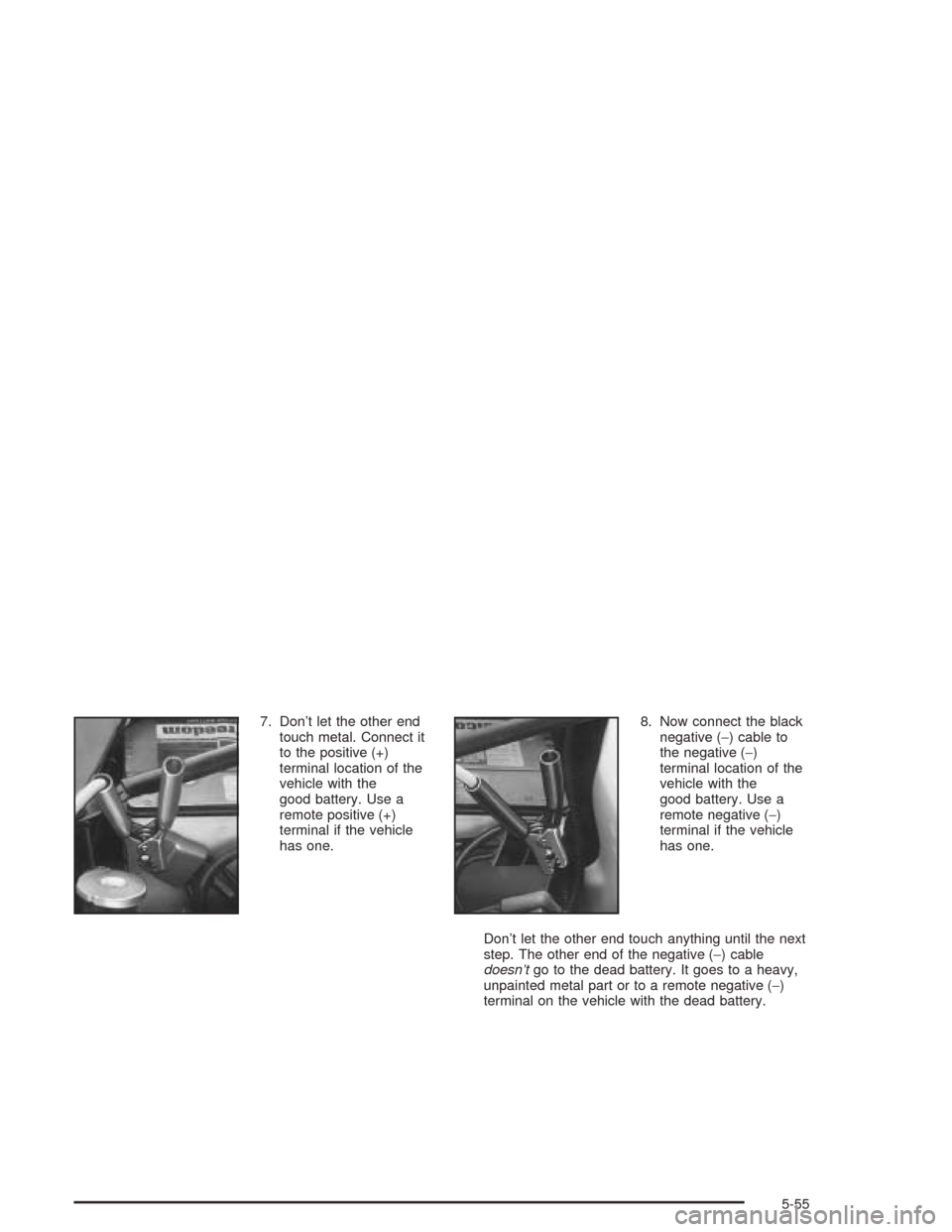
7. Don’t let the other end
touch metal. Connect it
to the positive (+)
terminal location of the
vehicle with the
good battery. Use a
remote positive (+)
terminal if the vehicle
has one.8. Now connect the black
negative (−) cable to
the negative (−)
terminal location of the
vehicle with the
good battery. Use a
remote negative (−)
terminal if the vehicle
has one.
Don’t let the other end touch anything until the next
step. The other end of the negative (−) cable
doesn’tgo to the dead battery. It goes to a heavy,
unpainted metal part or to a remote negative (−)
terminal on the vehicle with the dead battery.
5-55
Page 318 of 420
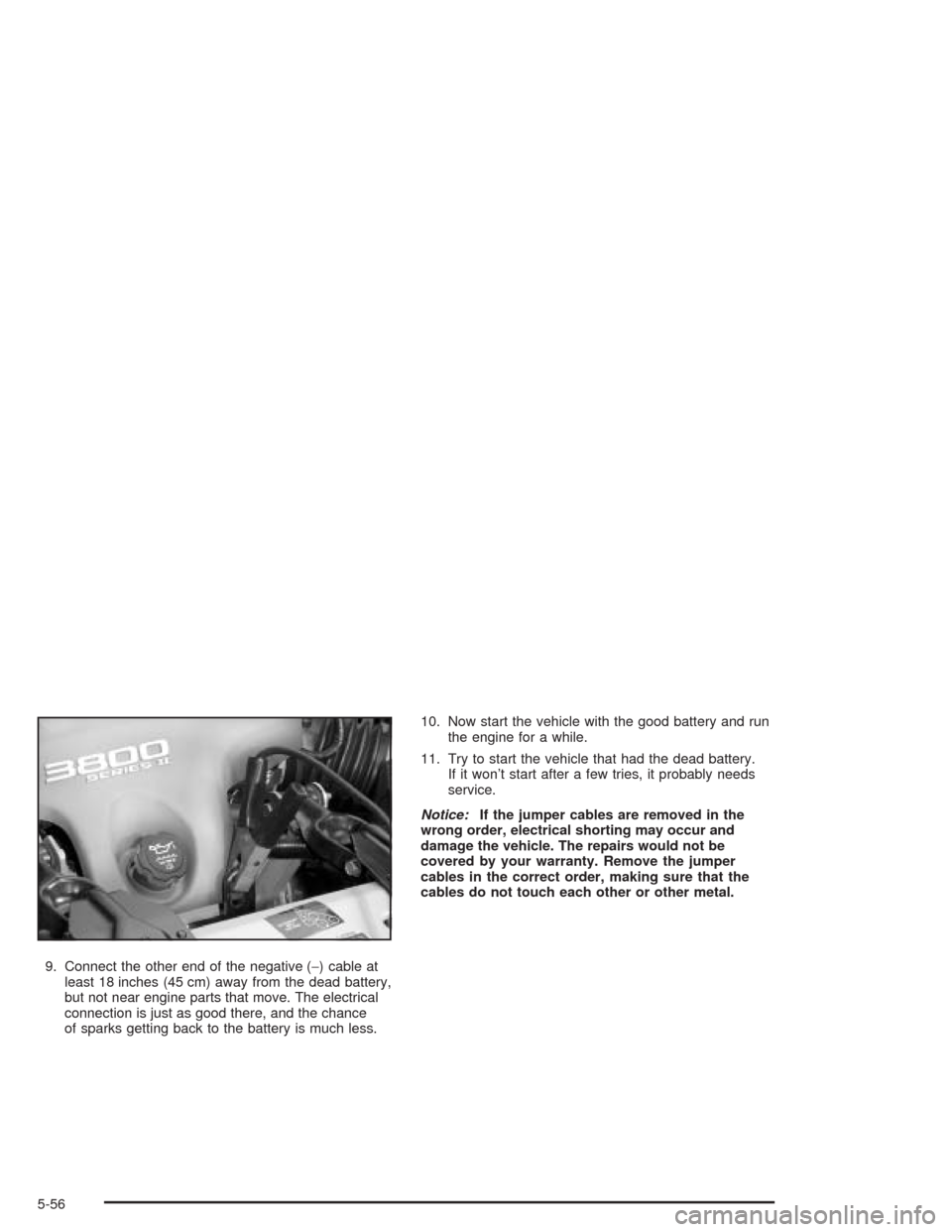
9. Connect the other end of the negative (−) cable at
least 18 inches (45 cm) away from the dead battery,
but not near engine parts that move. The electrical
connection is just as good there, and the chance
of sparks getting back to the battery is much less.10. Now start the vehicle with the good battery and run
the engine for a while.
11. Try to start the vehicle that had the dead battery.
If it won’t start after a few tries, it probably needs
service.
Notice:If the jumper cables are removed in the
wrong order, electrical shorting may occur and
damage the vehicle. The repairs would not be
covered by your warranty. Remove the jumper
cables in the correct order, making sure that the
cables do not touch each other or other metal.
5-56
Page 319 of 420
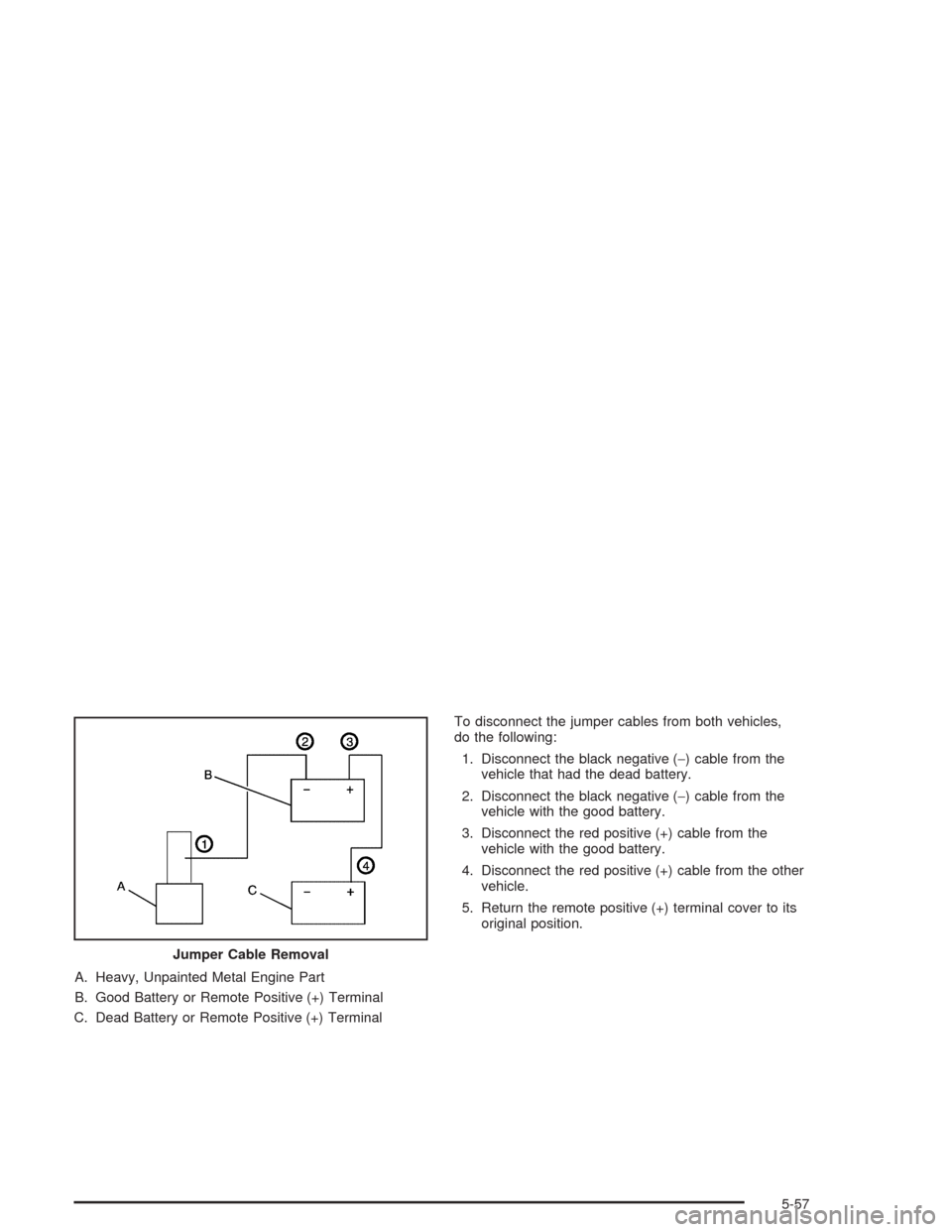
A. Heavy, Unpainted Metal Engine Part
B. Good Battery or Remote Positive (+) Terminal
C. Dead Battery or Remote Positive (+) TerminalTo disconnect the jumper cables from both vehicles,
do the following:
1. Disconnect the black negative (−) cable from the
vehicle that had the dead battery.
2. Disconnect the black negative (−) cable from the
vehicle with the good battery.
3. Disconnect the red positive (+) cable from the
vehicle with the good battery.
4. Disconnect the red positive (+) cable from the other
vehicle.
5. Return the remote positive (+) terminal cover to its
original position.
Jumper Cable Removal
5-57
Page 336 of 420
Any time you adjust a tire’s pressure, rotate your tires,
or have one or more tires repaired or replaced, you’ll
need to reset (calibrate) the tire pressure monitor
system. You’ll also need to reset the system whenever
you buy new tires and whenever the vehicle’s battery
has been disconnected.
To reset (calibrate) the system: The tire pressure
monitor system can be reset two ways. With the ignition
position at ON, pull the interior lamps control to the
ON and OFF settings three times.
It can also be reset through the radio using the
following steps:
1. Turn the ignition to ACC or ON and turn the
radio off.
2. Press and hold the TUNE DISP button on the radio
for at least ve seconds until SETTINGS is
displayed.
3. Press the SEEK SCAN up or down arrow to scroll
through the main menu.
4. Scroll until TIRE MON appears on the display.
5. Press the 1 PREV or 2 NEXT button to enter the
submenu. RESET will be displayed.6. Press the TUNE DISP button to reset. A chime will
be heard to verify the new setting and DONE will
be displayed for one second.
7. Once the monitor has been reset, scroll until EXIT
appears on the display.
8. Press the TUNE DISP button to exit programming.
A chime will be heard to verify exit.
The system completes the calibration process during
driving.
The system normally takes 15 to 20 minutes of driving
in each of three speed ranges to “learn” tire pressures.
The speed ranges are 15 to 40 mph (25 to 65 km/h),
40 to 65 mph (65 to 105 km/h) and above
65 mph (105 km/h). When learning is complete, the
system will alert you after two to eight minutes if a
tire is 12 psi (83 kPa) different from the other three tires.
Detection thresholds may be higher and detection
times may be longer on rough roads, curves and at high
speeds. The system is not capable of detection at
speeds greater than 70 mph (110 km/h).
5-74
Page 367 of 420
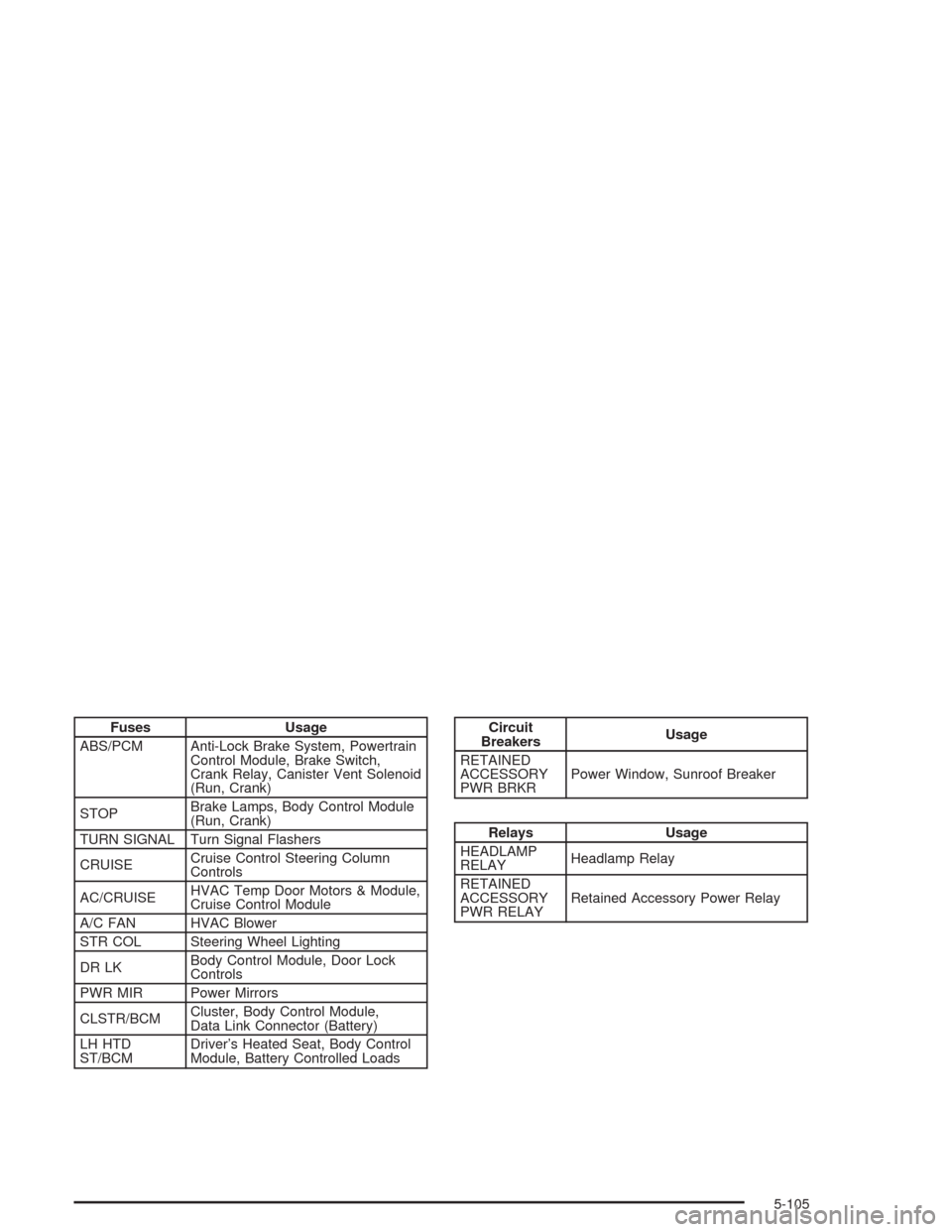
Fuses Usage
ABS/PCM Anti-Lock Brake System, Powertrain
Control Module, Brake Switch,
Crank Relay, Canister Vent Solenoid
(Run, Crank)
STOPBrake Lamps, Body Control Module
(Run, Crank)
TURN SIGNAL Turn Signal Flashers
CRUISECruise Control Steering Column
Controls
AC/CRUISEHVAC Temp Door Motors & Module,
Cruise Control Module
A/C FAN HVAC Blower
STR COL Steering Wheel Lighting
DR LKBody Control Module, Door Lock
Controls
PWR MIR Power Mirrors
CLSTR/BCMCluster, Body Control Module,
Data Link Connector (Battery)
LH HTD
ST/BCMDriver’s Heated Seat, Body Control
Module, Battery Controlled LoadsCircuit
BreakersUsage
RETAINED
ACCESSORY
PWR BRKRPower Window, Sunroof Breaker
Relays Usage
HEADLAMP
RELAYHeadlamp Relay
RETAINED
ACCESSORY
PWR RELAYRetained Accessory Power Relay
5-105
Page 369 of 420
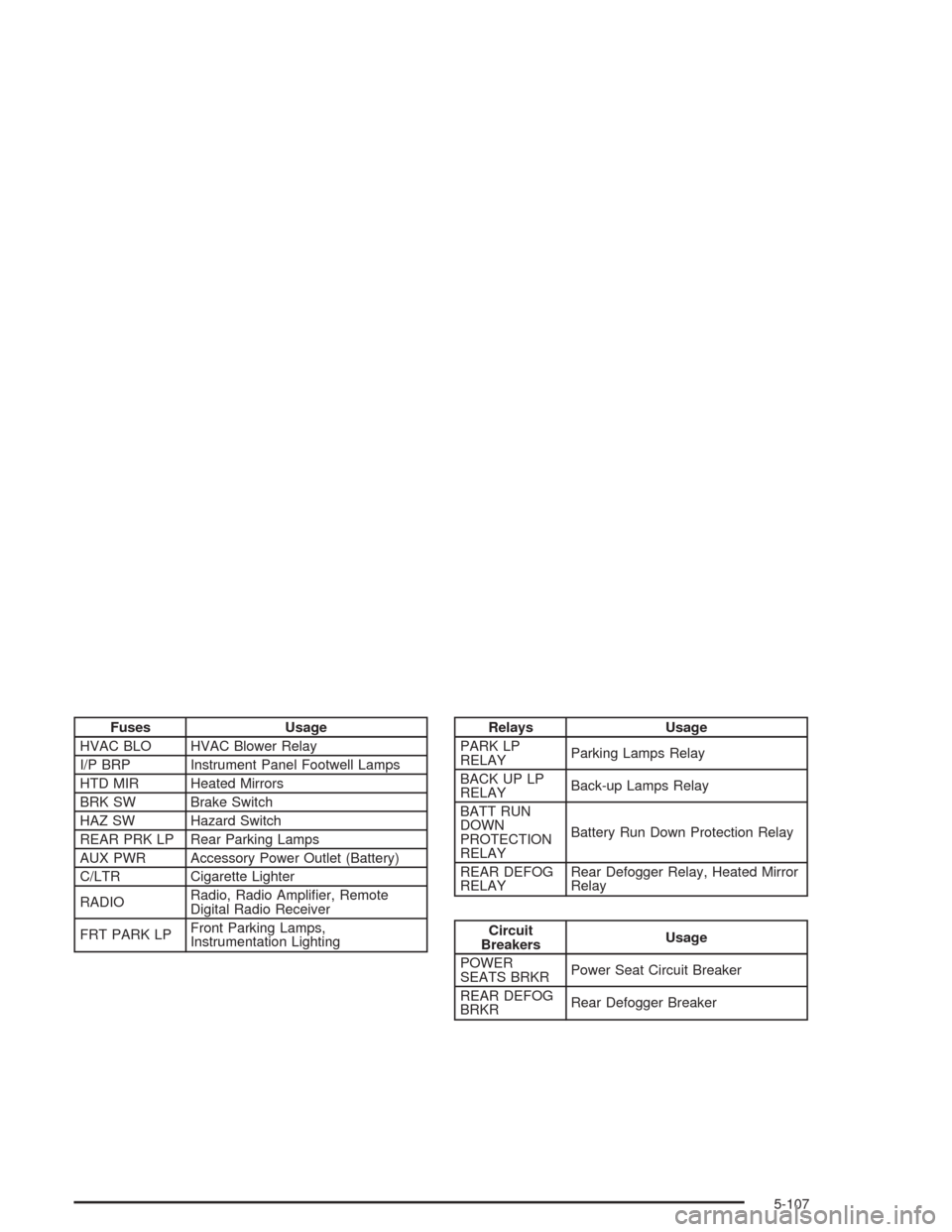
Fuses Usage
HVAC BLO HVAC Blower Relay
I/P BRP Instrument Panel Footwell Lamps
HTD MIR Heated Mirrors
BRK SW Brake Switch
HAZ SW Hazard Switch
REAR PRK LP Rear Parking Lamps
AUX PWR Accessory Power Outlet (Battery)
C/LTR Cigarette Lighter
RADIORadio, Radio Amplier, Remote
Digital Radio Receiver
FRT PARK LPFront Parking Lamps,
Instrumentation LightingRelays Usage
PARK LP
RELAYParking Lamps Relay
BACK UP LP
RELAYBack-up Lamps Relay
BATT RUN
DOWN
PROTECTION
RELAYBattery Run Down Protection Relay
REAR DEFOG
RELAYRear Defogger Relay, Heated Mirror
Relay
Circuit
BreakersUsage
POWER
SEATS BRKRPower Seat Circuit Breaker
REAR DEFOG
BRKRRear Defogger Breaker
5-107
Page 370 of 420
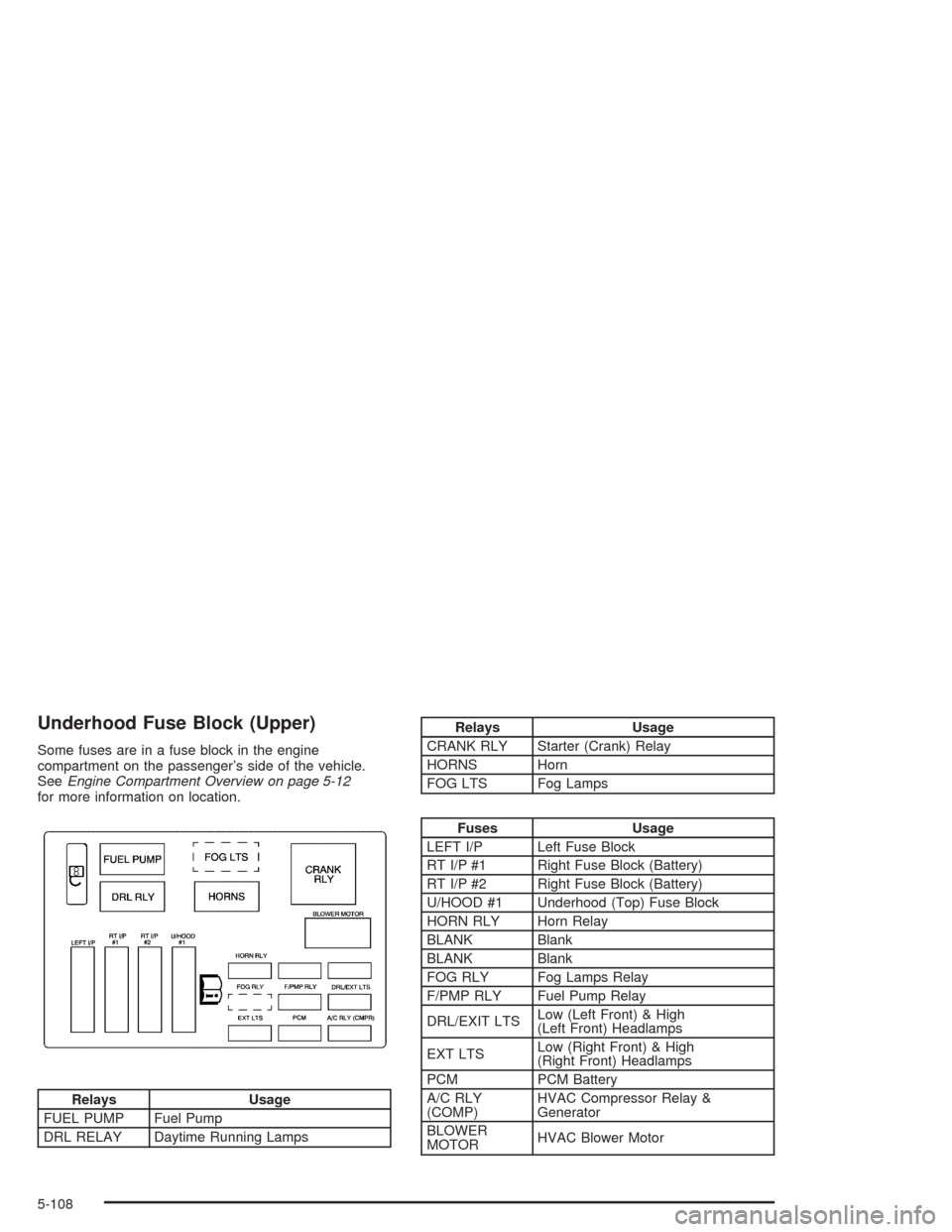
Underhood Fuse Block (Upper)
Some fuses are in a fuse block in the engine
compartment on the passenger’s side of the vehicle.
SeeEngine Compartment Overview on page 5-12
for more information on location.
Relays Usage
FUEL PUMP Fuel Pump
DRL RELAY Daytime Running Lamps
Relays Usage
CRANK RLY Starter (Crank) Relay
HORNS Horn
FOG LTS Fog Lamps
Fuses Usage
LEFT I/P Left Fuse Block
RT I/P #1 Right Fuse Block (Battery)
RT I/P #2 Right Fuse Block (Battery)
U/HOOD #1 Underhood (Top) Fuse Block
HORN RLY Horn Relay
BLANK Blank
BLANK Blank
FOG RLY Fog Lamps Relay
F/PMP RLY Fuel Pump Relay
DRL/EXIT LTSLow (Left Front) & High
(Left Front) Headlamps
EXT LTSLow (Right Front) & High
(Right Front) Headlamps
PCM PCM Battery
A/C RLY
(COMP)HVAC Compressor Relay &
Generator
BLOWER
MOTORHVAC Blower Motor
5-108