engine coolant CHEVROLET IMPALA 2006 9.G Owner's Manual
[x] Cancel search | Manufacturer: CHEVROLET, Model Year: 2006, Model line: IMPALA, Model: CHEVROLET IMPALA 2006 9.GPages: 394, PDF Size: 2.42 MB
Page 283 of 394
{CAUTION:
Steam and scalding liquids from a hot cooling
system can blow out and burn you badly. They
are under pressure, and if you turn the radiator
pressure cap — even a little — they can come
out at high speed. Never turn the cap when the
cooling system, including the radiator pressure
cap, is hot. Wait for the cooling system and
radiator pressure cap to cool if you ever have
to turn the pressure cap.
How to Add Coolant to the Cooling
System (V6 Engines)
Notice:Your engine has a specic radiator ll
procedure. Failure to follow this procedure could
cause your engine to overheat and be severely
damaged.
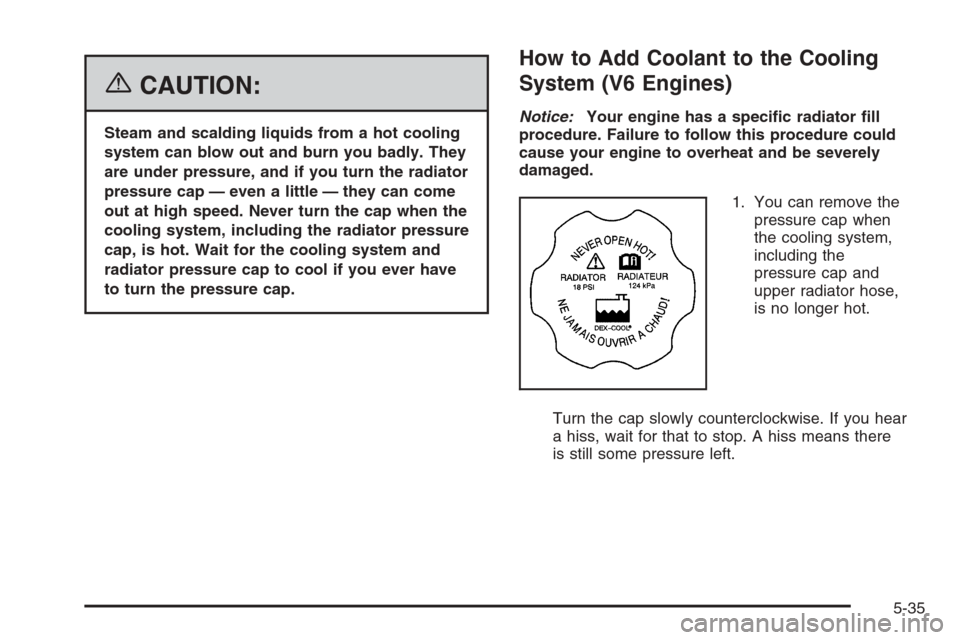
1. You can remove the
pressure cap when
the cooling system,
including the
pressure cap and
upper radiator hose,
is no longer hot.
Turn the cap slowly counterclockwise. If you hear
a hiss, wait for that to stop. A hiss means there
is still some pressure left.
5-35
Page 284 of 394
2. Then keep turning the pressure cap and remove it.
{CAUTION:
You can be burned if you spill coolant on hot
engine parts. Coolant contains ethylene glycol
and it will burn if the engine parts are hot
enough. Do not spill coolant on a hot engine.
3. Fill the radiator with the proper DEX-COOL
®
coolant mixture, up to the base of the ller
neck. SeeEngine Coolant on page 5-26for more
information about the proper coolant mixture.
4. Rinse or wipe any spilled coolant from the engine
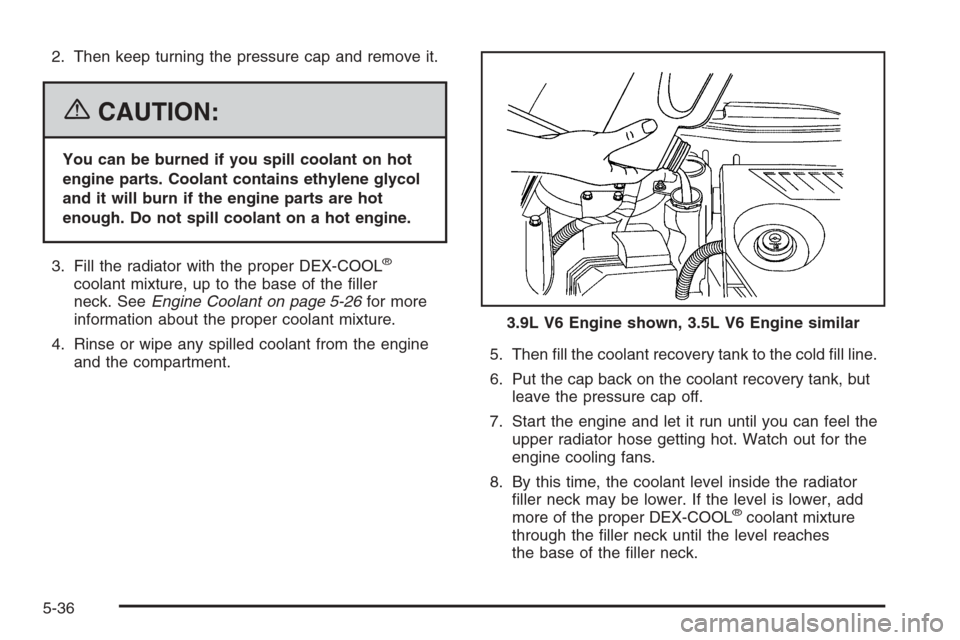
and the compartment.5. Then ll the coolant recovery tank to the cold ll line.
6. Put the cap back on the coolant recovery tank, but
leave the pressure cap off.
7. Start the engine and let it run until you can feel the
upper radiator hose getting hot. Watch out for the
engine cooling fans.
8. By this time, the coolant level inside the radiator
ller neck may be lower. If the level is lower, add
more of the proper DEX-COOL
®coolant mixture
through the ller neck until the level reaches
the base of the ller neck. 3.9L V6 Engine shown, 3.5L V6 Engine similar
5-36
Page 285 of 394
9. Then replace the pressure cap. At any time during
this procedure if coolant begins to ow out of the
ller neck, reinstall the pressure cap. Be sure
the cap is hand-tight and fully seated.
10. Check the coolant in the recovery tank. The level in
the coolant recovery tank should be at the cold ll
line when the engine is cold.
How to Add Coolant to the Cooling
System (5.3L V8 Engine)
Notice:Your engine has a specic cooling system
drain and ll procedure. Failure to follow this
procedure could cause your engine to overheat
and be severely damaged. If your engine’s cooling
system needs to be drained and re-lled, please
see your dealer.
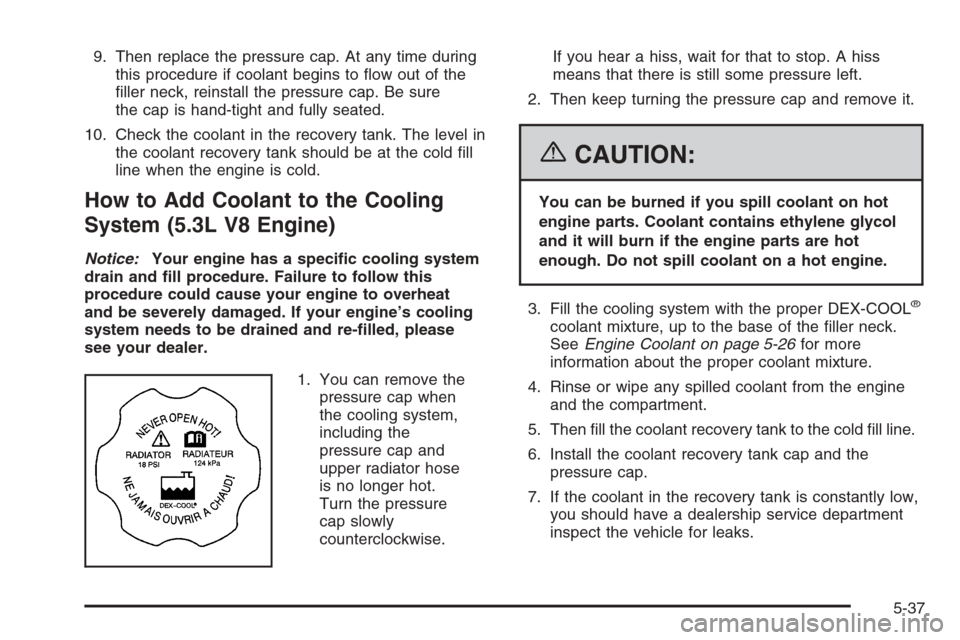
1. You can remove the
pressure cap when
the cooling system,
including the
pressure cap and
upper radiator hose
is no longer hot.
Turn the pressure
cap slowly
counterclockwise.If you hear a hiss, wait for that to stop. A hiss
means that there is still some pressure left.
2. Then keep turning the pressure cap and remove it.
{CAUTION:
You can be burned if you spill coolant on hot
engine parts. Coolant contains ethylene glycol
and it will burn if the engine parts are hot
enough. Do not spill coolant on a hot engine.
3. Fill the cooling system with the proper DEX-COOL
®
coolant mixture, up to the base of the ller neck.
SeeEngine Coolant on page 5-26for more
information about the proper coolant mixture.
4. Rinse or wipe any spilled coolant from the engine
and the compartment.
5. Then ll the coolant recovery tank to the cold ll line.
6. Install the coolant recovery tank cap and the
pressure cap.
7. If the coolant in the recovery tank is constantly low,
you should have a dealership service department
inspect the vehicle for leaks.
5-37
Page 287 of 394
Windshield Washer Fluid
What to Use
When you need windshield washer uid, be sure to
read the manufacturer’s instructions before use. If you
will be operating your vehicle in an area where the
temperature may fall below freezing, use a uid that
has sufficient protection against freezing.
Adding Washer Fluid
A WASHER FLUID LOW ADD FLUID message will be
displayed on the Driver Information Center (DIC)
when you need to add windshield washer uid to your
vehicle. SeeDIC Warnings and Messages on page 3-45
for more information.
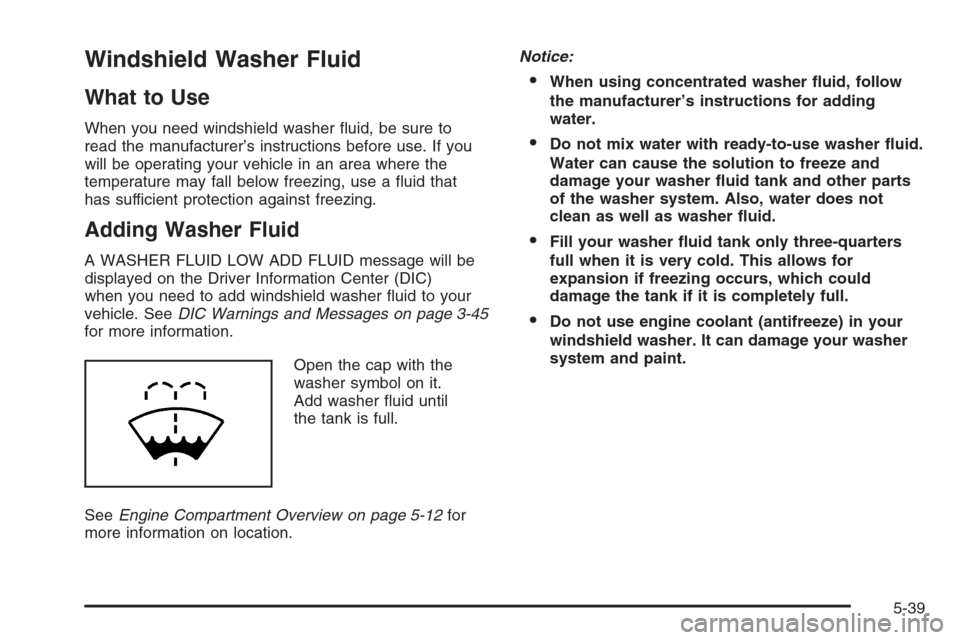
Open the cap with the
washer symbol on it.
Add washer uid until
the tank is full.
SeeEngine Compartment Overview on page 5-12for
more information on location.Notice:
When using concentrated washer uid, follow
the manufacturer’s instructions for adding
water.
Do not mix water with ready-to-use washer uid.
Water can cause the solution to freeze and
damage your washer uid tank and other parts
of the washer system. Also, water does not
clean as well as washer uid.
Fill your washer uid tank only three-quarters
full when it is very cold. This allows for
expansion if freezing occurs, which could
damage the tank if it is completely full.
Do not use engine coolant (antifreeze) in your
windshield washer. It can damage your washer
system and paint.
5-39
Page 353 of 394
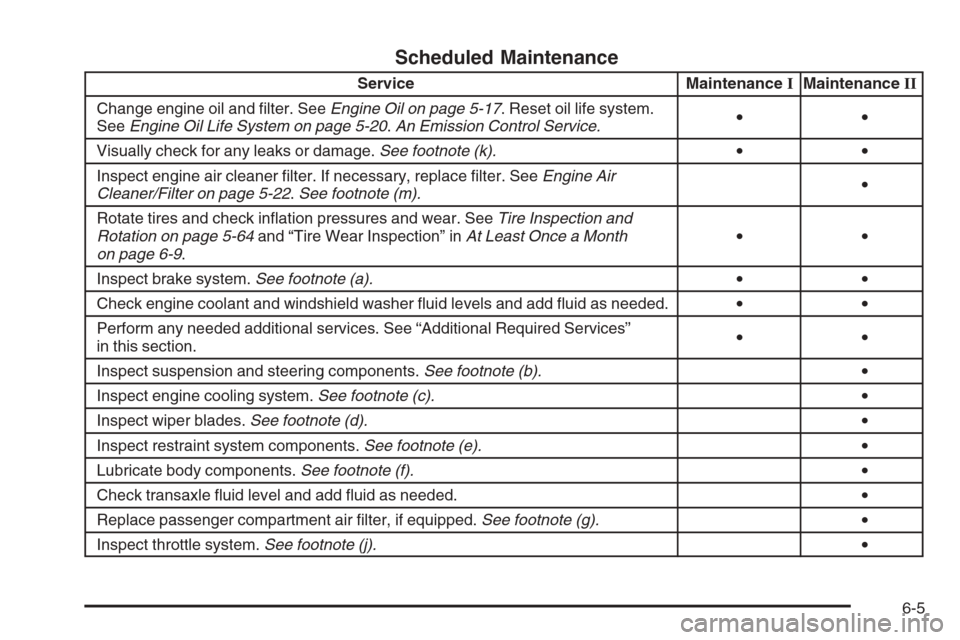
Scheduled Maintenance
Service MaintenanceIMaintenanceII
Change engine oil and lter. SeeEngine Oil on page 5-17. Reset oil life system.
SeeEngine Oil Life System on page 5-20.An Emission Control Service.••
Visually check for any leaks or damage.See footnote (k).••
Inspect engine air cleaner lter. If necessary, replace lter. SeeEngine Air
Cleaner/Filter on page 5-22.See footnote (m).•
Rotate tires and check ination pressures and wear. SeeTire Inspection and
Rotation on page 5-64and “Tire Wear Inspection” inAt Least Once a Month
on page 6-9.••
Inspect brake system.See footnote (a).••
Check engine coolant and windshield washer uid levels and add uid as needed.••
Perform any needed additional services. See “Additional Required Services”
in this section.••
Inspect suspension and steering components.See footnote (b).•
Inspect engine cooling system.See footnote (c).•
Inspect wiper blades.See footnote (d).•
Inspect restraint system components.See footnote (e).•
Lubricate body components.See footnote (f).•
Check transaxle uid level and add uid as needed.•
Replace passenger compartment air lter, if equipped.See footnote (g).•
Inspect throttle system.See footnote (j).•
6-5
Page 356 of 394
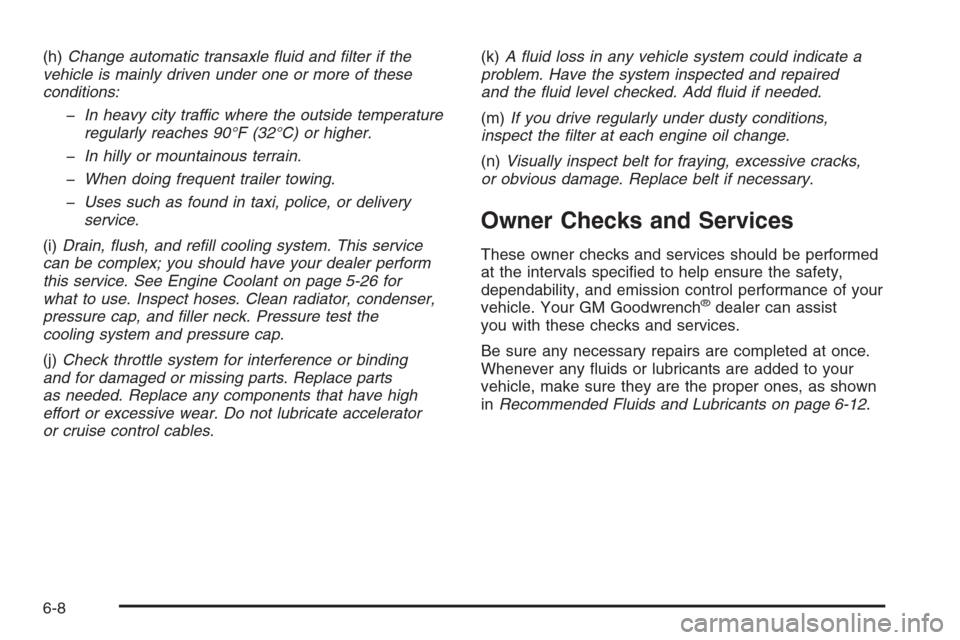
(h)Change automatic transaxle uid and lter if the
vehicle is mainly driven under one or more of these
conditions:
In heavy city traffic where the outside temperature
regularly reaches 90°F (32°C) or higher.
In hilly or mountainous terrain.
When doing frequent trailer towing.
Uses such as found in taxi, police, or delivery
service.
(i)Drain, ush, and rell cooling system. This service
can be complex; you should have your dealer perform
this service. See Engine Coolant on page 5-26 for
what to use. Inspect hoses. Clean radiator, condenser,
pressure cap, and ller neck. Pressure test the
cooling system and pressure cap.
(j)Check throttle system for interference or binding
and for damaged or missing parts. Replace parts
as needed. Replace any components that have high
effort or excessive wear. Do not lubricate accelerator
or cruise control cables.(k)A uid loss in any vehicle system could indicate a
problem. Have the system inspected and repaired
and the uid level checked. Add uid if needed.
(m)If you drive regularly under dusty conditions,
inspect the lter at each engine oil change.
(n)Visually inspect belt for fraying, excessive cracks,
or obvious damage. Replace belt if necessary.
Owner Checks and Services
These owner checks and services should be performed
at the intervals specied to help ensure the safety,
dependability, and emission control performance of your
vehicle. Your GM Goodwrench
®dealer can assist
you with these checks and services.
Be sure any necessary repairs are completed at once.
Whenever any uids or lubricants are added to your
vehicle, make sure they are the proper ones, as shown
inRecommended Fluids and Lubricants on page 6-12.
6-8
Page 357 of 394
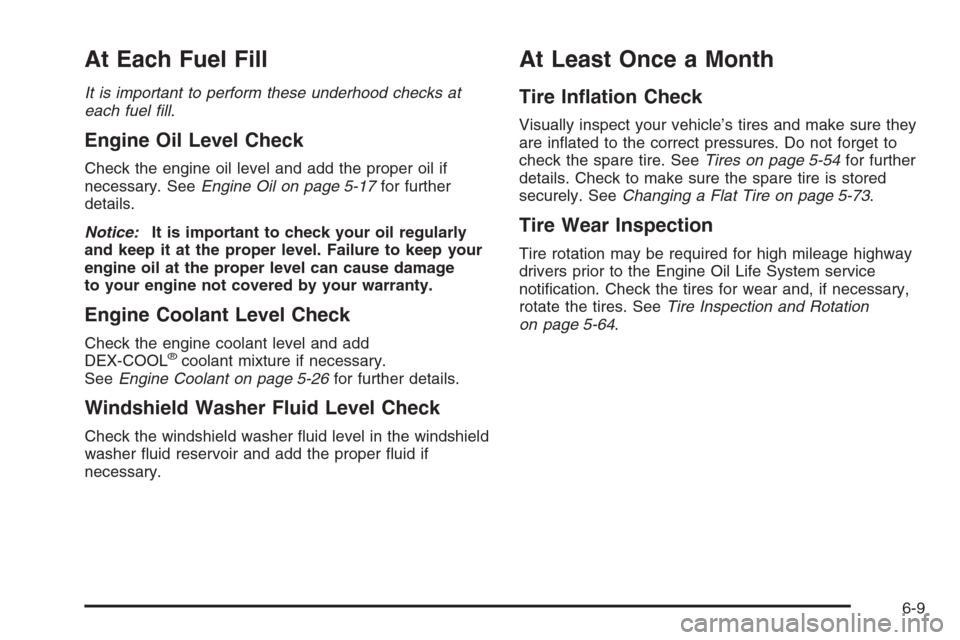
At Each Fuel Fill
It is important to perform these underhood checks at
each fuel ll.
Engine Oil Level Check
Check the engine oil level and add the proper oil if
necessary. SeeEngine Oil on page 5-17for further
details.
Notice:It is important to check your oil regularly
and keep it at the proper level. Failure to keep your
engine oil at the proper level can cause damage
to your engine not covered by your warranty.
Engine Coolant Level Check
Check the engine coolant level and add
DEX-COOL®coolant mixture if necessary.
SeeEngine Coolant on page 5-26for further details.
Windshield Washer Fluid Level Check
Check the windshield washer uid level in the windshield
washer uid reservoir and add the proper uid if
necessary.
At Least Once a Month
Tire Ination Check
Visually inspect your vehicle’s tires and make sure they
are inated to the correct pressures. Do not forget to
check the spare tire. SeeTires on page 5-54for further
details. Check to make sure the spare tire is stored
securely. SeeChanging a Flat Tire on page 5-73.
Tire Wear Inspection
Tire rotation may be required for high mileage highway
drivers prior to the Engine Oil Life System service
notication. Check the tires for wear and, if necessary,
rotate the tires. SeeTire Inspection and Rotation
on page 5-64.
6-9
Page 360 of 394
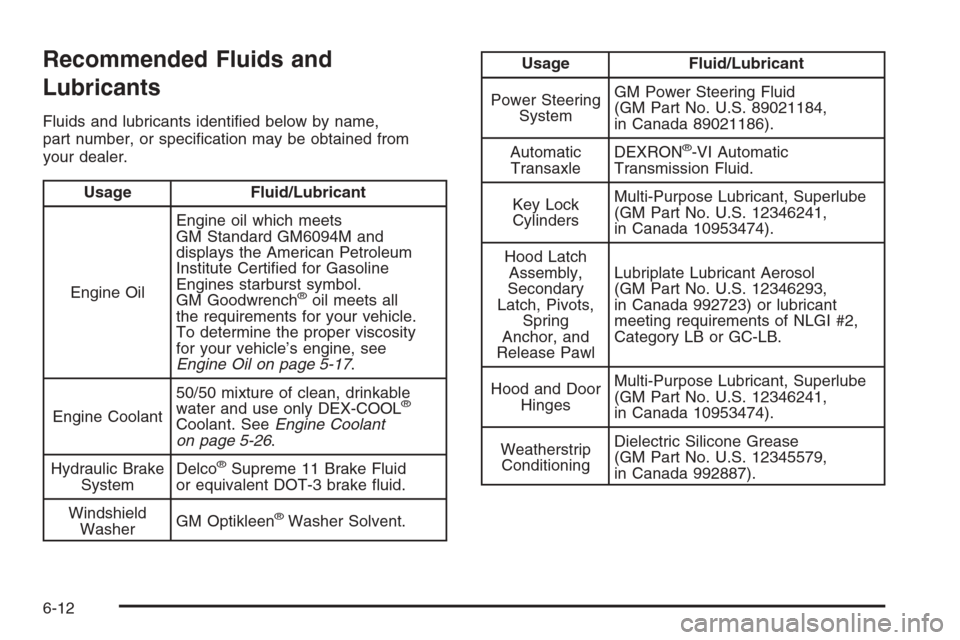
Recommended Fluids and
Lubricants
Fluids and lubricants identied below by name,
part number, or specication may be obtained from
your dealer.
Usage Fluid/Lubricant
Engine OilEngine oil which meets
GM Standard GM6094M and
displays the American Petroleum
Institute Certied for Gasoline
Engines starburst symbol.
GM Goodwrench
®oil meets all
the requirements for your vehicle.
To determine the proper viscosity
for your vehicle’s engine, see
Engine Oil on page 5-17.
Engine Coolant50/50 mixture of clean, drinkable
water and use only DEX-COOL
®
Coolant. SeeEngine Coolant
on page 5-26.
Hydraulic Brake
SystemDelco
®Supreme 11 Brake Fluid
or equivalent DOT-3 brake uid.
Windshield
WasherGM Optikleen
®Washer Solvent.
Usage Fluid/Lubricant
Power Steering
SystemGM Power Steering Fluid
(GM Part No. U.S. 89021184,
in Canada 89021186).
Automatic
TransaxleDEXRON
®-VI Automatic
Transmission Fluid.
Key Lock
CylindersMulti-Purpose Lubricant, Superlube
(GM Part No. U.S. 12346241,
in Canada 10953474).
Hood Latch
Assembly,
Secondary
Latch, Pivots,
Spring
Anchor, and
Release PawlLubriplate Lubricant Aerosol
(GM Part No. U.S. 12346293,
in Canada 992723) or lubricant
meeting requirements of NLGI #2,
Category LB or GC-LB.
Hood and Door
HingesMulti-Purpose Lubricant, Superlube
(GM Part No. U.S. 12346241,
in Canada 10953474).
Weatherstrip
ConditioningDielectric Silicone Grease
(GM Part No. U.S. 12345579,
in Canada 992887).
6-12
Page 383 of 394
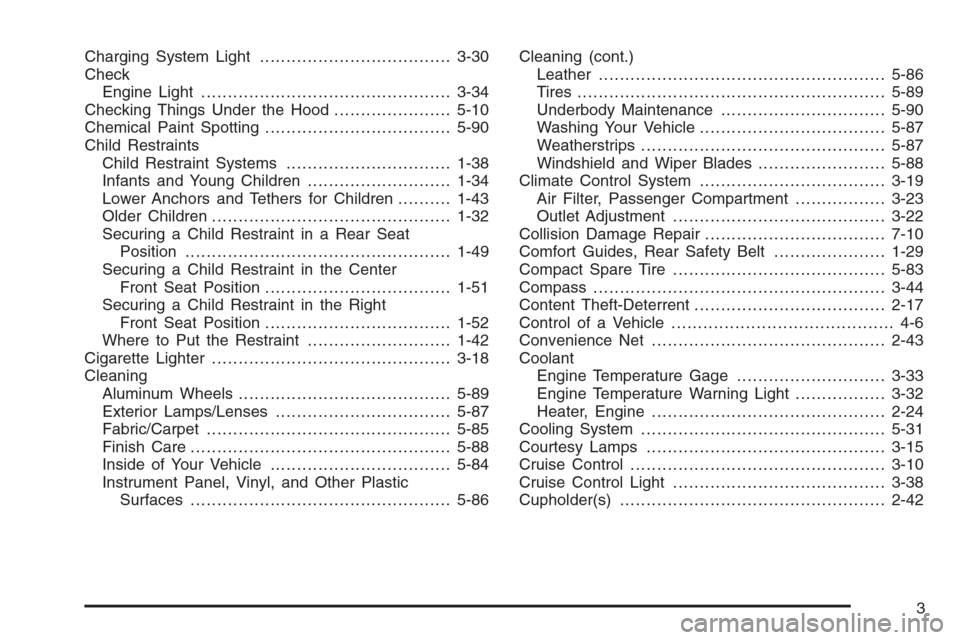
Charging System Light....................................3-30
Check
Engine Light...............................................3-34
Checking Things Under the Hood......................5-10
Chemical Paint Spotting...................................5-90
Child Restraints
Child Restraint Systems...............................1-38
Infants and Young Children...........................1-34
Lower Anchors and Tethers for Children..........1-43
Older Children.............................................1-32
Securing a Child Restraint in a Rear Seat
Position..................................................1-49
Securing a Child Restraint in the Center
Front Seat Position...................................1-51
Securing a Child Restraint in the Right
Front Seat Position...................................1-52
Where to Put the Restraint...........................1-42
Cigarette Lighter.............................................3-18
Cleaning
Aluminum Wheels........................................5-89
Exterior Lamps/Lenses.................................5-87
Fabric/Carpet..............................................5-85
Finish Care.................................................5-88
Inside of Your Vehicle..................................5-84
Instrument Panel, Vinyl, and Other Plastic
Surfaces.................................................5-86Cleaning (cont.)
Leather......................................................5-86
Tires..........................................................5-89
Underbody Maintenance...............................5-90
Washing Your Vehicle...................................5-87
Weatherstrips..............................................5-87
Windshield and Wiper Blades........................5-88
Climate Control System...................................3-19
Air Filter, Passenger Compartment.................3-23
Outlet Adjustment........................................3-22
Collision Damage Repair..................................7-10
Comfort Guides, Rear Safety Belt.....................1-29
Compact Spare Tire........................................5-83
Compass.......................................................3-44
Content Theft-Deterrent....................................2-17
Control of a Vehicle.......................................... 4-6
Convenience Net............................................2-43
Coolant
Engine Temperature Gage............................3-33
Engine Temperature Warning Light.................3-32
Heater, Engine............................................2-24
Cooling System..............................................5-31
Courtesy Lamps.............................................3-15
Cruise Control................................................3-10
Cruise Control Light........................................3-38
Cupholder(s)..................................................2-42
3
Page 385 of 394
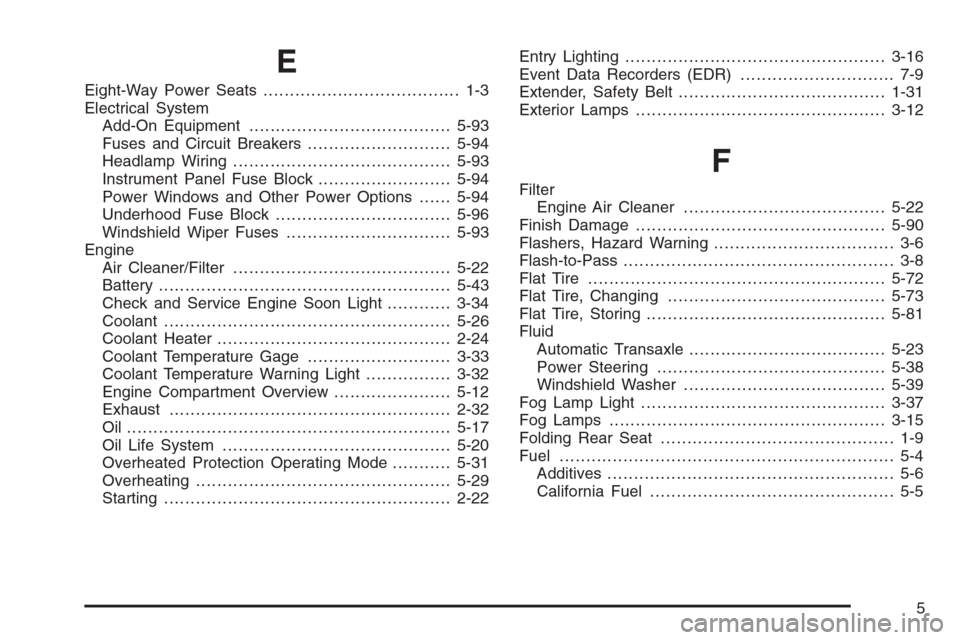
E
Eight-Way Power Seats..................................... 1-3
Electrical System
Add-On Equipment......................................5-93
Fuses and Circuit Breakers...........................5-94
Headlamp Wiring.........................................5-93
Instrument Panel Fuse Block.........................5-94
Power Windows and Other Power Options......5-94
Underhood Fuse Block.................................5-96
Windshield Wiper Fuses...............................5-93
Engine
Air Cleaner/Filter.........................................5-22
Battery.......................................................5-43
Check and Service Engine Soon Light............3-34
Coolant......................................................5-26
Coolant Heater............................................2-24
Coolant Temperature Gage...........................3-33
Coolant Temperature Warning Light................3-32
Engine Compartment Overview......................5-12
Exhaust.....................................................2-32
Oil .............................................................5-17
Oil Life System...........................................5-20
Overheated Protection Operating Mode...........5-31
Overheating................................................5-29
Starting......................................................2-22Entry Lighting.................................................3-16
Event Data Recorders (EDR)............................. 7-9
Extender, Safety Belt.......................................1-31
Exterior Lamps...............................................3-12
F
Filter
Engine Air Cleaner......................................5-22
Finish Damage...............................................5-90
Flashers, Hazard Warning.................................. 3-6
Flash-to-Pass................................................... 3-8
Flat Tire........................................................5-72
Flat Tire, Changing.........................................5-73
Flat Tire, Storing.............................................5-81
Fluid
Automatic Transaxle.....................................5-23
Power Steering...........................................5-38
Windshield Washer......................................5-39
Fog Lamp Light..............................................3-37
Fog Lamps ....................................................3-15
Folding Rear Seat............................................ 1-9
Fuel............................................................... 5-4
Additives...................................................... 5-6
California Fuel.............................................. 5-5
5