brake light CHEVROLET IMPALA 2007 9.G User Guide
[x] Cancel search | Manufacturer: CHEVROLET, Model Year: 2007, Model line: IMPALA, Model: CHEVROLET IMPALA 2007 9.GPages: 460, PDF Size: 2.56 MB
Page 256 of 460
Traction Control System (TCS)
Your vehicle may have a traction control system
that limits wheel spin. This is especially useful
in slippery road conditions. The system operates
only if it senses that one or both of the front wheels
are spinning or beginning to lose traction. When
this happens, the system reduces engine
power and may also upshift the transmission
and apply the front brakes to limit wheel spin.
This light will ash
when your traction
control system is
limiting wheel spin.
You may feel or hear the system working, but this
is normal.
If your vehicle is in cruise control when the
traction control system begins to limit wheel spin,
the cruise control will automatically disengage.
When road conditions allow you to safely
use it again, you may re-engage the cruise
control. SeeCruise Control on page 157.The traction control system operates in all
transmission shift lever positions. But the system
can upshift the transmission only as high as
the shift lever position you’ve chosen, so you
should use the lower gears only when necessary.
SeeAutomatic Transaxle Operation on page 116.
When the system is on,
this warning light will
come on and stay on to
let you know if there’s
a problem.
A SERVICE TRACTION CONTROL message will
also appear on the DIC. When this warning
light is on, the system will not limit wheel spin.
Adjust your driving accordingly. SeeDIC Warnings
and Messages on page 199for more information.
To limit wheel spin, especially in slippery road
conditions, you should always leave the traction
control system on. But you can turn the system off
if you ever need to. You should turn the system
off if your vehicle ever gets stuck in sand, mud or
snow and rocking the vehicle is required.
256
Page 263 of 460
If you have the Anti-Lock Brake System (ABS),
remember: It helps avoid only the braking skid.
If you do not have ABS, then in a braking
skid, where the wheels are no longer rolling,
release enough pressure on the brakes to get
the wheels rolling again. This restores steering
control. Push the brake pedal down steadily
when you have to stop suddenly. As long as the
wheels are rolling, you will have steering control.
Driving at Night
Night driving is more dangerous than day driving.
One reason is that some drivers are likely to
be impaired — by alcohol or drugs, with night
vision problems, or by fatigue.
Here are some tips on night driving.
Drive defensively.
Do not drink and drive.
Adjust the inside rearview mirror to reduce the
glare from headlamps behind you.
Since you cannot see as well, slow down and
keep more space between you and other
vehicles.
Slow down, especially on higher speed roads.
Your vehicle’s headlamps can light up only so
much road ahead.
In remote areas, watch for animals.
If you are tired, pull off the road in a safe
place and rest.
No one can see as well at night as in the daytime.
But as we get older these differences increase.
A 50-year-old driver might require at least twice as
much light to see the same thing at night as a
20-year-old.
What you do in the daytime can also affect your
night vision. For example, if you spend the
day in bright sunshine you are wise to wear
sunglasses. Your eyes will have less trouble
adjusting to night. But if you are driving, do not
wear sunglasses at night. They might cut down on
glare from headlamps, but they also make a lot
of things invisible.
263
Page 265 of 460
The heavier the rain, the harder it is to see.
Even if your windshield wiper blades are in good
shape, a heavy rain can make it harder to see
road signs and traffic signals, pavement markings,
the edge of the road, and even people walking.
It is wise to keep your windshield wiping equipment
in good shape and keep your windshield washer
uid reservoir lled with washer uid. Replace your
windshield wiper inserts when they show signs of
streaking or missing areas on the windshield, or
when strips of rubber start to separate from the
inserts.
{CAUTION:
Wet brakes can cause accidents. They
may not work as well in a quick stop and
may cause pulling to one side. You could
lose control of the vehicle.
After driving through a large puddle of
water or a car wash, apply the brake pedal
lightly until the brakes work normally.Driving too fast through large water puddles or
even going through some car washes can cause
problems, too. The water may affect your brakes.
Try to avoid puddles. But if you cannot, try to slow
down before you hit them.
Hydroplaning
Hydroplaning is dangerous. So much water can
build up under your tires that they can actually ride
on the water. This can happen if the road is wet
enough and you are going fast enough. When your
vehicle is hydroplaning, it has little or no contact
with the road.
Hydroplaning does not happen often. But it can if
your tires do not have much tread or if the pressure
in one or more is low. It can happen if a lot of water
is standing on the road. If you can see reections
from trees, telephone poles, or other vehicles, and
raindrops dimple the water’s surface, there could be
hydroplaning.
Hydroplaning usually happens at higher speeds.
There just is not a hard and fast rule about
hydroplaning. The best advice is to slow down
when it is raining.
265
Page 334 of 460
Brakes
Brake Fluid
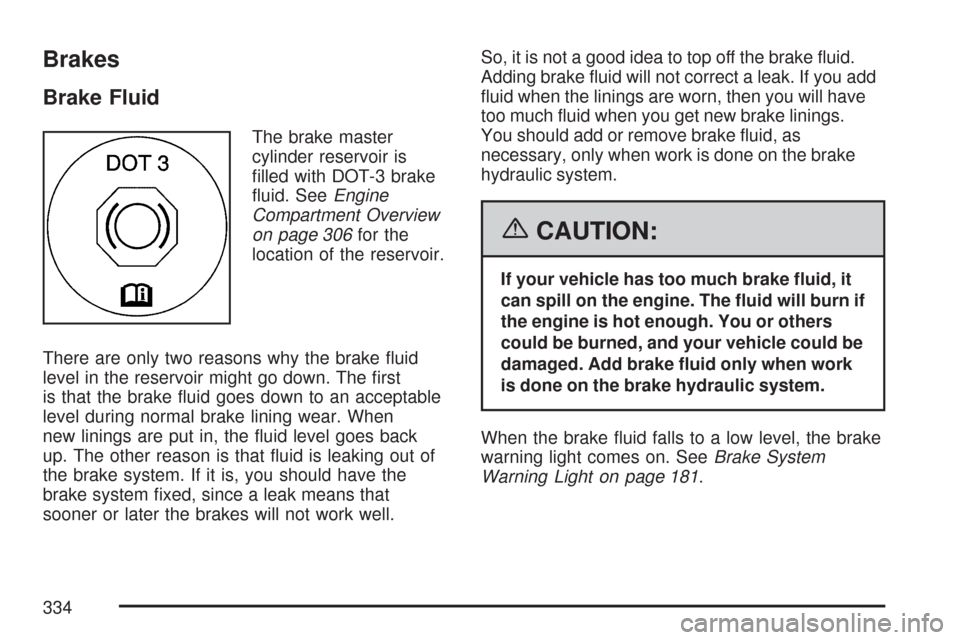
The brake master
cylinder reservoir is
lled with DOT-3 brake
uid. SeeEngine
Compartment Overview
on page 306for the
location of the reservoir.
There are only two reasons why the brake uid
level in the reservoir might go down. The rst
is that the brake uid goes down to an acceptable
level during normal brake lining wear. When
new linings are put in, the uid level goes back
up. The other reason is that uid is leaking out of
the brake system. If it is, you should have the
brake system xed, since a leak means that
sooner or later the brakes will not work well.So, it is not a good idea to top off the brake uid.
Adding brake uid will not correct a leak. If you add
uid when the linings are worn, then you will have
too much uid when you get new brake linings.
You should add or remove brake uid, as
necessary, only when work is done on the brake
hydraulic system.
{CAUTION:
If your vehicle has too much brake uid, it
can spill on the engine. The uid will burn if
the engine is hot enough. You or others
could be burned, and your vehicle could be
damaged. Add brake uid only when work
is done on the brake hydraulic system.
When the brake uid falls to a low level, the brake
warning light comes on. SeeBrake System
Warning Light on page 181.
334
Page 336 of 460
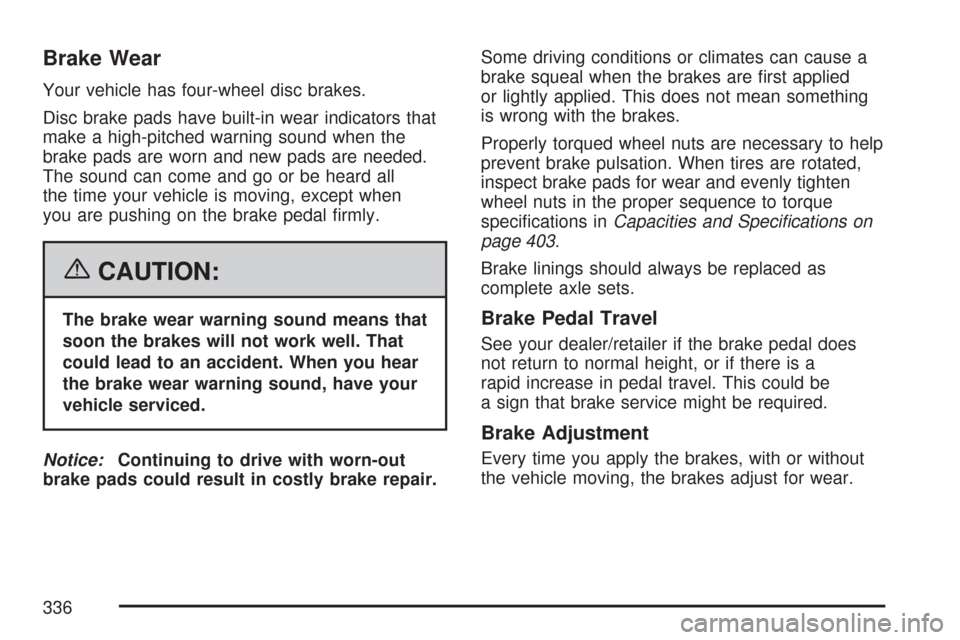
Brake Wear
Your vehicle has four-wheel disc brakes.
Disc brake pads have built-in wear indicators that
make a high-pitched warning sound when the
brake pads are worn and new pads are needed.
The sound can come and go or be heard all
the time your vehicle is moving, except when
you are pushing on the brake pedal rmly.
{CAUTION:
The brake wear warning sound means that
soon the brakes will not work well. That
could lead to an accident. When you hear
the brake wear warning sound, have your
vehicle serviced.
Notice:Continuing to drive with worn-out
brake pads could result in costly brake repair.Some driving conditions or climates can cause a
brake squeal when the brakes are rst applied
or lightly applied. This does not mean something
is wrong with the brakes.
Properly torqued wheel nuts are necessary to help
prevent brake pulsation. When tires are rotated,
inspect brake pads for wear and evenly tighten
wheel nuts in the proper sequence to torque
specications inCapacities and Specications on
page 403.
Brake linings should always be replaced as
complete axle sets.Brake Pedal Travel
See your dealer/retailer if the brake pedal does
not return to normal height, or if there is a
rapid increase in pedal travel. This could be
a sign that brake service might be required.
Brake Adjustment
Every time you apply the brakes, with or without
the vehicle moving, the brakes adjust for wear.
336
Page 339 of 460
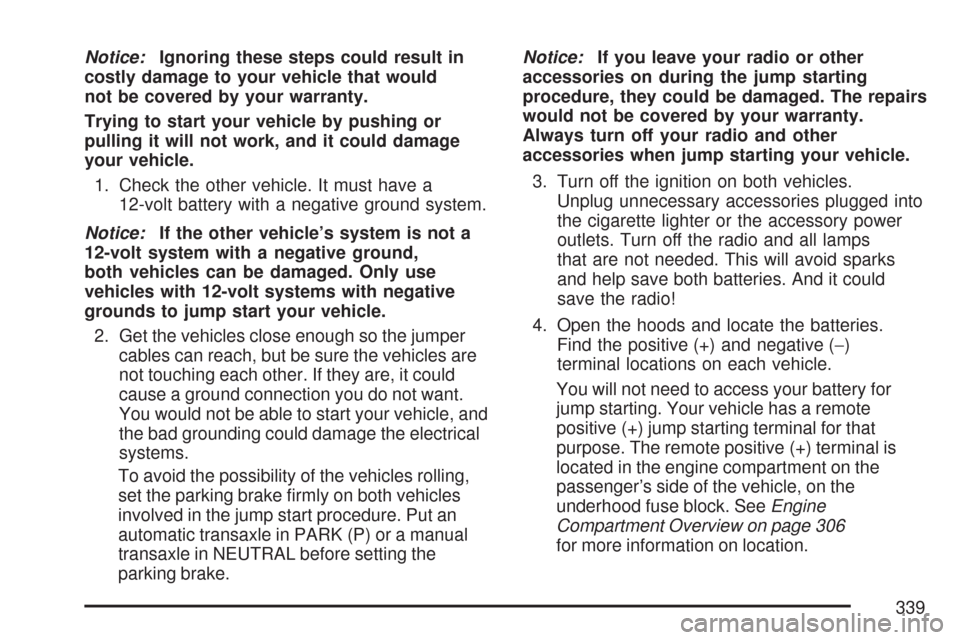
Notice:Ignoring these steps could result in
costly damage to your vehicle that would
not be covered by your warranty.
Trying to start your vehicle by pushing or
pulling it will not work, and it could damage
your vehicle.
1. Check the other vehicle. It must have a
12-volt battery with a negative ground system.
Notice:If the other vehicle’s system is not a
12-volt system with a negative ground,
both vehicles can be damaged. Only use
vehicles with 12-volt systems with negative
grounds to jump start your vehicle.
2. Get the vehicles close enough so the jumper
cables can reach, but be sure the vehicles are
not touching each other. If they are, it could
cause a ground connection you do not want.
You would not be able to start your vehicle, and
the bad grounding could damage the electrical
systems.
To avoid the possibility of the vehicles rolling,
set the parking brake rmly on both vehicles
involved in the jump start procedure. Put an
automatic transaxle in PARK (P) or a manual
transaxle in NEUTRAL before setting the
parking brake.Notice:If you leave your radio or other
accessories on during the jump starting
procedure, they could be damaged. The repairs
would not be covered by your warranty.
Always turn off your radio and other
accessories when jump starting your vehicle.
3. Turn off the ignition on both vehicles.
Unplug unnecessary accessories plugged into
the cigarette lighter or the accessory power
outlets. Turn off the radio and all lamps
that are not needed. This will avoid sparks
and help save both batteries. And it could
save the radio!
4. Open the hoods and locate the batteries.
Find the positive (+) and negative (−)
terminal locations on each vehicle.
You will not need to access your battery for
jump starting. Your vehicle has a remote
positive (+) jump starting terminal for that
purpose. The remote positive (+) terminal is
located in the engine compartment on the
passenger’s side of the vehicle, on the
underhood fuse block. SeeEngine
Compartment Overview on page 306
for more information on location.
339
Page 401 of 460
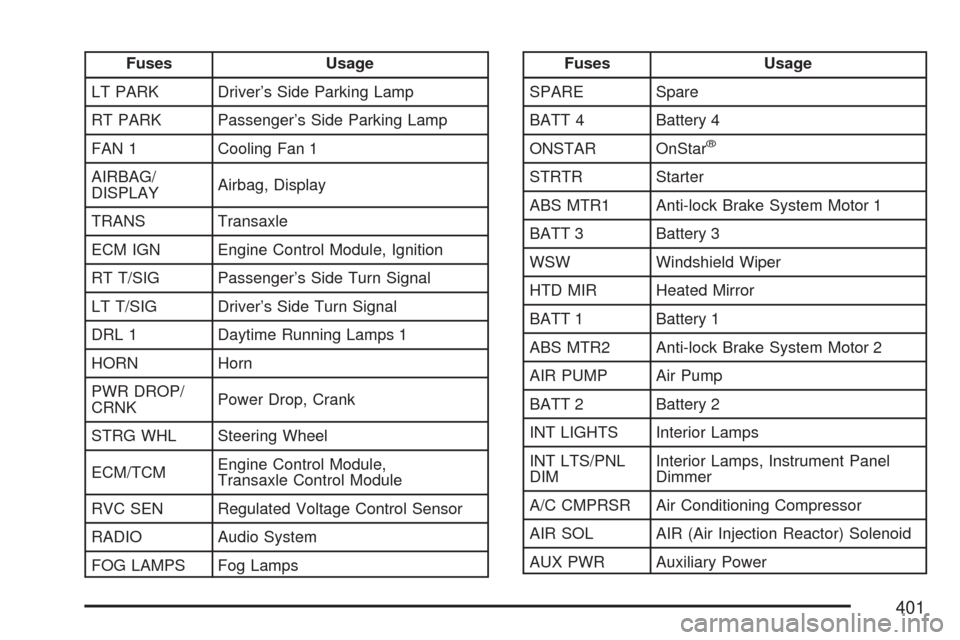
Fuses Usage
LT PARK Driver’s Side Parking Lamp
RT PARK Passenger’s Side Parking Lamp
FAN 1 Cooling Fan 1
AIRBAG/
DISPLAYAirbag, Display
TRANS Transaxle
ECM IGN Engine Control Module, Ignition
RT T/SIG Passenger’s Side Turn Signal
LT T/SIG Driver’s Side Turn Signal
DRL 1 Daytime Running Lamps 1
HORN Horn
PWR DROP/
CRNKPower Drop, Crank
STRG WHL Steering Wheel
ECM/TCMEngine Control Module,
Transaxle Control Module
RVC SEN Regulated Voltage Control Sensor
RADIO Audio System
FOG LAMPS Fog LampsFuses Usage
SPARE Spare
BATT 4 Battery 4
ONSTAR OnStar
®
STRTR Starter
ABS MTR1 Anti-lock Brake System Motor 1
BATT 3 Battery 3
WSW Windshield Wiper
HTD MIR Heated Mirror
BATT 1 Battery 1
ABS MTR2 Anti-lock Brake System Motor 2
AIR PUMP Air Pump
BATT 2 Battery 2
INT LIGHTS Interior Lamps
INT LTS/PNL
DIMInterior Lamps, Instrument Panel
Dimmer
A/C CMPRSR Air Conditioning Compressor
AIR SOL AIR (Air Injection Reactor) Solenoid
AUX PWR Auxiliary Power
401
Page 412 of 460
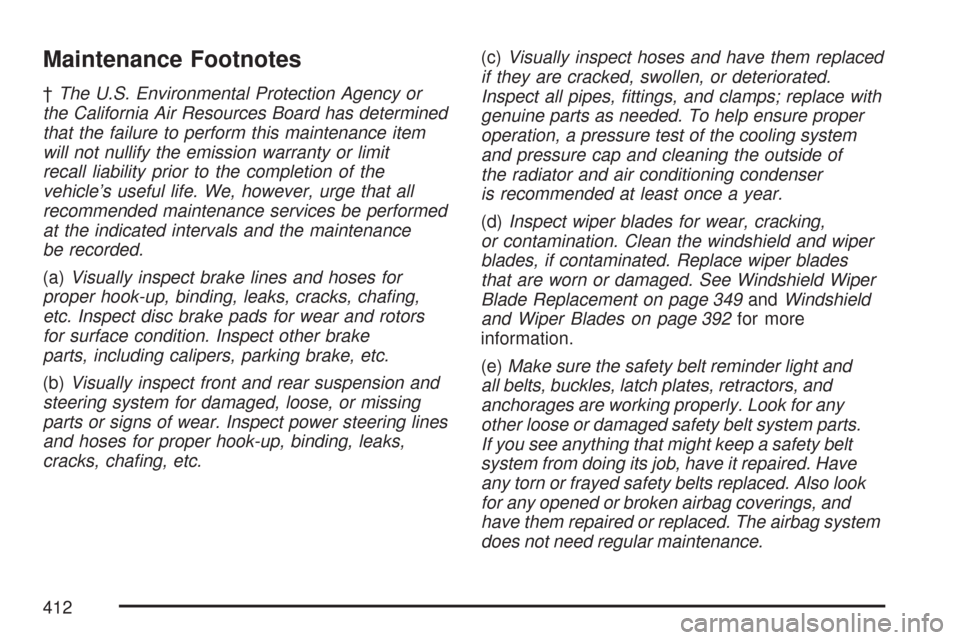
Maintenance Footnotes
†The U.S. Environmental Protection Agency or
the California Air Resources Board has determined
that the failure to perform this maintenance item
will not nullify the emission warranty or limit
recall liability prior to the completion of the
vehicle’s useful life. We, however, urge that all
recommended maintenance services be performed
at the indicated intervals and the maintenance
be recorded.
(a)Visually inspect brake lines and hoses for
proper hook-up, binding, leaks, cracks, chang,
etc. Inspect disc brake pads for wear and rotors
for surface condition. Inspect other brake
parts, including calipers, parking brake, etc.
(b)Visually inspect front and rear suspension and
steering system for damaged, loose, or missing
parts or signs of wear. Inspect power steering lines
and hoses for proper hook-up, binding, leaks,
cracks, chang, etc.(c)Visually inspect hoses and have them replaced
if they are cracked, swollen, or deteriorated.
Inspect all pipes, ttings, and clamps; replace with
genuine parts as needed. To help ensure proper
operation, a pressure test of the cooling system
and pressure cap and cleaning the outside of
the radiator and air conditioning condenser
is recommended at least once a year.
(d)Inspect wiper blades for wear, cracking,
or contamination. Clean the windshield and wiper
blades, if contaminated. Replace wiper blades
that are worn or damaged. See Windshield Wiper
Blade Replacement on page 349andWindshield
and Wiper Blades on page 392for more
information.
(e)Make sure the safety belt reminder light and
all belts, buckles, latch plates, retractors, and
anchorages are working properly. Look for any
other loose or damaged safety belt system parts.
If you see anything that might keep a safety belt
system from doing its job, have it repaired. Have
any torn or frayed safety belts replaced. Also look
for any opened or broken airbag coverings, and
have them repaired or replaced. The airbag system
does not need regular maintenance.
412
Page 445 of 460
A
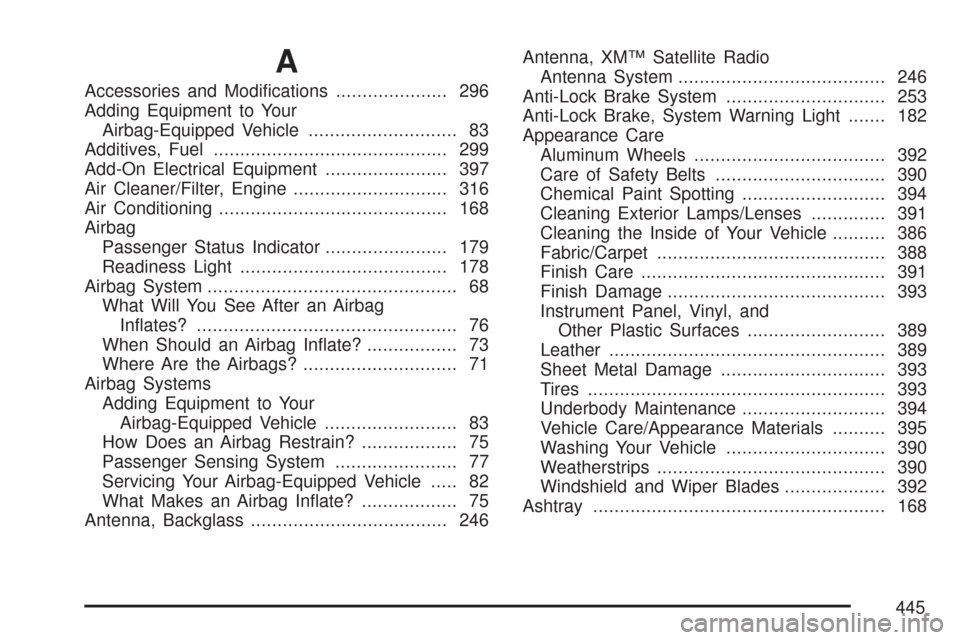
Accessories and Modications..................... 296
Adding Equipment to Your
Airbag-Equipped Vehicle............................ 83
Additives, Fuel............................................ 299
Add-On Electrical Equipment....................... 397
Air Cleaner/Filter, Engine............................. 316
Air Conditioning........................................... 168
Airbag
Passenger Status Indicator....................... 179
Readiness Light....................................... 178
Airbag System............................................... 68
What Will You See After an Airbag
Inates?................................................. 76
When Should an Airbag Inate?................. 73
Where Are the Airbags?............................. 71
Airbag Systems
Adding Equipment to Your
Airbag-Equipped Vehicle......................... 83
How Does an Airbag Restrain?.................. 75
Passenger Sensing System....................... 77
Servicing Your Airbag-Equipped Vehicle..... 82
What Makes an Airbag Inate?.................. 75
Antenna, Backglass..................................... 246Antenna, XM™ Satellite Radio
Antenna System....................................... 246
Anti-Lock Brake System.............................. 253
Anti-Lock Brake, System Warning Light....... 182
Appearance Care
Aluminum Wheels.................................... 392
Care of Safety Belts................................ 390
Chemical Paint Spotting........................... 394
Cleaning Exterior Lamps/Lenses.............. 391
Cleaning the Inside of Your Vehicle.......... 386
Fabric/Carpet........................................... 388
Finish Care.............................................. 391
Finish Damage......................................... 393
Instrument Panel, Vinyl, and
Other Plastic Surfaces.......................... 389
Leather.................................................... 389
Sheet Metal Damage............................... 393
Tires........................................................ 393
Underbody Maintenance........................... 394
Vehicle Care/Appearance Materials.......... 395
Washing Your Vehicle.............................. 390
Weatherstrips........................................... 390
Windshield and Wiper Blades................... 392
Ashtray....................................................... 168
445
Page 446 of 460
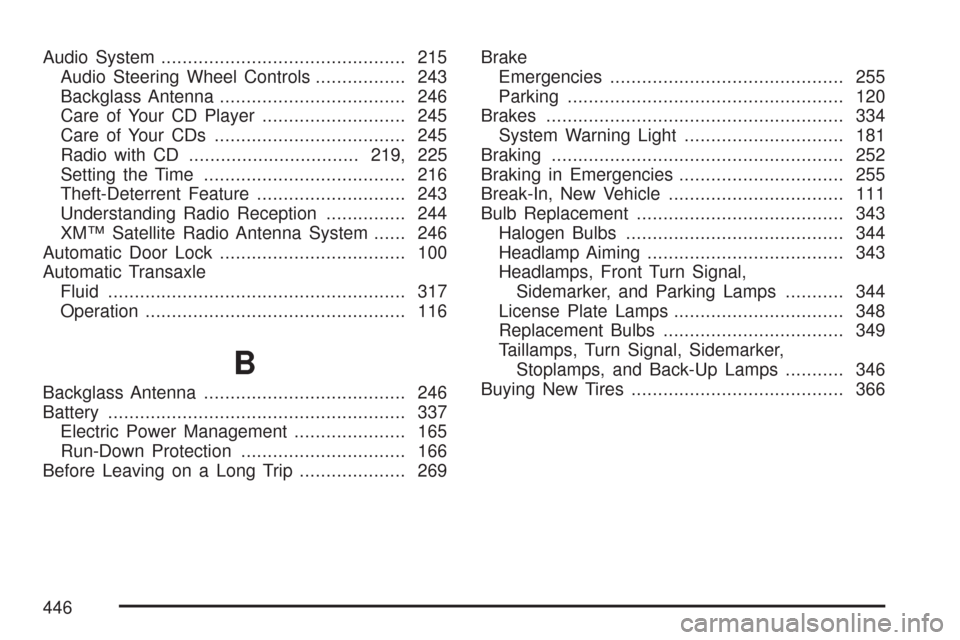
Audio System.............................................. 215
Audio Steering Wheel Controls................. 243
Backglass Antenna................................... 246
Care of Your CD Player........................... 245
Care of Your CDs.................................... 245
Radio with CD................................219, 225
Setting the Time...................................... 216
Theft-Deterrent Feature............................ 243
Understanding Radio Reception............... 244
XM™ Satellite Radio Antenna System...... 246
Automatic Door Lock................................... 100
Automatic Transaxle
Fluid........................................................ 317
Operation................................................. 116
B
Backglass Antenna...................................... 246
Battery........................................................ 337
Electric Power Management..................... 165
Run-Down Protection............................... 166
Before Leaving on a Long Trip.................... 269Brake
Emergencies............................................ 255
Parking.................................................... 120
Brakes........................................................ 334
System Warning Light.............................. 181
Braking....................................................... 252
Braking in Emergencies............................... 255
Break-In, New Vehicle................................. 111
Bulb Replacement....................................... 343
Halogen Bulbs......................................... 344
Headlamp Aiming..................................... 343
Headlamps, Front Turn Signal,
Sidemarker, and Parking Lamps........... 344
License Plate Lamps................................ 348
Replacement Bulbs.................................. 349
Taillamps, Turn Signal, Sidemarker,
Stoplamps, and Back-Up Lamps........... 346
Buying New Tires........................................ 366
446