mirror CHEVROLET IMPALA 2007 9.G User Guide
[x] Cancel search | Manufacturer: CHEVROLET, Model Year: 2007, Model line: IMPALA, Model: CHEVROLET IMPALA 2007 9.GPages: 460, PDF Size: 2.56 MB
Page 263 of 460
If you have the Anti-Lock Brake System (ABS),
remember: It helps avoid only the braking skid.
If you do not have ABS, then in a braking
skid, where the wheels are no longer rolling,
release enough pressure on the brakes to get
the wheels rolling again. This restores steering
control. Push the brake pedal down steadily
when you have to stop suddenly. As long as the
wheels are rolling, you will have steering control.
Driving at Night
Night driving is more dangerous than day driving.
One reason is that some drivers are likely to
be impaired — by alcohol or drugs, with night
vision problems, or by fatigue.
Here are some tips on night driving.
Drive defensively.
Do not drink and drive.
Adjust the inside rearview mirror to reduce the
glare from headlamps behind you.
Since you cannot see as well, slow down and
keep more space between you and other
vehicles.
Slow down, especially on higher speed roads.
Your vehicle’s headlamps can light up only so
much road ahead.
In remote areas, watch for animals.
If you are tired, pull off the road in a safe
place and rest.
No one can see as well at night as in the daytime.
But as we get older these differences increase.
A 50-year-old driver might require at least twice as
much light to see the same thing at night as a
20-year-old.
What you do in the daytime can also affect your
night vision. For example, if you spend the
day in bright sunshine you are wise to wear
sunglasses. Your eyes will have less trouble
adjusting to night. But if you are driving, do not
wear sunglasses at night. They might cut down on
glare from headlamps, but they also make a lot
of things invisible.
263
Page 268 of 460
Freeway Driving
Mile for mile, freeways — also called thruways,
parkways, expressways, turnpikes, or
superhighways — are the safest of all roads.
But they have their own special rules.The most important advice on freeway driving
is: Keep up with traffic and keep to the right. Drive
at the same speed most of the other drivers are
driving. Too-fast or too-slow driving breaks a
smooth traffic ow. Treat the left lane on a freeway
as a passing lane.
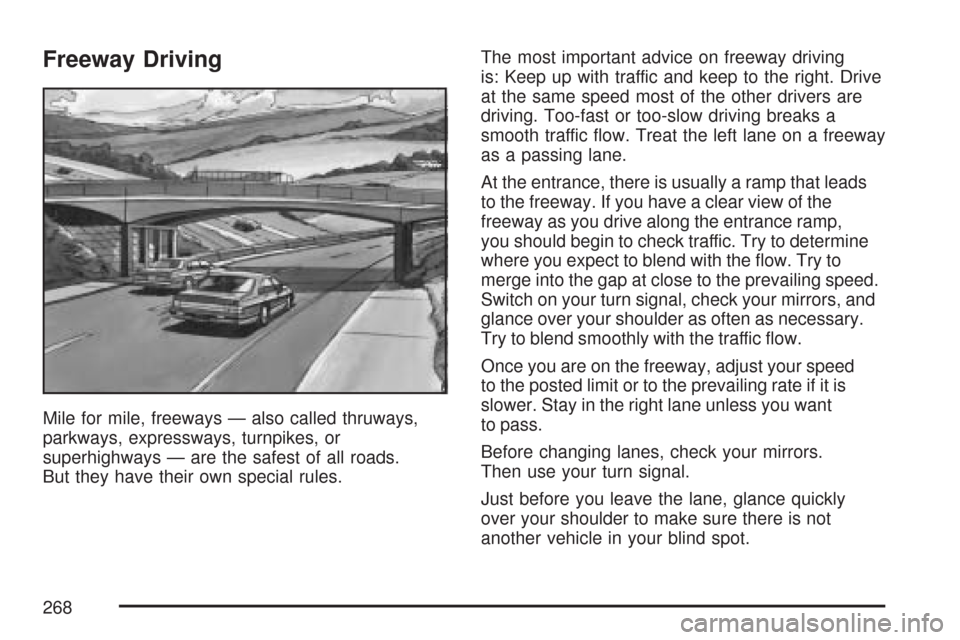
At the entrance, there is usually a ramp that leads
to the freeway. If you have a clear view of the
freeway as you drive along the entrance ramp,
you should begin to check traffic. Try to determine
where you expect to blend with the ow. Try to
merge into the gap at close to the prevailing speed.
Switch on your turn signal, check your mirrors, and
glance over your shoulder as often as necessary.
Try to blend smoothly with the traffic ow.
Once you are on the freeway, adjust your speed
to the posted limit or to the prevailing rate if it is
slower. Stay in the right lane unless you want
to pass.
Before changing lanes, check your mirrors.
Then use your turn signal.
Just before you leave the lane, glance quickly
over your shoulder to make sure there is not
another vehicle in your blind spot.
268
Page 270 of 460
Highway Hypnosis
Is there actually such a condition as highway
hypnosis? Or is it just plain falling asleep at the
wheel? Call it highway hypnosis, lack of
awareness, or whatever.
There is something about an easy stretch of road
with the same scenery, along with the hum of the
tires on the road, the drone of the engine, and the
rush of the wind against the vehicle that can make
you sleepy. Do not let it happen to you! If it does,
your vehicle can leave the road in less than a
second, and you could crash and be injured.
What can you do about highway hypnosis?
First, be aware that it can happen.
Then here are some tips:
Make sure your vehicle is well ventilated, with
a comfortably cool interior.
Keep your eyes moving. Scan the road ahead
and to the sides. Check your rearview mirrors
and your instruments frequently.
If you get sleepy, pull off the road into a rest,
service, or parking area and take a nap, get
some exercise, or both. For safety, treat
drowsiness on the highway as an emergency.
Hill and Mountain Roads
Driving on steep hills or mountains is different
from driving in at or rolling terrain.
If you drive regularly in steep country, or if you are
planning to visit there, here are some tips that
can make your trips safer and more enjoyable.
Keep your vehicle in good shape. Check
all uid levels and also the brakes, tires,
cooling system, and transaxle. These parts
can work hard on mountain roads.
270
Page 288 of 460
Trailer Brakes
Does your trailer have its own brakes? Be sure to
read and follow the instructions for the trailer
brakes so you’ll be able to install, adjust
and maintain them properly.
If your vehicle has anti-lock brakes, do not try
to tap into your vehicle’s brake system. If you
do, both brake systems won’t work well, or
at all.
Even if your vehicle doesn’t have anti-lock
brakes, don’t tap into your vehicle’s brake
system if the trailer’s brake system will
use more than 0.02 cubic inch (0.3 cc) of uid
from your vehicle’s master cylinder. If it
does, both braking systems won’t work well.
You could even lose your brakes.
Will the trailer brake parts take 3,000 psi
(20 650 kPa) of pressure? If not, the
trailer brake system must not be used with
your vehicle.
If everything checks out this far, then make
the brake uid tap at the upper rear master
cylinder port. But don’t use copper tubing
for this. If you do, it will bend and break off.
Use steel brake tubing.
Driving with a Trailer
Towing a trailer requires a certain amount of
experience. Before setting out for the open road,
you’ll want to get to know your rig. Acquaint
yourself with the feel of handling and braking with
the added weight of the trailer. And always
keep in mind that the vehicle you are driving is
now a good deal longer and not nearly as
responsive as your vehicle is by itself.
Before you start, check the trailer hitch and
platform (and attachments), safety chains,
electrical connector, lamps, tires and mirror
adjustment. If the trailer has electric brakes, start
your vehicle and trailer moving and then apply
the trailer brake controller by hand to be sure the
brakes are working. This lets you check your
electrical connection at the same time.
During your trip, check occasionally to be sure
that the load is secure, and that the lamps and any
trailer brakes are still working.
288
Page 399 of 460
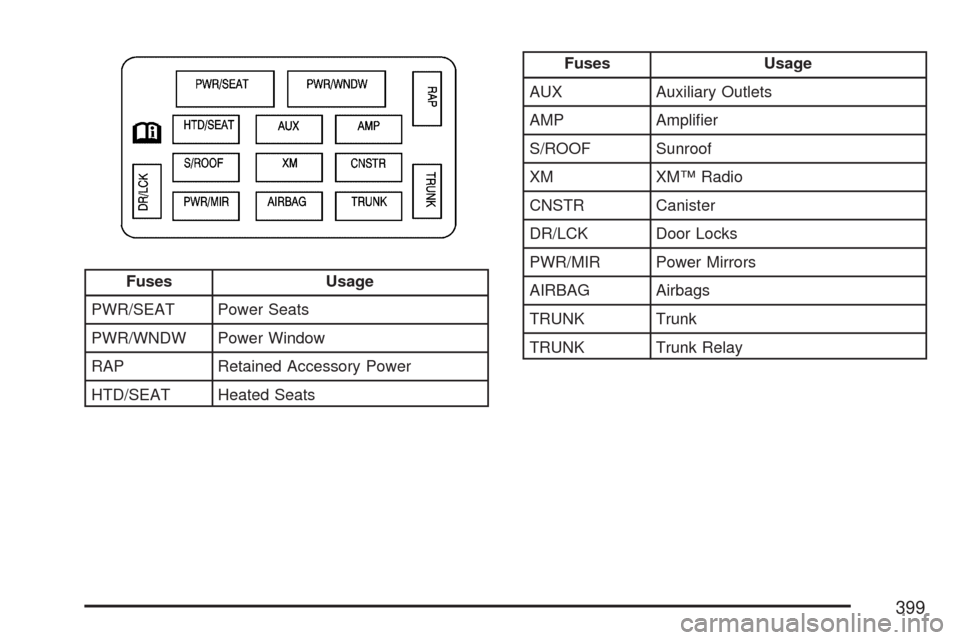
Fuses Usage
PWR/SEAT Power Seats
PWR/WNDW Power Window
RAP Retained Accessory Power
HTD/SEAT Heated Seats
Fuses Usage
AUX Auxiliary Outlets
AMP Amplier
S/ROOF Sunroof
XM XM™ Radio
CNSTR Canister
DR/LCK Door Locks
PWR/MIR Power Mirrors
AIRBAG Airbags
TRUNK Trunk
TRUNK Trunk Relay
399
Page 401 of 460
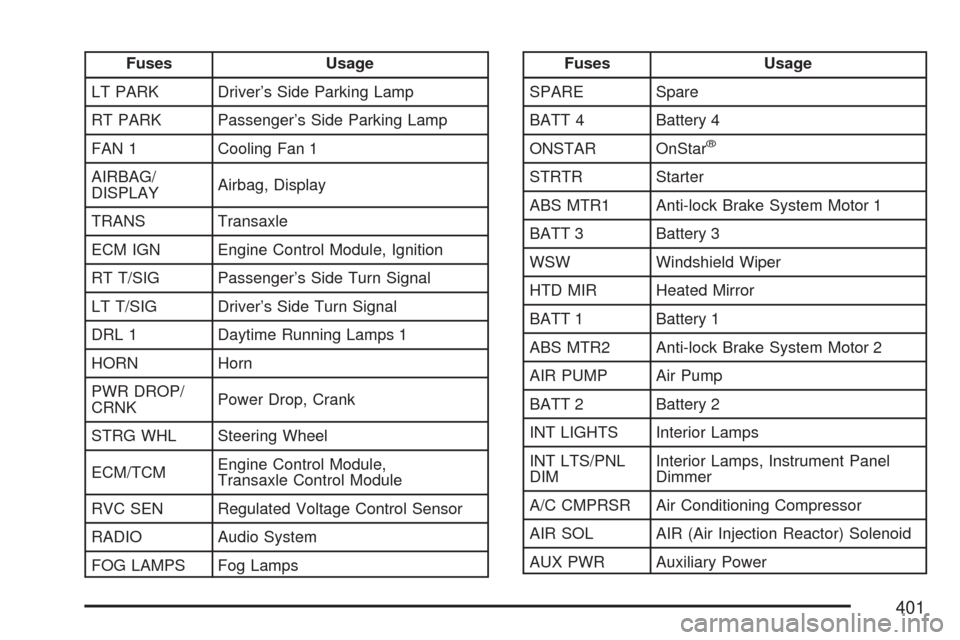
Fuses Usage
LT PARK Driver’s Side Parking Lamp
RT PARK Passenger’s Side Parking Lamp
FAN 1 Cooling Fan 1
AIRBAG/
DISPLAYAirbag, Display
TRANS Transaxle
ECM IGN Engine Control Module, Ignition
RT T/SIG Passenger’s Side Turn Signal
LT T/SIG Driver’s Side Turn Signal
DRL 1 Daytime Running Lamps 1
HORN Horn
PWR DROP/
CRNKPower Drop, Crank
STRG WHL Steering Wheel
ECM/TCMEngine Control Module,
Transaxle Control Module
RVC SEN Regulated Voltage Control Sensor
RADIO Audio System
FOG LAMPS Fog LampsFuses Usage
SPARE Spare
BATT 4 Battery 4
ONSTAR OnStar
®
STRTR Starter
ABS MTR1 Anti-lock Brake System Motor 1
BATT 3 Battery 3
WSW Windshield Wiper
HTD MIR Heated Mirror
BATT 1 Battery 1
ABS MTR2 Anti-lock Brake System Motor 2
AIR PUMP Air Pump
BATT 2 Battery 2
INT LIGHTS Interior Lamps
INT LTS/PNL
DIMInterior Lamps, Instrument Panel
Dimmer
A/C CMPRSR Air Conditioning Compressor
AIR SOL AIR (Air Injection Reactor) Solenoid
AUX PWR Auxiliary Power
401
Page 454 of 460
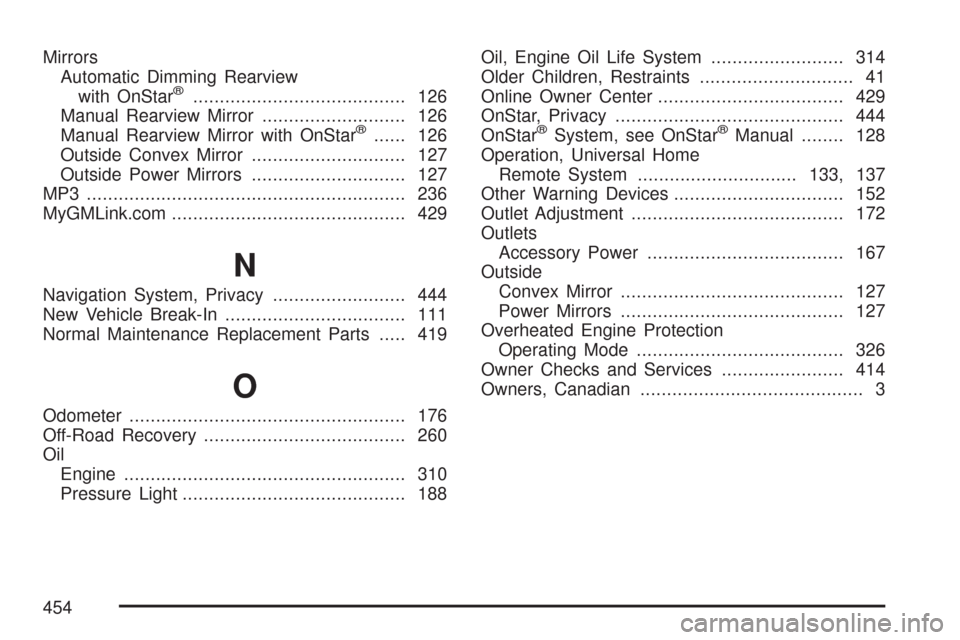
Mirrors
Automatic Dimming Rearview
with OnStar
®........................................ 126
Manual Rearview Mirror........................... 126
Manual Rearview Mirror with OnStar
®...... 126
Outside Convex Mirror............................. 127
Outside Power Mirrors............................. 127
MP3 ............................................................ 236
MyGMLink.com............................................ 429
N
Navigation System, Privacy......................... 444
New Vehicle Break-In.................................. 111
Normal Maintenance Replacement Parts..... 419
O
Odometer.................................................... 176
Off-Road Recovery...................................... 260
Oil
Engine..................................................... 310
Pressure Light.......................................... 188Oil, Engine Oil Life System ......................... 314
Older Children, Restraints............................. 41
Online Owner Center................................... 429
OnStar, Privacy........................................... 444
OnStar
®System, see OnStar®Manual........ 128
Operation, Universal Home
Remote System..............................133, 137
Other Warning Devices................................ 152
Outlet Adjustment........................................ 172
Outlets
Accessory Power..................................... 167
Outside
Convex Mirror.......................................... 127
Power Mirrors.......................................... 127
Overheated Engine Protection
Operating Mode....................................... 326
Owner Checks and Services....................... 414
Owners, Canadian.......................................... 3
454
Page 456 of 460
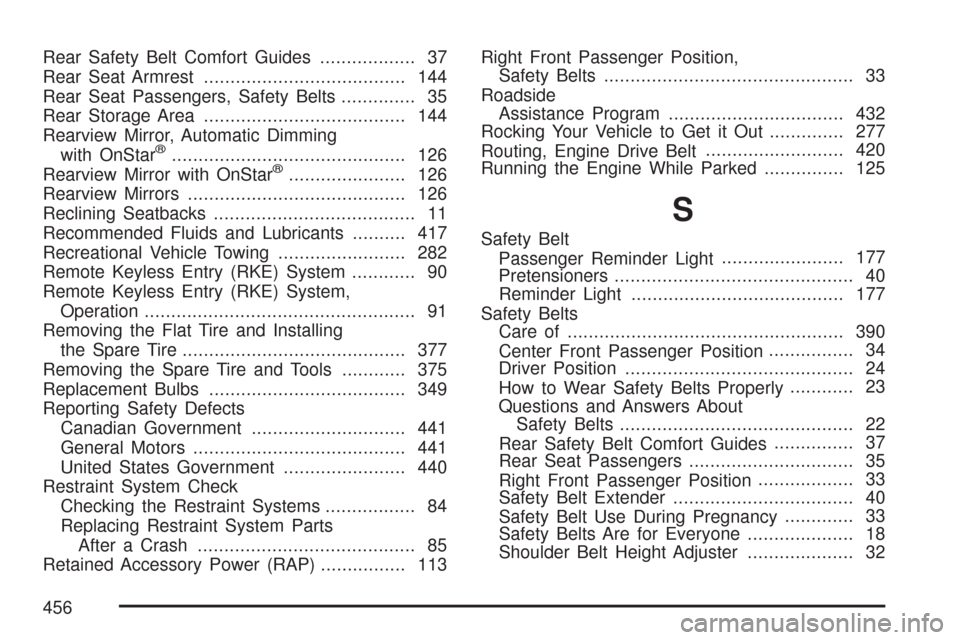
Rear Safety Belt Comfort Guides.................. 37
Rear Seat Armrest...................................... 144
Rear Seat Passengers, Safety Belts.............. 35
Rear Storage Area...................................... 144
Rearview Mirror, Automatic Dimming
with OnStar
®............................................ 126
Rearview Mirror with OnStar®...................... 126
Rearview Mirrors......................................... 126
Reclining Seatbacks...................................... 11
Recommended Fluids and Lubricants.......... 417
Recreational Vehicle Towing........................ 282
Remote Keyless Entry (RKE) System............ 90
Remote Keyless Entry (RKE) System,
Operation................................................... 91
Removing the Flat Tire and Installing
the Spare Tire.......................................... 377
Removing the Spare Tire and Tools............ 375
Replacement Bulbs..................................... 349
Reporting Safety Defects
Canadian Government............................. 441
General Motors........................................ 441
United States Government....................... 440
Restraint System Check
Checking the Restraint Systems................. 84
Replacing Restraint System Parts
After a Crash......................................... 85
Retained Accessory Power (RAP)................ 113Right Front Passenger Position,
Safety Belts............................................... 33
Roadside
Assistance Program................................. 432
Rocking Your Vehicle to Get it Out.............. 277
Routing, Engine Drive Belt.......................... 420
Running the Engine While Parked............... 125
S
Safety Belt
Passenger Reminder Light....................... 177
Pretensioners............................................. 40
Reminder Light........................................ 177
Safety Belts
Care of.................................................... 390
Center Front Passenger Position................ 34
Driver Position........................................... 24
How to Wear Safety Belts Properly............ 23
Questions and Answers About
Safety Belts............................................ 22
Rear Safety Belt Comfort Guides............... 37
Rear Seat Passengers............................... 35
Right Front Passenger Position.................. 33
Safety Belt Extender.................................. 40
Safety Belt Use During Pregnancy............. 33
Safety Belts Are for Everyone.................... 18
Shoulder Belt Height Adjuster.................... 32
456