phone CHEVROLET IMPALA 2007 9.G User Guide
[x] Cancel search | Manufacturer: CHEVROLET, Model Year: 2007, Model line: IMPALA, Model: CHEVROLET IMPALA 2007 9.GPages: 460, PDF Size: 2.56 MB
Page 244 of 460
g(Mute/Voice Recognition):Press and release
the
gbutton to silence the system. Press and
release the
gbutton again, to turn the sound on.
If your vehicle has OnStar
®, press and hold
the
gbutton for longer than one second to interact
with the OnStar®system. See theOnStar®System
on page 128in this manual for more information.
SRCE (Source):Press this button to switch
between AM, FM, XM (if equipped), CD, and
AUX jack.
+
e−e(Volume):Press the + (plus)
or−(minus)
ebutton to increase or to decrease
the radio volume.
¨(Seek):Press the¨seek arrow to go to the
next radio station and stay there.
Radio Reception
Frequency interference and static can occur
during normal radio reception if items such as cell
phone chargers, vehicle convenience accessories,
and external electronic devices are plugged
into the accessory power outlet. If there is
interference or static, unplug the item from the
accessory power outlet.
AM
The range for most AM stations is greater than for
FM, especially at night. The longer range can cause
station frequencies to interfere with each other.
For better radio reception, most AM radio stations
boosts the power levels during the day, and then
reduce these levels during the night. Static can also
occur when things like storms and power lines
interfere with radio reception. When this happens,
try reducing the treble on your radio.
244
Page 246 of 460
Backglass Antenna
The AM-FM antenna is integrated with the rear
window defogger, located in the rear window. Make
sure that the inside surface of the rear window is
not scratched and that the lines on the glass are not
damaged. If the inside surface is damaged, it could
interfere with radio reception. Also, for proper radio
reception, the antenna connector at the top-center
of the rear window needs to be properly attached to
the post on the glass.
Notice:Do not apply aftermarket glass tinting
with metallic lm. The metallic lm in some
tinting materials will interfere with or distort
the incoming radio reception. Any damage
caused to your backglass antenna due
to metallic tinting materials will not be
covered by your warranty.
Notice:Using a razor blade or sharp object to
clear the inside rear window may damage
the rear window antenna and/or the rear
window defogger. Repairs would not be
covered by your warranty. Do not clear the
inside rear window with sharp objects.
Because this antenna is built into the rear window,
there is a reduced risk of damage caused by
car washes and vandals.If static is heard on the radio, when the rear
window defogger is turned on, it could mean that
a defogger grid line has been damaged and
the grid line must be repaired.
If adding a cellular telephone to your vehicle, and
the antenna needs to be attached to the glass,
make sure that you do not damage the grid lines
for the AM-FM antenna. There is enough space
between the lines to attach a cellular telephone
antenna without interfering with radio reception.
XM™ Satellite Radio
Antenna System
The XM™ Satellite Radio antenna is located on
the roof of your vehicle. Keep this antenna clear of
snow and ice build up for clear radio reception.
A vehicle with a sunroof might not get the
best performance from the XM™ system if the
sunroof is open.
Loading items onto the roof of your vehicle can
interfere with the performance of the XM™ system.
Make sure the XM™ Satellite Radio antenna is
not obstructed.
246
Page 265 of 460
The heavier the rain, the harder it is to see.
Even if your windshield wiper blades are in good
shape, a heavy rain can make it harder to see
road signs and traffic signals, pavement markings,
the edge of the road, and even people walking.
It is wise to keep your windshield wiping equipment
in good shape and keep your windshield washer
uid reservoir lled with washer uid. Replace your
windshield wiper inserts when they show signs of
streaking or missing areas on the windshield, or
when strips of rubber start to separate from the
inserts.
{CAUTION:
Wet brakes can cause accidents. They
may not work as well in a quick stop and
may cause pulling to one side. You could
lose control of the vehicle.
After driving through a large puddle of
water or a car wash, apply the brake pedal
lightly until the brakes work normally.Driving too fast through large water puddles or
even going through some car washes can cause
problems, too. The water may affect your brakes.
Try to avoid puddles. But if you cannot, try to slow
down before you hit them.
Hydroplaning
Hydroplaning is dangerous. So much water can
build up under your tires that they can actually ride
on the water. This can happen if the road is wet
enough and you are going fast enough. When your
vehicle is hydroplaning, it has little or no contact
with the road.
Hydroplaning does not happen often. But it can if
your tires do not have much tread or if the pressure
in one or more is low. It can happen if a lot of water
is standing on the road. If you can see reections
from trees, telephone poles, or other vehicles, and
raindrops dimple the water’s surface, there could be
hydroplaning.
Hydroplaning usually happens at higher speeds.
There just is not a hard and fast rule about
hydroplaning. The best advice is to slow down
when it is raining.
265
Page 302 of 460
Filling the Tank
{CAUTION:
Fuel vapor burns violently and a fuel re
can cause bad injuries. To help avoid
injuries to you and others, read and follow
all the instructions on the pump island.
Turn off your engine when you are
refueling. Do not smoke if you are near
fuel or refueling your vehicle. Do not use
cellular phones. Keep sparks, ames, and
smoking materials away from fuel. Do not
leave the fuel pump unattended when
refueling your vehicle. This is against the
law in some places. Do not re-enter the
vehicle while pumping fuel. Keep children
away from the fuel pump; never let
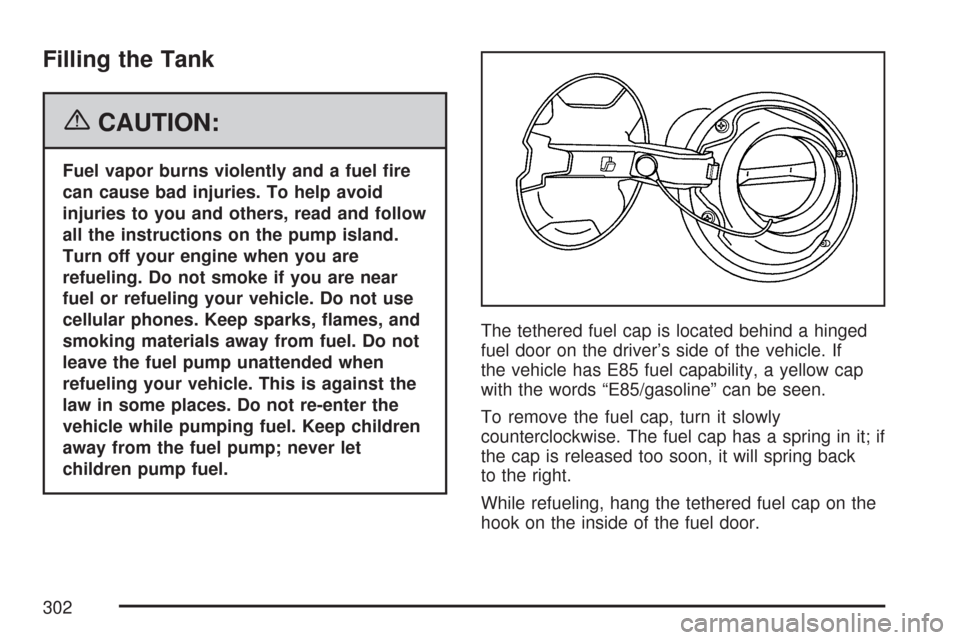
children pump fuel.The tethered fuel cap is located behind a hinged
fuel door on the driver’s side of the vehicle. If
the vehicle has E85 fuel capability, a yellow cap
with the words “E85/gasoline” can be seen.
To remove the fuel cap, turn it slowly
counterclockwise. The fuel cap has a spring in it; if
the cap is released too soon, it will spring back
to the right.
While refueling, hang the tethered fuel cap on the
hook on the inside of the fuel door.
302
Page 304 of 460
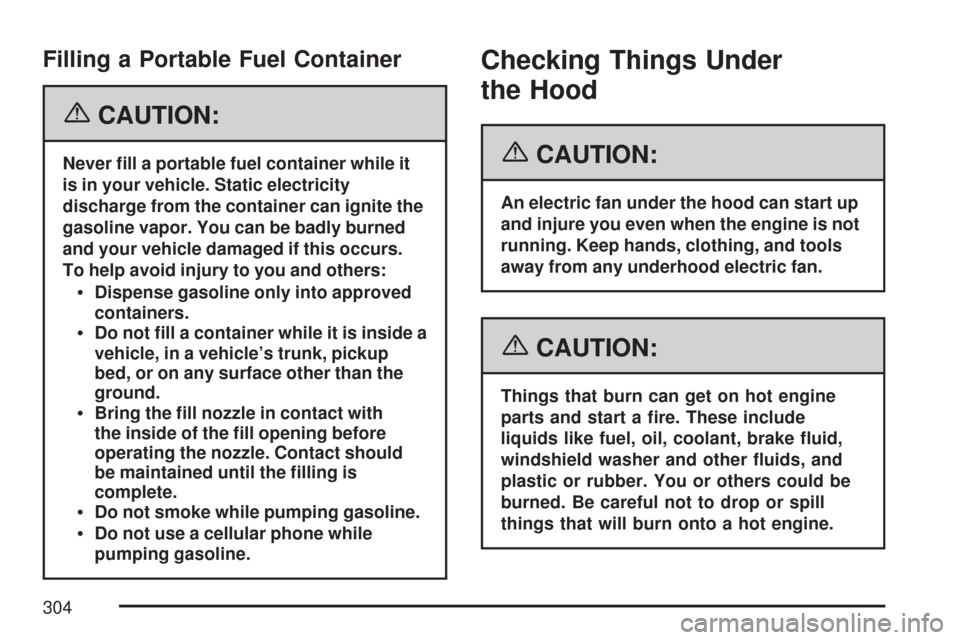
Filling a Portable Fuel Container
{CAUTION:
Never ll a portable fuel container while it
is in your vehicle. Static electricity
discharge from the container can ignite the
gasoline vapor. You can be badly burned
and your vehicle damaged if this occurs.
To help avoid injury to you and others:
Dispense gasoline only into approved
containers.
Do not ll a container while it is inside a
vehicle, in a vehicle’s trunk, pickup
bed, or on any surface other than the
ground.
Bring the ll nozzle in contact with
the inside of the ll opening before
operating the nozzle. Contact should
be maintained until the lling is
complete.
Do not smoke while pumping gasoline.
Do not use a cellular phone while
pumping gasoline.
Checking Things Under
the Hood
{CAUTION:
An electric fan under the hood can start up
and injure you even when the engine is not
running. Keep hands, clothing, and tools
away from any underhood electric fan.
{CAUTION:
Things that burn can get on hot engine
parts and start a re. These include
liquids like fuel, oil, coolant, brake uid,
windshield washer and other uids, and
plastic or rubber. You or others could be
burned. Be careful not to drop or spill
things that will burn onto a hot engine.
304
Page 425 of 460
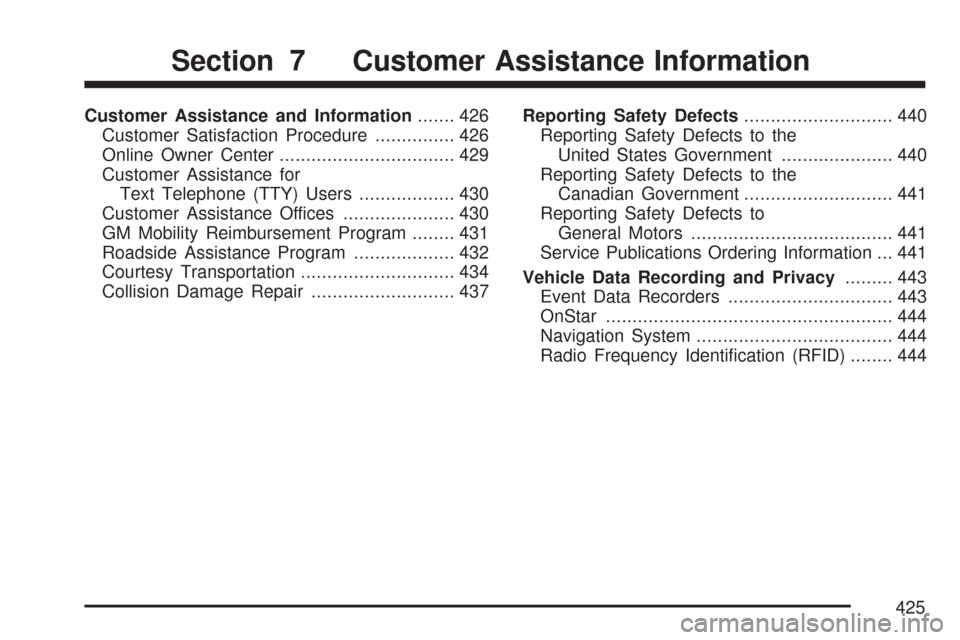
Customer Assistance and Information....... 426
Customer Satisfaction Procedure............... 426
Online Owner Center................................. 429
Customer Assistance for
Text Telephone (TTY) Users.................. 430
Customer Assistance Offices..................... 430
GM Mobility Reimbursement Program........ 431
Roadside Assistance Program................... 432
Courtesy Transportation............................. 434
Collision Damage Repair........................... 437Reporting Safety Defects............................ 440
Reporting Safety Defects to the
United States Government..................... 440
Reporting Safety Defects to the
Canadian Government............................ 441
Reporting Safety Defects to
General Motors...................................... 441
Service Publications Ordering Information ... 441
Vehicle Data Recording and Privacy......... 443
Event Data Recorders............................... 443
OnStar...................................................... 444
Navigation System..................................... 444
Radio Frequency Identication (RFID)........ 444
Section 7 Customer Assistance Information
425
Page 427 of 460
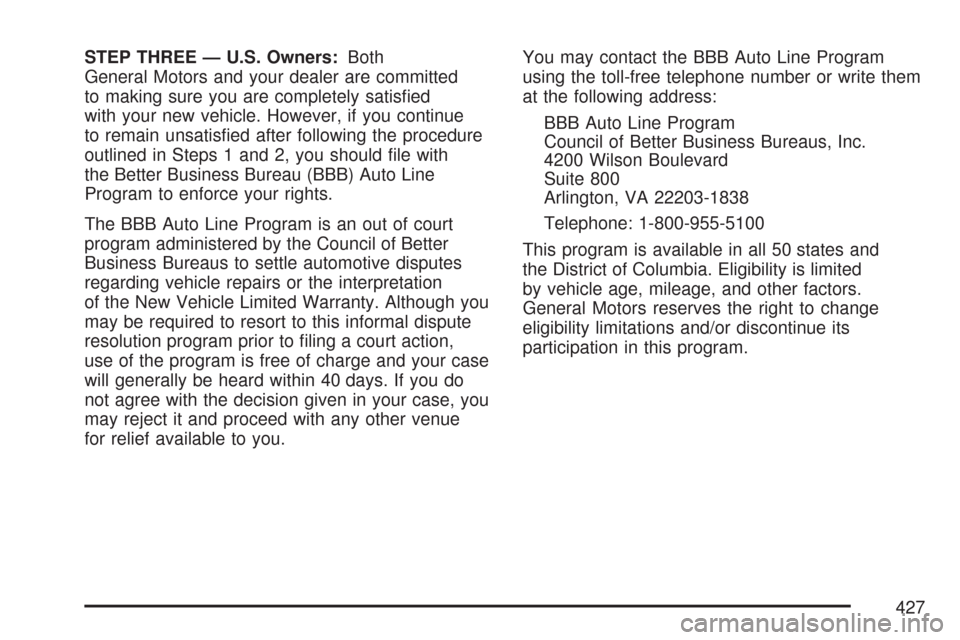
STEP THREE — U.S. Owners:Both
General Motors and your dealer are committed
to making sure you are completely satised
with your new vehicle. However, if you continue
to remain unsatised after following the procedure
outlined in Steps 1 and 2, you should le with
the Better Business Bureau (BBB) Auto Line
Program to enforce your rights.
The BBB Auto Line Program is an out of court
program administered by the Council of Better
Business Bureaus to settle automotive disputes
regarding vehicle repairs or the interpretation
of the New Vehicle Limited Warranty. Although you
may be required to resort to this informal dispute
resolution program prior to ling a court action,
use of the program is free of charge and your case
will generally be heard within 40 days. If you do
not agree with the decision given in your case, you
may reject it and proceed with any other venue
for relief available to you.You may contact the BBB Auto Line Program
using the toll-free telephone number or write them
at the following address:
BBB Auto Line Program
Council of Better Business Bureaus, Inc.
4200 Wilson Boulevard
Suite 800
Arlington, VA 22203-1838
Telephone: 1-800-955-5100
This program is available in all 50 states and
the District of Columbia. Eligibility is limited
by vehicle age, mileage, and other factors.
General Motors reserves the right to change
eligibility limitations and/or discontinue its
participation in this program.
427
Page 429 of 460
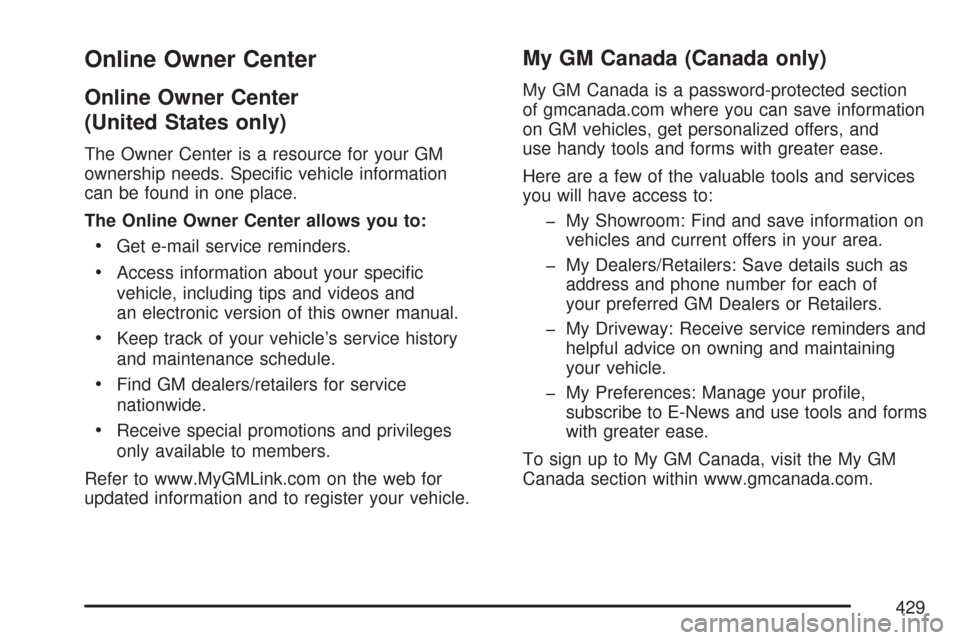
Online Owner Center
Online Owner Center
(United States only)
The Owner Center is a resource for your GM
ownership needs. Specic vehicle information
can be found in one place.
The Online Owner Center allows you to:
Get e-mail service reminders.
Access information about your specic
vehicle, including tips and videos and
an electronic version of this owner manual.
Keep track of your vehicle’s service history
and maintenance schedule.
Find GM dealers/retailers for service
nationwide.
Receive special promotions and privileges
only available to members.
Refer to www.MyGMLink.com on the web for
updated information and to register your vehicle.
My GM Canada (Canada only)
My GM Canada is a password-protected section
of gmcanada.com where you can save information
on GM vehicles, get personalized offers, and
use handy tools and forms with greater ease.
Here are a few of the valuable tools and services
you will have access to:
My Showroom: Find and save information on
vehicles and current offers in your area.
My Dealers/Retailers: Save details such as
address and phone number for each of
your preferred GM Dealers or Retailers.
My Driveway: Receive service reminders and
helpful advice on owning and maintaining
your vehicle.
My Preferences: Manage your prole,
subscribe to E-News and use tools and forms
with greater ease.
To sign up to My GM Canada, visit the My GM
Canada section within www.gmcanada.com.
429
Page 430 of 460
Customer Assistance for Text
Telephone (TTY) Users
To assist customers who are deaf, hard of
hearing, or speech-impaired and who use Text
Telephones (TTYs), Chevrolet has TTY equipment
available at its Customer Assistance Center.
Any TTY user in the U.S. can communicate with
Chevrolet by dialing: 1-800-833-CHEV (2438).
(TTY users in Canada can dial 1-800-263-3830.)
Customer Assistance Offices
Chevrolet encourages customers to call the
toll-free number for assistance. However, if a
customer wishes to write or e-mail Chevrolet, the
letter should be addressed to:
United States — Customer Assistance
Chevrolet Motor Division
Chevrolet Customer Assistance Center
P.O. Box 33170
Detroit, MI 48232-5170
www.Chevrolet.com
1-800-222-1020
1-800-833-2438 (For Text Telephone
devices (TTYs))Roadside Assistance: 1-800-CHEV-USA
(243-8872)
Fax Number: 313-381-0022
From Puerto Rico:
1-800-496-9992 (English)
1-800-496-9993 (Spanish)
Fax Number: 313-381-0022
From U.S. Virgin Islands:
1-800-496-9994
Fax Number: 313-381-0022
Canada — Customer Assistance
General Motors of Canada Limited
Customer Communication Centre, CA1-163-005
1908 Colonel Sam Drive
Oshawa, Ontario L1H 8P7
www.gmcanada.com
1-800-263-3777 (English)
1-800-263-7854 (French)
1-800-263-3830 (For Text Telephone
devices (TTYs))
Roadside Assistance: 1-800-268-6800
430
Page 431 of 460
Overseas — Customer Assistance
Please contact the local General Motors
Business Unit.
Mexico, Central America and
Caribbean Islands/Countries
(Except Puerto Rico and U.S. Virgin
Islands) —Customer Assistance
General Motors de Mexico, S. de R.L. de C.V.
Customer Assistance Center
Paseo de la Reforma # 2740
Col. Lomas de Bezares
C.P. 11910, Mexico, D.F.
01-800-508-0000
Long Distance: 011-52-53 29 0 800
GM Mobility Reimbursement
Program
This program, available to qualied applicants, can
reimburse you up to $1,000 of the cost of eligible
aftermarket adaptive equipment required for
your vehicle, such as hand controls or a
wheelchair/scooter lift.
The offer is available for a very limited period of
time from the date of vehicle purchase/lease.
For more details, or to determine your vehicle’s
eligibility, visit gmmobility.com or call the GM
Mobility Assistance Center at 1-800-323-9935.
Text telephone (TTY) users, call 1-800-833-9935.
General Motors of Canada also has a Mobility
Program. Call 1-800-GM-DRIVE (463-7483)
for details. TTY users call 1-800-263-3830.
431