trailer CHEVROLET IMPALA 2007 9.G Owner's Manual
[x] Cancel search | Manufacturer: CHEVROLET, Model Year: 2007, Model line: IMPALA, Model: CHEVROLET IMPALA 2007 9.GPages: 460, PDF Size: 2.56 MB
Page 325 of 460
If No Steam Is Coming From
Your Engine
An overheat warning can indicate a serious
problem.
If you get an engine overheat warning but see or
hear no steam, the problem may not be too
serious. Sometimes the engine can get a little too
hot when you:
Climb a long hill on a hot day.
Stop after high-speed driving.
Idle for long periods in traffic.
Tow a trailer.
If an overheat warning occurs without any sign of
steam, try this for a minute or so:
1. In heavy traffic, let the engine idle in
NEUTRAL (N) while stopped. If it is safe to do
so, pull off the road, shift to PARK (P) or
NEUTRAL (N) and let the engine idle.
2. Set the heater at the highest setting and the
fan at the highest speed and open the
windows as necessary.If the overheat warning no longer exists, the
vehicle can be driven. Just to be safe, drive slower
for about 10 minutes. If the warning does not
come back on, the vehicle can be driven normally.
If the warning continues, and you have not
stopped, pull over, stop, and park the vehicle
right away.
If there is still no sign of steam, idle the engine
for three minutes while parked. If the warning
is still there, turn off the engine and get everyone
out of the vehicle until it cools down. Also, see
“Overheated Engine Protection Operating Mode”
later in this section.
You may decide not to lift the hood but to get
service help right away.
325
Page 326 of 460
Overheated Engine Protection
Operating Mode
This emergency operating mode allows your
vehicle to be driven to a safe place in an
emergency situation. If an overheated engine
condition exists, an overheat protection mode
which alternates ring groups of cylinders helps
prevent engine damage. In this mode, you
will notice a signicant loss in power and engine
performance. The coolant temperature gage
will indicate an overheat condition exists. Driving
extended miles (km) and/or towing a trailer in
the overheat protection mode should be avoided.
Notice:After driving in the overheated
engine protection operating mode, to avoid
engine damage, allow the engine to cool before
attempting any repair. The engine oil will be
severely degraded. Repair the cause of coolant
loss, change the oil and reset the oil life
system. SeeEngine Oil on page 310.
Cooling System
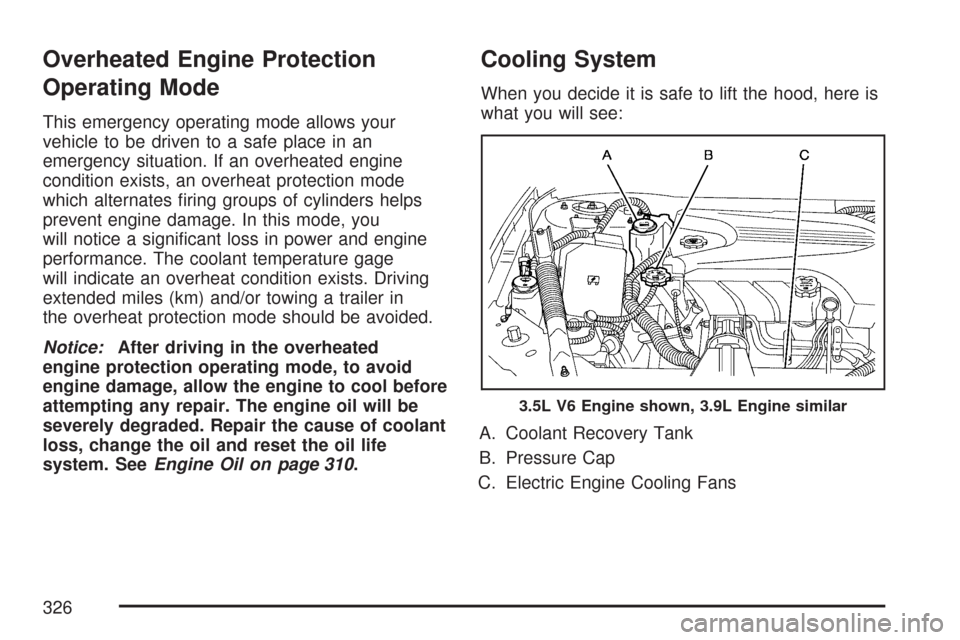
When you decide it is safe to lift the hood, here is
what you will see:
A. Coolant Recovery Tank
B. Pressure Cap
C. Electric Engine Cooling Fans
3.5L V6 Engine shown, 3.9L Engine similar
326
Page 413 of 460
(f)Lubricate all key lock cylinders. Lubricate
all hinges and latches, including those for the body
doors, hood, secondary latch, pivots, spring
anchor, release pawl, rear compartment, glove
box door, console door, and any folding seat
hardware. More frequent lubrication may
be required when exposed to a corrosive
environment. Applying silicone grease on
weatherstrips with a clean cloth will make them
last longer, seal better, and not stick or squeak.
(g)If you drive regularly under dusty conditions,
the lter may require replacement more often.
(h)Change automatic transmission uid and lter
if the vehicle is mainly driven under one or
more of these conditions:
In heavy city traffic where the outside
temperature regularly reaches 90°F (32°C)
or higher.
In hilly or mountainous terrain.
When doing frequent trailer towing.
Uses such as found in taxi, police, or delivery
service.(i)Drain, ush, and rell cooling system.
This service can be complex; you should have
your dealer/retailer perform this service. See
Engine Coolant on page 320for what to use.
Inspect hoses. Clean radiator, condenser, pressure
cap, and ller neck. Pressure test the cooling
system and pressure cap.
(j)Check throttle system for interference or
binding and for damaged or missing parts. Replace
parts as needed. Replace any components that
have high effort or excessive wear. Do not
lubricate accelerator or cruise control cables.
(k)A uid loss in any vehicle system could indicate
a problem. Have the system inspected and repaired
and the uid level checked. Add uid if needed.
(m)If you drive regularly under dusty conditions,
inspect the lter at each engine oil change.
(n)Visually inspect belt for fraying, excessive
cracks, or obvious damage. Replace belt if
necessary.
413
Page 458 of 460
T
Tachometer................................................. 176
Taillamps
Turn Signal, Sidemarker, Stoplamps, and
Back-Up Lamps.................................... 346
TCS Warning Light...................................... 183
Theft-Deterrent, Radio................................. 243
Theft-Deterrent Systems.............................. 107
Content Theft-Deterrent............................ 107
PASS-Key
®III+........................................ 108
PASS-Key®III+ Operation........................ 109
Tilt Wheel.................................................... 153
Time, Setting............................................... 216
Tire
Pressure Light.......................................... 184
Tires........................................................... 351
Aluminum Wheels, Cleaning..................... 392
Buying New Tires..................................... 366
Chains..................................................... 372
Changing a Flat Tire................................ 374
Cleaning.................................................. 393
Compact Spare Tire................................. 385
Different Size........................................... 368
If a Tire Goes Flat................................... 373Tires (cont.)
Ination - Tire Pressure............................ 359
Inspection and Rotation............................ 364
Installing the Spare Tire........................... 377
Pressure Monitor System ......................... 360
Removing the Flat Tire............................. 377
Removing the Spare Tire and Tools......... 375
Storing a Flat or Spare Tire and Tools..... 383
Tire Sidewall Labeling.............................. 352
Tire Terminology and Denitions............... 356
Uniform Tire Quality Grading.................... 369
Wheel Alignment and Tire Balance........... 370
Wheel Replacement................................. 371
When It Is Time for New Tires................. 366
Towing
Recreational Vehicle................................. 282
Towing a Trailer....................................... 284
Your Vehicle............................................. 282
Traction
Control System (TCS).............................. 256
Control System Warning Light.................. 183
Trunk.......................................................... 102
Turn and Lane-Change Signals................... 154
Turn Signal/Multifunction Lever.................... 153
458