lock CHEVROLET IMPALA 2008 9.G Owners Manual
[x] Cancel search | Manufacturer: CHEVROLET, Model Year: 2008, Model line: IMPALA, Model: CHEVROLET IMPALA 2008 9.GPages: 400, PDF Size: 5.37 MB
Page 348 of 400
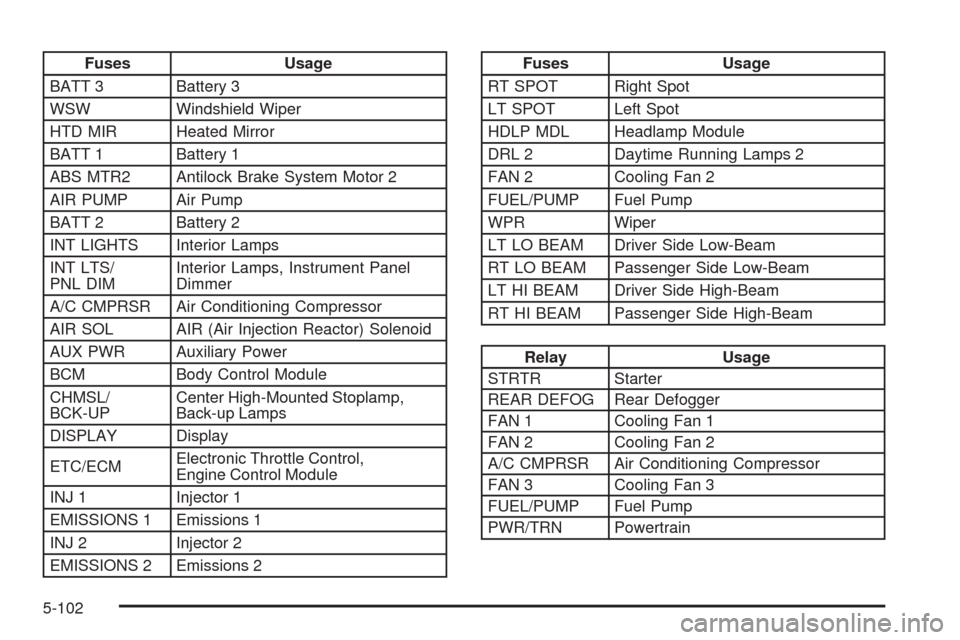
Fuses Usage
BATT 3 Battery 3
WSW Windshield Wiper
HTD MIR Heated Mirror
BATT 1 Battery 1
ABS MTR2 Antilock Brake System Motor 2
AIR PUMP Air Pump
BATT 2 Battery 2
INT LIGHTS Interior Lamps
INT LTS/
PNL DIMInterior Lamps, Instrument Panel
Dimmer
A/C CMPRSR Air Conditioning Compressor
AIR SOL AIR (Air Injection Reactor) Solenoid
AUX PWR Auxiliary Power
BCM Body Control Module
CHMSL/
BCK-UPCenter High-Mounted Stoplamp,
Back-up Lamps
DISPLAY Display
ETC/ECMElectronic Throttle Control,
Engine Control Module
INJ 1 Injector 1
EMISSIONS 1 Emissions 1
INJ 2 Injector 2
EMISSIONS 2 Emissions 2Fuses Usage
RT SPOT Right Spot
LT SPOT Left Spot
HDLP MDL Headlamp Module
DRL 2 Daytime Running Lamps 2
FAN 2 Cooling Fan 2
FUEL/PUMP Fuel Pump
WPR Wiper
LT LO BEAM Driver Side Low-Beam
RT LO BEAM Passenger Side Low-Beam
LT HI BEAM Driver Side High-Beam
RT HI BEAM Passenger Side High-Beam
Relay Usage
STRTR Starter
REAR DEFOG Rear Defogger
FAN 1 Cooling Fan 1
FAN 2 Cooling Fan 2
A/C CMPRSR Air Conditioning Compressor
FAN 3 Cooling Fan 3
FUEL/PUMP Fuel Pump
PWR/TRN Powertrain
5-102
Page 357 of 400
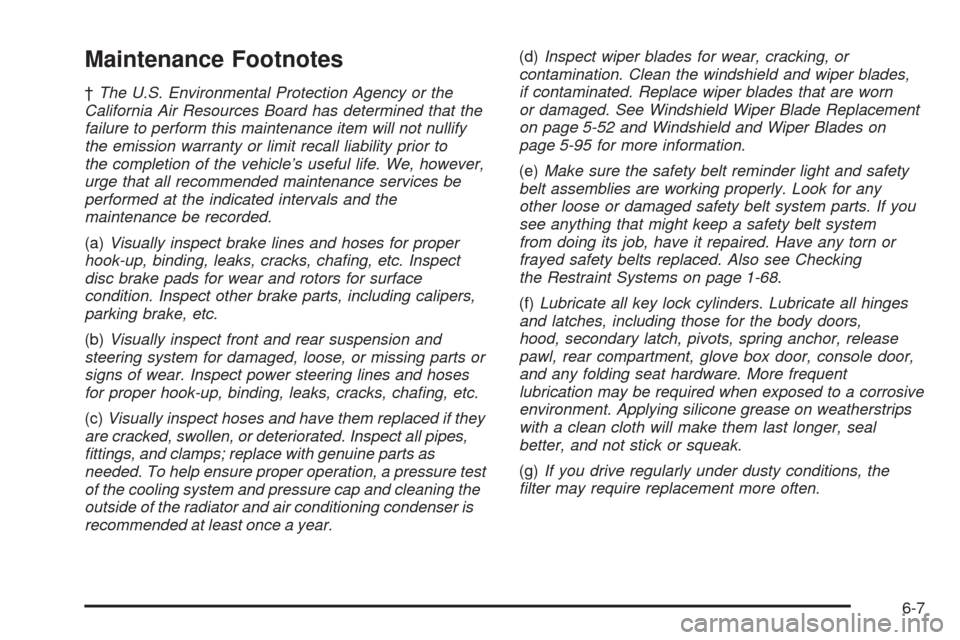
Maintenance Footnotes
†The U.S. Environmental Protection Agency or the
California Air Resources Board has determined that the
failure to perform this maintenance item will not nullify
the emission warranty or limit recall liability prior to
the completion of the vehicle’s useful life. We, however,
urge that all recommended maintenance services be
performed at the indicated intervals and the
maintenance be recorded.
(a)Visually inspect brake lines and hoses for proper
hook-up, binding, leaks, cracks, chafing, etc. Inspect
disc brake pads for wear and rotors for surface
condition. Inspect other brake parts, including calipers,
parking brake, etc.
(b)Visually inspect front and rear suspension and
steering system for damaged, loose, or missing parts or
signs of wear. Inspect power steering lines and hoses
for proper hook-up, binding, leaks, cracks, chafing, etc.
(c)Visually inspect hoses and have them replaced if they
are cracked, swollen, or deteriorated. Inspect all pipes,
fittings, and clamps; replace with genuine parts as
needed. To help ensure proper operation, a pressure test
of the cooling system and pressure cap and cleaning the
outside of the radiator and air conditioning condenser is
recommended at least once a year.(d)Inspect wiper blades for wear, cracking, or
contamination. Clean the windshield and wiper blades,
if contaminated. Replace wiper blades that are worn
or damaged. See Windshield Wiper Blade Replacement
on page 5-52 and Windshield and Wiper Blades on
page 5-95 for more information.
(e)Make sure the safety belt reminder light and safety
belt assemblies are working properly. Look for any
other loose or damaged safety belt system parts. If you
see anything that might keep a safety belt system
from doing its job, have it repaired. Have any torn or
frayed safety belts replaced. Also see Checking
the Restraint Systems on page 1-68.
(f)Lubricate all key lock cylinders. Lubricate all hinges
and latches, including those for the body doors,
hood, secondary latch, pivots, spring anchor, release
pawl, rear compartment, glove box door, console door,
and any folding seat hardware. More frequent
lubrication may be required when exposed to a corrosive
environment. Applying silicone grease on weatherstrips
with a clean cloth will make them last longer, seal
better, and not stick or squeak.
(g)If you drive regularly under dusty conditions, the
filter may require replacement more often.
6-7
Page 360 of 400
At Least Once a Year
Starter Switch Check
{CAUTION:
When you are doing this inspection, the
vehicle could move suddenly. If the vehicle
moves, you or others could be injured.
1. Before you start, be sure you have enough room
around the vehicle.
2. Firmly apply both the parking brake and the regular
brake. SeeParking Brake on page 2-30.
Do not use the accelerator pedal, and be ready to
turn off the engine immediately if it starts.
3. Try to start the engine in each gear. The vehicle
should start only in PARK (P) or NEUTRAL (N).
If the vehicle starts in any other position,
contact your dealer/retailer for service.
Automatic Transmission Shift Lock
Control System Check
{CAUTION:
When you are doing this inspection, the
vehicle could move suddenly. If the vehicle
moves, you or others could be injured.
1. Before you start, be sure you have enough room
around the vehicle. It should be parked on a level
surface.
2. Firmly apply the parking brake. SeeParking Brake
on page 2-30.
Be ready to apply the regular brake immediately if
the vehicle begins to move.
3. With the engine off, turn the ignition to ON/RUN,
but do not start the engine. Without applying the
regular brake, try to move the shift lever out
of PARK (P) with normal effort. If the shift lever
moves out of PARK (P), contact your dealer/retailer
for service.
6-10
Page 361 of 400
Ignition Transmission Lock Check
While parked, and with the parking brake set, try to turn
the ignition to LOCK/OFF in each shift lever position.
The ignition should turn to LOCK/OFF only
when the shift lever is in PARK (P).
The ignition key should come out only in
LOCK/OFF.
Contact your dealer/retailer if service is required.
Parking Brake and Automatic
Transmission Park (P) Mechanism Check
{CAUTION:
When you are doing this check, your vehicle
could begin to move. You or others could be
injured and property could be damaged. Make
sure there is room in front of your vehicle in
case it begins to roll. Be ready to apply the
regular brake at once should the vehicle begin
to move.Park on a fairly steep hill, with the vehicle facing
downhill. Keeping your foot on the regular brake,
set the parking brake.
To check the parking brake’s holding ability:
With the engine running and the transmission
in NEUTRAL (N), slowly remove foot pressure from
the regular brake pedal. Do this until the vehicle
is held by the parking brake only.
To check the PARK (P) mechanism’s holding ability:
With the engine running, shift to PARK (P). Then
release the parking brake followed by the regular
brake.
Contact your dealer/retailer if service is required.
Underbody Flushing Service
At least every spring, use plain water to ush any
corrosive materials from the underbody. Take care to
clean thoroughly any areas where mud and other debris
can collect.
6-11
Page 362 of 400
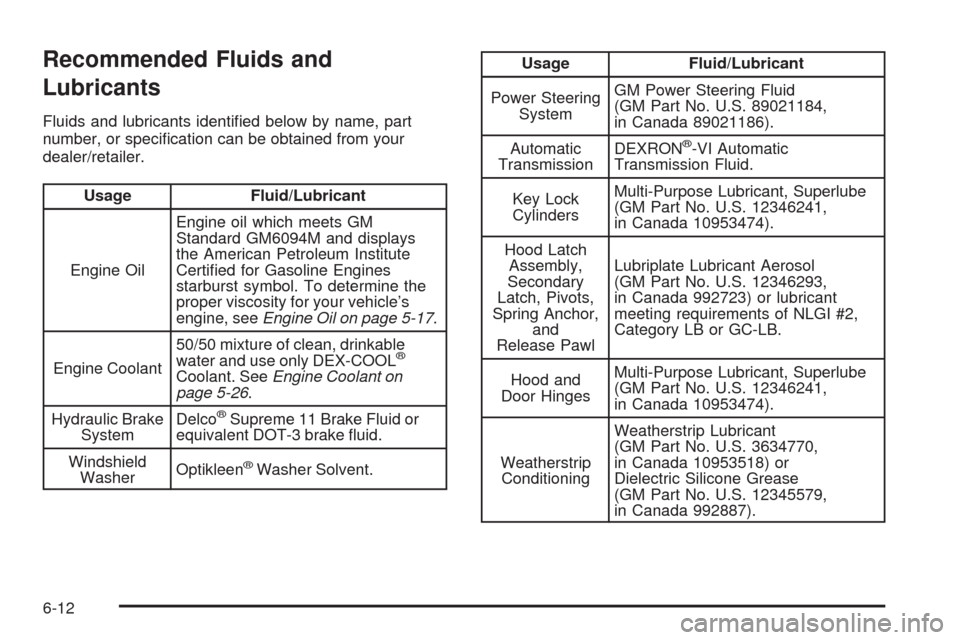
Recommended Fluids and
Lubricants
Fluids and lubricants identied below by name, part
number, or specication can be obtained from your
dealer/retailer.
Usage Fluid/Lubricant
Engine OilEngine oil which meets GM
Standard GM6094M and displays
the American Petroleum Institute
Certied for Gasoline Engines
starburst symbol. To determine the
proper viscosity for your vehicle’s
engine, seeEngine Oil on page 5-17.
Engine Coolant50/50 mixture of clean, drinkable
water and use only DEX-COOL
®
Coolant. SeeEngine Coolant on
page 5-26.
Hydraulic Brake
SystemDelco
®Supreme 11 Brake Fluid or
equivalent DOT-3 brake uid.
Windshield
WasherOptikleen
®Washer Solvent.
Usage Fluid/Lubricant
Power Steering
SystemGM Power Steering Fluid
(GM Part No. U.S. 89021184,
in Canada 89021186).
Automatic
TransmissionDEXRON
®-VI Automatic
Transmission Fluid.
Key Lock
CylindersMulti-Purpose Lubricant, Superlube
(GM Part No. U.S. 12346241,
in Canada 10953474).
Hood Latch
Assembly,
Secondary
Latch, Pivots,
Spring Anchor,
and
Release PawlLubriplate Lubricant Aerosol
(GM Part No. U.S. 12346293,
in Canada 992723) or lubricant
meeting requirements of NLGI #2,
Category LB or GC-LB.
Hood and
Door HingesMulti-Purpose Lubricant, Superlube
(GM Part No. U.S. 12346241,
in Canada 10953474).
Weatherstrip
ConditioningWeatherstrip Lubricant
(GM Part No. U.S. 3634770,
in Canada 10953518) or
Dielectric Silicone Grease
(GM Part No. U.S. 12345579,
in Canada 992887).
6-12
Page 375 of 400
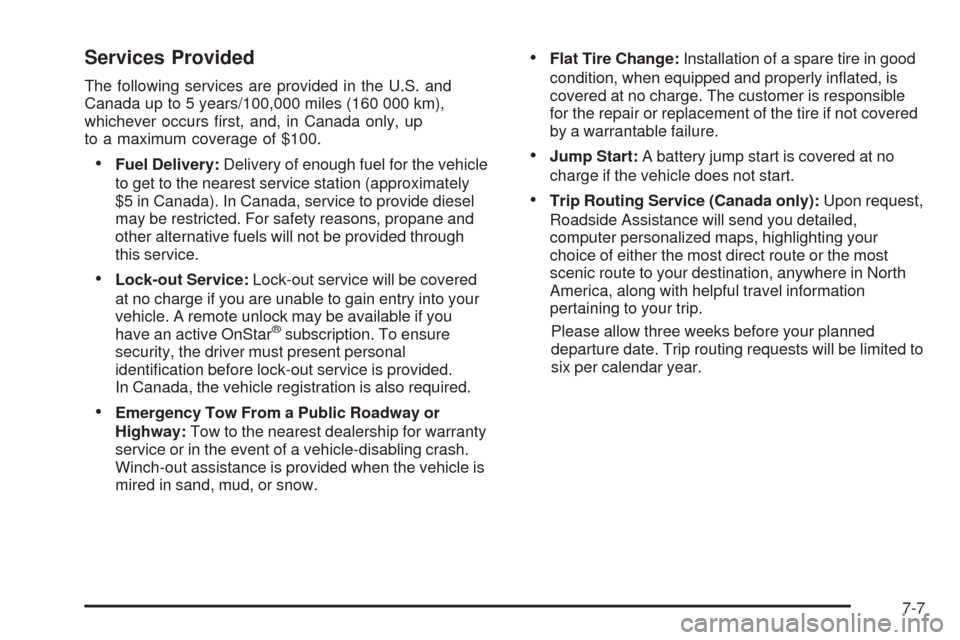
Services Provided
The following services are provided in the U.S. and
Canada up to 5 years/100,000 miles (160 000 km),
whichever occurs rst, and, in Canada only, up
to a maximum coverage of $100.
Fuel Delivery:Delivery of enough fuel for the vehicle
to get to the nearest service station (approximately
$5 in Canada). In Canada, service to provide diesel
may be restricted. For safety reasons, propane and
other alternative fuels will not be provided through
this service.
Lock-out Service:Lock-out service will be covered
at no charge if you are unable to gain entry into your
vehicle. A remote unlock may be available if you
have an active OnStar
®subscription. To ensure
security, the driver must present personal
identication before lock-out service is provided.
In Canada, the vehicle registration is also required.
Emergency Tow From a Public Roadway or
Highway:Tow to the nearest dealership for warranty
service or in the event of a vehicle-disabling crash.
Winch-out assistance is provided when the vehicle is
mired in sand, mud, or snow.
Flat Tire Change:Installation of a spare tire in good
condition, when equipped and properly inated, is
covered at no charge. The customer is responsible
for the repair or replacement of the tire if not covered
by a warrantable failure.
Jump Start:A battery jump start is covered at no
charge if the vehicle does not start.
Trip Routing Service (Canada only):Upon request,
Roadside Assistance will send you detailed,
computer personalized maps, highlighting your
choice of either the most direct route or the most
scenic route to your destination, anywhere in North
America, along with helpful travel information
pertaining to your trip.
Please allow three weeks before your planned
departure date. Trip routing requests will be limited to
six per calendar year.
7-7
Page 384 of 400
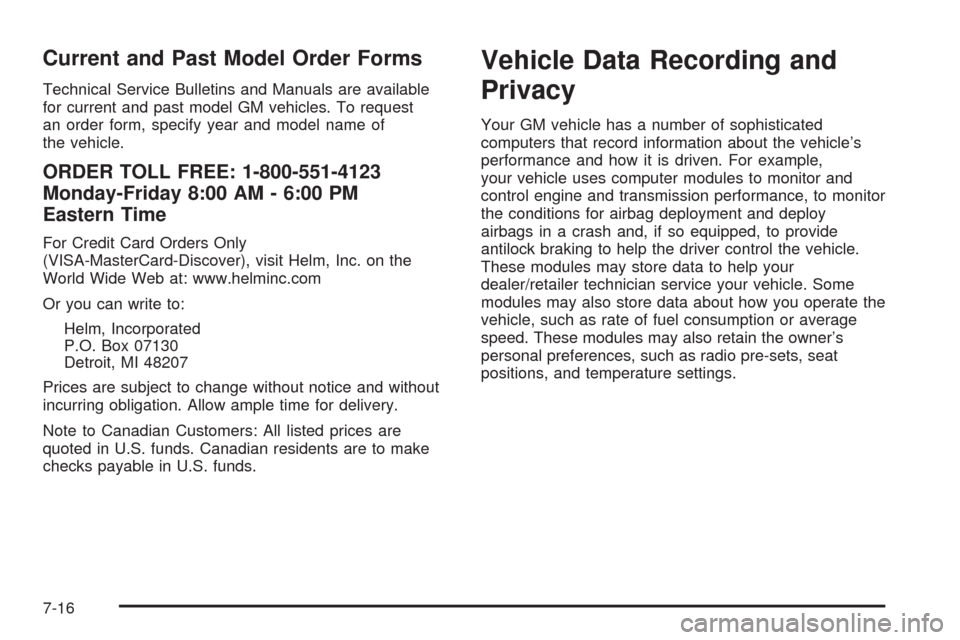
Current and Past Model Order Forms
Technical Service Bulletins and Manuals are available
for current and past model GM vehicles. To request
an order form, specify year and model name of
the vehicle.
ORDER TOLL FREE: 1-800-551-4123
Monday-Friday 8:00 AM - 6:00 PM
Eastern Time
For Credit Card Orders Only
(VISA-MasterCard-Discover), visit Helm, Inc. on the
World Wide Web at: www.helminc.com
Or you can write to:
Helm, Incorporated
P.O. Box 07130
Detroit, MI 48207
Prices are subject to change without notice and without
incurring obligation. Allow ample time for delivery.
Note to Canadian Customers: All listed prices are
quoted in U.S. funds. Canadian residents are to make
checks payable in U.S. funds.
Vehicle Data Recording and
Privacy
Your GM vehicle has a number of sophisticated
computers that record information about the vehicle’s
performance and how it is driven. For example,
your vehicle uses computer modules to monitor and
control engine and transmission performance, to monitor
the conditions for airbag deployment and deploy
airbags in a crash and, if so equipped, to provide
antilock braking to help the driver control the vehicle.
These modules may store data to help your
dealer/retailer technician service your vehicle. Some
modules may also store data about how you operate the
vehicle, such as rate of fuel consumption or average
speed. These modules may also retain the owner’s
personal preferences, such as radio pre-sets, seat
positions, and temperature settings.
7-16
Page 386 of 400
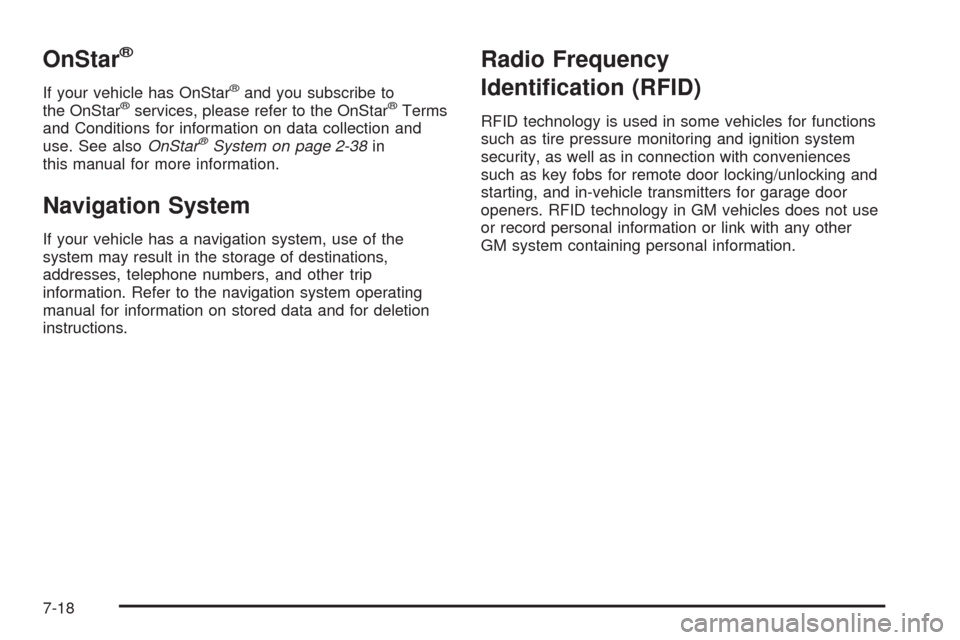
OnStar®
If your vehicle has OnStar®and you subscribe to
the OnStar®services, please refer to the OnStar®Terms
and Conditions for information on data collection and
use. See alsoOnStar
®System on page 2-38in
this manual for more information.
Navigation System
If your vehicle has a navigation system, use of the
system may result in the storage of destinations,
addresses, telephone numbers, and other trip
information. Refer to the navigation system operating
manual for information on stored data and for deletion
instructions.
Radio Frequency
Identication (RFID)
RFID technology is used in some vehicles for functions
such as tire pressure monitoring and ignition system
security, as well as in connection with conveniences
such as key fobs for remote door locking/unlocking and
starting, and in-vehicle transmitters for garage door
openers. RFID technology in GM vehicles does not use
or record personal information or link with any other
GM system containing personal information.
7-18
Page 387 of 400
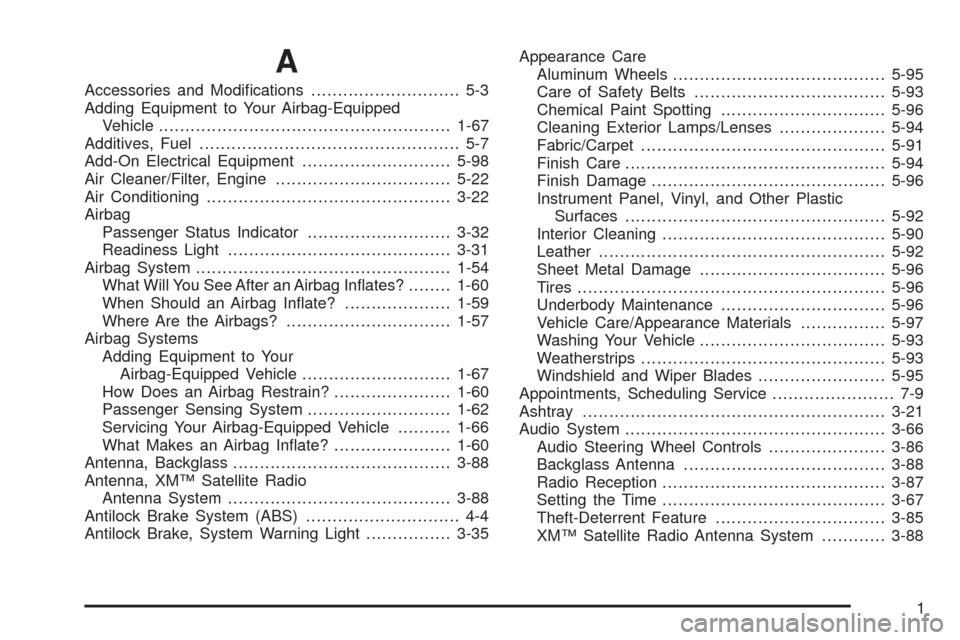
A
Accessories and Modications............................ 5-3
Adding Equipment to Your Airbag-Equipped
Vehicle.......................................................1-67
Additives, Fuel................................................. 5-7
Add-On Electrical Equipment............................5-98
Air Cleaner/Filter, Engine.................................5-22
Air Conditioning..............................................3-22
Airbag
Passenger Status Indicator...........................3-32
Readiness Light..........................................3-31
Airbag System................................................1-54
What Will You See After an Airbag Inates?........1-60
When Should an Airbag Inate?....................1-59
Where Are the Airbags?...............................1-57
Airbag Systems
Adding Equipment to Your
Airbag-Equipped Vehicle............................1-67
How Does an Airbag Restrain?......................1-60
Passenger Sensing System...........................1-62
Servicing Your Airbag-Equipped Vehicle..........1-66
What Makes an Airbag Inate?......................1-60
Antenna, Backglass.........................................3-88
Antenna, XM™ Satellite Radio
Antenna System..........................................3-88
Antilock Brake System (ABS)............................. 4-4
Antilock Brake, System Warning Light................3-35Appearance Care
Aluminum Wheels........................................5-95
Care of Safety Belts....................................5-93
Chemical Paint Spotting...............................5-96
Cleaning Exterior Lamps/Lenses....................5-94
Fabric/Carpet..............................................5-91
Finish Care.................................................5-94
Finish Damage............................................5-96
Instrument Panel, Vinyl, and Other Plastic
Surfaces.................................................5-92
Interior Cleaning..........................................5-90
Leather......................................................5-92
Sheet Metal Damage...................................5-96
Tires
..........................................................5-96
Underbody Maintenance...............................5-96
Vehicle Care/Appearance Materials................5-97
Washing Your Vehicle...................................5-93
Weatherstrips..............................................5-93
Windshield and Wiper Blades........................5-95
Appointments, Scheduling Service....................... 7-9
Ashtray.........................................................3-21
Audio System.................................................3-66
Audio Steering Wheel Controls......................3-86
Backglass Antenna......................................3-88
Radio Reception..........................................3-87
Setting the Time..........................................3-67
Theft-Deterrent Feature................................3-85
XM™ Satellite Radio Antenna System............3-88
1
Page 388 of 400
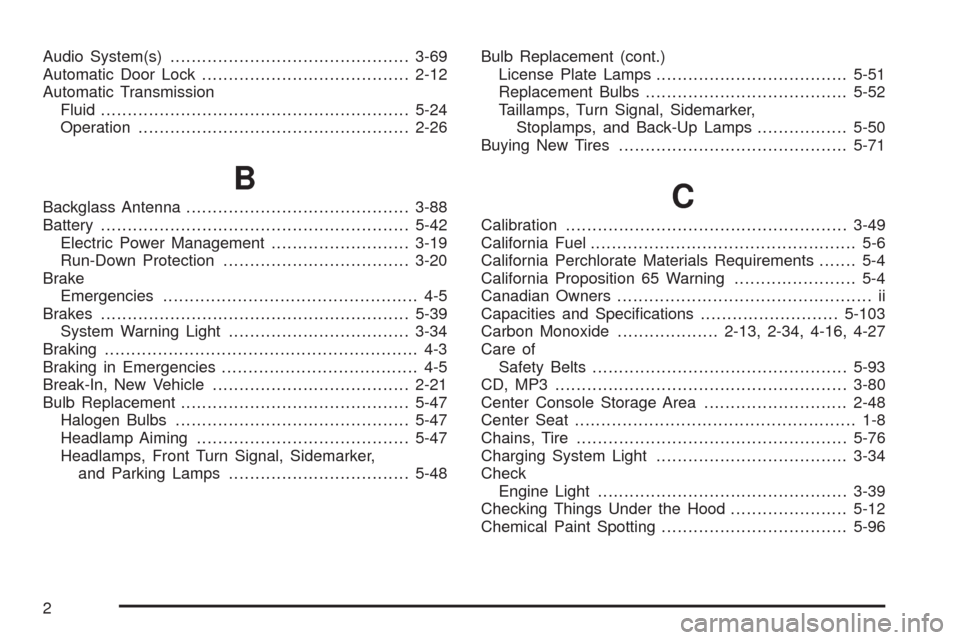
Audio System(s).............................................3-69
Automatic Door Lock.......................................2-12
Automatic Transmission
Fluid..........................................................5-24
Operation...................................................2-26
B
Backglass Antenna..........................................3-88
Battery..........................................................5-42
Electric Power Management..........................3-19
Run-Down Protection...................................3-20
Brake
Emergencies................................................ 4-5
Brakes..........................................................5-39
System Warning Light..................................3-34
Braking........................................................... 4-3
Braking in Emergencies..................................... 4-5
Break-In, New Vehicle.....................................2-21
Bulb Replacement...........................................5-47
Halogen Bulbs............................................5-47
Headlamp Aiming........................................5-47
Headlamps, Front Turn Signal, Sidemarker,
and Parking Lamps..................................5-48Bulb Replacement (cont.)
License Plate Lamps....................................5-51
Replacement Bulbs......................................5-52
Taillamps, Turn Signal, Sidemarker,
Stoplamps, and Back-Up Lamps.................5-50
Buying New Tires...........................................5-71C
Calibration.....................................................3-49
California Fuel.................................................. 5-6
California Perchlorate Materials Requirements....... 5-4
California Proposition 65 Warning....................... 5-4
Canadian Owners................................................ ii
Capacities and Specications..........................5-103
Carbon Monoxide...................2-13, 2-34, 4-16, 4-27
Care of
Safety Belts................................................5-93
CD, MP3 .......................................................3-80
Center Console Storage Area...........................2-48
Center Seat..................................................... 1-8
Chains, Tire...................................................5-76
Charging System Light....................................3-34
Check
Engine Light...............................................3-39
Checking Things Under the Hood......................5-12
Chemical Paint Spotting...................................5-96
2