ECO mode CHEVROLET IMPALA 2008 9.G User Guide
[x] Cancel search | Manufacturer: CHEVROLET, Model Year: 2008, Model line: IMPALA, Model: CHEVROLET IMPALA 2008 9.GPages: 400, PDF Size: 5.37 MB
Page 279 of 400
{CAUTION:
An electric engine cooling fan under the hood
can start up even when the engine is not
running and can injure you. Keep hands,
clothing, and tools away from any underhood
electric fan.
If the coolant inside the coolant recovery tank is boiling,
do not do anything else until it cools down. The
vehicle should be parked on a level surface.
If your vehicle has one of the V6 engines, the coolant
recovery tank is located in the rear of the engine
compartment on the passenger’s side of the vehicle.
If your vehicle has the 5.3L V8 engine, the coolant
recovery tank is located in the rear of the engine
compartment on the driver’s side of the vehicle.
SeeEngine Compartment Overview on page 5-14.
When the engine is cold, the coolant level should be at
or above the COLD FILL line on the coolant recovery
tank. To check the coolant level, look for the COLD FILL
line on the side of the coolant recovery tank that
faces the engine. If the level is not correct, there may
be a leak at the pressure cap or in the radiator
hoses, heater hoses, radiator, water pump, or
somewhere else in the cooling system.
{CAUTION:
Heater and radiator hoses, and other engine
parts, can be very hot. Do not touch them.
If you do, you can be burned.
Do not run the engine if there is a leak. If you run
the engine, it could lose all coolant. That could
cause an engine re, and you could be burned.
Get any leak xed before you drive the vehicle.
If there seems to be no leak, with the engine on, check
to see if the electric engine cooling fans are running.
If the engine is overheating, the fans should be running.
If the fans are not running, your vehicle needs service.
Notice:Engine damage from running your
engine without coolant is not covered by your
warranty. SeeOverheated Engine Protection
Operating Mode on page 5-31for information on
driving to a safe place in an emergency.
Notice:Using coolant other than DEX-COOL
®may
cause premature engine, heater core, or radiator
corrosion. In addition, the engine coolant could
require changing sooner, at 30,000 miles (50 000 km)
or 24 months, whichever occurs rst. Any repairs
would not be covered by the warranty. Always use
DEX-COOL
®(silicate-free) coolant in the vehicle.
5-33
Page 306 of 400

Normal Occupant Weight:The number of
occupants a vehicle is designed to seat multiplied
by 150 lbs (68 kg). SeeLoading Your Vehicle
on page 4-21.
Occupant Distribution
:Designated seating
positions.
Outward Facing Sidewall
:The side of an
asymmetrical tire that has a particular side that
faces outward when mounted on a vehicle.
The side of the tire that contains a whitewall, bears
white lettering, or bears manufacturer, brand,
and/or model name molding that is higher
or deeper than the same moldings on the other
sidewall of the tire.
Passenger (P-Metric) Tire
:A tire used on
passenger cars and some light duty trucks and
multipurpose vehicles.
Recommended Ination Pressure
:Vehicle
manufacturer’s recommended tire ination
pressure as shown on the tire placard.
SeeInflation - Tire Pressure on page 5-61and
Loading Your Vehicle on page 4-21.Radial Ply Tire
:A pneumatic tire in which the ply
cords that extend to the beads are laid at
90 degrees to the centerline of the tread.
Rim
:A metal support for a tire and upon which
the tire beads are seated.
Sidewall
:The portion of a tire between the tread
and the bead.
Speed Rating
:An alphanumeric code assigned to
a tire indicating the maximum speed at which a
tire can operate.
Traction
:The friction between the tire and the
road surface. The amount of grip provided.
Tread
:The portion of a tire that comes into
contact with the road.
Treadwear Indicators
:Narrow bands, sometimes
called wear bars, that show across the tread of
a tire when only 1/16 inch (1.6 mm) of tread
remains. SeeWhen It Is Time for New Tires on
page 5-70.
5-60
Page 313 of 400
TPMS Sensor Matching Process
Each TPMS sensor has a unique identication code.
Any time you rotate your vehicle’s tires or replace one or
more of the TPMS sensors, the identication codes
will need to be matched to the new tire/wheel position.
The sensors are matched to the tire/wheel positions
in the following order: driver side front tire, passenger
side front tire, passenger side rear tire, and driver
side rear tire using a TPMS diagnostic tool. See your
dealer/retailer for service.
The TPMS sensors can also be matched to each
tire/wheel position by increasing or decreasing the tire’s
air pressure. If increasing the tire’s air pressure, do
not exceed the maximum ination pressure indicated on
the tire’s sidewall.
To decrease air-pressure out of a tire you can use the
pointed end of the valve cap, a pencil-style air pressure
gage, or a key.
You have two minutes to match the rst tire/wheel
position, and ve minutes overall to match all
four tire/wheel positions. If it takes longer than
two minutes, to match the rst tire and wheel, or
more than ve minutes to match all four tire and wheel
positions the matching process stops and you need
to start over.The TPMS sensor matching process is outlined below:
1. Set the parking brake.
2. Turn the ignition switch to ON/RUN with the
engine off.
3. Press the Remote Keyless Entry (RKE) transmitter’s
LOCK and UNLOCK buttons at the same time for
approximately ve seconds. The horn sounds twice
to signal the receiver is in relearn mode and
TIRE LEARNING ACTIVE message displays on the
DIC screen.
4. Start with the driver side front tire.
5. Remove the valve cap from the valve cap stem.
Activate the TPMS sensor by increasing or
decreasing the tire’s air pressure for ve seconds,
or until a horn chirp sounds. The horn chirp,
which may take up to 30 seconds to sound,
conrms that the sensor identication code has
been matched to this tire and wheel position.
6. Proceed to the passenger side front tire, and
repeat the procedure in Step 5.
5-67
Page 333 of 400
Storing a Flat or Spare Tire and
Tools (Base Model)
{CAUTION:
Storing a jack, a tire, or other equipment in the
passenger compartment of the vehicle could
cause injury. In a sudden stop or collision,
loose equipment could strike someone. Store
all these in the proper place.
After the compact spare tire has been installed on the
vehicle, store the at tire in the trunk.
When storing a full-size tire, use the extension with
the extension protector, located in the foam holder,
to help avoid wheel surface damage.To store a full-size tire:
1. Install the tools in their original location in the
trunk area and secure.
2. Place the tire valve stem facing down and
the protector/guide placed through a wheel
bolt hole.
3. Remove the protector and attach the retainer
securely
4. Store the cover as far forward as possible.
When storing a compact spare tire in the trunk, put the
protector back in the foam holder.
The compact spare is for temporary use only. Replace
the compact spare tire with a full-size tire as soon
as you can. SeeCompact Spare Tire on page 5-89.
Use this as a guide for storing the compact spare tire
and tools.
5-87
Page 376 of 400

Trip Interruption Benets and Assistance
(Canada only):In the event of a warranty related
vehicle disablement, while en route and over
250 kilometres from the original point of departure,
you may qualify for trip interruption expense
assistance. This assistance covers reasonable
reimbursement of up to a maximum of $500
(Canadian) for (A) meals (maximum of $50/day),
(B) lodging (maximum of $100/night) and
(C) alternate ground transportation (maximum of
$40/day). This benet is to assist you with some of
the unplanned expense you may incur while waiting
for your vehicle to be repaired.
Pre-authorization, original detailed receipts and a
copy of the repair order are required.
Once authorization has been given, your advisor will
help you make any necessary arrangements and
explain how to claim for trip interruption expense
assistance.
Alternative Service (Canada only):There may be
times, when Roadside Assistance cannot provide
timely assistance. Your advisor may authorize you to
secure local emergency road service, and you will be
reimbursed up to $100 upon submission of the
original receipt to Roadside Assistance.In many instances, mechanical failures may be covered.
However, any cost for parts and labor for non-warranty
repairs are the responsibility of the driver.
Chevrolet and General Motors of Canada Limited
reserve the right to limit services or reimbursement to
an owner or driver when, in their sole discretion,
the claims become excessive in frequency or type of
occurrence.
Calling for Assistance
For prompt and efficient assistance when calling, please
provide the following to the Roadside Assistance
Representative:
Your name, home address, and home telephone
number
Telephone number of your location
Location of the vehicle
Model, year, color, and license plate number of the
vehicle
Odometer reading, Vehicle Identication Number
(VIN), and delivery date of the vehicle
Description of the problem
7-8
Page 384 of 400
Current and Past Model Order Forms
Technical Service Bulletins and Manuals are available
for current and past model GM vehicles. To request
an order form, specify year and model name of
the vehicle.
ORDER TOLL FREE: 1-800-551-4123
Monday-Friday 8:00 AM - 6:00 PM
Eastern Time
For Credit Card Orders Only
(VISA-MasterCard-Discover), visit Helm, Inc. on the
World Wide Web at: www.helminc.com
Or you can write to:
Helm, Incorporated
P.O. Box 07130
Detroit, MI 48207
Prices are subject to change without notice and without
incurring obligation. Allow ample time for delivery.
Note to Canadian Customers: All listed prices are
quoted in U.S. funds. Canadian residents are to make
checks payable in U.S. funds.
Vehicle Data Recording and
Privacy
Your GM vehicle has a number of sophisticated
computers that record information about the vehicle’s
performance and how it is driven. For example,
your vehicle uses computer modules to monitor and
control engine and transmission performance, to monitor
the conditions for airbag deployment and deploy
airbags in a crash and, if so equipped, to provide
antilock braking to help the driver control the vehicle.
These modules may store data to help your
dealer/retailer technician service your vehicle. Some
modules may also store data about how you operate the
vehicle, such as rate of fuel consumption or average
speed. These modules may also retain the owner’s
personal preferences, such as radio pre-sets, seat
positions, and temperature settings.
7-16
Page 391 of 400
Engine
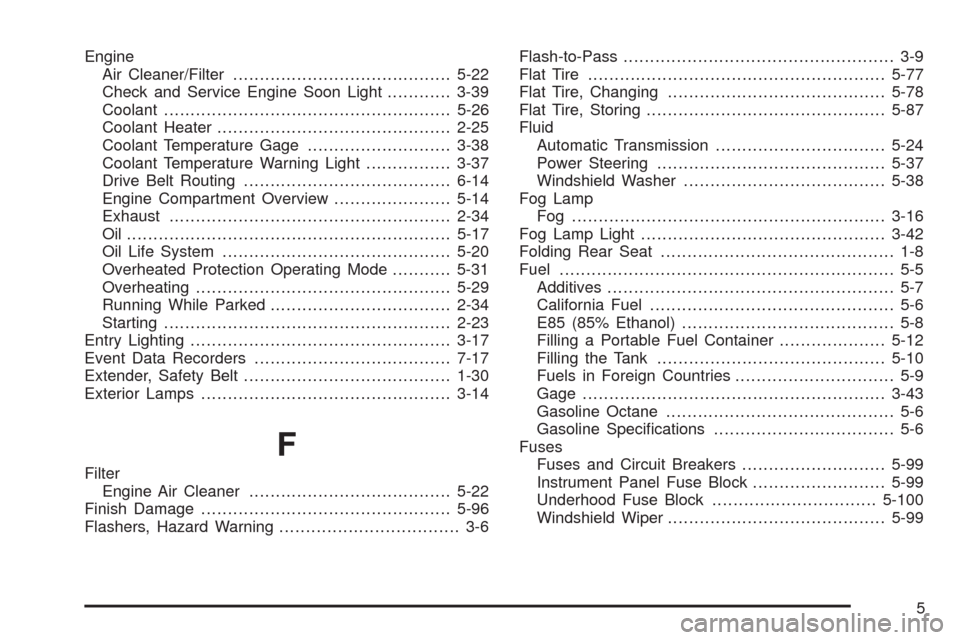
Air Cleaner/Filter.........................................5-22
Check and Service Engine Soon Light............3-39
Coolant......................................................5-26
Coolant Heater............................................2-25
Coolant Temperature Gage...........................3-38
Coolant Temperature Warning Light................3-37
Drive Belt Routing.......................................6-14
Engine Compartment Overview......................5-14
Exhaust.....................................................2-34
Oil .............................................................5-17
Oil Life System...........................................5-20
Overheated Protection Operating Mode...........5-31
Overheating................................................5-29
Running While Parked..................................2-34
Starting......................................................2-23
Entry Lighting.................................................3-17
Event Data Recorders.....................................7-17
Extender, Safety Belt.......................................1-30
Exterior Lamps...............................................3-14
F
Filter
Engine Air Cleaner......................................5-22
Finish Damage...............................................5-96
Flashers, Hazard Warning.................................. 3-6Flash-to-Pass................................................... 3-9
Flat Tire........................................................5-77
Flat Tire, Changing.........................................5-78
Flat Tire, Storing.............................................5-87
Fluid
Automatic Transmission................................5-24
Power Steering...........................................5-37
Windshield Washer......................................5-38
Fog Lamp
Fog ...........................................................3-16
Fog Lamp Light..............................................3-42
Folding Rear Seat............................................ 1-8
Fuel............................................................... 5-5
Additives...................................................... 5-7
California Fuel.............................................. 5-6
E85 (85% Ethanol)........................................ 5-8
Filling a Portable Fuel Container....................5-12
Filling the Tank...........................................5-10
Fuels in Foreign Countries.............................. 5-9
Gage.........................................................3-43
Gasoline Octane........................................... 5-6
Gasoline Specications.................................. 5-6
Fuses
Fuses and Circuit Breakers...........................5-99
Instrument Panel Fuse Block.........................5-99
Underhood Fuse Block...............................5-100
Windshield Wiper.........................................5-99
5
Page 395 of 400
O
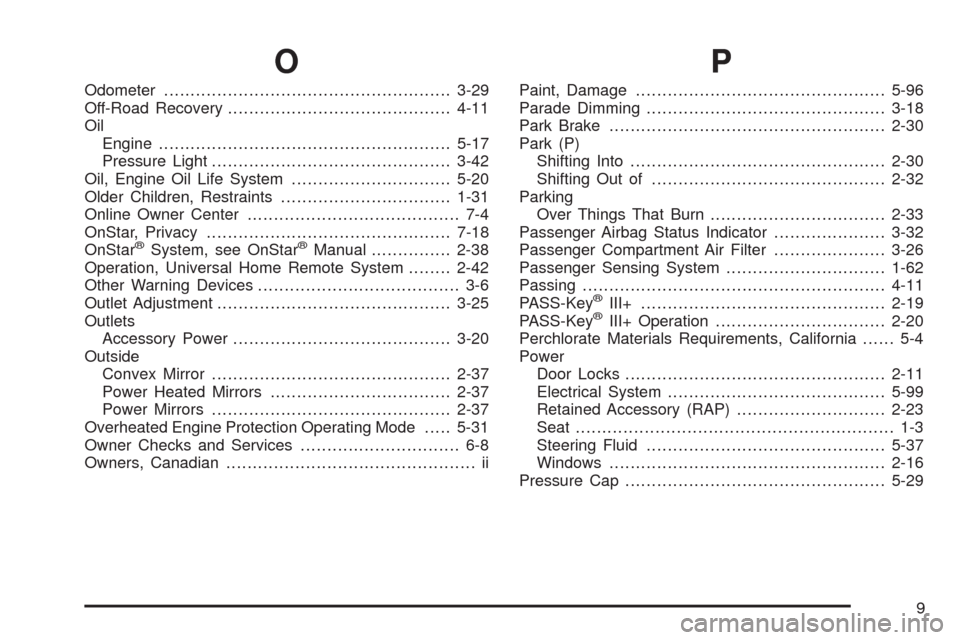
Odometer......................................................3-29
Off-Road Recovery..........................................4-11
Oil
Engine.......................................................5-17
Pressure Light.............................................3-42
Oil, Engine Oil Life System..............................5-20
Older Children, Restraints................................1-31
Online Owner Center........................................ 7-4
OnStar, Privacy..............................................7-18
OnStar
®System, see OnStar®Manual...............2-38
Operation, Universal Home Remote System........2-42
Other Warning Devices...................................... 3-6
Outlet Adjustment............................................3-25
Outlets
Accessory Power.........................................3-20
Outside
Convex Mirror.............................................2-37
Power Heated Mirrors..................................2-37
Power Mirrors.............................................2-37
Overheated Engine Protection Operating Mode.....5-31
Owner Checks and Services.............................. 6-8
Owners, Canadian............................................... ii
P
Paint, Damage...............................................5-96
Parade Dimming.............................................3-18
Park Brake....................................................2-30
Park (P)
Shifting Into................................................2-30
Shifting Out of............................................2-32
Parking
Over Things That Burn.................................2-33
Passenger Airbag Status Indicator.....................3-32
Passenger Compartment Air Filter.....................3-26
Passenger Sensing System..............................1-62
Passing.........................................................4-11
PASS-Key
®III+..............................................2-19
PASS-Key®III+ Operation................................2-20
Perchlorate Materials Requirements, California...... 5-4
Power
Door Locks.................................................2-11
Electrical System.........................................5-99
Retained Accessory (RAP)............................2-23
Seat............................................................ 1-3
Steering Fluid.............................................5-37
Windows....................................................2-16
Pressure Cap.................................................5-29
9