mirror CHEVROLET IMPALA 2008 9.G User Guide
[x] Cancel search | Manufacturer: CHEVROLET, Model Year: 2008, Model line: IMPALA, Model: CHEVROLET IMPALA 2008 9.GPages: 400, PDF Size: 5.37 MB
Page 149 of 400
Rear Window Defogger
The rear window defogger uses a warming grid to
remove fog from the rear window.
<(Rear Window Defogger):The rear window
defogger turns off automatically after it has been
activated for 10 minutes. It can be turned off manually,
by pressing the button again or by turning the ignition
to the LOCK/OFF position. If additional window clearing
is required, the rear window defogger can be turned
on again for additional window clearing. The length of
defogger operation will increase if the vehicle is
being driven.
If your vehicle has heated outside rearview mirrors,
the mirrors will heat to help clear fog or frost from the
surface of the mirror when the rear window defog button
is pressed. SeeOutside Power Mirrors on page 2-37.
Do not drive the vehicle until all the windows are clear.
Notice:Do not use anything sharp on the inside
of the rear window. If you do, you could cut or
damage the warming grid, and the repairs would not
be covered by your warranty. Do not attach a
temporary vehicle license, tape, a decal or anything
similar to the defogger grid.
Outlet Adjustment
Use the thumbwheel located below or to the side of
the outlet, to change the direction of the air ow.
Operation Tips
Clear away any ice, snow or leaves from the air
inlets at the base of the windshield that may
block the ow of air into your vehicle.
Use of non-GM approved hood deectors may
adversely affect the performance of the system.
Keep the path under the front seats clear of objects
to help circulate the air inside your vehicle more
effectively.
If the airow seems low when the fan is at the
highest setting, the passenger compartment
air lter, if equipped, may need to replaced. For
more information, seePassenger Compartment Air
Filter on page 3-26andScheduled Maintenance
on page 6-4.
If fogging reoccurs while in vent or bi-level modes
with mild temperature throughout the vehicle, turn
on the air conditioner to reduce windshield fogging.
3-25
Page 224 of 400
Loss of Control
Let us review what driving experts say about what
happens when the three control systems — brakes,
steering, and acceleration — do not have enough friction
where the tires meet the road to do what the driver
has asked.
In any emergency, do not give up. Keep trying to
steer and constantly seek an escape route or area of
less danger.
Skidding
In a skid, a driver can lose control of the vehicle.
Defensive drivers avoid most skids by taking reasonable
care suited to existing conditions, and by not overdriving
those conditions. But skids are always possible.
The three types of skids correspond to your vehicle’s
three control systems. In the braking skid, the wheels are
not rolling. In the steering or cornering skid, too much
speed or steering in a curve causes tires to slip and lose
cornering force. And in the acceleration skid, too much
throttle causes the driving wheels to spin.
A cornering skid and an acceleration skid are best
handled by easing your foot off the accelerator pedal.If your vehicle starts to slide, ease your foot off the
accelerator pedal and quickly steer the way you want
the vehicle to go. If you start steering quickly enough,
your vehicle may straighten out. Always be ready
for a second skid if it occurs.
Of course, traction is reduced when water, snow, ice,
gravel, or other material is on the road. For safety, you
will want to slow down and adjust your driving to
these conditions. It is important to slow down on slippery
surfaces because stopping distance will be longer and
vehicle control more limited.
While driving on a surface with reduced traction, try
your best to avoid sudden steering, acceleration,
or braking, including reducing vehicle speed by shifting
to a lower gear. Any sudden changes could cause
the tires to slide. You may not realize the surface is
slippery until your vehicle is skidding. Learn to recognize
warning clues — such as enough water, ice, or packed
snow on the road to make a mirrored surface — and
slow down when you have any doubt.
If you have the Antilock Brake System (ABS),
remember: It helps avoid only the braking skid. If you do
not have ABS, then in a braking skid, where the
wheels are no longer rolling, release enough pressure
on the brakes to get the wheels rolling again. This
restores steering control. Push the brake pedal down
steadily when you have to stop suddenly. As long as the
wheels are rolling, you will have steering control.
4-12
Page 225 of 400
Driving at Night
Night driving is more dangerous than day driving because
some drivers are likely to be impaired — by alcohol or
drugs, with night vision problems, or by fatigue.
Night driving tips include:
Drive defensively.
Do not drink and drive.
Reduce headlamp glare by adjusting the inside
rearview mirror.
Slow down and keep more space between you and
other vehicles because your headlamps can only
light up so much road ahead.
Watch for animals.
When tired, pull off the road.
Do not wear sunglasses.
Avoid staring directly into approaching headlamps.
Keep the windshield and all glass on your vehicle
clean — inside and out.
Keep your eyes moving, especially during turns
or curves.
No one can see as well at night as in the daytime. But, as
we get older, these differences increase. A 50-year-old
driver might need at least twice as much light to see the
same thing at night as a 20-year-old.
Driving in Rain and on Wet Roads
Rain and wet roads can reduce vehicle traction
and affect your ability to stop and accelerate.
Always drive slower in these types of driving conditions
and avoid driving through large puddles and
deep-standing or owing water.
{CAUTION:
Wet brakes can cause accidents. They might
not work as well in a quick stop and could
cause pulling to one side. You could lose
control of the vehicle.
After driving through a large puddle of water
or a car/vehicle wash, lightly apply the brake
pedal until the brakes work normally.
Flowing or rushing water creates strong
forces. Driving through owing water could
cause your vehicle to be carried away. If this
happens, you and other vehicle occupants
could drown. Do not ignore police warnings
and be very cautious about trying to drive
through owing water.
4-13
Page 226 of 400
Hydroplaning
Hydroplaning is dangerous. Water can build up under
your vehicle’s tires so they actually ride on the
water. This can happen if the road is wet enough and
you are going fast enough. When your vehicle is
hydroplaning, it has little or no contact with the road.
There is no hard and fast rule about hydroplaning.
The best advice is to slow down when the road
is wet.
Other Rainy Weather Tips
Besides slowing down, other wet weather driving tips
include:
Allow extra following distance.
Pass with caution.
Keep windshield wiping equipment in
good shape.
Keep the windshield washer uid reservoir lled.
Have good tires with proper tread depth.
SeeTires on page 5-54.
Before Leaving on a Long Trip
To prepare your vehicle for a long trip, consider having
it serviced by your dealer/retailer before departing.
Things to check on your own include:
Windshield Washer Fluid:Reservoir full?
Windows clean — inside and outside?
Wiper Blades:In good shape?
Fuel, Engine Oil, Other Fluids:All levels checked?
Lamps:Do they all work and are lenses clean?
Tires:Are treads good? Are tires inated to
recommended pressure?
Weather and Maps:Safe to travel?
Have up-to-date maps?
Highway Hypnosis
Always be alert and pay attention to your surroundings
while driving. If you become tired or sleepy, nd a safe
place to park your vehicle and rest.
Other driving tips include:
Keep the vehicle well ventilated.
Keep interior temperature cool.
Keep your eyes moving — scan the road
ahead and to the sides.
Check the rearview mirror and vehicle
instruments often.
4-14
Page 243 of 400
Driving with a Trailer
Towing a trailer requires a certain amount of experience.
Before setting out for the open road, you will want to
get to know your rig. Acquaint yourself with the feel of
handling and braking with the added weight of the trailer.
And always keep in mind that the vehicle you are
driving is now a good deal longer and not nearly as
responsive as your vehicle is by itself.
Before you start, check the trailer hitch and platform
(and attachments), safety chains, electrical connector,
lamps, tires and mirror adjustment. If the trailer has
electric brakes, start your vehicle and trailer moving and
then apply the trailer brake controller by hand to be
sure the brakes are working. This lets you check your
electrical connection at the same time.
During your trip, check occasionally to be sure that the
load is secure, and that the lamps and any trailer
brakes are still working.
Following Distance
Stay at least twice as far behind the vehicle ahead as
you would when driving your vehicle without a trailer.
This can help you avoid situations that require
heavy braking and sudden turns.
Passing
You will need more passing distance up ahead when
you are towing a trailer. And, because you are a
good deal longer, you will need to go much farther
beyond the passed vehicle before you can return to
your lane.
Backing Up
Hold the bottom of the steering wheel with one hand.
Then, to move the trailer to the left, just move that hand
to the left. To move the trailer to the right, move your
hand to the right. Always back up slowly and, if possible,
have someone guide you.
Making Turns
Notice:Making very sharp turns while trailering
could cause the trailer to come in contact with the
vehicle. Your vehicle could be damaged. Avoid
making very sharp turns while trailering.
When you are turning with a trailer, make wider turns
than normal. Do this so your trailer will not strike
soft shoulders, curbs, road signs, trees or other objects.
Avoid jerky or sudden maneuvers. Signal well in
advance.
4-31
Page 346 of 400
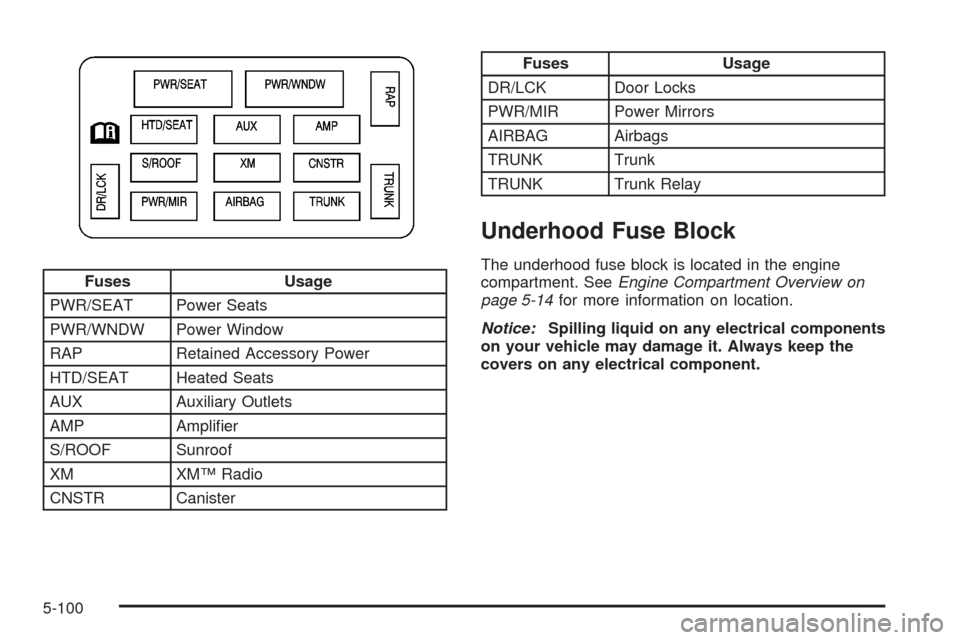
Fuses Usage
PWR/SEAT Power Seats
PWR/WNDW Power Window
RAP Retained Accessory Power
HTD/SEAT Heated Seats
AUX Auxiliary Outlets
AMP Amplier
S/ROOF Sunroof
XM XM™ Radio
CNSTR Canister
Fuses Usage
DR/LCK Door Locks
PWR/MIR Power Mirrors
AIRBAG Airbags
TRUNK Trunk
TRUNK Trunk Relay
Underhood Fuse Block
The underhood fuse block is located in the engine
compartment. SeeEngine Compartment Overview on
page 5-14for more information on location.
Notice:Spilling liquid on any electrical components
on your vehicle may damage it. Always keep the
covers on any electrical component.
5-100
Page 348 of 400
Fuses Usage
BATT 3 Battery 3
WSW Windshield Wiper
HTD MIR Heated Mirror
BATT 1 Battery 1
ABS MTR2 Antilock Brake System Motor 2
AIR PUMP Air Pump
BATT 2 Battery 2
INT LIGHTS Interior Lamps
INT LTS/
PNL DIMInterior Lamps, Instrument Panel
Dimmer
A/C CMPRSR Air Conditioning Compressor
AIR SOL AIR (Air Injection Reactor) Solenoid
AUX PWR Auxiliary Power
BCM Body Control Module
CHMSL/
BCK-UPCenter High-Mounted Stoplamp,
Back-up Lamps
DISPLAY Display
ETC/ECMElectronic Throttle Control,
Engine Control Module
INJ 1 Injector 1
EMISSIONS 1 Emissions 1
INJ 2 Injector 2
EMISSIONS 2 Emissions 2Fuses Usage
RT SPOT Right Spot
LT SPOT Left Spot
HDLP MDL Headlamp Module
DRL 2 Daytime Running Lamps 2
FAN 2 Cooling Fan 2
FUEL/PUMP Fuel Pump
WPR Wiper
LT LO BEAM Driver Side Low-Beam
RT LO BEAM Passenger Side Low-Beam
LT HI BEAM Driver Side High-Beam
RT HI BEAM Passenger Side High-Beam
Relay Usage
STRTR Starter
REAR DEFOG Rear Defogger
FAN 1 Cooling Fan 1
FAN 2 Cooling Fan 2
A/C CMPRSR Air Conditioning Compressor
FAN 3 Cooling Fan 3
FUEL/PUMP Fuel Pump
PWR/TRN Powertrain
5-102
Page 393 of 400
J
Jump Starting.................................................5-43
K
Keyless Entry System....................................... 2-4
Keys............................................................... 2-3
L
Labeling, Tire Sidewall.....................................5-55
Lamps
Courtesy....................................................3-17
Dome........................................................3-17
Mirror Reading............................................3-19
Reading.....................................................3-19
Lap Belt........................................................1-29
Lap-Shoulder Belt...........................................1-24
LATCH System
Child Restraints...........................................1-41
License Plate Lamps.......................................5-51
Light
Airbag Readiness........................................3-31
Antilock Brake System Warning.....................3-35
Brake System Warning.................................3-34Light (cont.)
Charging System.........................................3-34
Cruise Control.............................................3-43
Electronic StabiliTrak
®Control Indicator...........3-36
Engine Coolant Temperature Warning.............3-37
Fog Lamp..................................................3-42
Highbeam On.............................................3-43
Malfunction Indicator....................................3-39
Oil Pressure...............................................3-42
Passenger Airbag Status Indicator..................3-32
Safety Belt Reminders..................................3-30
Security.....................................................3-42
TCS Warning Light......................................3-36
Tire Pressure..............................................3-38
Traction Control System (TCS) Warning..........3-36
Lighting
Delayed Entry.............................................3-18
Delayed Exit...............................................3-18
Entry.........................................................3-17
Parade Dimming..........................................3-18
Lights
Exterior Lamps............................................3-14
Flash-to-Pass............................................... 3-9
High/Low Beam Changer................................ 3-8
Loading Your Vehicle.......................................4-21
Lockout Protection..........................................2-13
7
Page 394 of 400
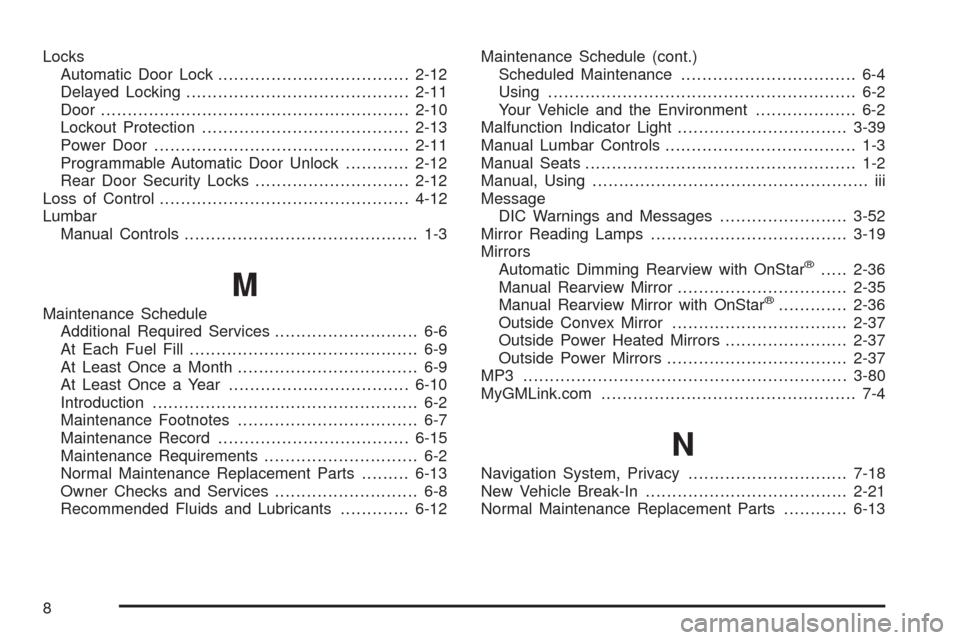
Locks
Automatic Door Lock....................................2-12
Delayed Locking..........................................2-11
Door..........................................................2-10
Lockout Protection.......................................2-13
Power Door................................................2-11
Programmable Automatic Door Unlock............2-12
Rear Door Security Locks.............................2-12
Loss of Control...............................................4-12
Lumbar
Manual Controls............................................ 1-3
M
Maintenance Schedule
Additional Required Services........................... 6-6
At Each Fuel Fill........................................... 6-9
At Least Once a Month.................................. 6-9
At Least Once a Year..................................6-10
Introduction.................................................. 6-2
Maintenance Footnotes.................................. 6-7
Maintenance Record....................................6-15
Maintenance Requirements............................. 6-2
Normal Maintenance Replacement Parts.........6-13
Owner Checks and Services........................... 6-8
Recommended Fluids and Lubricants.............6-12Maintenance Schedule (cont.)
Scheduled Maintenance................................. 6-4
Using.......................................................... 6-2
Your Vehicle and the Environment................... 6-2
Malfunction Indicator Light................................3-39
Manual Lumbar Controls.................................... 1-3
Manual Seats................................................... 1-2
Manual, Using.................................................... iii
Message
DIC Warnings and Messages........................3-52
Mirror Reading Lamps.....................................3-19
Mirrors
Automatic Dimming Rearview with OnStar
®.....2-36
Manual Rearview Mirror................................2-35
Manual Rearview Mirror with OnStar
®.............2-36
Outside Convex Mirror.................................2-37
Outside Power Heated Mirrors.......................2-37
Outside Power Mirrors..................................2-37
MP3 .............................................................3-80
MyGMLink.com................................................ 7-4
N
Navigation System, Privacy..............................7-18
New Vehicle Break-In......................................2-21
Normal Maintenance Replacement Parts............6-13
8
Page 395 of 400
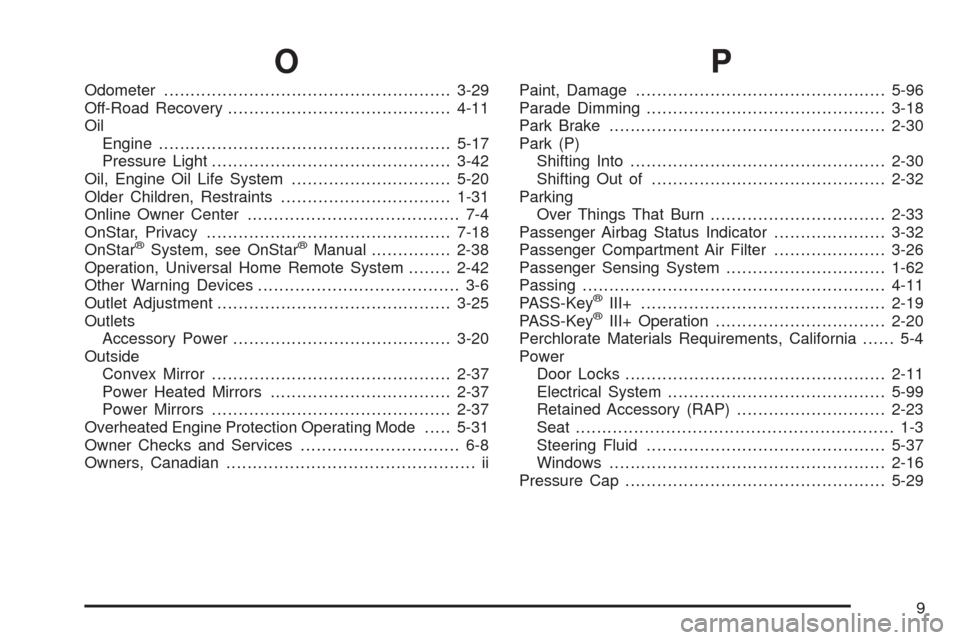
O
Odometer......................................................3-29
Off-Road Recovery..........................................4-11
Oil
Engine.......................................................5-17
Pressure Light.............................................3-42
Oil, Engine Oil Life System..............................5-20
Older Children, Restraints................................1-31
Online Owner Center........................................ 7-4
OnStar, Privacy..............................................7-18
OnStar
®System, see OnStar®Manual...............2-38
Operation, Universal Home Remote System........2-42
Other Warning Devices...................................... 3-6
Outlet Adjustment............................................3-25
Outlets
Accessory Power.........................................3-20
Outside
Convex Mirror.............................................2-37
Power Heated Mirrors..................................2-37
Power Mirrors.............................................2-37
Overheated Engine Protection Operating Mode.....5-31
Owner Checks and Services.............................. 6-8
Owners, Canadian............................................... ii
P
Paint, Damage...............................................5-96
Parade Dimming.............................................3-18
Park Brake....................................................2-30
Park (P)
Shifting Into................................................2-30
Shifting Out of............................................2-32
Parking
Over Things That Burn.................................2-33
Passenger Airbag Status Indicator.....................3-32
Passenger Compartment Air Filter.....................3-26
Passenger Sensing System..............................1-62
Passing.........................................................4-11
PASS-Key
®III+..............................................2-19
PASS-Key®III+ Operation................................2-20
Perchlorate Materials Requirements, California...... 5-4
Power
Door Locks.................................................2-11
Electrical System.........................................5-99
Retained Accessory (RAP)............................2-23
Seat............................................................ 1-3
Steering Fluid.............................................5-37
Windows....................................................2-16
Pressure Cap.................................................5-29
9