trunk CHEVROLET IMPALA 2008 9.G User Guide
[x] Cancel search | Manufacturer: CHEVROLET, Model Year: 2008, Model line: IMPALA, Model: CHEVROLET IMPALA 2008 9.GPages: 400, PDF Size: 5.37 MB
Page 228 of 400
Winter Driving
Here are some tips for winter driving:
Have your vehicle in good shape for winter.
You might want to put winter emergency supplies
in the trunk.
Include an ice scraper, a small brush or broom, a
supply of windshield washer uid, a rag, some winter
outer clothing, a small shovel, a ashlight, a red cloth,
and a couple of reective warning triangles. And, if
you will be driving under severe conditions, include a
small bag of sand, a piece of old carpet, or a couple of
burlap bags to help provide traction. Be sure you
properly secure these items in your vehicle.
Also seeTires on page 5-54.
Driving on Snow or Ice
Most of the time, those places where the tires meet the
road probably have good traction.
However, if there is snow or ice between the tires and
the road, you can have a very slippery situation.
You have a lot less traction, or grip, and need to be
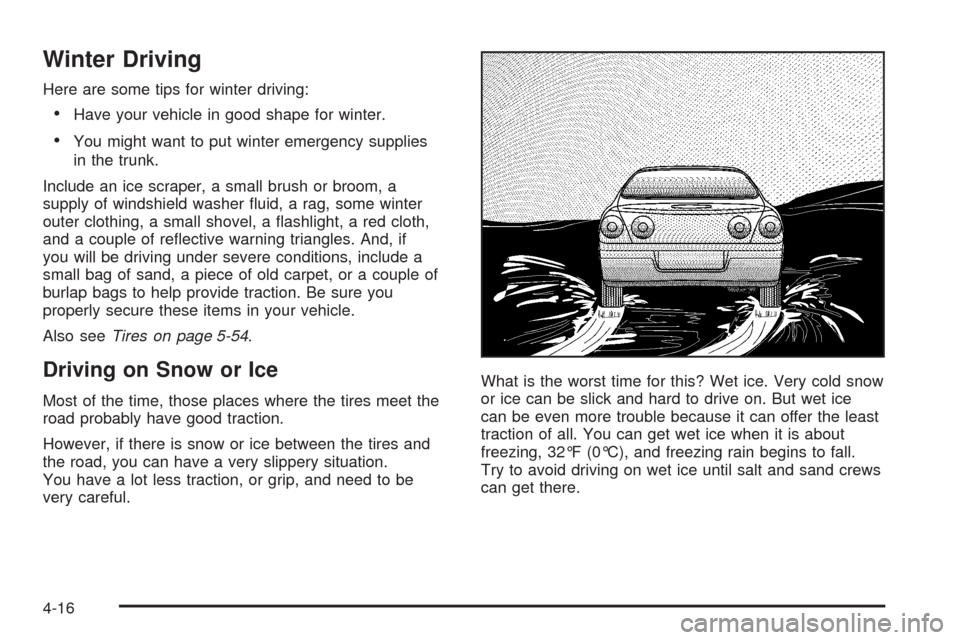
very careful.What is the worst time for this? Wet ice. Very cold snow
or ice can be slick and hard to drive on. But wet ice
can be even more trouble because it can offer the least
traction of all. You can get wet ice when it is about
freezing, 32°F (0°C), and freezing rain begins to fall.
Try to avoid driving on wet ice until salt and sand crews
can get there.
4-16
Page 237 of 400
Never exceed the GVWR for your vehicle or the
Gross Axle Weight Rating (GAWR) for either
the front or rear axle.
If the vehicle is going to carry a heavy load,
spread it out. See “Steps for Determining Correct
Load Limit” earlier in this section.
{CAUTION:
Do not load your vehicle any heavier than
the Gross Vehicle Weight Rating (GVWR),
or either the maximum front or rear Gross
Axle Weight Rating (GAWR). If you do,
parts on your vehicle can break, and it
can change the way your vehicle handles.
These could cause you to lose control
and crash. Also, overloading can shorten
the life of your vehicle.
Notice:Overloading your vehicle may cause
damage. Repairs would not be covered by your
warranty. Do not overload your vehicle.If things like suitcases, tools, packages, or
anything else are put inside the vehicle, they will
go as fast as the vehicle goes. If you have to stop
or turn quickly, or if there is a crash, they will
keep going.
{CAUTION:
Things you put inside your vehicle can
strike and injure people in a sudden stop
or turn, or in a crash.
Put things in the trunk of your vehicle.
In a trunk, put them as far forward as
you can. Try to spread the weight
evenly.
Never stack heavier things, like
suitcases, inside the vehicle so that
some of them are above the tops of
the seats.
Do not leave an unsecured child
restraint in your vehicle.
When you carry something inside the
vehicle, secure it whenever you can.
Do not leave a seat folded down
unless you need to.
4-25
Page 258 of 400
Filling a Portable Fuel Container
{CAUTION:
Never ll a portable fuel container while it is
in your vehicle. Static electricity discharge
from the container can ignite the fuel vapor.
You can be badly burned and your vehicle
damaged if this occurs. To help avoid injury to
you and others:
Dispense fuel only into approved
containers.
Do not ll a container while it is inside a
vehicle, in a vehicle’s trunk, pickup bed, or
on any surface other than the ground.
Bring the ll nozzle in contact with the
inside of the ll opening before operating
the nozzle. Contact should be maintained
until the lling is complete.
Do not smoke while pumping fuel.
Do not use a cellular phone while
pumping fuel.
Checking Things Under
the Hood
{CAUTION:
An electric fan under the hood can start up
and injure you even when the engine is not
running. Keep hands, clothing, and tools away
from any underhood electric fan.
{CAUTION:
Things that burn can get on hot engine parts
and start a re. These include liquids like fuel,
oil, coolant, brake uid, windshield washer and
other uids, and plastic or rubber. You or
others could be burned. Be careful not to drop
or spill things that will burn onto a hot engine.
5-12
Page 296 of 400
Taillamps, Turn Signal, Sidemarker,
Stoplamps and Back-up Lamps
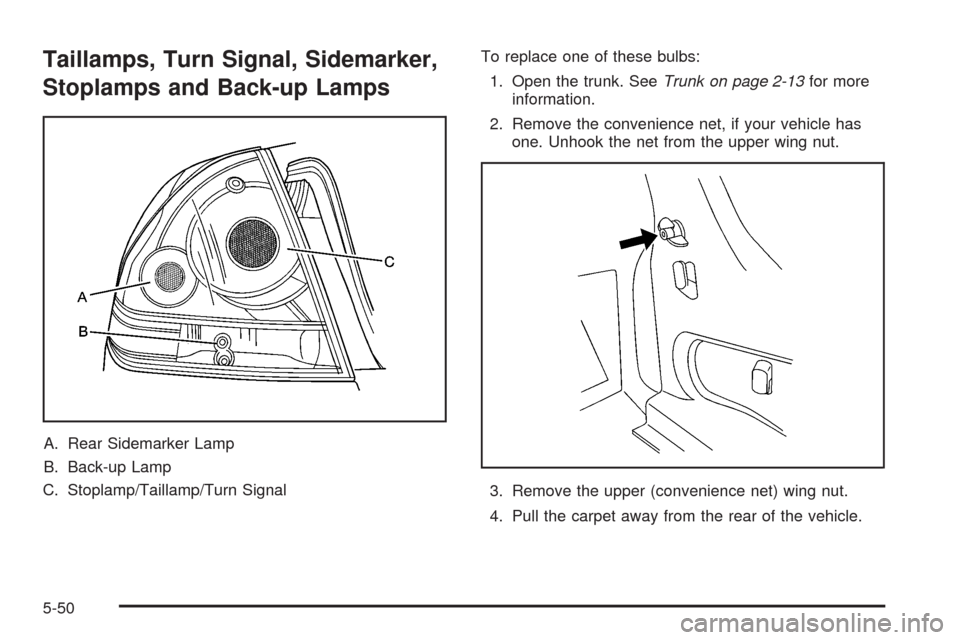
A. Rear Sidemarker Lamp
B. Back-up Lamp
C. Stoplamp/Taillamp/Turn SignalTo replace one of these bulbs:
1. Open the trunk. SeeTrunk on page 2-13for more
information.
2. Remove the convenience net, if your vehicle has
one. Unhook the net from the upper wing nut.
3. Remove the upper (convenience net) wing nut.
4. Pull the carpet away from the rear of the vehicle.
5-50
Page 325 of 400
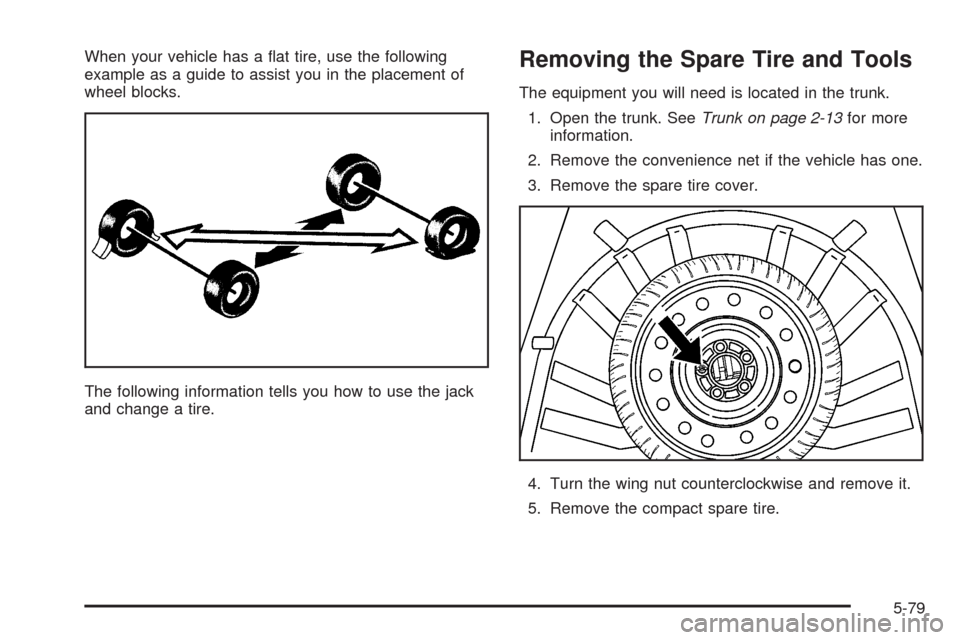
When your vehicle has a at tire, use the following
example as a guide to assist you in the placement of
wheel blocks.
The following information tells you how to use the jack
and change a tire.Removing the Spare Tire and Tools
The equipment you will need is located in the trunk.
1. Open the trunk. SeeTrunk on page 2-13for more
information.
2. Remove the convenience net if the vehicle has one.
3. Remove the spare tire cover.
4. Turn the wing nut counterclockwise and remove it.
5. Remove the compact spare tire.
5-79
Page 327 of 400
Removing the Flat Tire and
Installing the Spare Tire
Your vehicle may have aluminum wheels with exposed
wheel nuts. Use the wheel wrench to loosen all the
wheel nuts. Do not remove them yet.
Or, your vehicle may have steel wheels with plastic
covers.
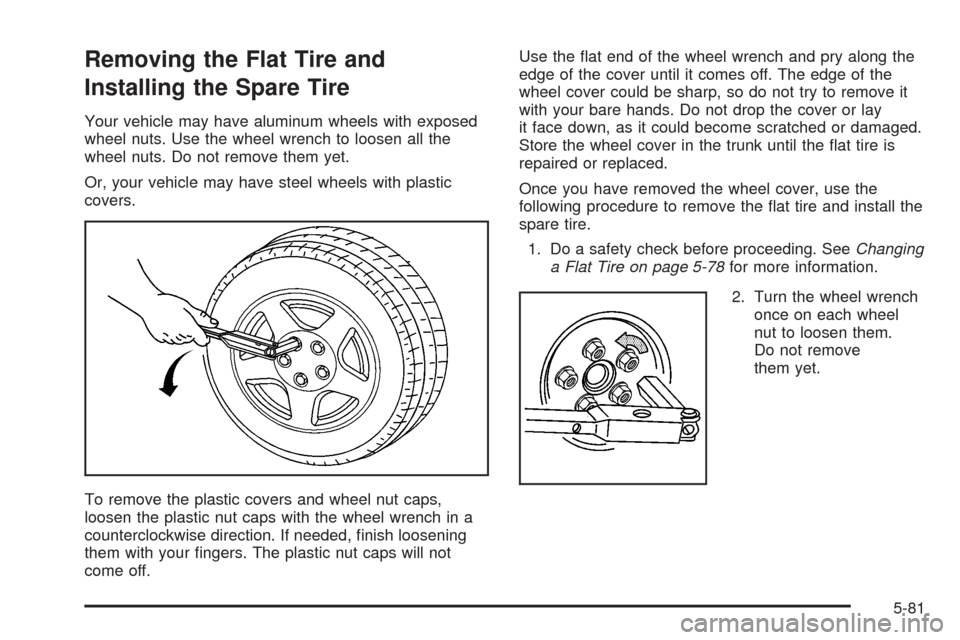
To remove the plastic covers and wheel nut caps,
loosen the plastic nut caps with the wheel wrench in a
counterclockwise direction. If needed, nish loosening
them with your ngers. The plastic nut caps will not
come off.Use the at end of the wheel wrench and pry along the
edge of the cover until it comes off. The edge of the
wheel cover could be sharp, so do not try to remove it
with your bare hands. Do not drop the cover or lay
it face down, as it could become scratched or damaged.
Store the wheel cover in the trunk until the at tire is
repaired or replaced.
Once you have removed the wheel cover, use the
following procedure to remove the at tire and install the
spare tire.
1. Do a safety check before proceeding. SeeChanging
a Flat Tire on page 5-78for more information.
2. Turn the wheel wrench
once on each wheel
nut to loosen them.
Do not remove
them yet.
5-81
Page 333 of 400
Storing a Flat or Spare Tire and
Tools (Base Model)
{CAUTION:
Storing a jack, a tire, or other equipment in the
passenger compartment of the vehicle could
cause injury. In a sudden stop or collision,
loose equipment could strike someone. Store
all these in the proper place.
After the compact spare tire has been installed on the
vehicle, store the at tire in the trunk.
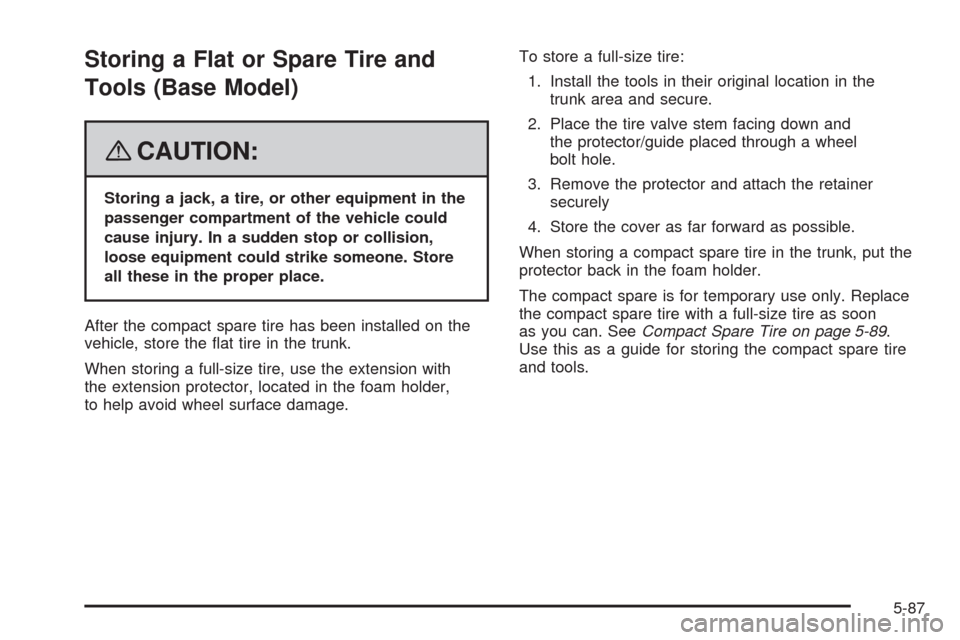
When storing a full-size tire, use the extension with
the extension protector, located in the foam holder,
to help avoid wheel surface damage.To store a full-size tire:
1. Install the tools in their original location in the
trunk area and secure.
2. Place the tire valve stem facing down and
the protector/guide placed through a wheel
bolt hole.
3. Remove the protector and attach the retainer
securely
4. Store the cover as far forward as possible.
When storing a compact spare tire in the trunk, put the
protector back in the foam holder.
The compact spare is for temporary use only. Replace
the compact spare tire with a full-size tire as soon
as you can. SeeCompact Spare Tire on page 5-89.
Use this as a guide for storing the compact spare tire
and tools.
5-87
Page 344 of 400
Vehicle Identication
Vehicle Identication Number (VIN)
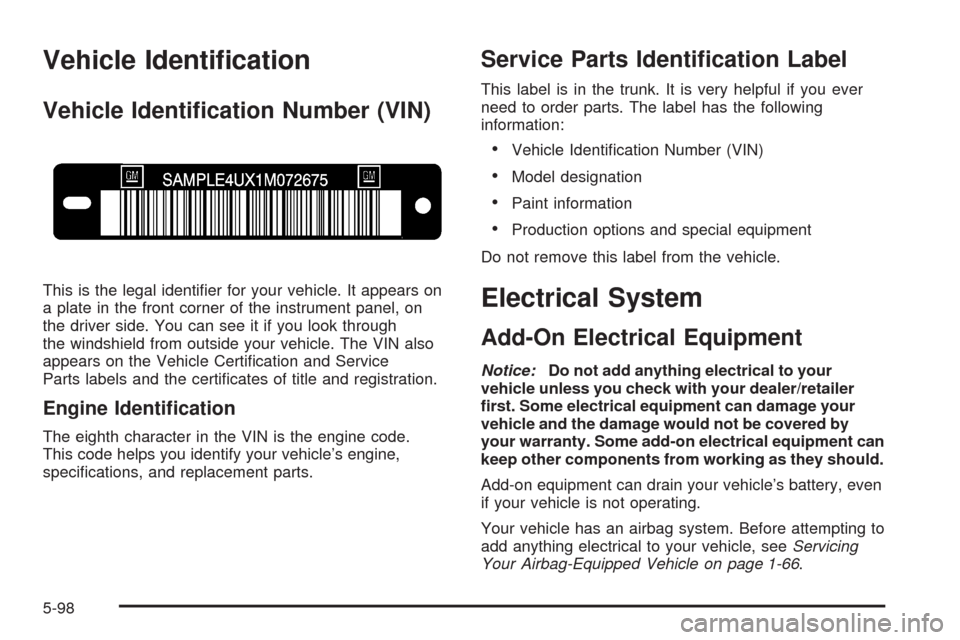
This is the legal identier for your vehicle. It appears on
a plate in the front corner of the instrument panel, on
the driver side. You can see it if you look through
the windshield from outside your vehicle. The VIN also
appears on the Vehicle Certication and Service
Parts labels and the certicates of title and registration.
Engine Identication
The eighth character in the VIN is the engine code.
This code helps you identify your vehicle’s engine,
specications, and replacement parts.
Service Parts Identication Label
This label is in the trunk. It is very helpful if you ever
need to order parts. The label has the following
information:
Vehicle Identication Number (VIN)
Model designation
Paint information
Production options and special equipment
Do not remove this label from the vehicle.
Electrical System
Add-On Electrical Equipment
Notice:Do not add anything electrical to your
vehicle unless you check with your dealer/retailer
rst. Some electrical equipment can damage your
vehicle and the damage would not be covered by
your warranty. Some add-on electrical equipment can
keep other components from working as they should.
Add-on equipment can drain your vehicle’s battery, even
if your vehicle is not operating.
Your vehicle has an airbag system. Before attempting to
add anything electrical to your vehicle, seeServicing
Your Airbag-Equipped Vehicle on page 1-66.
5-98
Page 346 of 400
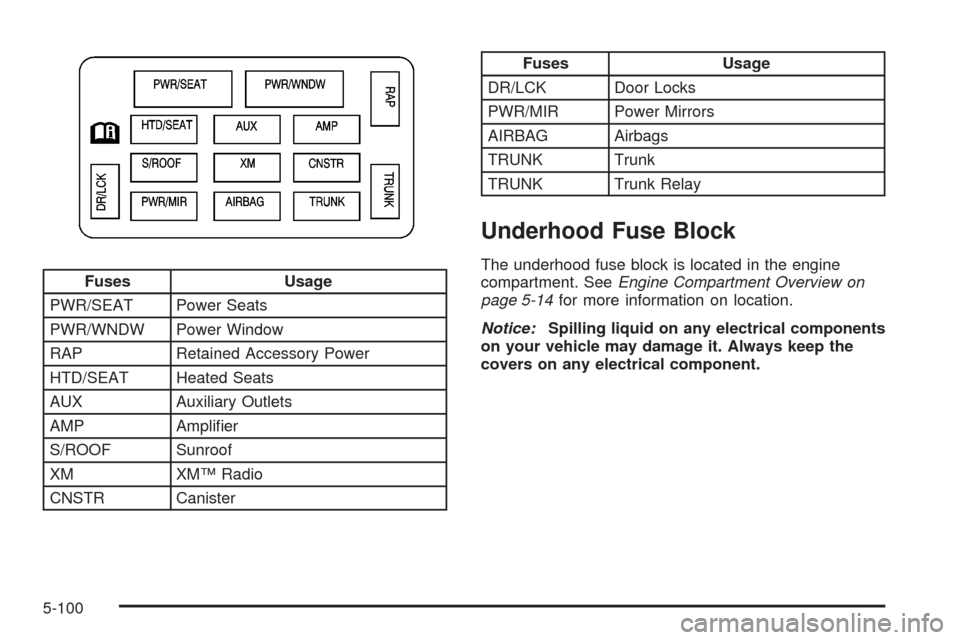
Fuses Usage
PWR/SEAT Power Seats
PWR/WNDW Power Window
RAP Retained Accessory Power
HTD/SEAT Heated Seats
AUX Auxiliary Outlets
AMP Amplier
S/ROOF Sunroof
XM XM™ Radio
CNSTR Canister
Fuses Usage
DR/LCK Door Locks
PWR/MIR Power Mirrors
AIRBAG Airbags
TRUNK Trunk
TRUNK Trunk Relay
Underhood Fuse Block
The underhood fuse block is located in the engine
compartment. SeeEngine Compartment Overview on
page 5-14for more information on location.
Notice:Spilling liquid on any electrical components
on your vehicle may damage it. Always keep the
covers on any electrical component.
5-100
Page 399 of 400
Towing
Recreational Vehicle.....................................4-26
Towing a Trailer..........................................4-27
Your Vehicle...............................................4-26
Traction
Control System (TCS).................................... 4-6
Control System Warning Light.......................3-36
Transmission
Fluid, Automatic...........................................5-24
Transmission Operation, Automatic....................2-26
Trunk............................................................2-13
Turn and Lane-Change Signals.......................... 3-8
Turn Signal/Multifunction Lever........................... 3-7
U
Uniform Tire Quality Grading............................5-73
Universal Home Remote System.......................2-41
Operation...................................................2-42
Using this Manual............................................... iii
V
Vehicle
Control........................................................ 4-3
Damage Warnings........................................... iv
Loading......................................................4-21
Symbols......................................................... ivVehicle Customization, DIC..............................3-60
Vehicle Data Recording and Privacy..................7-16
Vehicle Identication
Number (VIN).............................................5-98
Service Parts Identication Label...................5-98
Vehicle, Remote Start....................................... 2-8
Ventilation Adjustment......................................3-25
Visors...........................................................2-17
W
Warning Lights, Gages and Indicators................3-27
Warnings
DIC Warnings and Messages........................3-52
Hazard Warning Flashers............................... 3-6
Other Warning Devices.................................. 3-6
Safety and Symbols......................................... iii
Vehicle Damage.............................................. iv
Wheels
Alignment and Tire Balance..........................5-74
Different Size..............................................5-72
Replacement...............................................5-74
Where to Put the Restraint...............................1-40
Windows.......................................................2-15
Power........................................................2-16
13