check engine light CHEVROLET IMPALA 2009 9.G User Guide
[x] Cancel search | Manufacturer: CHEVROLET, Model Year: 2009, Model line: IMPALA, Model: CHEVROLET IMPALA 2009 9.GPages: 406, PDF Size: 2.25 MB
Page 177 of 406
SERVICE TRACTION CONTROL
If your vehicle has the Traction Control System (TCS),
this message displays when the system is not functioning
properly. A warning light also appears on the instrument
panel cluster. SeeTraction Control System (TCS)
Warning Light on page 3-32. SeeTraction Control
System (TCS) on page 4-8for more information.
Have the TCS serviced by your dealer/retailer as
soon as possible.
SERVICE TRANSMISSION
This message displays when there is a problem with the
transmission. See your dealer/retailer for service.
SERVICE VEHICLE SOON
This message displays when a non-emissions related
malfunction occurs. Have the vehicle serviced by
your dealer/retailer as soon as possible.
STABILITRAK NOT READY
If your vehicle has Electronic Stability Control (ESC),
this message may display and the ESC/TCS light on the
instrument panel cluster may be on after rst driving the
vehicle and exceeding 19 mph (30 km/h) for 30 seconds.
The ESC system is not functional until the light has turned
off. SeeElectronic Stability Control (ESC) on page 4-6for
more information.
STARTING DISABLED SERVICE
THROTTLE
This message displays if the starting of the engine is
disabled due to the electronic throttle control system.
Have your vehicle serviced by your dealer/retailer
immediately.
This message only appears while the ignition is in
ON/RUN, and will not disappear until the problem is
resolved.
This message cannot be acknowledged.
THEFT ATTEMPTED
This message displays if the content theft-deterrent
system has detected a break-in attempt while you were
away from your vehicle. SeeContent Theft-Deterrent
on page 2-16for more information.
TIGHTEN GAS CAP
This message may be displayed if the gas cap is not
on, or is not fully tightened. Check the gas cap to ensure
that it is on properly. SeeFilling the Tank on page 5-10
for more information.
3-55
Page 223 of 406
Antilock Brake System (ABS)
The vehicle might have the Antilock Brake System
(ABS), an advanced electronic braking system that helps
prevent a braking skid.
If the vehicle has ABS,
this warning light on the
instrument panel cluster
comes on briey when the
vehicle is started.
When the engine is started, or when the vehicle begins
to drive away, ABS checks itself. A momentary motor
or clicking noise might be heard while this test is going
on, and it might even be noticed that the brake pedal
moves or pulses a little. This is normal.
Let us say the road is wet and you are driving safely.
Suddenly, an animal jumps out in front of you. You slam
on the brakes and continue braking. Here is what
happens with ABS:
A computer senses that the wheels are slowing down. If
one of the wheels is about to stop rolling, the computer
will separately work the brakes at each front wheel
and at both rear wheels.ABS can change the brake pressure to each wheel, as
required, faster than any driver could. This can help
the driver steer around the obstacle while braking hard.
As the brakes are applied, the computer keeps
receiving updates on wheel speed and controls braking
pressure accordingly.
Remember: ABS does not change the time needed to get
a foot up to the brake pedal or always decrease stopping
distance. If you get too close to the vehicle in front of you,
there will not be enough time to apply the brakes if that
vehicle suddenly slows or stops. Always leave enough
room up ahead to stop, even with ABS.
Using ABS
Do not pump the brakes. Just hold the brake pedal
down rmly and let antilock work. A slight brake pedal
pulsation might be felt or some noise might be
heard, but this is normal.
4-5
Page 258 of 406
If the vehicle has the 5.3L V8 engine (VIN Code C), use
premium unleaded gasoline with a posted octane rating
of 91 or higher. You can also use regular unleaded
gasoline rated at 87 octane or higher, but the vehicle’s
acceleration could be slightly reduced, and you might
notice a slight audible knocking noise, commonly referred
to as spark knock. If the octane is less than 87, you might
notice a heavy knocking noise when you drive. If this
occurs, use a gasoline rated at 87 octane or higher as
soon as possible. Otherwise, you could damage the
engine. If you are using gasoline rated at 87 octane or
higher and you hear heavy knocking, the engine needs
service.
Gasoline Specications
At a minimum, gasoline should meet ASTM specication
D 4814 in the United States or CAN/CGSB-3.5 or 3.511 in
Canada. Some gasolines contain an octane-enhancing
additive called methylcyclopentadienyl manganese
tricarbonyl (MMT). We recommend against the use of
gasolines containing MMT. SeeAdditives on page 5-6for
additional information.
California Fuel
If the vehicle is certied to meet California Emissions
Standards, it is designed to operate on fuels that meet
California specications. See the underhood emission
control label. If this fuel is not available in states adopting
California emissions standards, the vehicle will operate
satisfactorily on fuels meeting federal specications, but
emission control system performance might be affected.
The malfunction indicator lamp could turn on and the
vehicle might fail a smog-check test. SeeMalfunction
Indicator Lamp on page 3-36. If this occurs, return to your
authorized dealer/retailer for diagnosis. If it is determined
that the condition is caused by the type of fuel used,
repairs might not be covered by the vehicle warranty.
Additives
To provide cleaner air, all gasolines in the United States
are now required to contain additives that help prevent
engine and fuel system deposits from forming, allowing
the emission control system to work properly. In most
cases, you should not have to add anything to the fuel.
5-6
Page 283 of 406
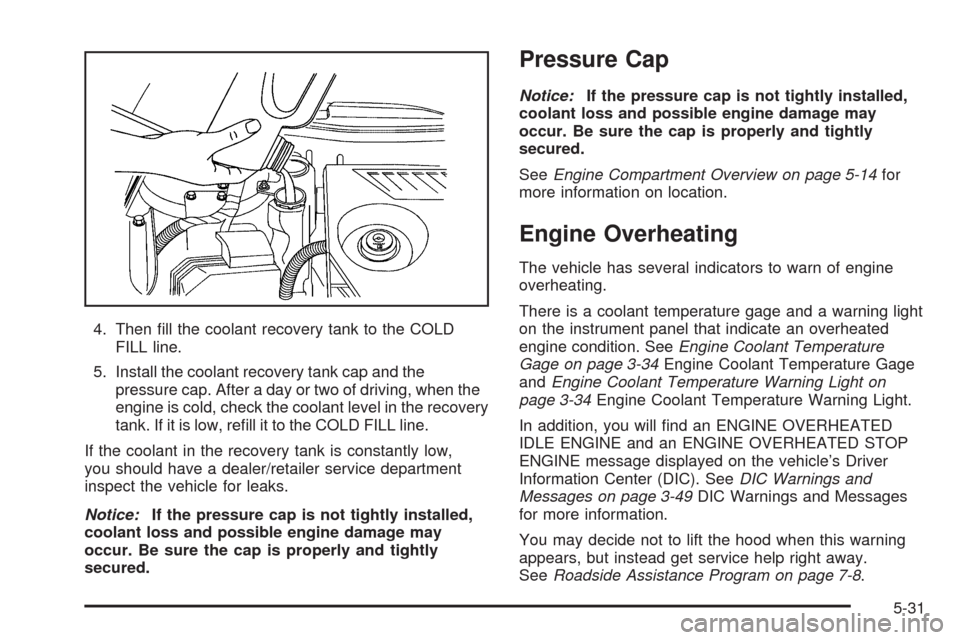
4. Then ll the coolant recovery tank to the COLD
FILL line.
5. Install the coolant recovery tank cap and the
pressure cap. After a day or two of driving, when the
engine is cold, check the coolant level in the recovery
tank. If it is low, rell it to the COLD FILL line.
If the coolant in the recovery tank is constantly low,
you should have a dealer/retailer service department
inspect the vehicle for leaks.
Notice:If the pressure cap is not tightly installed,
coolant loss and possible engine damage may
occur. Be sure the cap is properly and tightly
secured.
Pressure Cap
Notice:If the pressure cap is not tightly installed,
coolant loss and possible engine damage may
occur. Be sure the cap is properly and tightly
secured.
SeeEngine Compartment Overview on page 5-14for
more information on location.
Engine Overheating
The vehicle has several indicators to warn of engine
overheating.
There is a coolant temperature gage and a warning light
on the instrument panel that indicate an overheated
engine condition. SeeEngine Coolant Temperature
Gage on page 3-34Engine Coolant Temperature Gage
andEngine Coolant Temperature Warning Light on
page 3-34Engine Coolant Temperature Warning Light.
In addition, you will nd an ENGINE OVERHEATED
IDLE ENGINE and an ENGINE OVERHEATED STOP
ENGINE message displayed on the vehicle’s Driver
Information Center (DIC). SeeDIC Warnings and
Messages on page 3-49DIC Warnings and Messages
for more information.
You may decide not to lift the hood when this warning
appears, but instead get service help right away.
SeeRoadside Assistance Program on page 7-8.
5-31
Page 295 of 406
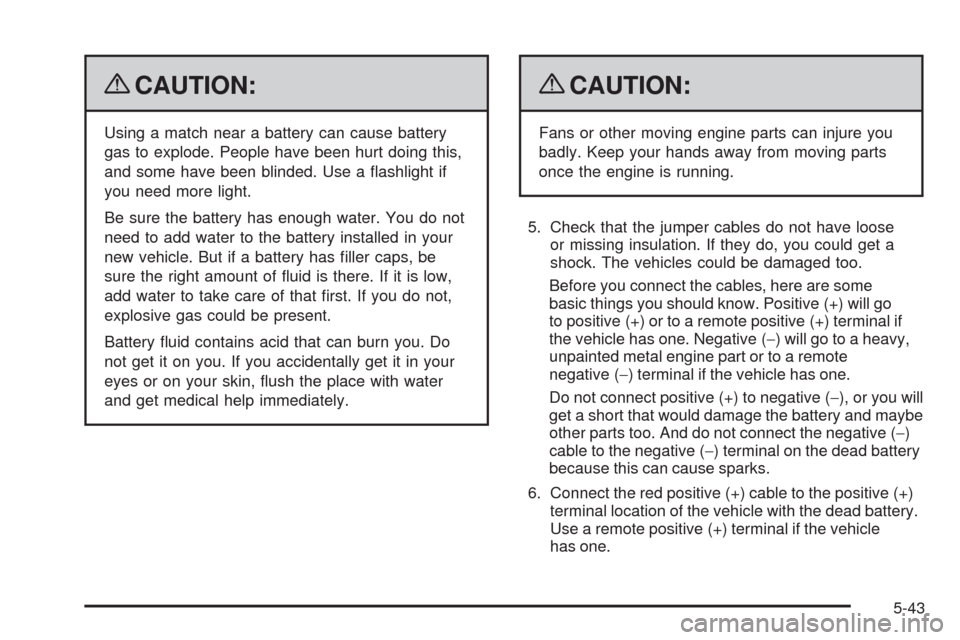
{CAUTION:
Using a match near a battery can cause battery
gas to explode. People have been hurt doing this,
and some have been blinded. Use a ashlight if
you need more light.
Be sure the battery has enough water. You do not
need to add water to the battery installed in your
new vehicle. But if a battery has ller caps, be
sure the right amount of uid is there. If it is low,
add water to take care of that rst. If you do not,
explosive gas could be present.
Battery uid contains acid that can burn you. Do
not get it on you. If you accidentally get it in your
eyes or on your skin, ush the place with water
and get medical help immediately.
{CAUTION:
Fans or other moving engine parts can injure you
badly. Keep your hands away from moving parts
once the engine is running.
5. Check that the jumper cables do not have loose
or missing insulation. If they do, you could get a
shock. The vehicles could be damaged too.
Before you connect the cables, here are some
basic things you should know. Positive (+) will go
to positive (+) or to a remote positive (+) terminal if
the vehicle has one. Negative (−) will go to a heavy,
unpainted metal engine part or to a remote
negative (−) terminal if the vehicle has one.
Do not connect positive (+) to negative (−), or you will
get a short that would damage the battery and maybe
other parts too. And do not connect the negative (−)
cable to the negative (−) terminal on the dead battery
because this can cause sparks.
6. Connect the red positive (+) cable to the positive (+)
terminal location of the vehicle with the dead battery.
Use a remote positive (+) terminal if the vehicle
has one.
5-43
Page 395 of 406
Canadian Owners................................................ ii
Capacities and Specications..........................5-101
Carbon Monoxide
Engine Exhaust...........................................2-30
Trunk.........................................................2-12
Winter Driving.............................................4-17
Care of
Safety Belts................................................5-92
CD, MP3 .......................................................3-77
Center Console Storage...................................2-43
Center Seat...................................................1-10
Chains, Tire...................................................5-74
Charging System Light....................................3-30
Check
Engine Lamp..............................................3-36
Checking Things Under the Hood......................5-12
Chemical Paint Spotting...................................5-95
Child Restraints
Infants and Young Children...........................1-37
Lower Anchors and Tethers for Children..........1-45
Older Children.............................................1-34
Securing a Child Restraint in a Rear
Seat Position...........................................1-50
Securing a Child Restraint in the Center
Front Seat Position...................................1-53
Securing a Child Restraint in the Right
Front Seat Position...................................1-54
Systems.....................................................1-41
Where to Put the Restraint...........................1-43Cigarette Lighter.............................................3-19
Circuit Breakers..............................................5-97
Cleaning
Aluminum Wheels........................................5-94
Exterior Lamps/Lenses.................................5-93
Fabric/Carpet..............................................5-90
Finish Care.................................................5-93
Instrument Panel, Vinyl, and Other Plastic
Surfaces.................................................5-91
Interior.......................................................5-89
Leather......................................................5-91
Tires
..........................................................5-95
Underbody Maintenance...............................5-95
Washing Your Vehicle...................................5-92
Weatherstrips..............................................5-92
Windshield and Wiper Blades........................5-94
Climate Control System...................................3-20
Outlet Adjustment........................................3-23
Clock, Setting.................................................3-64
Collision Damage Repair..................................7-12
Compact Spare Tire........................................5-88
Compass.......................................................3-47
Content Theft-Deterrent....................................2-16
Control of a Vehicle.......................................... 4-3
Convenience Net............................................2-43
Coolant
Engine.......................................................5-28
Engine Temperature Gage............................3-34
Engine Temperature Warning Light.................3-34
3
Page 397 of 406
E
E85 Fuel......................................................... 5-8
EDR .............................................................7-18
Electrical Equipment
Add-On Equipment......................................5-96
Electrical System
Fuses and Circuit Breakers...........................5-97
Headlamp Wiring.........................................5-97
Instrument Panel Fuse Block.........................5-97
Power Windows and Other Power Options......5-97
Underhood Fuse Block.................................5-98
Windshield Wiper Fuses...............................5-97
Electronic Immobilizer
PASS-Key
®III+...........................................2-17
Electronic Immobilizer Operation
PASS-Key
®III+...........................................2-18
Electronic Stability Control................................. 4-6
Engine
Air Cleaner/Filter.........................................5-21
Check and Service Engine Soon Lamp...........3-36
Compartment Overview................................5-14
Coolant......................................................5-28
Coolant Heater............................................2-22
Coolant Temperature Gage...........................3-34
Coolant Temperature Warning Light................3-34
Cooling System...........................................5-26
Drive Belt Routing.......................................6-14
Exhaust.....................................................2-30
Oil .............................................................5-17Engine (cont.)
Oil Life System...........................................5-20
Overheated Protection Operating Mode...........5-34
Overheating................................................5-31
Starting......................................................2-21
Entry Lighting.................................................3-15
Event Data Recorders.....................................7-18
Extender, Safety Belt.......................................1-33
Exterior Lamps...............................................3-12
F
Filter
Engine Air Cleaner......................................5-21
Finish Damage...............................................5-95
Flashers, Hazard Warning.................................. 3-6
Flash-to-Pass................................................... 3-8
Flat Tire........................................................5-75
Flat Tire, Changing.........................................5-76
Flat Tire, Storing.............................................5-85
Fluid
Automatic Transmission................................5-24
Power Steering...........................................5-34
Windshield Washer......................................5-35
Fog Lamp
Fog ...........................................................3-14
Fog Lamp Light..............................................3-40
Folding Rear Seat...........................................1-10
5
Page 399 of 406
Highway Hypnosis...........................................4-15
Hill and Mountain Roads..................................4-16
Hood
Checking Things Under................................5-12
Release.....................................................5-13
Horn ............................................................... 3-6
How to Wear Safety Belts Properly...................1-18
I
Ignition Positions.............................................2-20
Infants and Young Children, Restraints...............1-37
Ination - Tire Pressure...................................5-60
Instrument Panel
Brightness..................................................3-15
Cluster.......................................................3-25
Overview..................................................... 3-4
Introduction...................................................... 6-2
J
Jump Starting.................................................5-40
K
Keyless Entry, Remote Operation........................ 2-5
Keyless Entry System....................................... 2-4
Keys............................................................... 2-3
L
Labeling, Tire Sidewall.....................................5-54
Lamp
Malfunction Indicator....................................3-36
Lamps
Courtesy....................................................3-15
Dome ........................................................3-15
License Plate..............................................5-51
Mirror Reading............................................3-17
Reading.....................................................3-17
Lap Belt........................................................1-32
Lap-Shoulder Belt...........................................1-27
LATCH System for Child Restraints...................1-45
Lighting
Delayed Entry.............................................3-16
Delayed Exit...............................................3-16
Entry.........................................................3-15
Parade Dimming..........................................3-16
Lights
Airbag Readiness........................................3-28
Antilock Brake System (ABS) Warning............3-31
Brake System Warning.................................3-30
Charging System.........................................3-30
Cruise Control.............................................3-40
Electronic StabiliTrak Control Indicator............3-33
Engine Coolant Temperature Warning.............3-34
Exterior Lamps............................................3-12
Flash-to-Pass............................................... 3-8
7
Page 401 of 406
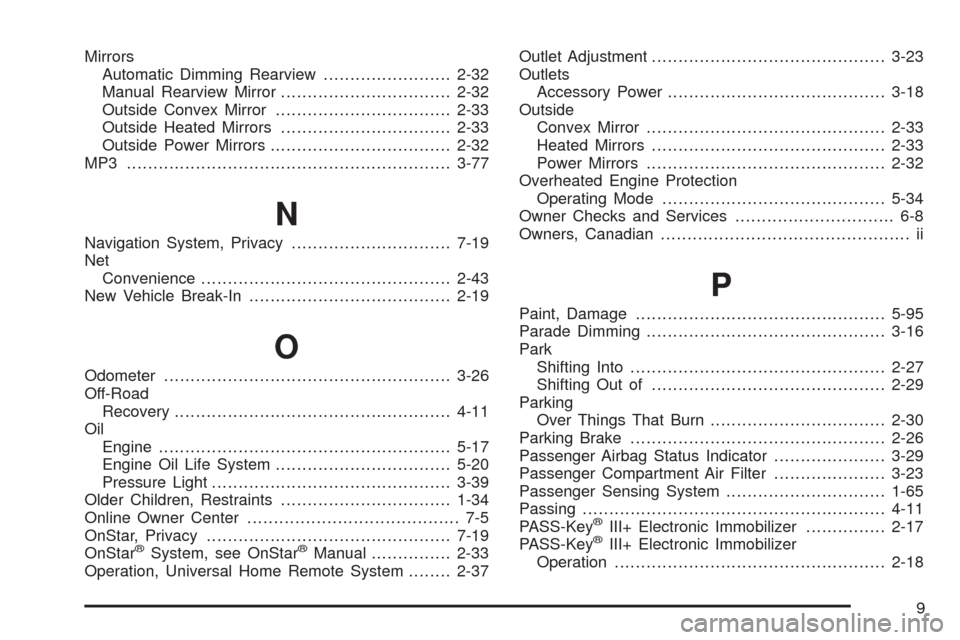
Mirrors
Automatic Dimming Rearview........................2-32
Manual Rearview Mirror................................2-32
Outside Convex Mirror.................................2-33
Outside Heated Mirrors................................2-33
Outside Power Mirrors..................................2-32
MP3 .............................................................3-77
N
Navigation System, Privacy..............................7-19
Net
Convenience...............................................2-43
New Vehicle Break-In......................................2-19
O
Odometer......................................................3-26
Off-Road
Recovery....................................................4-11
Oil
Engine.......................................................5-17
Engine Oil Life System.................................5-20
Pressure Light.............................................3-39
Older Children, Restraints................................1-34
Online Owner Center........................................ 7-5
OnStar, Privacy..............................................7-19
OnStar
®System, see OnStar®Manual...............2-33
Operation, Universal Home Remote System........2-37Outlet Adjustment............................................3-23
Outlets
Accessory Power.........................................3-18
Outside
Convex Mirror.............................................2-33
Heated Mirrors............................................2-33
Power Mirrors.............................................2-32
Overheated Engine Protection
Operating Mode..........................................5-34
Owner Checks and Services.............................. 6-8
Owners, Canadian............................................... ii
P
Paint, Damage...............................................5-95
Parade Dimming.............................................3-16
Park
Shifting Into................................................2-27
Shifting Out of............................................2-29
Parking
Over Things That Burn.................................2-30
Parking Brake................................................2-26
Passenger Airbag Status Indicator.....................3-29
Passenger Compartment Air Filter.....................3-23
Passenger Sensing System..............................1-65
Passing.........................................................4-11
PASS-Key
®III+ Electronic Immobilizer...............2-17
PASS-Key®III+ Electronic Immobilizer
Operation...................................................2-18
9