mirror CHEVROLET IMPALA 2010 9.G User Guide
[x] Cancel search | Manufacturer: CHEVROLET, Model Year: 2010, Model line: IMPALA, Model: CHEVROLET IMPALA 2010 9.GPages: 432, PDF Size: 1.89 MB
Page 163 of 432
Delayed Exit LightingThis feature illuminates the interior for a period of time
after the key is removed from the ignition.
The ignition must be off for delayed exit lighting to work.
When the key is removed, interior illumination activates
and remains on until one of the following occurs:•
The ignition is in ON/RUN.
•
The power door locks are activated.
•
An illumination period of 20 seconds has elapsed.
If during the illumination period a door is opened,
the timed illumination period will be canceled and the
interior lamps will remain on because a door is open.
Parade DimmingParade mode automatically prohibits the dimming of
the instrument panel displays during the daylight while
the headlamps are on so that the displays are still
able to be seen.Reading LampsThe vehicle has reading lamps that also act as the
dome lamp. Press the button near each lamp to turn
them on and off.
Map LampsThe vehicle has map lamps on the rearview mirror.
Press the button near each lamp on the mirror to turn
the map lamps on and off.Electric Power ManagementThe vehicle has Electric Power Management (EPM) that
estimates the battery’s temperature and state of charge.
It then adjusts the voltage for best performance and
extended life of the battery.
When the battery’s state of charge is low, the voltage is
raised slightly to quickly bring the charge back up. When
the state of charge is high, the voltage is lowered slightly
to prevent overcharging. If the vehicle has a voltmeter
gage or a voltage display on the Driver Information
Center (DIC), you may see the voltage move up or down.
This is normal. If there is a problem, an alert will be
displayed.
The battery can be discharged at idle if the electrical
loads are very high. This is true for all vehicles. This is
because the generator (alternator) may not be spinning
fast enough at idle to produce all the power that is
needed for very high electrical loads.
4-13
Page 169 of 432

Using these settings together for long periods of time
may cause the air inside the vehicle to become too dry.
To prevent this from happening, after the air inside
the vehicle has cooled, turn the recirculation mode off.
The air conditioning system removes moisture from
the air, so a small amount of water may drip under
the vehicle while idling or after turning off the engine.
This is normal.:
(Outside Air):Press to turn on outside air.
An indicator light comes on to show that it is on.
Outside air will circulate throughout the vehicle.
?
(Recirculation):Press to turn on the recirculation
mode. An indicator light comes on to show that
it is on.
This mode helps to quickly heat or cool the air inside the
vehicle once the temperature inside the vehicle is equal
to or better than the outside temperature. It can be used
to prevent outside air and odors from entering the vehicle.
The recirculation mode is not available in outside air,
floor, defog or defrost modes. If the button is selected
while in these modes, the indicator flashes three times.
Rear Window DefoggerThe rear window defogger uses a warming grid to
remove fog from the rear window.<
(Rear Window Defogger):The rear window
defogger turns off automatically after it has been
activated for 10 minutes. It can be turned off manually,
by pressing the button again or by turning the ignition
to the LOCK/OFF position. The rear window defogger
can be turned on again for additional window clearing.
The length of defogger operation will increase if the
vehicle is being driven.
For vehicles with heated outside rearview mirrors, the
mirrors heat to help clear fog or frost from the surface of
the mirror when the rear window defog button is
pressed. SeeOutside Power Mirrors on page 3-34.
Do not drive the vehicle until all the windows are clear.
Notice:Do not use anything sharp on the inside
of the rear window. If you do, you could cut or
damage the warming grid, and the repairs would not
be covered by the vehicle warranty. Do not attach
a temporary vehicle license, tape, a decal or
anything similar to the defogger grid.
4-19
Page 248 of 432

SkiddingIn a skid, a driver can lose control of the vehicle.
Defensive drivers avoid most skids by taking reasonable
care suited to existing conditions, and by not overdriving
those conditions. But skids are always possible.
The three types of skids correspond to the vehicle’s
three control systems. In the braking skid, the wheels
are not rolling. In the steering or cornering skid, too
much speed or steering in a curve causes tires to slip
and lose cornering force. And in the acceleration
skid, too much throttle causes the driving wheels
to spin.
If the vehicle starts to slide, ease your foot off the
accelerator pedal and quickly steer the way you want
the vehicle to go. If you start steering quickly enough,
the vehicle may straighten out. Always be ready for
a second skid if it occurs.
Of course, traction is reduced when water, snow, ice,
gravel, or other material is on the road. For safety, slow
down and adjust your driving to these conditions. It is
important to slow down on slippery surfaces because
stopping distance will be longer and vehicle control more
limited.While driving on a surface with reduced traction, try your
best to avoid sudden steering, acceleration, or braking,
including reducing vehicle speed by shifting to a lower
gear. Any sudden changes could cause the tires to
slide. You may not realize the surface is slippery until
the vehicle is skidding. Learn to recognize warning
clues — such as enough water, ice, or packed snow on
the road to make a mirrored surface — and slow down
when you have any doubt.
If the vehicle has the Antilock Brake System (ABS),
remember: It helps avoid only the braking skid. If
the vehicle does not have ABS, then in a braking skid,
where the wheels are no longer rolling, release
enough pressure on the brakes to get the wheels rolling
again. This restores steering control. Push the brake
pedal down steadily when you have to stop suddenly. As
long as the wheels are rolling, you will have steering
control.
5-12
Page 249 of 432
Driving at NightNight driving is more dangerous than day driving because
some drivers are likely to be impaired — by alcohol or
drugs, with night vision problems, or by fatigue.
Night driving tips include:•
Drive defensively.
•
Do not drink and drive.
•
Reduce headlamp glare by adjusting the inside
rearview mirror.
•
Slow down and keep more space between you and
other vehicles because headlamps can only light up
so much road ahead.
•
Watch for animals.
•
When tired, pull off the road.
•
Do not wear sunglasses.
•
Avoid staring directly into approaching headlamps.
•
Keep the windshield and all glass on your vehicle
clean — inside and out.
•
Keep your eyes moving, especially during turns or
curves.
No one can see as well at night as in the daytime.
But, as we get older, these differences increase.
A 50-year-old driver might need at least twice as much
light to see the same thing at night as a 20-year-old.
5-13
Page 251 of 432
Before Leaving on a Long TripTo prepare your vehicle for a long trip, consider having
it serviced by your dealer/retailer before departing.
Things to check on your own include:•
Windshield Washer Fluid:Reservoir full? Windows
clean — inside and outside?
•
Wiper Blades:In good shape?
•
Fuel, Engine Oil, Other Fluids:All levels checked?
•
Lamps:Do they all work and are lenses clean?
•
Tires:Are treads good? Are tires inflated to
recommended pressure?
•
Weather and Maps:Safe to travel? Have
up-to-date maps?
Highway HypnosisAlways be alert and pay attention to your surroundings
while driving. If you become tired or sleepy, find a
safe place to park your vehicle and rest.
Other driving tips include:•
Keep the vehicle well ventilated.
•
Keep interior temperature cool.
•
Keep your eyes moving — scan the road ahead
and to the sides.
•
Check the rearview mirror and vehicle instruments
often.
5-15
Page 254 of 432
Blizzard ConditionsBeing stuck in snow can be in a serious situation. Stay
with the vehicle unless there is help nearby. If possible,
use theRoadside Assistance Program on page 8-7.To
get help and keep everyone in the vehicle safe:•
Turn on theHazard Warning Flashers on page 4-3.
•
Tie a red cloth to an outside mirror.{
WARNING:
Snow can trap engine exhaust under the vehicle.
This may cause exhaust gases to get inside.
Engine exhaust contains carbon monoxide (CO)
which cannot be seen or smelled. It can cause
unconsciousness and even death.
If the vehicle is stuck in the snow:
•
Clear away snow from around the base of
your vehicle, especially any that is blocking
the exhaust pipe.
•
Check again from time to time to be sure
snow does not collect there.
WARNING: (Continued)
WARNING: (Continued)
•
Open a window about 5 cm (two inches) on
the side of the vehicle that is away from the
wind to bring in fresh air.
•
Fully open the air outlets on or under the
instrument panel.
•
Adjust the Climate Control system to a setting
that circulates the air inside the vehicle and
set the fan speed to the highest setting. See
Climate Control System in the Index.
For more information about carbon monoxide, see
Engine Exhaust on page 3-31.
Snow can trap exhaust gases under your vehicle.
This can cause deadly CO (carbon monoxide) gas
to get inside. CO could overcome you and kill you.
You cannot see it or smell it, so you might not
know it is in your vehicle. Clear away snow from
around the base of your vehicle, especially any
that is blocking the exhaust.
Run the engine for short periods only as needed to
keep warm, but be careful.
To save fuel, run the engine for only short periods as
needed to warm the vehicle and then shut the engine off
and close the window most of the way to save heat.
5-18
Page 268 of 432
Driving with a TrailerTowing a trailer requires a certain amount of experience.
Get to know the rig before setting out for the open
road. Get acquainted with the feel of handling and
braking with the added weight of the trailer. And always
keep in mind that the vehicle you are driving is now
longer and not as responsive as the vehicle is by itself.
Before starting, check all trailer hitch parts and
attachments, safety chains, electrical connectors, lamps,
tires and mirror adjustments. If the trailer has electric
brakes, start the vehicle and trailer moving and
then apply the trailer brake controller by hand to be sure
the brakes are working. This checks the electrical
connection at the same time.
During the trip, check occasionally to be sure that the
load is secure, and that the lamps and any trailer brakes
are still working.Following DistanceStay at least twice as far behind the vehicle ahead as
you would when driving the vehicle without a trailer. This
can help to avoid situations that require heavy braking
and sudden turns.
PassingMore passing distance is needed when towing a trailer.
Because the rig is longer, it is necessary to go much
farther beyond the passed vehicle before returning to
the lane.Backing UpHold the bottom of the steering wheel with one hand.
Then, to move the trailer to the left, move that hand
to the left. To move the trailer to the right, move your
hand to the right. Always back up slowly and, if possible,
have someone guide you.Making TurnsNotice:Making very sharp turns while trailering
could cause the trailer to come in contact with the
vehicle. The vehicle could be damaged. Avoid
making very sharp turns while trailering.
When turning with a trailer, make wider turns than
normal. Do this so the trailer will not strike soft
shoulders, curbs, road signs, trees or other objects.
Avoid jerky or sudden maneuvers. Signal well in
advance.
5-32
Page 367 of 432
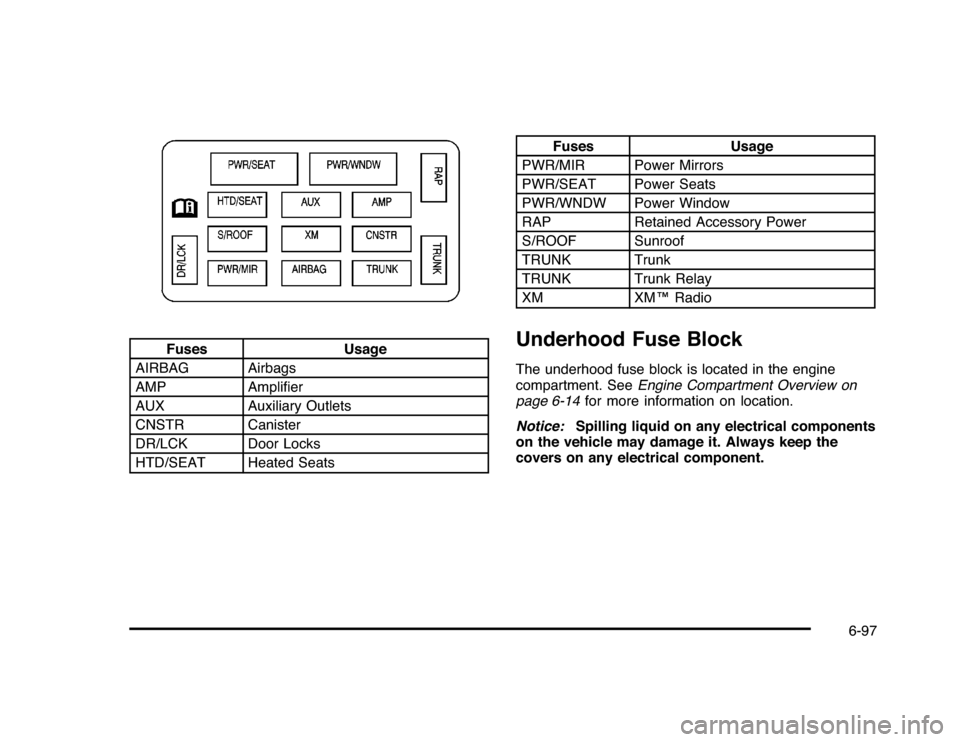
Fuses Usage
AIRBAG Airbags
AMP Amplifier
AUX Auxiliary Outlets
CNSTR Canister
DR/LCK Door Locks
HTD/SEAT Heated Seats
Fuses Usage
PWR/MIR Power Mirrors
PWR/SEAT Power Seats
PWR/WNDW Power Window
RAP Retained Accessory Power
S/ROOF Sunroof
TRUNK Trunk
TRUNK Trunk Relay
XM XM™ Radio
Underhood Fuse BlockThe underhood fuse block is located in the engine
compartment. SeeEngine Compartment Overview on
page 6-14for more information on location.
Notice:Spilling liquid on any electrical components
on the vehicle may damage it. Always keep the
covers on any electrical component.
6-97
Page 369 of 432
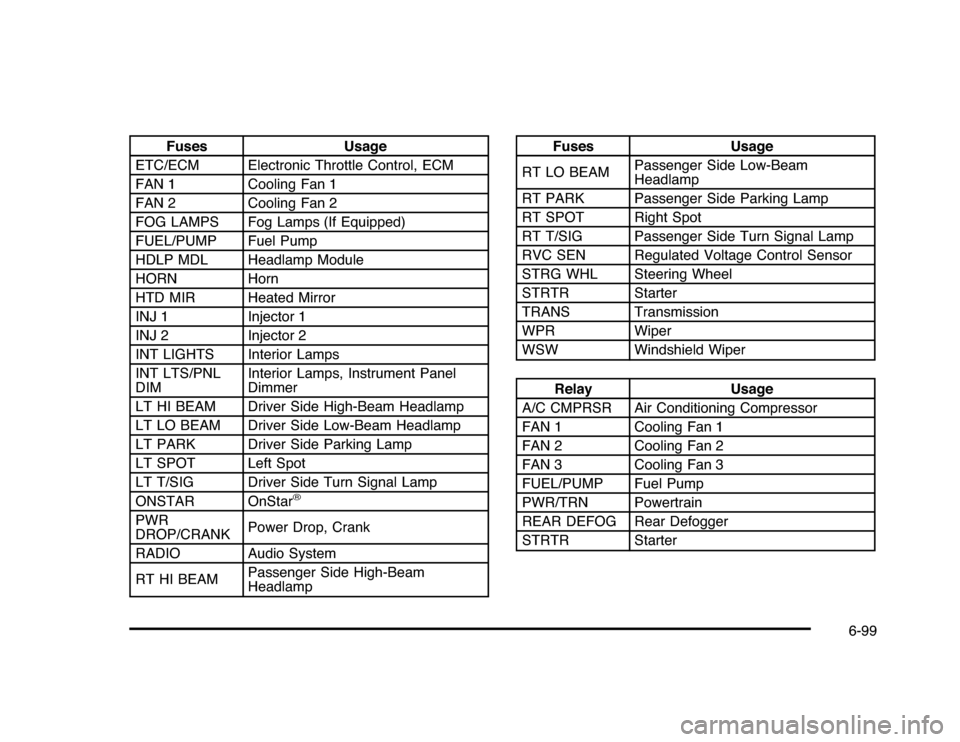
Fuses Usage
ETC/ECM Electronic Throttle Control, ECM
FAN 1 Cooling Fan 1
FAN 2 Cooling Fan 2
FOG LAMPS Fog Lamps (If Equipped)
FUEL/PUMP Fuel Pump
HDLP MDL Headlamp Module
HORN Horn
HTD MIR Heated Mirror
INJ 1 Injector 1
INJ 2 Injector 2
INT LIGHTS Interior Lamps
INT LTS/PNL
DIMInterior Lamps, Instrument Panel
Dimmer
LT HI BEAM Driver Side High-Beam Headlamp
LT LO BEAM Driver Side Low-Beam Headlamp
LT PARK Driver Side Parking Lamp
LT SPOT Left Spot
LT T/SIG Driver Side Turn Signal Lamp
ONSTAR OnStar
®
PWR
DROP/CRANKPower Drop, Crank
RADIO Audio System
RT HI BEAMPassenger Side High-Beam
Headlamp
Fuses Usage
RT LO BEAMPassenger Side Low-Beam
Headlamp
RT PARK Passenger Side Parking Lamp
RT SPOT Right Spot
RT T/SIG Passenger Side Turn Signal Lamp
RVC SEN Regulated Voltage Control Sensor
STRG WHL Steering Wheel
STRTR Starter
TRANS Transmission
WPR Wiper
WSW Windshield WiperRelay Usage
A/C CMPRSR Air Conditioning Compressor
FAN 1 Cooling Fan 1
FAN 2 Cooling Fan 2
FAN 3 Cooling Fan 3
FUEL/PUMP Fuel Pump
PWR/TRN Powertrain
REAR DEFOG Rear Defogger
STRTR Starter
6-99
Page 416 of 432
Lights (cont.)
Security .....................................................4-35
Tire Pressure . . ............................................4-31
Traction Control System (TCS) Warning..........4-28
Loading Your Vehicle.......................................5-20
Locks
Automatic Door Lock....................................3-10
Delayed Locking..........................................3-10
Door . . . ........................................................ 3-9
Lockout Protection.......................................3-12
Power Door . . . . ............................................3-10
Programmable Automatic Door Unlock............3-11
Rear Door Security Locks . . . . . ........................3-11
Loss of Control...............................................5-11
Lower Anchors and Tethers for Children . ............2-43
Lumbar
Manual Controls............................................ 2-5
M
Maintenance Schedule
Maintenance Record....................................7-13
Maintenance Replacement Parts....................7-11
Owner Checks and Services........................... 7-8
Recommended Fluids and Lubricants . ............7-10
Scheduled Maintenance................................. 7-3
Malfunction Indicator Lamp...............................4-31
Manual Lumbar Controls.................................... 2-5Manual Seats................................................... 2-4
Map Lamps....................................................4-13
Message
DIC Warnings and Messages........................4-44
Mirrors
Automatic Dimming Rearview........................3-33
Manual Rearview.........................................3-33
Outside Convex Mirror.................................3-34
Outside Heated Mirrors................................3-34
Outside Power Mirrors..................................3-34
MP3 .............................................................4-68
N
Navigation System, Privacy..............................8-20
Net, Convenience...........................................3-42
New Vehicle Break-In......................................3-19
O
Odometer......................................................4-23
Off-Road
Recovery....................................................5-11
Oil
Engine.......................................................6-15
Engine Oil Life System.................................6-18
Pressure Light.............................................4-34
8