wheel CHEVROLET IMPALA 2012 9.G Repair Manual
[x] Cancel search | Manufacturer: CHEVROLET, Model Year: 2012, Model line: IMPALA, Model: CHEVROLET IMPALA 2012 9.GPages: 374, PDF Size: 5.73 MB
Page 296 of 374
Black plate (54,1)Chevrolet Impala Owner Manual - 2012
10-54 Vehicle Care
Tire Chains
{WARNING
Do not use tire chains. There is
not enough clearance. Tire chains
used on a vehicle without the
proper amount of clearance can
cause damage to the brakes,
suspension, or other vehicle
parts. The area damaged by the
tire chains could cause loss of
control and a crash.
Use another type of traction
device only if its manufacturer
recommends it for the vehicle's
tire size combination and road
conditions. Follow that
manufacturer's instructions. To
avoid vehicle damage, drive slow
and readjust or remove the
traction device if it contacts the
vehicle. Do not spin the wheels.
If traction devices are used, install
them on the front tires.
If a Tire Goes Flat
It is unusual for a tire to blow out
while driving, especially if the tires
are maintained properly. If air goes
out of a tire, it is much more likely to
leak out slowly. But if there ever is a
blowout, here are a few tips about
what to expect and what to do:
If a front tire fails, the flat tire
creates a drag that pulls the vehicle
toward that side. Take your foot off
the accelerator pedal and grip the
steering wheel firmly. Steer to
maintain lane position, and then
gently brake to a stop, well off the
road, if possible.
A rear blowout, particularly on a
curve, acts much like a skid and
may require the same correction as
used in a skid. Stop pressing the
accelerator pedal and steer to
straighten the vehicle. It may be
very bumpy and noisy. Gently brake
to a stop, well off the road,
if possible.{WARNING
Driving on a flat tire will cause
permanent damage to the tire.
Re-inflating a tire after it has
been driven on while severely
underinflated or flat may cause a
blowout and a serious crash.
Never attempt to re-inflate a tire
that has been driven on while
severely underinflated or flat.
Have your dealer or an authorized
tire service center repair or
replace the flat tire as soon as
possible.
Page 297 of 374
Black plate (55,1)Chevrolet Impala Owner Manual - 2012
Vehicle Care 10-55
{WARNING
Lifting a vehicle and getting
under it to do maintenance or
repairs is dangerous without the
appropriate safety equipment and
training. If a jack is provided with
the vehicle, it is designed only for
changing a flat tire. If it is used for
anything else, you or others could
be badly injured or killed if the
vehicle slips off the jack. If a jack
is provided with the vehicle, only
use it for changing a flat tire.
If a tire goes flat, avoid further tire
and wheel damage by driving slowly
to a level place, well off the road,
if possible. Turn on the hazard
warning flashers. See Hazard
Warning Flashers on page 6‑4.
{WARNING
Changing a tire can be
dangerous. The vehicle can slip
off the jack and roll over or fall
causing injury or death. Find a
level place to change the tire. To
help prevent the vehicle from
moving:
1. Set the parking brake firmly.
2. Put an automatic transmission in P (Park) or a
manual transmission in
1 (First) or R (Reverse).
3. Turn off the engine and do not restart while the vehicle
is raised.
4. Do not allow passengers to remain in the vehicle.
5. Place wheel blocks on both sides of the tire at the
opposite corner of the tire
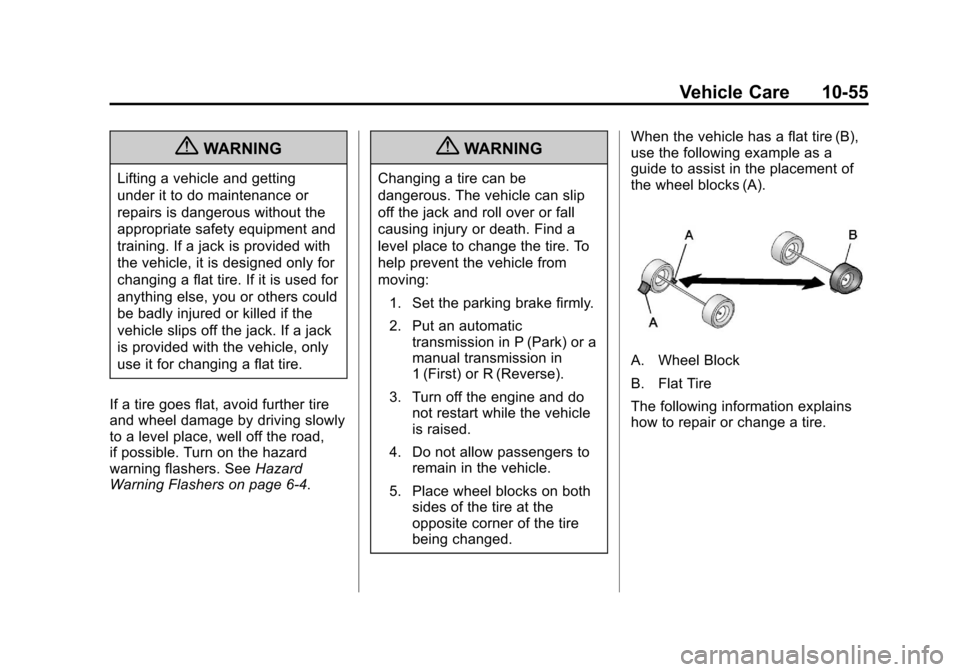
being changed. When the vehicle has a flat tire (B),
use the following example as a
guide to assist in the placement of
the wheel blocks (A).
A. Wheel Block
B. Flat Tire
The following information explains
how to repair or change a tire.
Page 298 of 374
Black plate (56,1)Chevrolet Impala Owner Manual - 2012
10-56 Vehicle Care
Tire Changing
Removing the Spare Tire and
Tools
The equipment you will need is
located in the trunk.
1. Open the trunk. SeeTrunk on
page 2‑10.
2. Remove the convenience net if the vehicle has one.
3. Remove the spare tire cover.
4. Turn the wing nut counterclockwise and remove it. 5. Remove the compact spare tire.
6. Turn the nut holding the jack
counterclockwise and remove it.
Then remove the jack and
wrench.
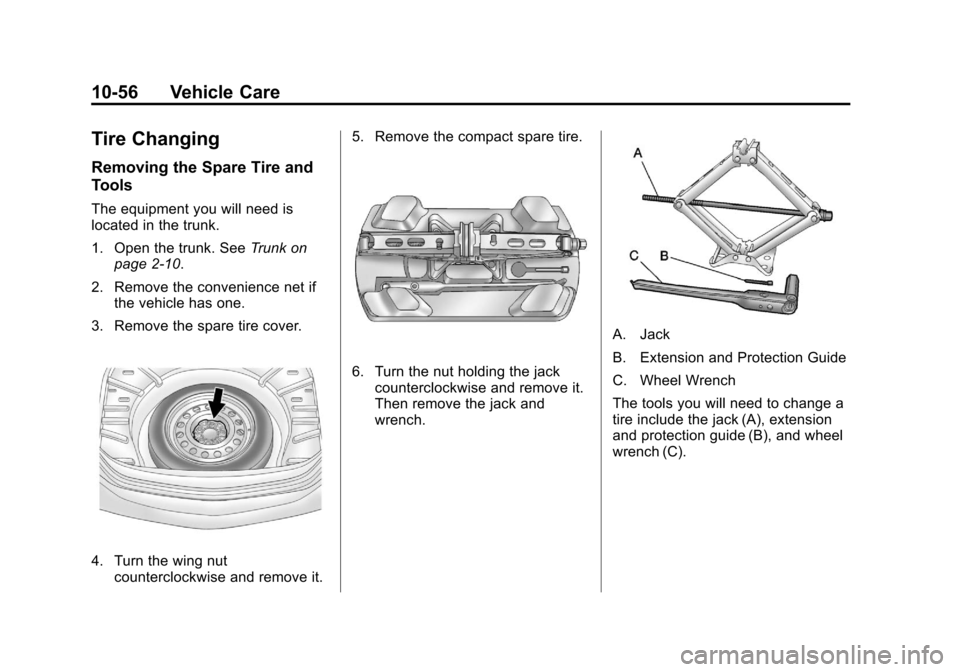
A. Jack
B. Extension and Protection Guide
C. Wheel Wrench
The tools you will need to change a
tire include the jack (A), extension
and protection guide (B), and wheel
wrench (C).
Page 299 of 374
Black plate (57,1)Chevrolet Impala Owner Manual - 2012
Vehicle Care 10-57
Removing the Flat Tire and
Installing the Spare Tire
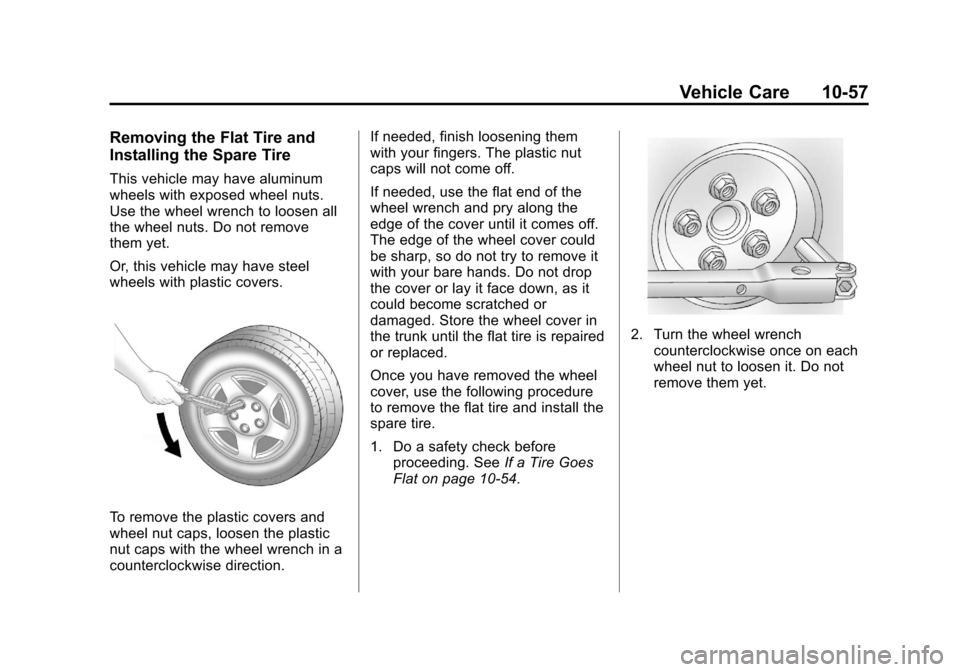
This vehicle may have aluminum
wheels with exposed wheel nuts.
Use the wheel wrench to loosen all
the wheel nuts. Do not remove
them yet.
Or, this vehicle may have steel
wheels with plastic covers.
To remove the plastic covers and
wheel nut caps, loosen the plastic
nut caps with the wheel wrench in a
counterclockwise direction.If needed, finish loosening them
with your fingers. The plastic nut
caps will not come off.
If needed, use the flat end of the
wheel wrench and pry along the
edge of the cover until it comes off.
The edge of the wheel cover could
be sharp, so do not try to remove it
with your bare hands. Do not drop
the cover or lay it face down, as it
could become scratched or
damaged. Store the wheel cover in
the trunk until the flat tire is repaired
or replaced.
Once you have removed the wheel
cover, use the following procedure
to remove the flat tire and install the
spare tire.
1. Do a safety check before
proceeding. See If a Tire Goes
Flat on page 10‑54.
2. Turn the wheel wrench counterclockwise once on each
wheel nut to loosen it. Do not
remove them yet.
Page 300 of 374
Black plate (58,1)Chevrolet Impala Owner Manual - 2012
10-58 Vehicle Care
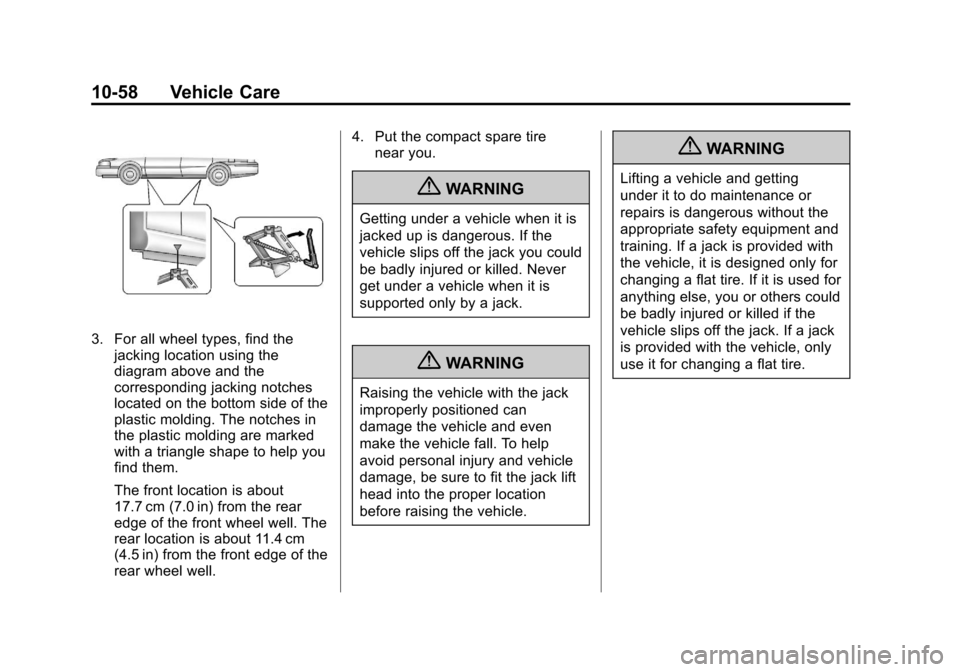
3. For all wheel types, find thejacking location using the
diagram above and the
corresponding jacking notches
located on the bottom side of the
plastic molding. The notches in
the plastic molding are marked
with a triangle shape to help you
find them.
The front location is about
17.7 cm (7.0 in) from the rear
edge of the front wheel well. The
rear location is about 11.4 cm
(4.5 in) from the front edge of the
rear wheel well. 4. Put the compact spare tire
near you.
{WARNING
Getting under a vehicle when it is
jacked up is dangerous. If the
vehicle slips off the jack you could
be badly injured or killed. Never
get under a vehicle when it is
supported only by a jack.
{WARNING
Raising the vehicle with the jack
improperly positioned can
damage the vehicle and even
make the vehicle fall. To help
avoid personal injury and vehicle
damage, be sure to fit the jack lift
head into the proper location
before raising the vehicle.
{WARNING
Lifting a vehicle and getting
under it to do maintenance or
repairs is dangerous without the
appropriate safety equipment and
training. If a jack is provided with
the vehicle, it is designed only for
changing a flat tire. If it is used for
anything else, you or others could
be badly injured or killed if the
vehicle slips off the jack. If a jack
is provided with the vehicle, only
use it for changing a flat tire.
Page 301 of 374
Black plate (59,1)Chevrolet Impala Owner Manual - 2012
Vehicle Care 10-59
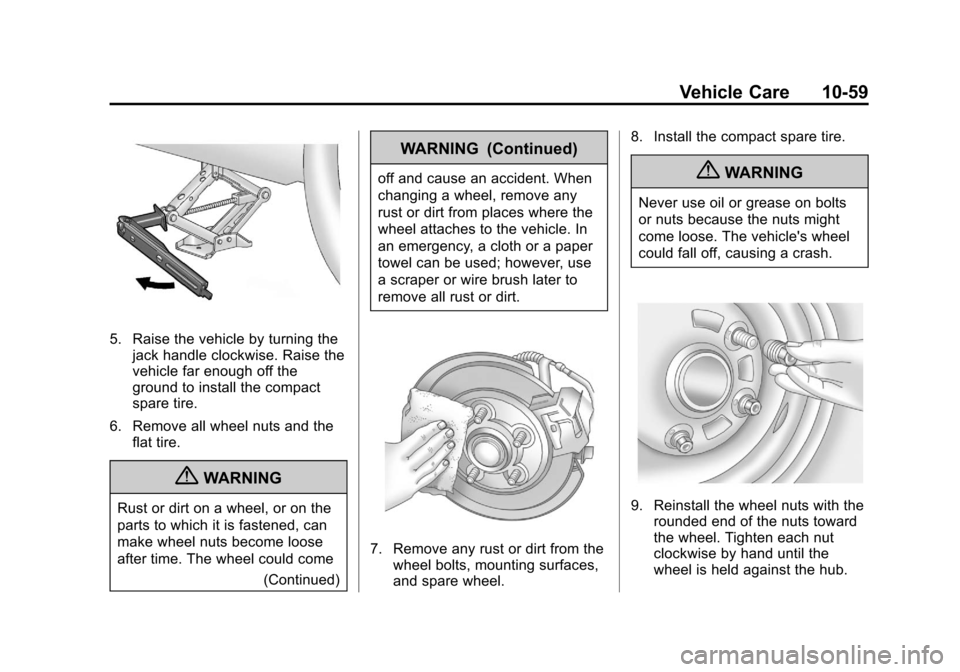
5. Raise the vehicle by turning thejack handle clockwise. Raise the
vehicle far enough off the
ground to install the compact
spare tire.
6. Remove all wheel nuts and the flat tire.
{WARNING
Rust or dirt on a wheel, or on the
parts to which it is fastened, can
make wheel nuts become loose
after time. The wheel could come
(Continued)
WARNING (Continued)
off and cause an accident. When
changing a wheel, remove any
rust or dirt from places where the
wheel attaches to the vehicle. In
an emergency, a cloth or a paper
towel can be used; however, use
a scraper or wire brush later to
remove all rust or dirt.
7. Remove any rust or dirt from thewheel bolts, mounting surfaces,
and spare wheel. 8. Install the compact spare tire.
{WARNING
Never use oil or grease on bolts
or nuts because the nuts might
come loose. The vehicle's wheel
could fall off, causing a crash.
9. Reinstall the wheel nuts with the
rounded end of the nuts toward
the wheel. Tighten each nut
clockwise by hand until the
wheel is held against the hub.
Page 302 of 374
Black plate (60,1)Chevrolet Impala Owner Manual - 2012
10-60 Vehicle Care
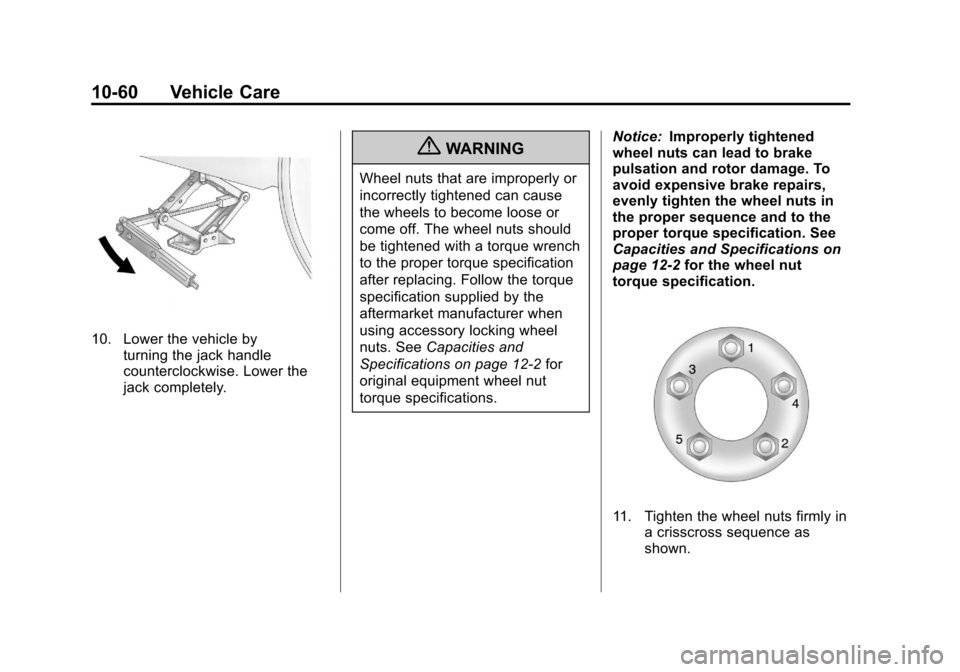
10. Lower the vehicle byturning the jack handle
counterclockwise. Lower the
jack completely.
{WARNING
Wheel nuts that are improperly or
incorrectly tightened can cause
the wheels to become loose or
come off. The wheel nuts should
be tightened with a torque wrench
to the proper torque specification
after replacing. Follow the torque
specification supplied by the
aftermarket manufacturer when
using accessory locking wheel
nuts. See Capacities and
Specifications on page 12‑2 for
original equipment wheel nut
torque specifications. Notice:
Improperly tightened
wheel nuts can lead to brake
pulsation and rotor damage. To
avoid expensive brake repairs,
evenly tighten the wheel nuts in
the proper sequence and to the
proper torque specification. See
Capacities and Specifications on
page 12‑2 for the wheel nut
torque specification.
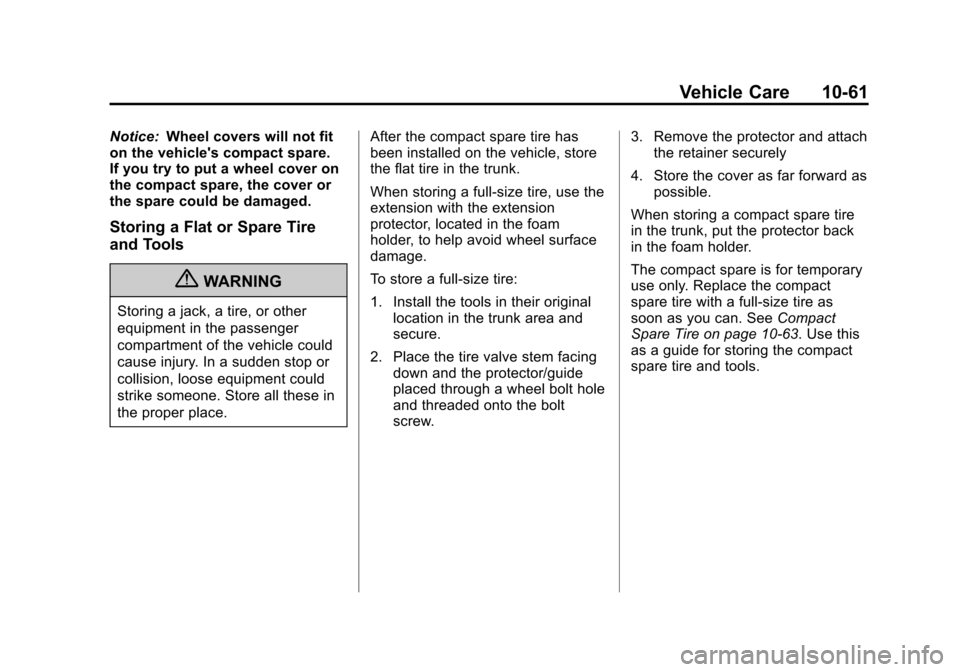
11. Tighten the wheel nuts firmly in a crisscross sequence as
shown.
Page 303 of 374
Black plate (61,1)Chevrolet Impala Owner Manual - 2012
Vehicle Care 10-61
Notice:Wheel covers will not fit
on the vehicle's compact spare.
If you try to put a wheel cover on
the compact spare, the cover or
the spare could be damaged.
Storing a Flat or Spare Tire
and Tools
{WARNING
Storing a jack, a tire, or other
equipment in the passenger
compartment of the vehicle could
cause injury. In a sudden stop or
collision, loose equipment could
strike someone. Store all these in
the proper place. After the compact spare tire has
been installed on the vehicle, store
the flat tire in the trunk.
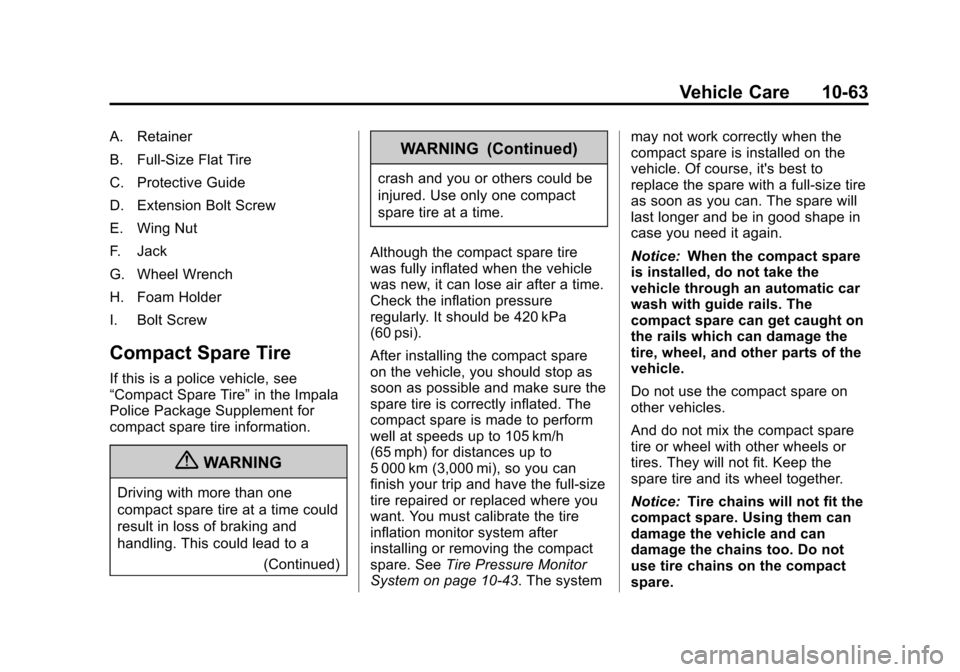
When storing a full-size tire, use the
extension with the extension
protector, located in the foam
holder, to help avoid wheel surface
damage.
To store a full-size tire:
1. Install the tools in their original
location in the trunk area and
secure.
2. Place the tire valve stem facing down and the protector/guide
placed through a wheel bolt hole
and threaded onto the bolt
screw. 3. Remove the protector and attach
the retainer securely
4. Store the cover as far forward as possible.
When storing a compact spare tire
in the trunk, put the protector back
in the foam holder.
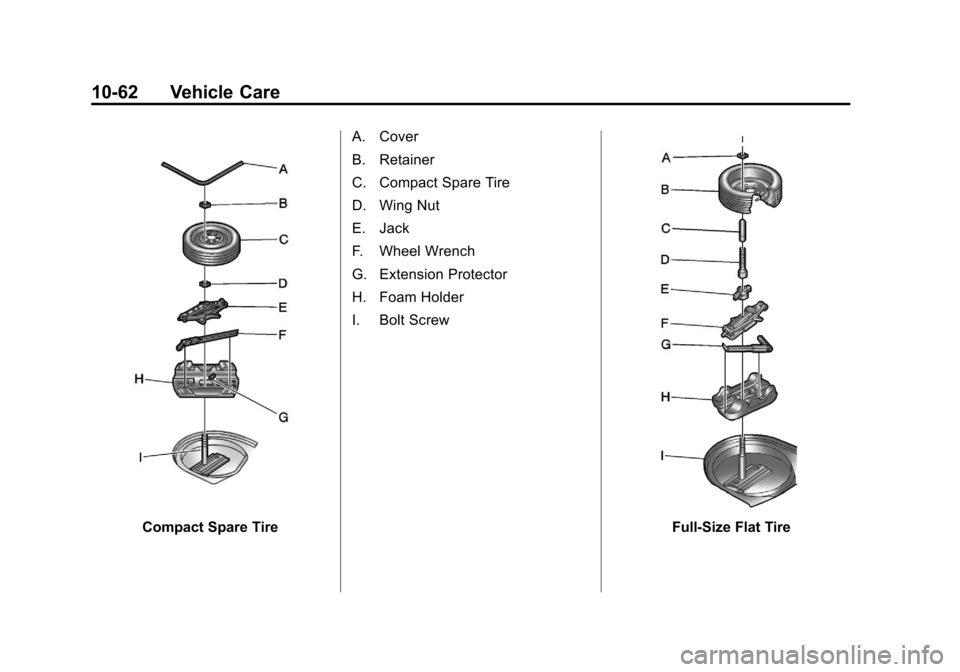
The compact spare is for temporary
use only. Replace the compact
spare tire with a full-size tire as
soon as you can. See Compact
Spare Tire on page 10‑63. Use this
as a guide for storing the compact
spare tire and tools.
Page 304 of 374
Black plate (62,1)Chevrolet Impala Owner Manual - 2012
10-62 Vehicle Care
Compact Spare TireA. Cover
B. Retainer
C. Compact Spare Tire
D. Wing Nut
E. Jack
F. Wheel Wrench
G. Extension Protector
H. Foam Holder
I. Bolt ScrewFull-Size Flat Tire
Page 305 of 374
Black plate (63,1)Chevrolet Impala Owner Manual - 2012
Vehicle Care 10-63
A. Retainer
B. Full-Size Flat Tire
C. Protective Guide
D. Extension Bolt Screw
E. Wing Nut
F. Jack
G. Wheel Wrench
H. Foam Holder
I. Bolt Screw
Compact Spare Tire
If this is a police vehicle, see
“Compact Spare Tire”in the Impala
Police Package Supplement for
compact spare tire information.
{WARNING
Driving with more than one
compact spare tire at a time could
result in loss of braking and
handling. This could lead to a
(Continued)
WARNING (Continued)
crash and you or others could be
injured. Use only one compact
spare tire at a time.
Although the compact spare tire
was fully inflated when the vehicle
was new, it can lose air after a time.
Check the inflation pressure
regularly. It should be 420 kPa
(60 psi).
After installing the compact spare
on the vehicle, you should stop as
soon as possible and make sure the
spare tire is correctly inflated. The
compact spare is made to perform
well at speeds up to 105 km/h
(65 mph) for distances up to
5 000 km (3,000 mi), so you can
finish your trip and have the full-size
tire repaired or replaced where you
want. You must calibrate the tire
inflation monitor system after
installing or removing the compact
spare. See Tire Pressure Monitor
System on page 10‑43. The system may not work correctly when the
compact spare is installed on the
vehicle. Of course, it's best to
replace the spare with a full-size tire
as soon as you can. The spare will
last longer and be in good shape in
case you need it again.
Notice:
When the compact spare
is installed, do not take the
vehicle through an automatic car
wash with guide rails. The
compact spare can get caught on
the rails which can damage the
tire, wheel, and other parts of the
vehicle.
Do not use the compact spare on
other vehicles.
And do not mix the compact spare
tire or wheel with other wheels or
tires. They will not fit. Keep the
spare tire and its wheel together.
Notice: Tire chains will not fit the
compact spare. Using them can
damage the vehicle and can
damage the chains too. Do not
use tire chains on the compact
spare.