trailer CHEVROLET IMPALA 2020 Owner's Guide
[x] Cancel search | Manufacturer: CHEVROLET, Model Year: 2020, Model line: IMPALA, Model: CHEVROLET IMPALA 2020Pages: 328, PDF Size: 5.07 MB
Page 214 of 328
Chevrolet Impala Owner Manual (GMNA-Localizing-U.S./Canada-13688912) -
2020 - CRC - 6/5/19
Vehicle Care 213
If Steam Is Coming from the
Engine Compartment
{Warning
Steam and scalding liquids from a
hot cooling system are under
pressure. Turning the pressure
cap, even a little, can cause them
to come out at high speed and
you could be burned. Never turn
the cap when the cooling system,
including the pressure cap, is hot.
Wait for the cooling system and
pressure cap to cool.
See Overheated Engine Protection
Operating Mode 0213 for
information on driving to a safe
place in an emergency.
If No Steam Is Coming from
the Engine Compartment
If an engine overheat warning is
displayed but no steam can be seen
or heard, the problem might not be
too serious. Sometimes the engine
can get a little too hot when the
vehicle: .
Climbs a long hill on a hot day.
. Stops after high-speed driving.
. Idles for long periods in traffic.
. Tows a trailer.
If the overheat warning displays with
no sign of steam: 1. Turn the air conditioning off.
2. Turn the heater on to the highest temperature and to the
highest fan speed. Open the
windows as necessary.
3. When it is safe to do so, pull off the road, shift to P (Park) or
N (Neutral), and let the
engine idle.
If the coolant temperature gauge is
no longer in the overheat zone, the
vehicle can be driven. Continue to
drive the vehicle slowly for about
10 minutes. Keep a safe vehicle
distance from the vehicle in front.
If the warning does not come back
on, continue to drive normally and
have the cooling system checked
for proper fill and function. If the warning continues, pull over,
stop, and park the vehicle
right away.
If there is no sign of steam, idle the
engine for three minutes while
parked. If the warning is still
displayed, turn off the engine until it
cools down. Also, see
Overheated
Engine Protection Operating Mode
0 213.
Overheated Engine
Protection
Operating Mode
This emergency operating mode
allows the vehicle to be driven to a
safe place in an emergency
situation. If an overheated engine
condition exists, an overheat
protection mode which alternates
firing groups of cylinders helps
prevent engine damage. In this
mode, there is significant loss in
power and engine performance.
The engine coolant temperature
gauge indicates if an overheat
condition exists. Driving extended
Page 215 of 328
Chevrolet Impala Owner Manual (GMNA-Localizing-U.S./Canada-13688912) -
2020 - CRC - 6/5/19
214 Vehicle Care
distances and/or towing a trailer in
the overheat protection mode
should be avoided.
Washer Fluid
What to Use
When windshield washer fluid is
needed, be sure to read the
manufacturer's instructions before
use. If operating the vehicle in an
area where the temperature may fall
below freezing, use a fluid that has
sufficient protection against
freezing.
Adding Washer Fluid
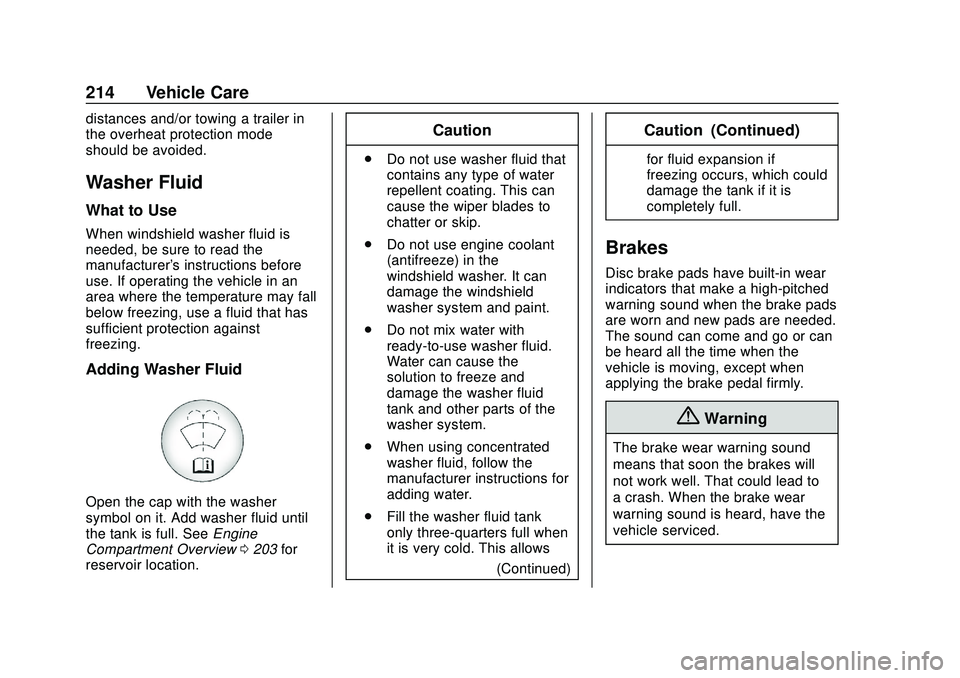
Open the cap with the washer
symbol on it. Add washer fluid until
the tank is full. SeeEngine
Compartment Overview 0203 for
reservoir location.
Caution
. Do not use washer fluid that
contains any type of water
repellent coating. This can
cause the wiper blades to
chatter or skip.
. Do not use engine coolant
(antifreeze) in the
windshield washer. It can
damage the windshield
washer system and paint.
. Do not mix water with
ready-to-use washer fluid.
Water can cause the
solution to freeze and
damage the washer fluid
tank and other parts of the
washer system.
. When using concentrated
washer fluid, follow the
manufacturer instructions for
adding water.
. Fill the washer fluid tank
only three-quarters full when
it is very cold. This allows
(Continued)
Caution (Continued)
for fluid expansion if
freezing occurs, which could
damage the tank if it is
completely full.
Brakes
Disc brake pads have built-in wear
indicators that make a high-pitched
warning sound when the brake pads
are worn and new pads are needed.
The sound can come and go or can
be heard all the time when the
vehicle is moving, except when
applying the brake pedal firmly.
{Warning
The brake wear warning sound
means that soon the brakes will
not work well. That could lead to
a crash. When the brake wear
warning sound is heard, have the
vehicle serviced.
Page 264 of 328
Chevrolet Impala Owner Manual (GMNA-Localizing-U.S./Canada-13688912) -
2020 - CRC - 6/5/19
Vehicle Care 263
vehicle with all four wheels on the
ground. Dolly towing is towing the
vehicle with two wheels on the
ground and two wheels up on a
device known as a dolly.
Here are some important things to
consider before recreational vehicle
towing:
.Before towing the vehicle,
become familiar with the local
laws that apply to recreational
vehicle towing. These laws may
vary by region.
. What is the towing capacity of
the towing vehicle? Be sure to
read the tow vehicle
manufacturer's
recommendations.
. How far will the vehicle be
towed? Some vehicles have
restrictions on how far and how
long they can tow.
. Does the vehicle have the
proper towing equipment? See
your dealer or trailering
professional for additional advice
and equipment
recommendations. .
Is the vehicle ready to be
towed? Just as preparing the
vehicle for a long trip, make sure
the vehicle is prepared to be
towed.
Caution
Use of a shield mounted in front
of the vehicle grille could restrict
airflow and cause damage to the
transmission. The repairs would
not be covered by the vehicle
warranty. If using a shield, only
use one that attaches to the
towing vehicle.
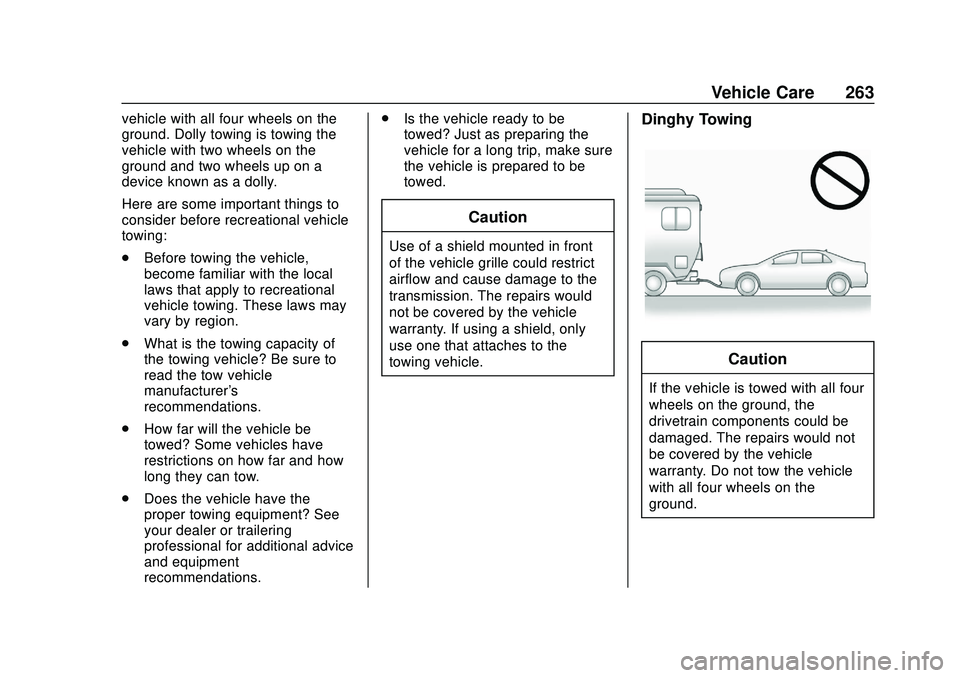
Dinghy Towing
Caution
If the vehicle is towed with all four
wheels on the ground, the
drivetrain components could be
damaged. The repairs would not
be covered by the vehicle
warranty. Do not tow the vehicle
with all four wheels on the
ground.
Page 276 of 328
Chevrolet Impala Owner Manual (GMNA-Localizing-U.S./Canada-13688912) -
2020 - CRC - 6/5/19
Service and Maintenance 275
The Tire Rotation and Required
Services are the responsibility of the
vehicle owner. It is recommended to
have your dealer perform these
services every 12 000 km/7,500 mi.
Proper vehicle maintenance helps to
keep the vehicle in good working
condition, improves fuel economy,
and reduces vehicle emissions.
Because of the way people use
vehicles, maintenance needs vary.
There may need to be more
frequent checks and services. The
Additional Required Services -
Normal are for vehicles that:
.Carry passengers and cargo
within recommended limits on
the Tire and Loading Information
label. See Vehicle Load Limits
0 147.
. Are driven on reasonable road
surfaces within legal driving
limits.
. Use the recommended fuel. See
Recommended Fuel 0185.
Refer to the information in the
Maintenance Schedule Additional
Required Services - Normal chart. The Additional Required Services -
Severe are for vehicles that are:
.
Mainly driven in heavy city traffic
in hot weather.
. Mainly driven in hilly or
mountainous terrain.
. Frequently towing a trailer.
. Used for high speed or
competitive driving.
. Used for taxi, police, or delivery
service.
Refer to the information in the
Maintenance Schedule Additional
Required Services - Severe chart.
{Warning
Performing maintenance work can
be dangerous and can cause
serious injury. Perform
maintenance work only if the
required information, proper tools,
and equipment are available.
If they are not, see your dealer to (Continued)
Warning (Continued)
have a trained technician do the
work. SeeDoing Your Own
Service Work 0200.
Page 326 of 328
Chevrolet Impala Owner Manual (GMNA-Localizing-U.S./Canada-13688912) -
2020 - CRC - 6/5/19
Index 325
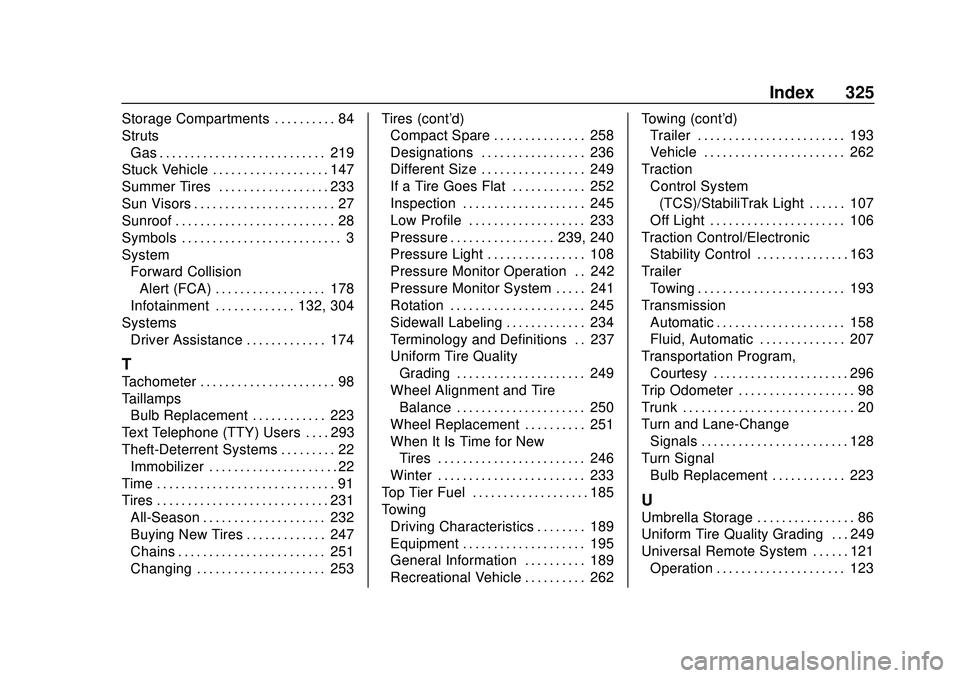
Storage Compartments . . . . . . . . . . 84
StrutsGas . . . . . . . . . . . . . . . . . . . . . . . . . . . 219
Stuck Vehicle . . . . . . . . . . . . . . . . . . . 147
Summer Tires . . . . . . . . . . . . . . . . . . 233
Sun Visors . . . . . . . . . . . . . . . . . . . . . . . 27
Sunroof . . . . . . . . . . . . . . . . . . . . . . . . . . 28
Symbols . . . . . . . . . . . . . . . . . . . . . . . . . . 3
System Forward CollisionAlert (FCA) . . . . . . . . . . . . . . . . . . 178
Infotainment . . . . . . . . . . . . . 132, 304
Systems Driver Assistance . . . . . . . . . . . . . 174
T
Tachometer . . . . . . . . . . . . . . . . . . . . . . 98
TaillampsBulb Replacement . . . . . . . . . . . . 223
Text Telephone (TTY) Users . . . . 293
Theft-Deterrent Systems . . . . . . . . . 22 Immobilizer . . . . . . . . . . . . . . . . . . . . . 22
Time . . . . . . . . . . . . . . . . . . . . . . . . . . . . . 91
Tires . . . . . . . . . . . . . . . . . . . . . . . . . . . . 231 All-Season . . . . . . . . . . . . . . . . . . . . 232
Buying New Tires . . . . . . . . . . . . . 247
Chains . . . . . . . . . . . . . . . . . . . . . . . . 251
Changing . . . . . . . . . . . . . . . . . . . . . 253 Tires (cont'd)
Compact Spare . . . . . . . . . . . . . . . 258
Designations . . . . . . . . . . . . . . . . . 236
Different Size . . . . . . . . . . . . . . . . . 249
If a Tire Goes Flat . . . . . . . . . . . . 252
Inspection . . . . . . . . . . . . . . . . . . . . 245
Low Profile . . . . . . . . . . . . . . . . . . . 233
Pressure . . . . . . . . . . . . . . . . . 239, 240
Pressure Light . . . . . . . . . . . . . . . . 108
Pressure Monitor Operation . . 242
Pressure Monitor System . . . . . 241
Rotation . . . . . . . . . . . . . . . . . . . . . . 245
Sidewall Labeling . . . . . . . . . . . . . 234
Terminology and Definitions . . 237
Uniform Tire Quality
Grading . . . . . . . . . . . . . . . . . . . . . 249
Wheel Alignment and Tire Balance . . . . . . . . . . . . . . . . . . . . . 250
Wheel Replacement . . . . . . . . . . 251
When It Is Time for New Tires . . . . . . . . . . . . . . . . . . . . . . . . 246
Winter . . . . . . . . . . . . . . . . . . . . . . . . 233
Top Tier Fuel . . . . . . . . . . . . . . . . . . . 185
Towing
Driving Characteristics . . . . . . . . 189
Equipment . . . . . . . . . . . . . . . . . . . . 195
General Information . . . . . . . . . . 189
Recreational Vehicle . . . . . . . . . . 262 Towing (cont'd)
Trailer . . . . . . . . . . . . . . . . . . . . . . . . 193
Vehicle . . . . . . . . . . . . . . . . . . . . . . . 262
Traction
Control System(TCS)/StabiliTrak Light . . . . . . 107
Off Light . . . . . . . . . . . . . . . . . . . . . . 106
Traction Control/Electronic Stability Control . . . . . . . . . . . . . . . 163
Trailer Towing . . . . . . . . . . . . . . . . . . . . . . . . 193
Transmission Automatic . . . . . . . . . . . . . . . . . . . . . 158
Fluid, Automatic . . . . . . . . . . . . . . 207
Transportation Program, Courtesy . . . . . . . . . . . . . . . . . . . . . . 296
Trip Odometer . . . . . . . . . . . . . . . . . . . 98
Trunk . . . . . . . . . . . . . . . . . . . . . . . . . . . . 20
Turn and Lane-Change Signals . . . . . . . . . . . . . . . . . . . . . . . . 128
Turn Signal Bulb Replacement . . . . . . . . . . . . 223
U
Umbrella Storage . . . . . . . . . . . . . . . . 86
Uniform Tire Quality Grading . . . 249
Universal Remote System . . . . . . 121Operation . . . . . . . . . . . . . . . . . . . . . 123