fuel CHEVROLET KODIAK 2004 User Guide
[x] Cancel search | Manufacturer: CHEVROLET, Model Year: 2004, Model line: KODIAK, Model: CHEVROLET KODIAK 2004Pages: 366, PDF Size: 6.87 MB
Page 152 of 366
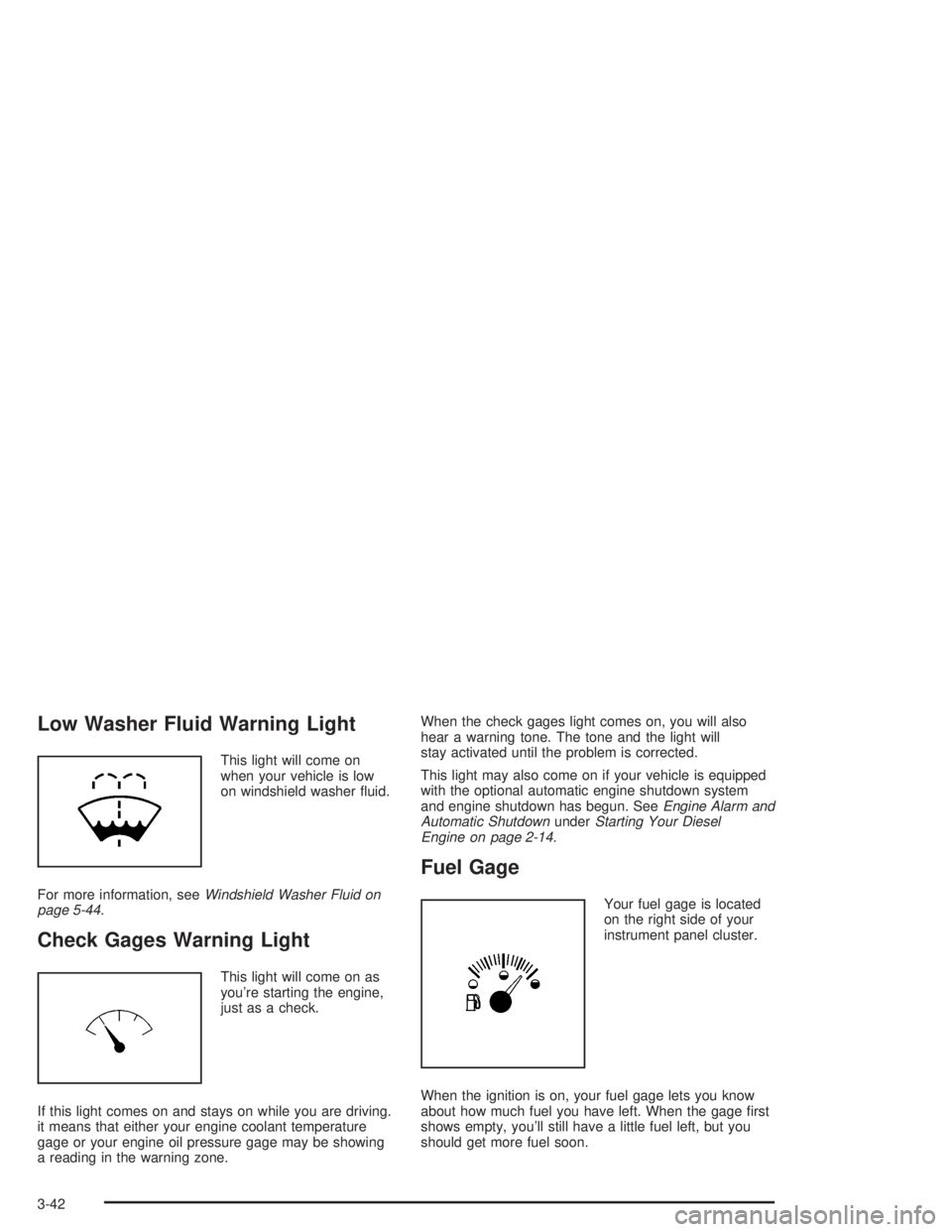
Low Washer Fluid Warning Light
This light will come on
when your vehicle is low
on windshield washer fluid.
For more information, seeWindshield Washer Fluid on
page 5-44.
Check Gages Warning Light
This light will come on as
you’re starting the engine,
just as a check.
If this light comes on and stays on while you are driving.
it means that either your engine coolant temperature
gage or your engine oil pressure gage may be showing
a reading in the warning zone.When the check gages light comes on, you will also
hear a warning tone. The tone and the light will
stay activated until the problem is corrected.
This light may also come on if your vehicle is equipped
with the optional automatic engine shutdown system
and engine shutdown has begun. SeeEngine Alarm and
Automatic ShutdownunderStarting Your Diesel
Engine on page 2-14.
Fuel Gage
Your fuel gage is located
on the right side of your
instrument panel cluster.
When the ignition is on, your fuel gage lets you know
about how much fuel you have left. When the gage first
shows empty, you’ll still have a little fuel left, but you
should get more fuel soon.
3-42
Page 153 of 366
If your vehicle has dual fuel tanks, the reading on the
gage is the total fuel left in both tanks.
Here are four concerns of some operators. None of
these shows a problem with your fuel gage:
•The gage moves a little when you turn a corner or
speed up.
•The gage does not go back to empty when you turn
off the ignition.
•At the gas station, the pump shuts off before the
gage reads full.
•It takes a little more or less fuel to fill up than the
gage indicated.
If you have a Caterpillar
®diesel engine, also see your
Caterpillar®Operation & Maintenance Manual.
Water in Fuel Warning Light
If your vehicle is equipped
with a diesel engine, you
may have this light.
This light will come on to warn you that there is water in
the fuel system. For more information on how this
light works, seeWater in Fuel on page 5-10.
3-43
Page 198 of 366
•Put on extra clothing or wrap a blanket around you.
If you have no blankets or extra clothing, make
body insulators from newspapers, burlap bags, rags,
floor mats — anything you can wrap around
yourself or tuck under your clothing to keep warm.
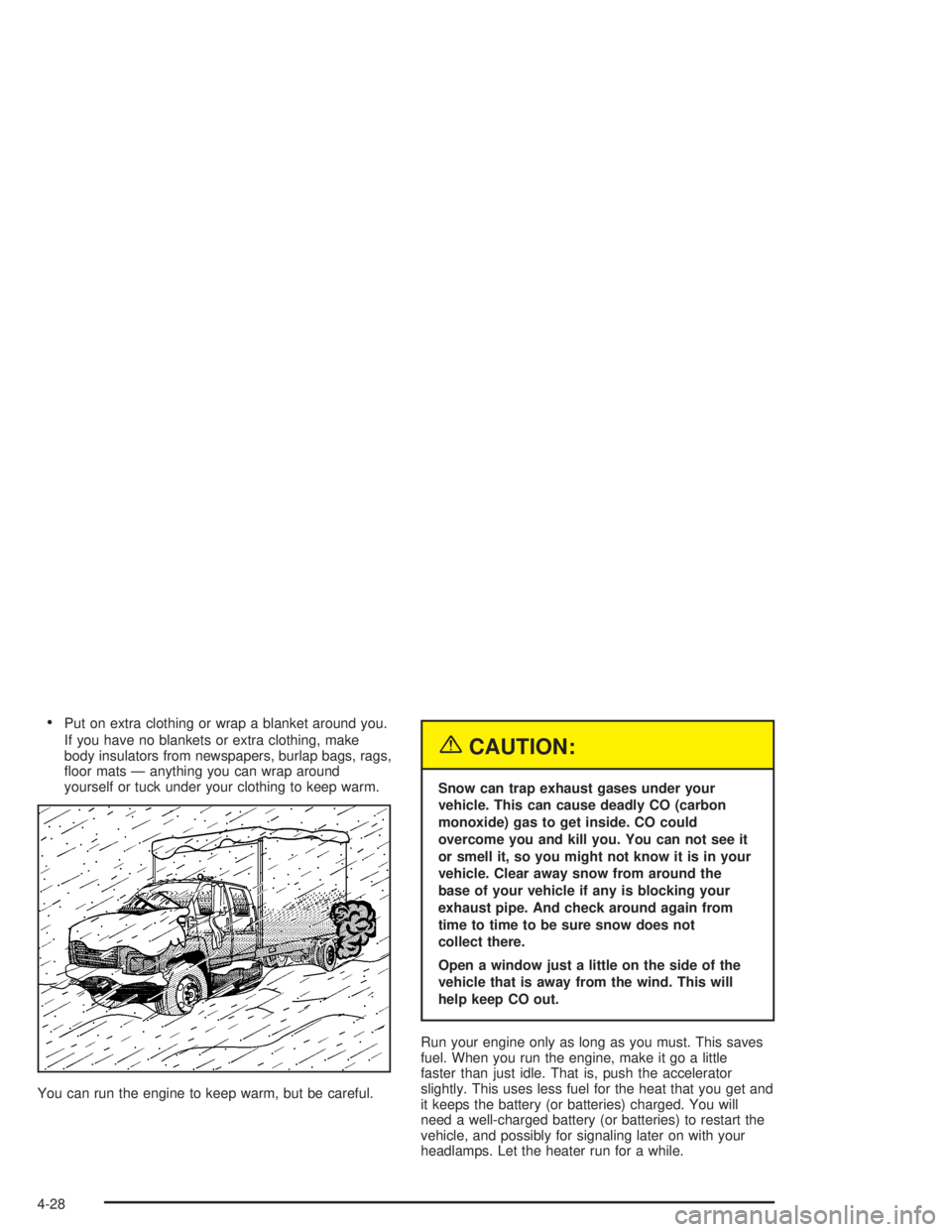
You can run the engine to keep warm, but be careful.
{CAUTION:
Snow can trap exhaust gases under your
vehicle. This can cause deadly CO (carbon
monoxide) gas to get inside. CO could
overcome you and kill you. You can not see it
or smell it, so you might not know it is in your
vehicle. Clear away snow from around the
base of your vehicle if any is blocking your
exhaust pipe. And check around again from
time to time to be sure snow does not
collect there.
Open a window just a little on the side of the
vehicle that is away from the wind. This will
help keep CO out.
Run your engine only as long as you must. This saves
fuel. When you run the engine, make it go a little
faster than just idle. That is, push the accelerator
slightly. This uses less fuel for the heat that you get and
it keeps the battery (or batteries) charged. You will
need a well-charged battery (or batteries) to restart the
vehicle, and possibly for signaling later on with your
headlamps. Let the heater run for a while.
4-28
Page 199 of 366
If you have a diesel engine, you may have to run it at a
higher speed to get enough heat.
Then, shut the engine off and close the window almost
all the way to preserve the heat. Start the engine
again and repeat this only when you feel really
uncomfortable from the cold. But do it as little as
possible. Preserve the fuel as long as you can. To help
keep warm, you can get out of the vehicle and do
some fairly vigorous exercises every half hour or so until
help comes.
If You Are Stuck: In Sand, Mud, Ice
or Snow
In order to free your vehicle when it is stuck, you will
need to spin the wheels, but you do not want to
spin your wheels too fast. The method known as
“rocking” can help you get out when you are stuck, but
you must use caution.
{CAUTION:
If you let your tires spin at high speed, they
can explode, and you or others could be
injured. And, the transmission or other parts of
the vehicle can overheat. That could cause an
engine compartment re or other damage.
When you are stuck, spin the wheels as little
as possible. Do not spin the wheels above
35 mph (55 km/h) as shown on the
speedometer.
Notice:Spinning your wheels can destroy parts of
your vehicle as well as the tires. If you spin the
wheels too fast while shifting your transmission
back and forth, you can destroy your transmission.
4-29
Page 203 of 366
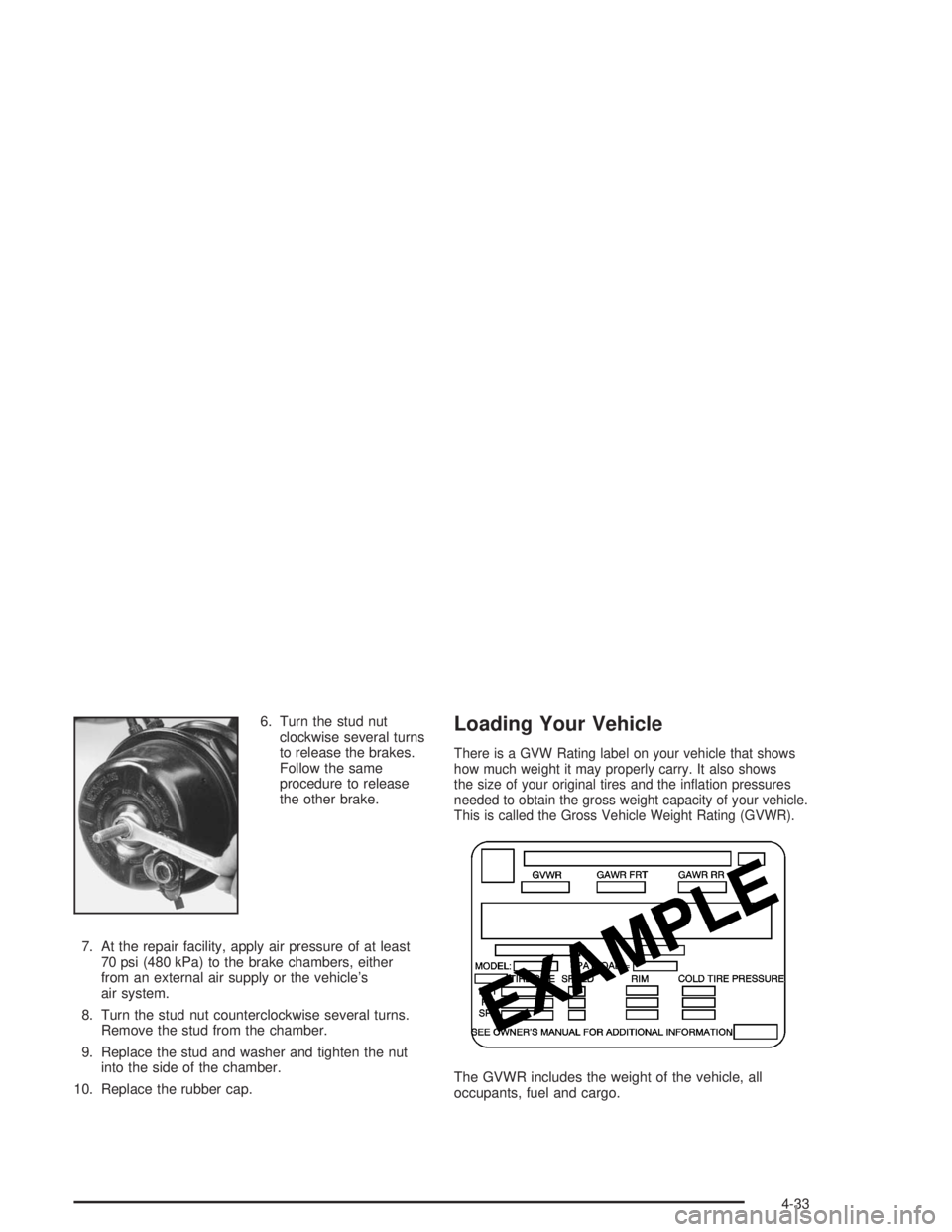
6. Turn the stud nut
clockwise several turns
to release the brakes.
Follow the same
procedure to release
the other brake.
7. At the repair facility, apply air pressure of at least
70 psi (480 kPa) to the brake chambers, either
from an external air supply or the vehicle’s
air system.
8. Turn the stud nut counterclockwise several turns.
Remove the stud from the chamber.
9. Replace the stud and washer and tighten the nut
into the side of the chamber.
10. Replace the rubber cap.Loading Your Vehicle
There is a GVW Rating label on your vehicle that shows
how much weight it may properly carry. It also shows
the size of your original tires and the inflation pressures
needed to obtain the gross weight capacity of your vehicle.
This is called the Gross Vehicle Weight Rating (GVWR).
The GVWR includes the weight of the vehicle, all
occupants, fuel and cargo.
4-33
Page 207 of 366
Service............................................................5-3
Doing Your Own Service Work.........................5-4
Two Safety Cautions about Engine Fan
Breakage...................................................5-5
Fuel................................................................5-6
Gasoline Octane............................................5-6
Gasoline Specifications....................................5-6
Additives.......................................................5-7
Diesel Engine Fuel.........................................5-8
What Fuel to Use...........................................5-8
Very Cold Weather Operation.........................5-10
Water in Fuel...............................................5-10
Running Out of Fuel.....................................5-15
Fuel Filter Replacement.................................5-15
Fuels in Foreign Countries.............................5-16
Filling Your Tank..........................................5-17
Filling a Portable Fuel Container.....................5-18
Checking Things Under the Hood....................5-18
Hood Latches...............................................5-19
Engine Oil (Caterpillar
®Diesel Engine).............5-20
Engine Oil (Gasoline Engine)..........................5-20
Engine Oil (DURAMAX™ Diesel).....................5-25
Engine Air Cleaner/Filter................................5-30
Automatic Transmission Fluid.........................5-31
Manual Transmission Fluid.............................5-32Engine Coolant (Gas and
DURAMAX™ engines)................................5-32
Engine Coolant (Caterpillar
®Diesel Engines).....5-35
Coolant Surge Tank Pressure Cap..................5-35
Engine Overheating.......................................5-36
Cooling System............................................5-38
Engine Fan Noise.........................................5-43
Power Steering Fluid.....................................5-43
Windshield Washer Fluid................................5-44
Brakes........................................................5-46
Battery........................................................5-55
Jump Starting...............................................5-56
Rear Axle.......................................................5-61
Rear Axle Shift Motor....................................5-61
Noise Control System.....................................5-62
Tampering with Noise Control System
Prohibited.................................................5-62
Bulb Replacement..........................................5-63
Replacement Bulbs.......................................5-63
Windshield Wiper Blade Replacement..............5-63
Other Service Items........................................5-64
Fuel Filter....................................................5-64
Primary Fuel Filter and Water Separator..........5-65
Secondary Fuel Filter and Water
Separator/Heater.......................................5-66
Section 5 Service and Appearance Care
5-1
Page 212 of 366
Fuel
If your vehicle has a diesel engine, seeDiesel Engine
Fuel on page 5-8.
For vehicles with gasoline engines, please read this.
Gasoline Octane
Use regular unleaded gasoline with a posted octane
of 87 or higher. If the octane is less than 87, you may
get a heavy knocking noise when you drive. If this
occurs, use a gasoline rated at 87 octane or higher as
soon as possible. Otherwise, you might damage
your engine. A little pinging noise when you accelerate
or drive uphill is considered normal. This does not
indicate a problem exists or that a higher-octane fuel is
necessary. If you are using 87 octane or higher-octane
fuel and hear heavy knocking, your engine needs
service.
Gasoline Specications
It is recommended that gasoline meet specifications
which were developed by automobile manufacturers
around the world and contained in the World-Wide Fuel
Charter which is available from the Alliance of
Automobile Manufacturers at www.autoalliance.org.
Gasoline meeting these specifications could provide
improved driveability and emission control system
performance compared to other gasoline.
In Canada, look for the
“Auto Makers’ Choice”
label on the pump.
Canada Only
5-6
Page 213 of 366
Additives
To provide cleaner air, all gasolines in the United States
are now required to contain additives that will help
prevent engine and fuel system deposits from forming,
allowing your emission control system to work
properly. You should not have to add anything to your
fuel. However, some gasolines contain only the
minimum amount of additive required to meet U.S.
Environmental Protection Agency regulations. General
Motors recommends that you buy gasolines that
are advertised to help keep fuel injectors and intake
valves clean. If your vehicle experiences problems due
to dirty injectors or valves, try a different brand of
gasoline.
Gasolines containing oxygenates, such as ethers and
ethanol, and reformulated gasolines may be available in
your area to contribute to clean air. General Motors
recommends that you use these gasolines, particularly if
they comply with the specifications described earlier.Notice:Your vehicle was not designed for fuel that
contains methanol. Do not use fuel containing
methanol. It can corrode metal parts in your fuel
system and also damage the plastic and rubber
parts. That damage would not be covered under
your warranty.
Some gasolines that are not reformulated for low
emissions may contain an octane-enhancing additive
called methylcyclopentadienyl manganese tricarbonyl
(MMT); ask the attendant where you buy gasoline
whether the fuel contains MMT. General Motors does
not recommend the use of such gasolines. Fuels
containing MMT can reduce the life of spark plugs and
the performance of the emission control system may
be affected. The malfunction indicator lamp may turn on.
If this occurs, return to your authorized GM dealer for
service.
5-7
Page 214 of 366
Diesel Engine Fuel
For the Caterpillar®diesel, see the Caterpillar®
Operation & Maintenance Manual for information
concerning fuel usage.
Notice:Diesel fuel or fuel additives not
recommended in this manual could damage your
fuel system and engine. Your warranty would
not cover this damage. And:
Diesel fuel that has been mixed with engine oil
or automatic transmission uid could damage
your engine and emission controls.
Aftermarket diesel fuel additives are not tested
by General Motors. Some additives, particularly
those which contain alcohol or water
emulsiers, may damage your fuel system. If
you believe that unique circumstances call for a
fuel additive to be used, consult your dealer
for advice.
If you ever run out of diesel fuel, it can be
difficult to restart your engine. To avoid all this,
never let your tank get empty.
If you run out of fuel,Running Out of Fuel on page 5-15,
tells you how to restart your engine.
What Fuel to Use
In the United States, for best results use Number 2–D
diesel fuel year-round (above and below freezing
conditions) as oil companies blend Number 2–D fuel to
address climate differences. Number 1–D diesel fuel
may be used in very cold temperatures (when it
stays below 0°F or−18°C); however, it will produce a
power and fuel economy loss. Avoid the use of Number
1–D diesel fuel in warm or hot climates. It may result
in stalling, poor starting when the engine is hot and may
damage the fuel injection system.
At a minimum, the diesel fuel you use should meet
specifications ASTM D975-02 (Grade Low Sulfur) in the
United States. In addition, the Engine Manufacturers
Association (EMA) has identified properties of an
improved diesel fuel for better engine performance and
durability. Diesel fuels corresponding to the EMA
Recommended Guideline on Premium Diesel Fuel
(FQP-1A) could provide better starting, less noise and
better vehicle performance. If there are questions
about the fuel you are using, contact your fuel supplier.
It is acceptable to use diesel fuel containing up to
5% biodiesel (B5), but the final blended fuel must meet
the same specification, ASTM D975–02 (Grade Low
Sulfur), as other fuels used in your vehicle, and
the biodiesel used for making this fuel must meet the
ASTM D6751–02 specification.
5-8
Page 215 of 366
Biodiesel is produced from vegetable oils or animal fat
that have been chemically modified to reduce the
possibility of damage to your fuel system and engine.
Higher concentration (i.e., greater than B5)
biodiesel-containing fuels or the use of unmodified
bio-oils blended into diesel fuel at any concentration is
not recommended and could damage your fuel
system and engine. Such damage would not be covered
by your warranty. If there are questions about the
biodiesel-containing fuels you are using, contact your
fuel supplier.
Diesel fuel may foam when you fill your tank. This can
cause the automatic pump nozzle to shut off, even
though your tank is not full. If this happens, just wait for
the foaming to stop and then continue to fill your tank.
{CAUTION:
Heat coming from the engine may cause the
fuel to expand and force the fuel out of your
tank. If something ignites the fuel, a re could
start and people could be burned. To help avoid
this, ll your fuel tank only until the automatic
nozzle shuts off. Do not try to “top it off.”
What Fuel to Use in Canada
Canadian fuels are blended for seasonal changes.
Diesel Type “A” fuel is blended for better cold weather
starting (below 0°F or−18°C); however, you may
notice some power and fuel economy loss. If Type “A”
fuel is used in warmer temperatures, stalling and
hard starting may occur. Diesel Type “B” fuel is blended
for temperatures above 0°F (−18°C). The emission
control system requires the use of diesel fuel with
low-sulfur (.05% by weight) content. Both low- and
higher-sulfur fuels will be available in Canada. Only
low-sulfur diesel fuels are available in the United States.
It is important that diesel-powered trucks are refueled
only with low-sulfur fuel. Use of fuels with higher-sulfur
content will affect the function of the emission
components and may cause reduced performance,
excessive smoke and unpleasant odor.
At a minimum, the diesel fuel you use should meet
specifications CAN/CGSB–3.517–2000 (Low Sulfur
Diesel) in Canada. In addition, the Engine Manufacturers
Association (EMA) has identified properties of an
improved diesel fuel for better engine performance and
durability (FQP-1A). Diesel fuels corresponding to
the EMA description could provide better starting, less
noise and better vehicle performance. If there are
questions about the fuel you are using, contact your fuel
supplier.
5-9