engine coolant CHEVROLET KODIAK 2004 Owner's Manual
[x] Cancel search | Manufacturer: CHEVROLET, Model Year: 2004, Model line: KODIAK, Model: CHEVROLET KODIAK 2004Pages: 366, PDF Size: 6.87 MB
Page 242 of 366
Engine Overheating
You will find a coolant temperature warning gage on
your vehicle’s instrument panel, as well as a low coolant
warning light. Your vehicle also has a check gages
warning light on the instrument panel.
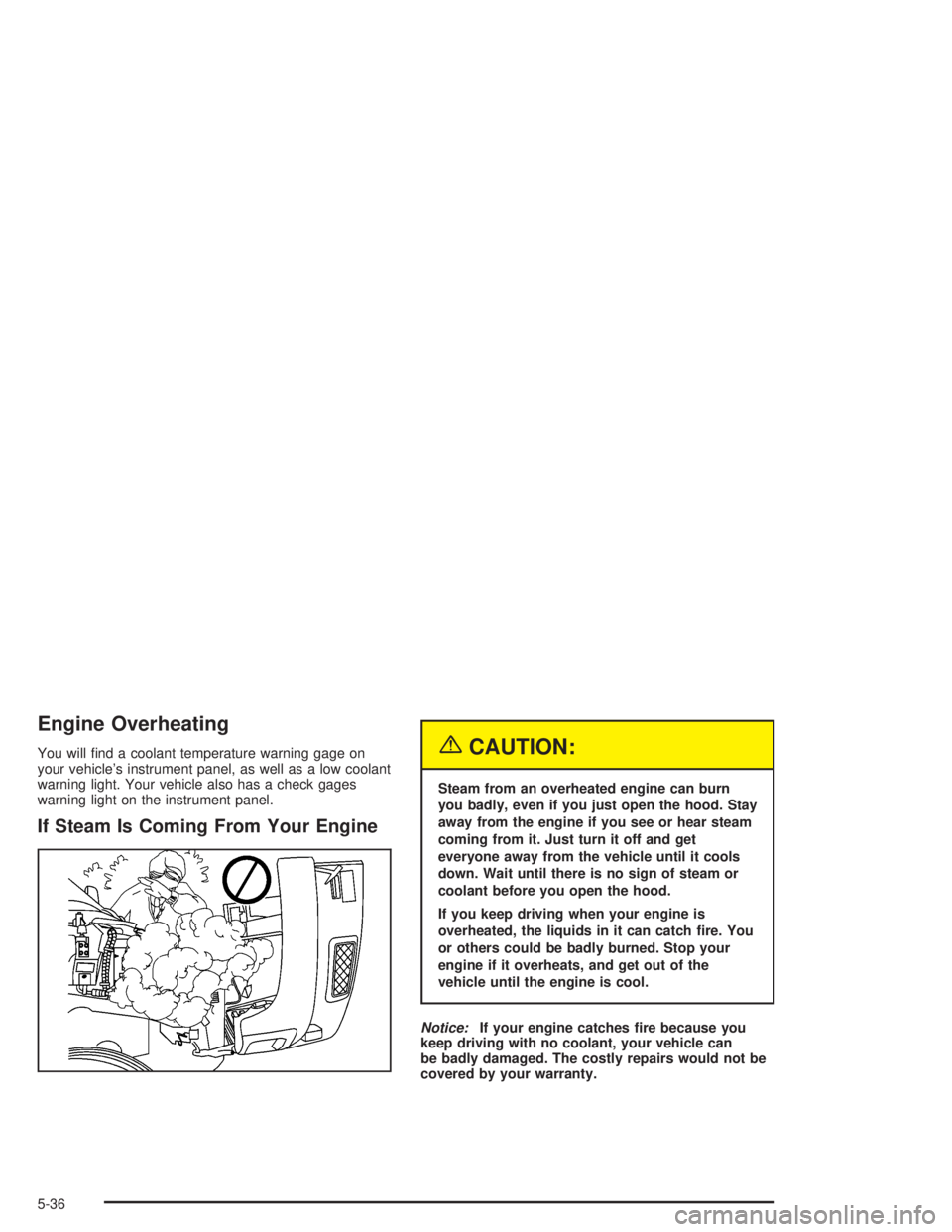
If Steam Is Coming From Your Engine
{CAUTION:
Steam from an overheated engine can burn
you badly, even if you just open the hood. Stay
away from the engine if you see or hear steam
coming from it. Just turn it off and get
everyone away from the vehicle until it cools
down. Wait until there is no sign of steam or
coolant before you open the hood.
If you keep driving when your engine is
overheated, the liquids in it can catch re. You
or others could be badly burned. Stop your
engine if it overheats, and get out of the
vehicle until the engine is cool.
Notice:If your engine catches re because you
keep driving with no coolant, your vehicle can
be badly damaged. The costly repairs would not be
covered by your warranty.
5-36
Page 243 of 366
If No Steam Is Coming From Your
Engine
An overheat warning, along with a low coolant light, can
indicate a serious problem. SeeLow Coolant Warning
Light on page 3-36for more information.
If you get an engine overheat warning with no low
coolant light, but see or hear no steam, the problem may
not be too serious. Sometimes the engine can get a
little too hot when you:
•Climb a long hill on a hot day.
•Stop after high-speed driving.
•Idle for long periods in traffic.
If you get the overheat warning with no sign of steam,
try this for a minute or so:
1. In heavy traffic, let the engine idle in neutral while
stopped. If it is safe to do so, pull off the road, shift
to park or neutral and let the engine idle.2. Turn on your heater to full hot at the highest fan
speed and open the window as necessary.
3. If climbing a hill, downshift to raise engine and fan
speeds.
If you no longer have the overheat warning, you can
drive. Just to be safe, drive slower for about 10 minutes.
If the warning doesn’t come back on, you can drive
normally.
If the warning continues and you have not stopped, pull
over, stop, and park your vehicle right away.
If there’s still no sign of steam, you can push down the
accelerator until the engine speed is about twice as
fast as normal idle speed for at least three minutes while
you’re parked. If you still have the warning,turn off
the engine and get everyone out of the vehicleuntil it
cools down.
You may decide not to lift the hood but to get service
help right away.
5-37
Page 244 of 366
Cooling System
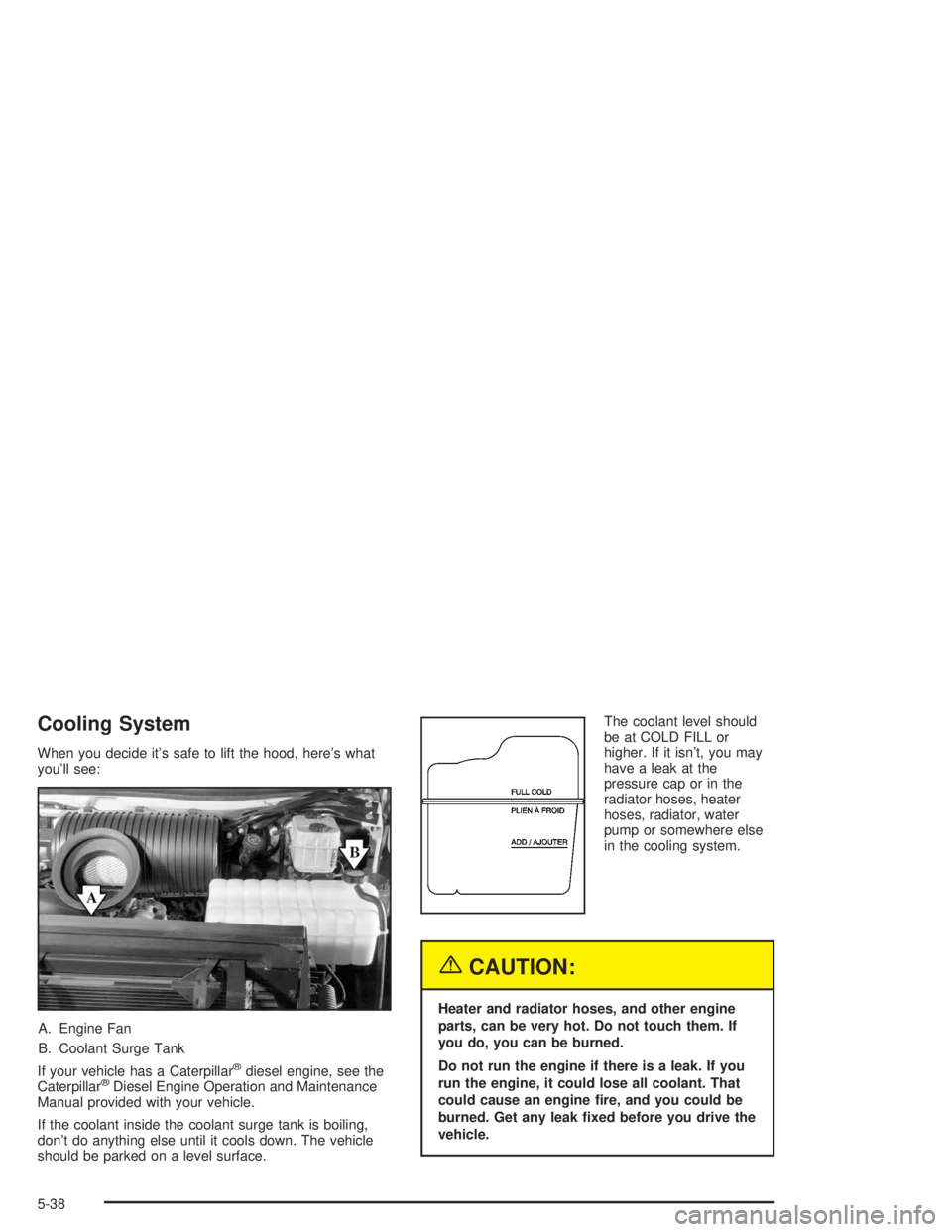
When you decide it’s safe to lift the hood, here’s what
you’ll see:
A. Engine Fan
B. Coolant Surge Tank
If your vehicle has a Caterpillar
®diesel engine, see the
Caterpillar®Diesel Engine Operation and Maintenance
Manual provided with your vehicle.
If the coolant inside the coolant surge tank is boiling,
don’t do anything else until it cools down. The vehicle
should be parked on a level surface.The coolant level should
be at COLD FILL or
higher. If it isn’t, you may
have a leak at the
pressure cap or in the
radiator hoses, heater
hoses, radiator, water
pump or somewhere else
in the cooling system.
{CAUTION:
Heater and radiator hoses, and other engine
parts, can be very hot. Do not touch them. If
you do, you can be burned.
Do not run the engine if there is a leak. If you
run the engine, it could lose all coolant. That
could cause an engine re, and you could be
burned. Get any leak xed before you drive the
vehicle.
5-38
Page 245 of 366
If there seems to be no leak, start the engine again.
The engine cooling fan speed should increase when idle
speed is doubled by pushing the accelerator pedal
down. If it doesn’t, your vehicle needs service. Turn off
the engine.
Notice:Engine damage from running your engine
without coolant is not covered by your warranty.
Notice:Using coolant other than DEX-COOL
®may
cause premature engine, heater core or radiator
corrosion. In addition, the engine coolant may
require changing sooner, at 30,000 miles (50 000 km)
or 24 months, whichever occurs rst. Any repairs
would not be covered by your warranty. Always use
DEX-COOL
®(silicate-free) coolant in your vehicle.
How to Add Coolant to the Coolant
Surge Tank
If you haven’t found a problem yet, check to see if
coolant is visible in the surge tank. If coolant is visible
but the coolant level isn’t at COLD FILL or higher, add a
50/50 mixture ofclean, drinkable waterand DEX-COOL
®
coolant at the coolant surge tank, but be sure the
cooling system, including the coolant surge tank
pressure cap, is cool before you do it. SeeEngine
Coolant (Gas and DURAMAX™ engines) on page 5-32
orEngine Coolant (Caterpillar
®Diesel Engines) on
page 5-35for more information.
5-39
Page 247 of 366
{CAUTION:
Adding only plain water to your cooling
system can be dangerous. Plain water, or
some other liquid such as alcohol, can boil
before the proper coolant mixture will. Your
vehicle’s coolant warning system is set for the
proper coolant mixture. With plain water or the
wrong mixture, your engine could get too hot
but you would not get the overheat warning.
Your engine could catch re and you or others
could be burned. Use a 50/50 mixture of clean,
drinkable water and DEX-COOL
®coolant.
Notice:In cold weather, water can freeze and crack
the engine, radiator, heater core and other parts.
Use the recommended coolant and the proper
coolant mixture.
{CAUTION:
You can be burned if you spill coolant on hot
engine parts. Coolant contains ethylene glycol
and it will burn if the engine parts are hot
enough. Do not spill coolant on a hot engine.
1. Park the vehicle on a level surface. You can
remove the coolant surge tank pressure cap
when the cooling system, including the coolant
surge tank pressure cap and upper radiator hose, is
no longer hot. Turn the pressure cap slowly
counterclockwise (left) about one full turn. If you
hear a hiss, wait for that to stop. A hiss means there
is still some pressure left.
2. Then keep turning the pressure cap slowly, and
remove it.
5-41
Page 248 of 366
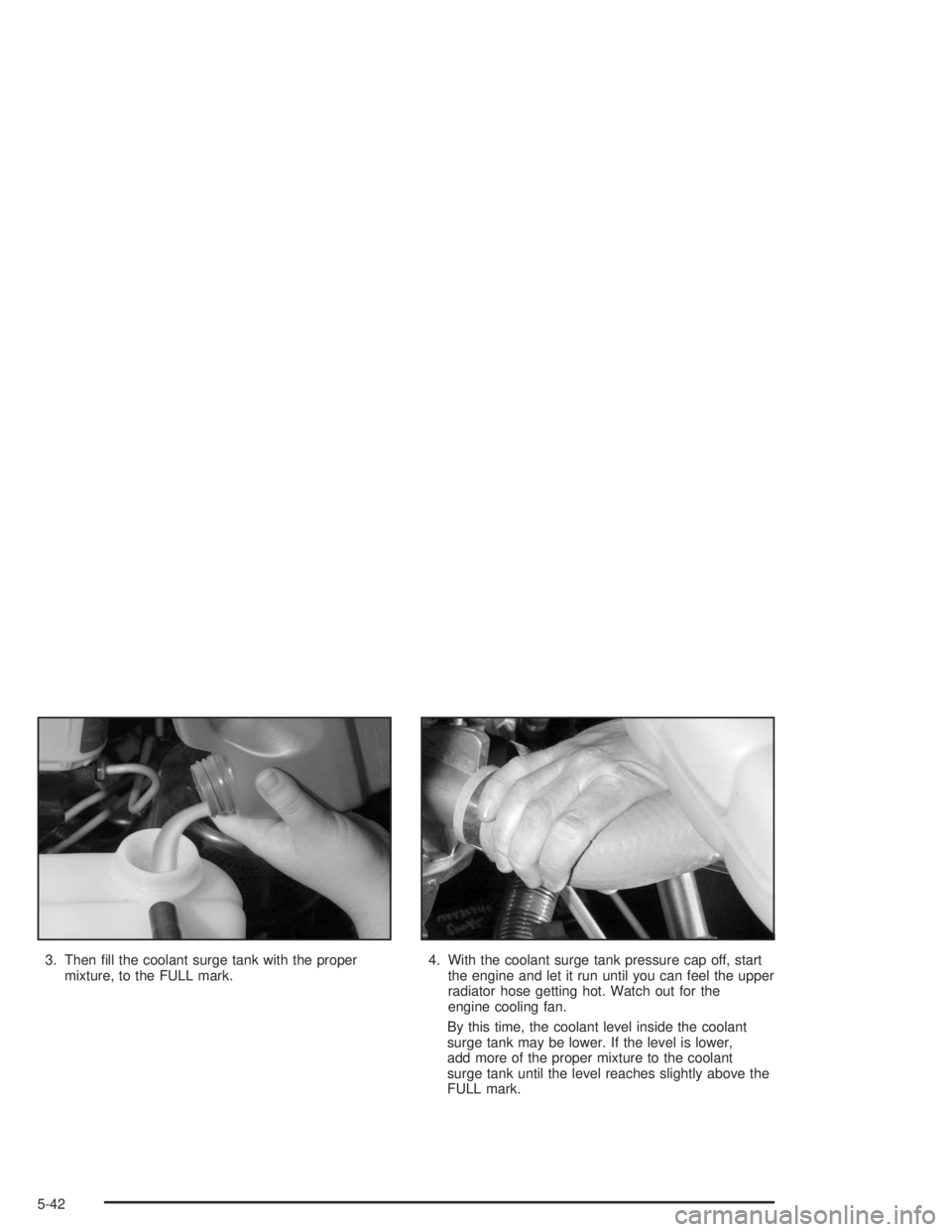
3. Then fill the coolant surge tank with the proper
mixture, to the FULL mark.4. With the coolant surge tank pressure cap off, start
the engine and let it run until you can feel the upper
radiator hose getting hot. Watch out for the
engine cooling fan.
By this time, the coolant level inside the coolant
surge tank may be lower. If the level is lower,
add more of the proper mixture to the coolant
surge tank until the level reaches slightly above the
FULL mark.
5-42
Page 251 of 366
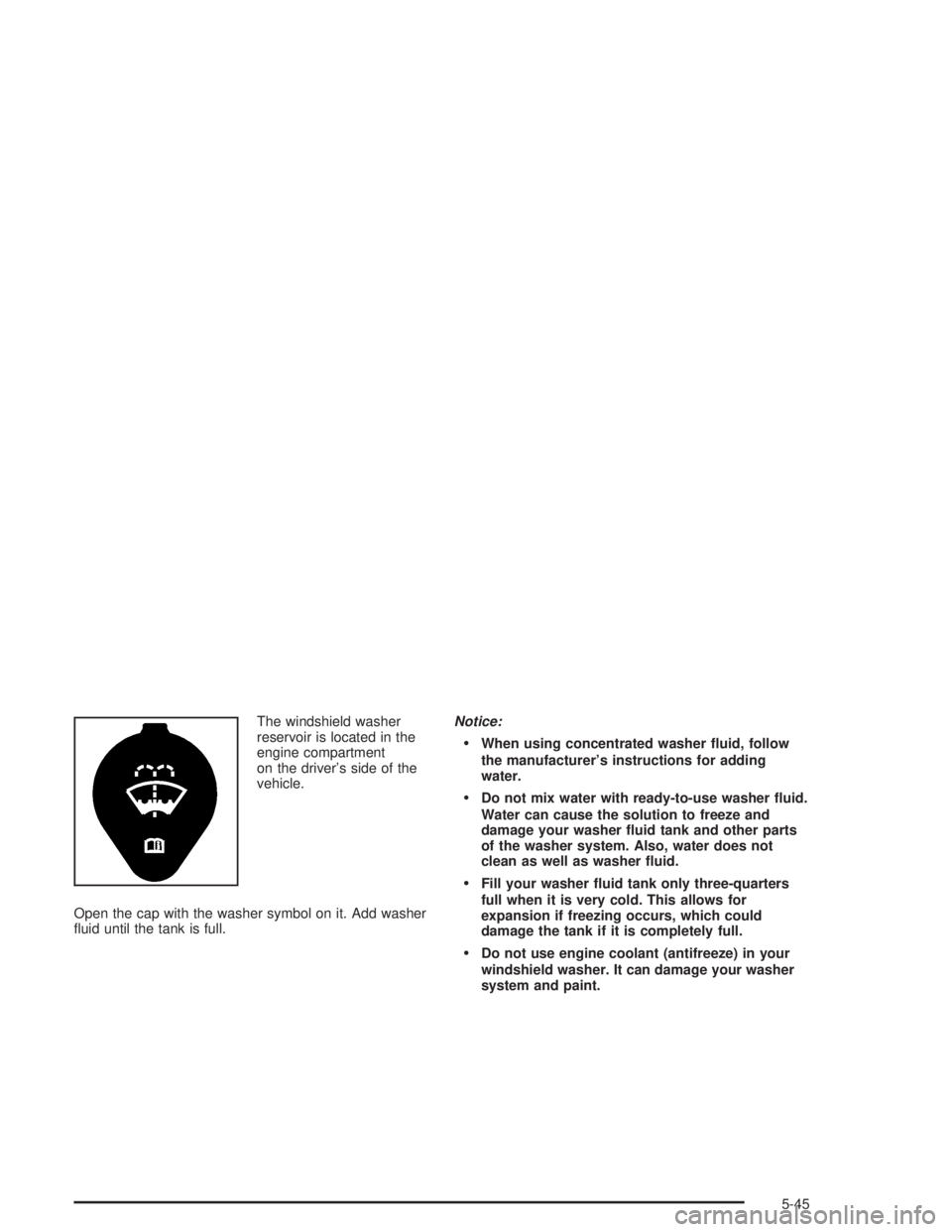
The windshield washer
reservoir is located in the
engine compartment
on the driver’s side of the
vehicle.
Open the cap with the washer symbol on it. Add washer
fluid until the tank is full.Notice:
When using concentrated washer uid, follow
the manufacturer’s instructions for adding
water.
Do not mix water with ready-to-use washer uid.
Water can cause the solution to freeze and
damage your washer uid tank and other parts
of the washer system. Also, water does not
clean as well as washer uid.
Fill your washer uid tank only three-quarters
full when it is very cold. This allows for
expansion if freezing occurs, which could
damage the tank if it is completely full.
Do not use engine coolant (antifreeze) in your
windshield washer. It can damage your washer
system and paint.
5-45
Page 332 of 366
(24)= Check the air intake system installation to see
that gaskets are seated properly and all hose
connections, fasteners and other components are tight.
Tighten connections and fasteners or replace parts
as required.
(26)= Evaporative Control System Service (if equipped):
Check all fuel and vapor lines and hoses for proper
connections and correct routing (or every 24 months,
whichever occurs first). Replace parts as needed.
(28)= Replace spark plugs. Inspect wires for damage.
Check the wire boot and boot heat shield fit at spark
plugs and coil. Replace parts as needed.
(30)= Check the fuel tank, fuel cap and fuel lines for
damage which could cause leakage. Inspect fuel cap for
correct sealing ability and any indications of damage.
Check fuel cap gasket for even filler neck imprint.
Replace parts as needed.
(31)= Check EGR system as described in the service
manual. SeeService Publications Ordering Information
on page 7-7.(32)= Inspect Electronic Vacuum Regulator Valve
(EVRV) filter for excessive contamination or plugging. If
needed, clean filter with solution of soap and water,
let dry and install.
(35)= Drain, flush and refill cooling system. SeePart C:
Recommended Fluids and Lubricants on page 6-29
for what to use. Inspect hoses. Clean radiator,
condenser, pressure cap and neck. Pressure test
cooling system and pressure cap. For Caterpillar
®diesel
engines, always refer to the Caterpillar®Diesel Engine
Operation & Maintenance Manual for coolant
recommendations and change intervals.
(37)= Rear axle service: Change the lubricant. See
Part C: Recommended Fluids and Lubricants on
page 6-29.
(38)= Front axle service: Re-pack upper kingpin roller
bearing.
6-22
Page 334 of 366
Part B: Owner Checks and Services
Listed in this part are owner checks and services
which should be performed at the intervals specified to
help ensure the safety, dependability and emission
control performance of your vehicle.
For your safety and that of others, any of the
safety-related components that may have been
damaged in an accident should be checked and any
needed repairs made before operating the vehicle.
At the minimum, these routine checks should be made
every 6 months or 6,000 miles (10 000 km), whichever
occurs first. Whenever repairs are needed, have
them completed before operating the vehicle.
At Each Fuel Fill
It is important for you or a service station attendant to
perform these underhood checks at each fuel ll.
Engine Oil Level Check
Check the engine oil level and add the proper oil if
necessary. See “Engine Oil” in the Index for further
details.
Engine Coolant Level Check
Check the engine coolant level and add DEX-COOL®
coolant mixture if necessary. See “Engine Coolant”
in the Index for further details.
Windshield Washer Fluid Level Check
Check the windshield washer fluid level in the windshield
washer tank and add the proper fluid if necessary.
SeeCleaning the Outside of Your Vehicle on page 5-80
for further details.
Tire Ination Check
Check tire inflation cold. Make sure tires are inflated to
the pressures specified on the GVW Rating label.
SeeLoading Your Vehicle on page 4-33andTires on
page 5-68for further details.
6-24
Page 338 of 366
Hood Latches Check
Check that the hood closes firmly. Check for broken,
damaged, loose or missing parts that might prevent tight
latching. Make sure the secondary latch (if equipped)
keeps the hood from opening all the way when the
primary latch is released.
Fluid Leaks Check
Check for fuel, coolant, oil or other fluid leaks by looking
at the surface beneath the vehicle after it has been
parked for awhile.
Underbody Inspection
Corrosive materials used for ice, snow removal and dust
control can collect on the underbody. If these materials
are not removed, accelerated corrosion (rust) can
occur on underbody parts such as fuel lines, frame, floor
pan and exhaust system. At least every spring, flush
these materials from the underbody with plain
water. Take care to clean well any areas where mud
and other debris can collect. Sediment packed in closed
areas of the frame should be loosened before being
flushed.
Engine Cover Check
Check that the cab’s engine cover and seal (if equipped)
are not torn or damaged. Be sure that the cover is
clamped down firmly to the floor.
At Least Once a Year
Key Lock Cylinders Service
Lubricate the key lock cylinders with the lubricant
specified in Part C.
Underbody Flushing Service
At least every spring, use plain water to flush any
corrosive materials from the underbody. Take care to
clean thoroughly any areas where mud and other debris
can collect.
Tractor Protection (Breakaway) Valve
Check
On air brake models, remove, disassemble, clean and
inspect the tractor protection (breakaway) valve.
6-28