oil CHEVROLET KODIAK 2004 Service Manual
[x] Cancel search | Manufacturer: CHEVROLET, Model Year: 2004, Model line: KODIAK, Model: CHEVROLET KODIAK 2004Pages: 366, PDF Size: 6.87 MB
Page 267 of 366
Rear Axle
When to Check and Change Lubricant
Refer to the Maintenance Schedule to determine
how often to check the lubricant and when to change it.
SeeScheduled Maintenance on page 6-5.
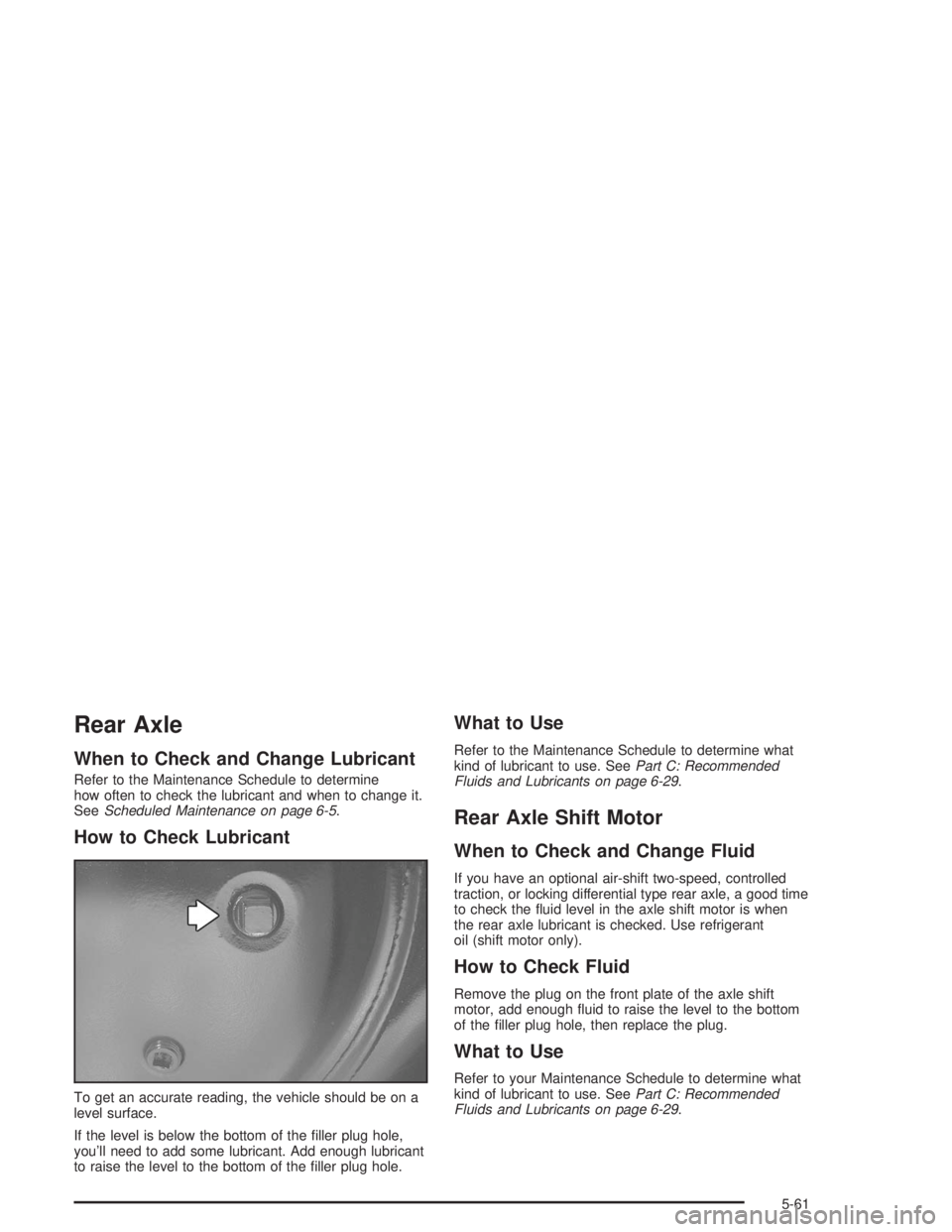
How to Check Lubricant
To get an accurate reading, the vehicle should be on a
level surface.
If the level is below the bottom of the filler plug hole,
you’ll need to add some lubricant. Add enough lubricant
to raise the level to the bottom of the filler plug hole.
What to Use
Refer to the Maintenance Schedule to determine what
kind of lubricant to use. SeePart C: Recommended
Fluids and Lubricants on page 6-29.
Rear Axle Shift Motor
When to Check and Change Fluid
If you have an optional air-shift two-speed, controlled
traction, or locking differential type rear axle, a good time
to check the fluid level in the axle shift motor is when
the rear axle lubricant is checked. Use refrigerant
oil (shift motor only).
How to Check Fluid
Remove the plug on the front plate of the axle shift
motor, add enough fluid to raise the level to the bottom
of the filler plug hole, then replace the plug.
What to Use
Refer to your Maintenance Schedule to determine what
kind of lubricant to use. SeePart C: Recommended
Fluids and Lubricants on page 6-29.
5-61
Page 271 of 366
Fuel Filter (Diesel Engines)
If you have a diesel engine, your fuel filter is located in
the engine compartment on the driver’s side of the
vehicle, or along the driver’s side frame rail. SeeFuel
Filter Replacementearlier in this section for further
information.
Also seeScheduled Maintenance on page 6-5for
recommended service intervals.
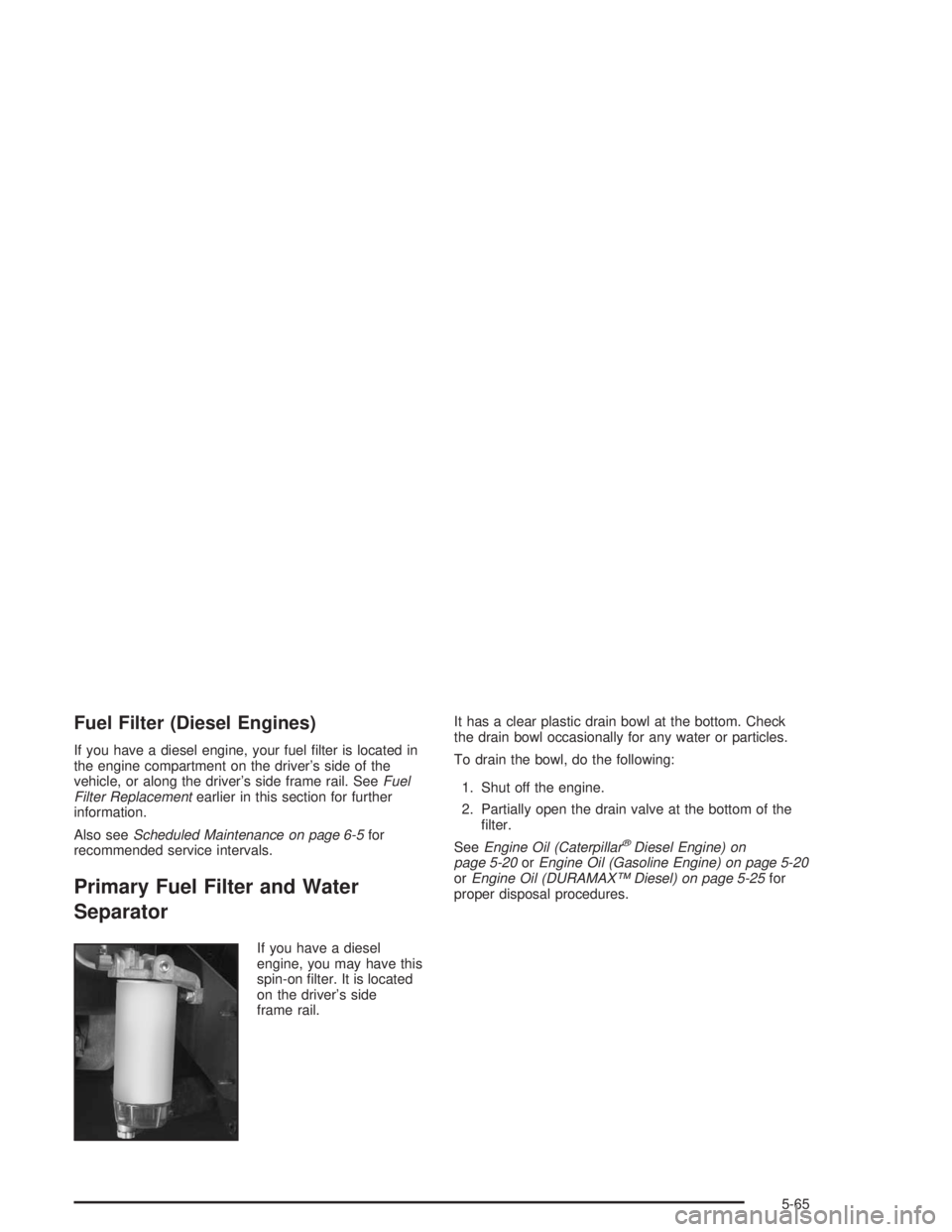
Primary Fuel Filter and Water
Separator
If you have a diesel
engine, you may have this
spin-on filter. It is located
on the driver’s side
frame rail.It has a clear plastic drain bowl at the bottom. Check
the drain bowl occasionally for any water or particles.
To drain the bowl, do the following:
1. Shut off the engine.
2. Partially open the drain valve at the bottom of the
filter.
SeeEngine Oil (Caterpillar
®Diesel Engine) on
page 5-20orEngine Oil (Gasoline Engine) on page 5-20
orEngine Oil (DURAMAX™ Diesel) on page 5-25for
proper disposal procedures.
5-65
Page 272 of 366

Secondary Fuel Filter and Water
Separator/Heater
If you have a Caterpillar®
diesel engine, you may
also have this spin-on filter
and fuel separator/heater.
It will be mounted in
the engine compartment
on the driver’s side of
the vehicle.
It has a metal drain bowl at the bottom. Occasionally,
check the bowl for any water or particles.
To check or drain the bowl, do the following:
•Shut off the engine.
•Push up on the spring loaded drain valve until clear
fuel is flowing from the valve.
The particles or water will drain out first. SeeEngine Oil
(Caterpillar
®Diesel Engine) on page 5-20orEngine
Oil (Gasoline Engine) on page 5-20orEngine Oil
(DURAMAX™ Diesel) on page 5-25for proper disposal
procedures.
Automatic Ether Injection System
If you have a Caterpillar®
diesel engine, you may
have this feature. The
ether cylinder is located in
the engine compartment
on the driver’s side of
the vehicle.
To change an empty ether cylinder, follow these steps.
1. Loosen the screw head on the cylinder-to-bracket
clamp.
2. Spread the clamp apart.
3. Clean any dirt from the neck of the cylinder and the
top of the valve before you take out the cylinder.
4. Check the inside of the valve for any foreign matter.
Clean the valve as necessary.
5. Cover the valve to protect it from dirt and take out
the cylinder.
5-66
Page 273 of 366
6. Install a new gasket whenever you take out the
cylinder. Use only one gasket and spread a light
film of clean oil on it before installation.
7. Put in the new cylinder. Turn it clockwise until it just
starts to contact the gasket.
8. Tighten the cylinder another half turn (180 degrees).
Don’t over-tighten.
9. Retighten the cylinder clamp.
Front Wheel Bearings with
Oil-Filled Hubs
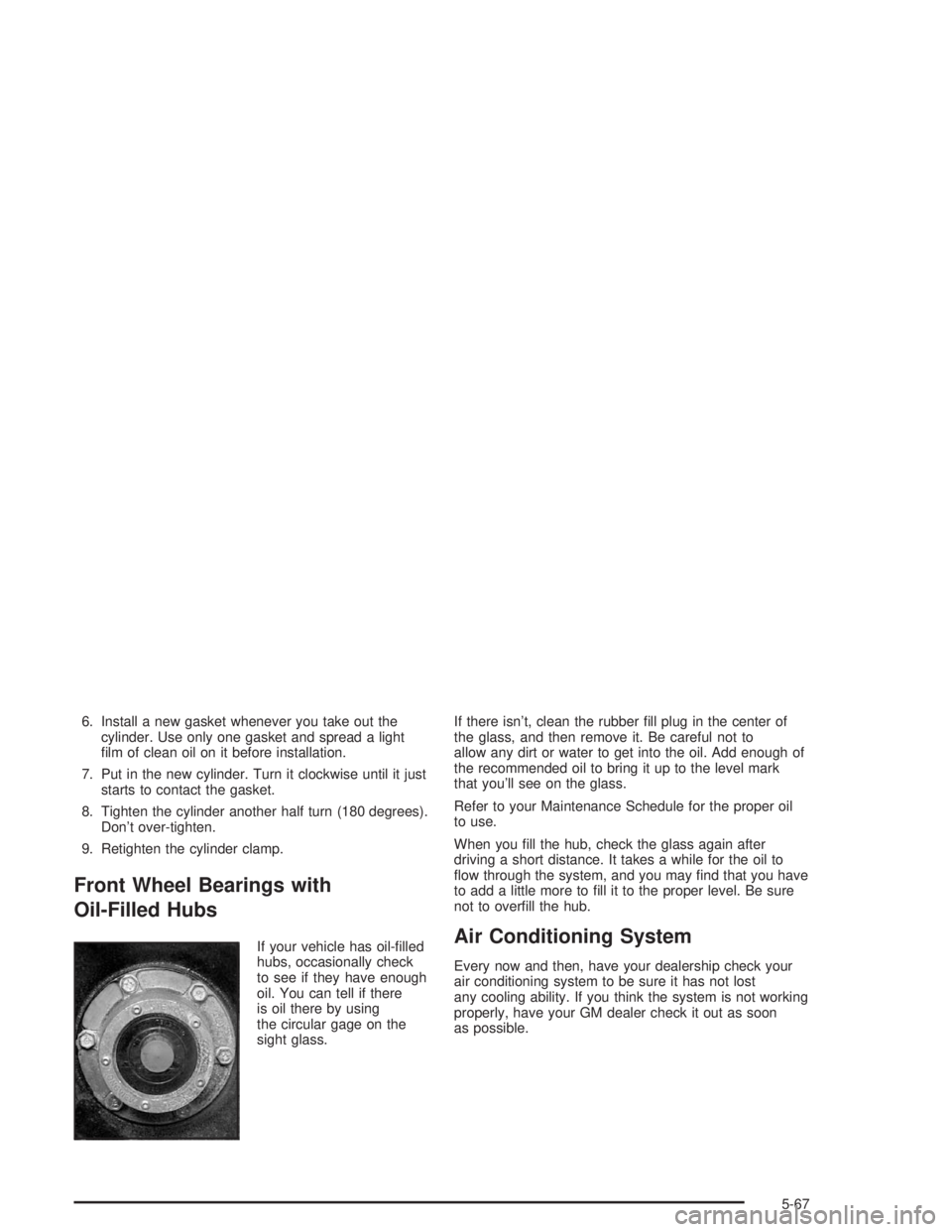
If your vehicle has oil-filled
hubs, occasionally check
to see if they have enough
oil. You can tell if there
is oil there by using
the circular gage on the
sight glass.If there isn’t, clean the rubber fill plug in the center of
the glass, and then remove it. Be careful not to
allow any dirt or water to get into the oil. Add enough of
the recommended oil to bring it up to the level mark
that you’ll see on the glass.
Refer to your Maintenance Schedule for the proper oil
to use.
When you fill the hub, check the glass again after
driving a short distance. It takes a while for the oil to
flow through the system, and you may find that you have
to add a little more to fill it to the proper level. Be sure
not to overfill the hub.Air Conditioning System
Every now and then, have your dealership check your
air conditioning system to be sure it has not lost
any cooling ability. If you think the system is not working
properly, have your GM dealer check it out as soon
as possible.
5-67
Page 278 of 366
3. Put on the wheel nuts.
4. Finger-tighten the nuts.
5. Oil the surfaces between the nuts and washers. Do
not oil the studs or the threads of the nut.
6. Tighten the nuts to 400 lb-ft (542 N-m) if an 8-hole
stud or 480 lb-ft (650 N-m) if a 10-hole stud, using
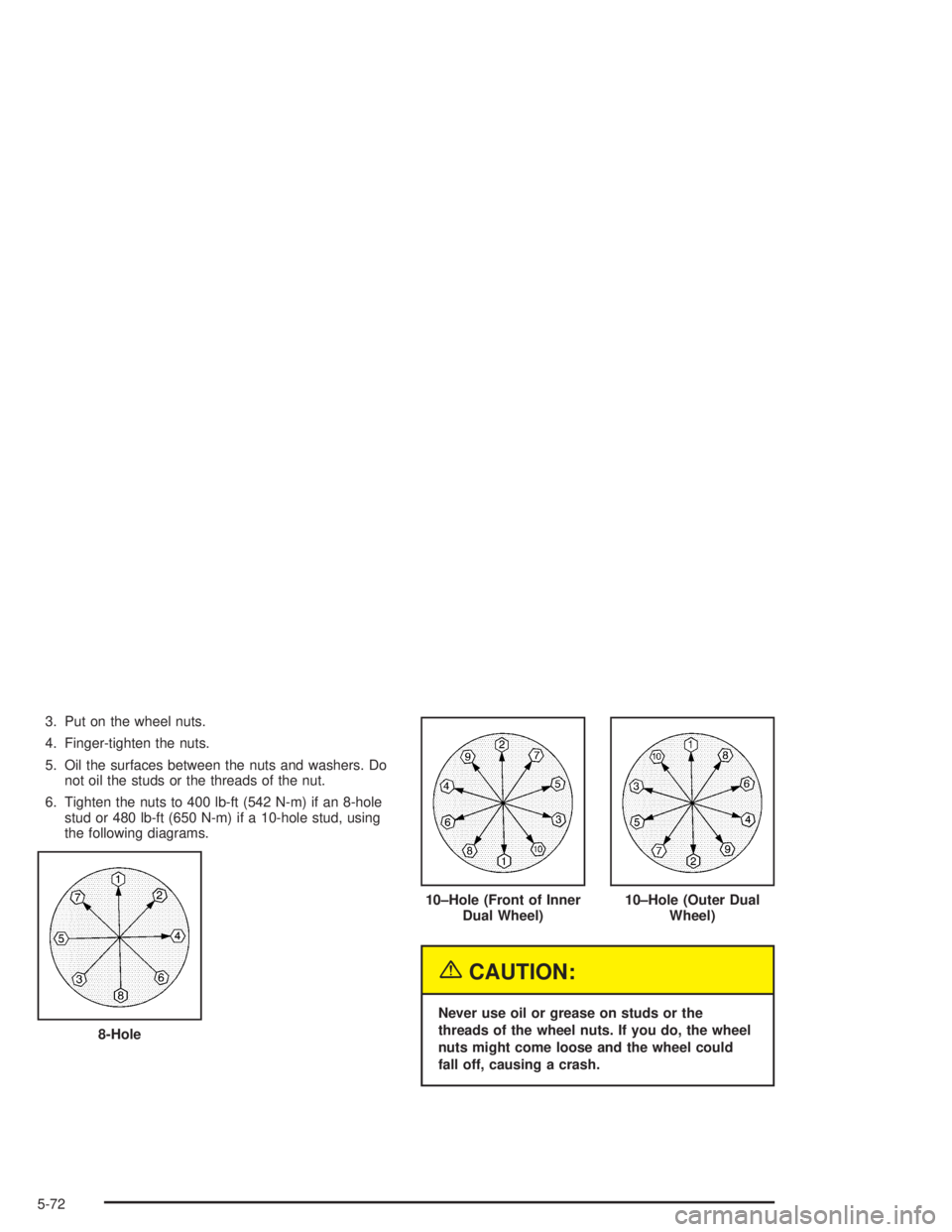
the following diagrams.
{CAUTION:
Never use oil or grease on studs or the
threads of the wheel nuts. If you do, the wheel
nuts might come loose and the wheel could
fall off, causing a crash. 8-Hole
10–Hole (Front of Inner
Dual Wheel)10–Hole (Outer Dual
Wheel)
5-72
Page 284 of 366
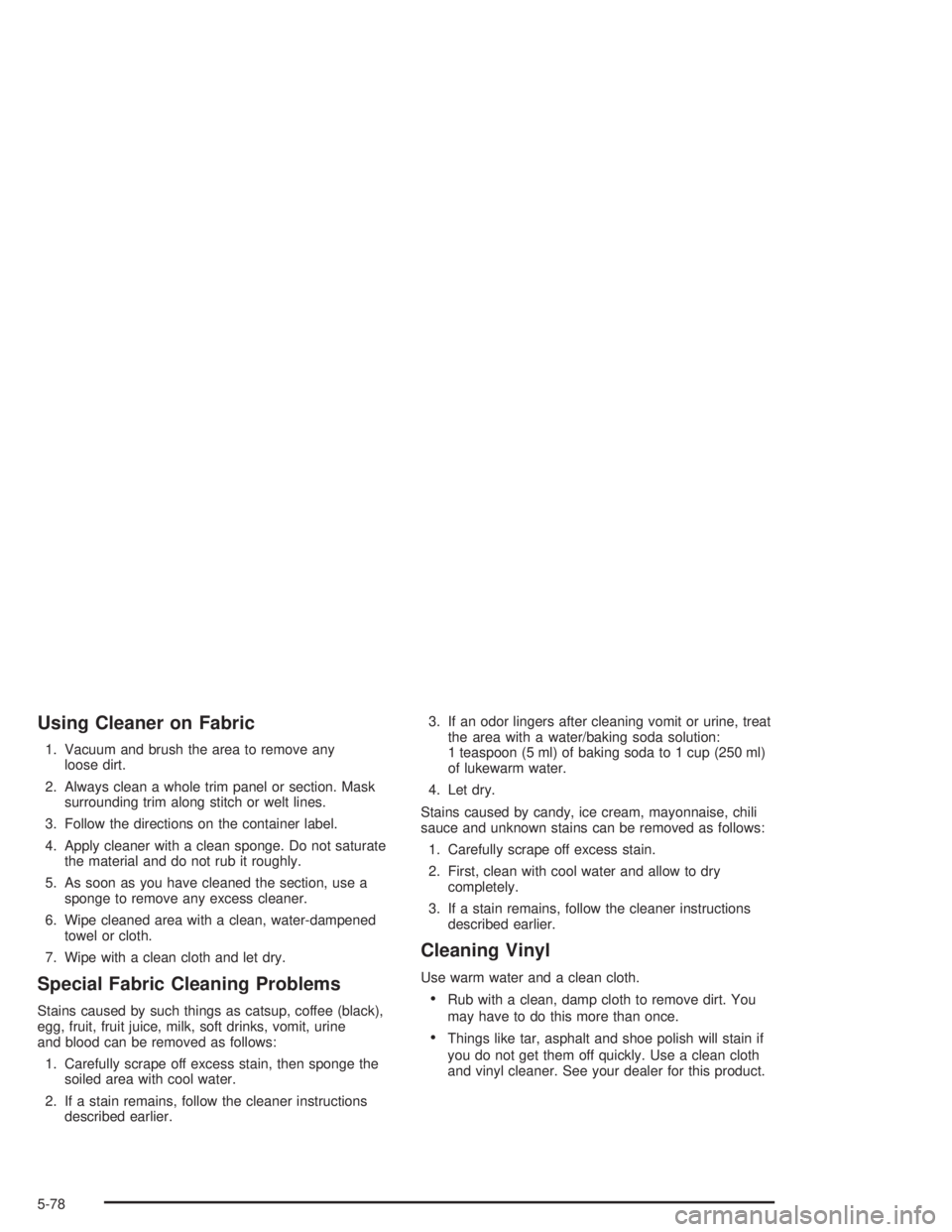
Using Cleaner on Fabric
1. Vacuum and brush the area to remove any
loose dirt.
2. Always clean a whole trim panel or section. Mask
surrounding trim along stitch or welt lines.
3. Follow the directions on the container label.
4. Apply cleaner with a clean sponge. Do not saturate
the material and do not rub it roughly.
5. As soon as you have cleaned the section, use a
sponge to remove any excess cleaner.
6. Wipe cleaned area with a clean, water-dampened
towel or cloth.
7. Wipe with a clean cloth and let dry.
Special Fabric Cleaning Problems
Stains caused by such things as catsup, coffee (black),
egg, fruit, fruit juice, milk, soft drinks, vomit, urine
and blood can be removed as follows:
1. Carefully scrape off excess stain, then sponge the
soiled area with cool water.
2. If a stain remains, follow the cleaner instructions
described earlier.3. If an odor lingers after cleaning vomit or urine, treat
the area with a water/baking soda solution:
1 teaspoon (5 ml) of baking soda to 1 cup (250 ml)
of lukewarm water.
4. Let dry.
Stains caused by candy, ice cream, mayonnaise, chili
sauce and unknown stains can be removed as follows:
1. Carefully scrape off excess stain.
2. First, clean with cool water and allow to dry
completely.
3. If a stain remains, follow the cleaner instructions
described earlier.
Cleaning Vinyl
Use warm water and a clean cloth.
•Rub with a clean, damp cloth to remove dirt. You
may have to do this more than once.
•Things like tar, asphalt and shoe polish will stain if
you do not get them off quickly. Use a clean cloth
and vinyl cleaner. See your dealer for this product.
5-78
Page 287 of 366
Foreign materials such as calcium chloride and other
salts, ice melting agents, road oil and tar, tree sap, bird
droppings, chemicals from industrial chimneys, etc.,
can damage your vehicle’s finish if they remain
on painted surfaces. Wash the vehicle as soon as
possible. If necessary, use non-abrasive cleaners that
are marked safe for painted surfaces to remove
foreign matter.
Exterior painted surfaces are subject to aging, weather
and chemical fallout that can take their toll over a
period of years. You can help to keep the paint finish
looking new by keeping your vehicle garaged or covered
whenever possible.
Protecting Exterior Bright Metal Parts
Bright metal parts should be cleaned regularly to keep
their luster. Washing with water is all that is usually
needed. However, you may use chrome polish on
chrome or stainless steel trim, if necessary.
Use special care with aluminum trim. To avoid damaging
protective trim, never use auto or chrome polish,
steam or caustic soap to clean aluminum. A coating of
wax, rubbed to high polish, is recommended for all
bright metal parts.
Windshield and Wiper Blades
If the windshield is not clear after using the windshield
washer, or if the wiper blade chatters when running,
wax, sap or other material may be on the blade or
windshield.
Clean the outside of the windshield with a full-strength
glass cleaning liquid. The windshield is clean if beads do
not form when you rinse it with water.
Grime from the windshield will stick to the wiper blades
and affect their performance. Clean the blade by
wiping vigorously with a cloth soaked in full-strength
windshield washer solvent. Then rinse the blade
with water.
Check the wiper blades and clean them as necessary;
replace blades that look worn.
5-81
Page 290 of 366
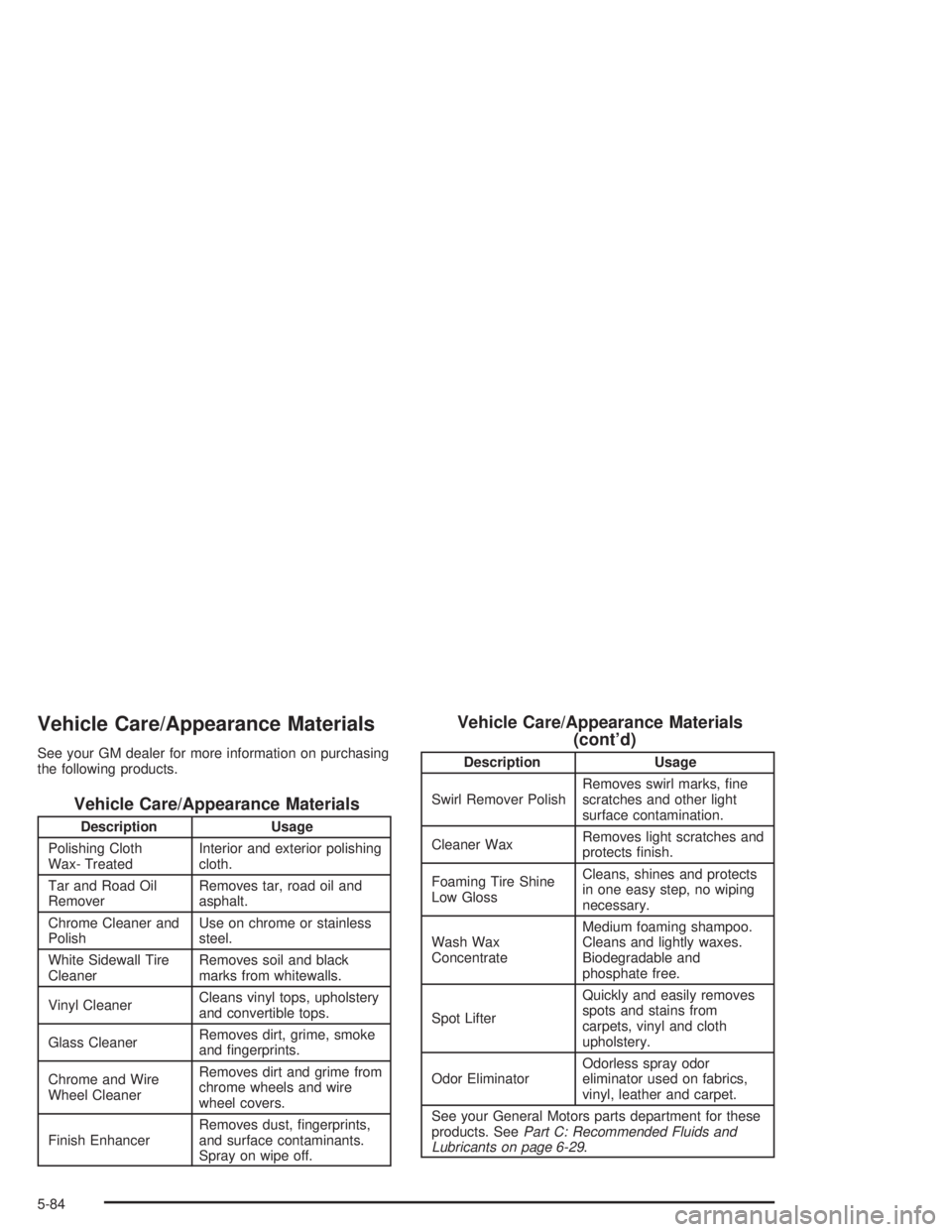
Vehicle Care/Appearance Materials
See your GM dealer for more information on purchasing
the following products.
Vehicle Care/Appearance Materials
Description Usage
Polishing Cloth
Wax- TreatedInterior and exterior polishing
cloth.
Tar and Road Oil
RemoverRemoves tar, road oil and
asphalt.
Chrome Cleaner and
PolishUse on chrome or stainless
steel.
White Sidewall Tire
CleanerRemoves soil and black
marks from whitewalls.
Vinyl CleanerCleans vinyl tops, upholstery
and convertible tops.
Glass CleanerRemoves dirt, grime, smoke
and fingerprints.
Chrome and Wire
Wheel CleanerRemoves dirt and grime from
chrome wheels and wire
wheel covers.
Finish EnhancerRemoves dust, fingerprints,
and surface contaminants.
Spray on wipe off.
Vehicle Care/Appearance Materials
(cont’d)
Description Usage
Swirl Remover PolishRemoves swirl marks, fine
scratches and other light
surface contamination.
Cleaner WaxRemoves light scratches and
protects finish.
Foaming Tire Shine
Low GlossCleans, shines and protects
in one easy step, no wiping
necessary.
Wash Wax
ConcentrateMedium foaming shampoo.
Cleans and lightly waxes.
Biodegradable and
phosphate free.
Spot LifterQuickly and easily removes
spots and stains from
carpets, vinyl and cloth
upholstery.
Odor EliminatorOdorless spray odor
eliminator used on fabrics,
vinyl, leather and carpet.
See your General Motors parts department for these
products. SeePart C: Recommended Fluids and
Lubricants on page 6-29.
5-84
Page 301 of 366
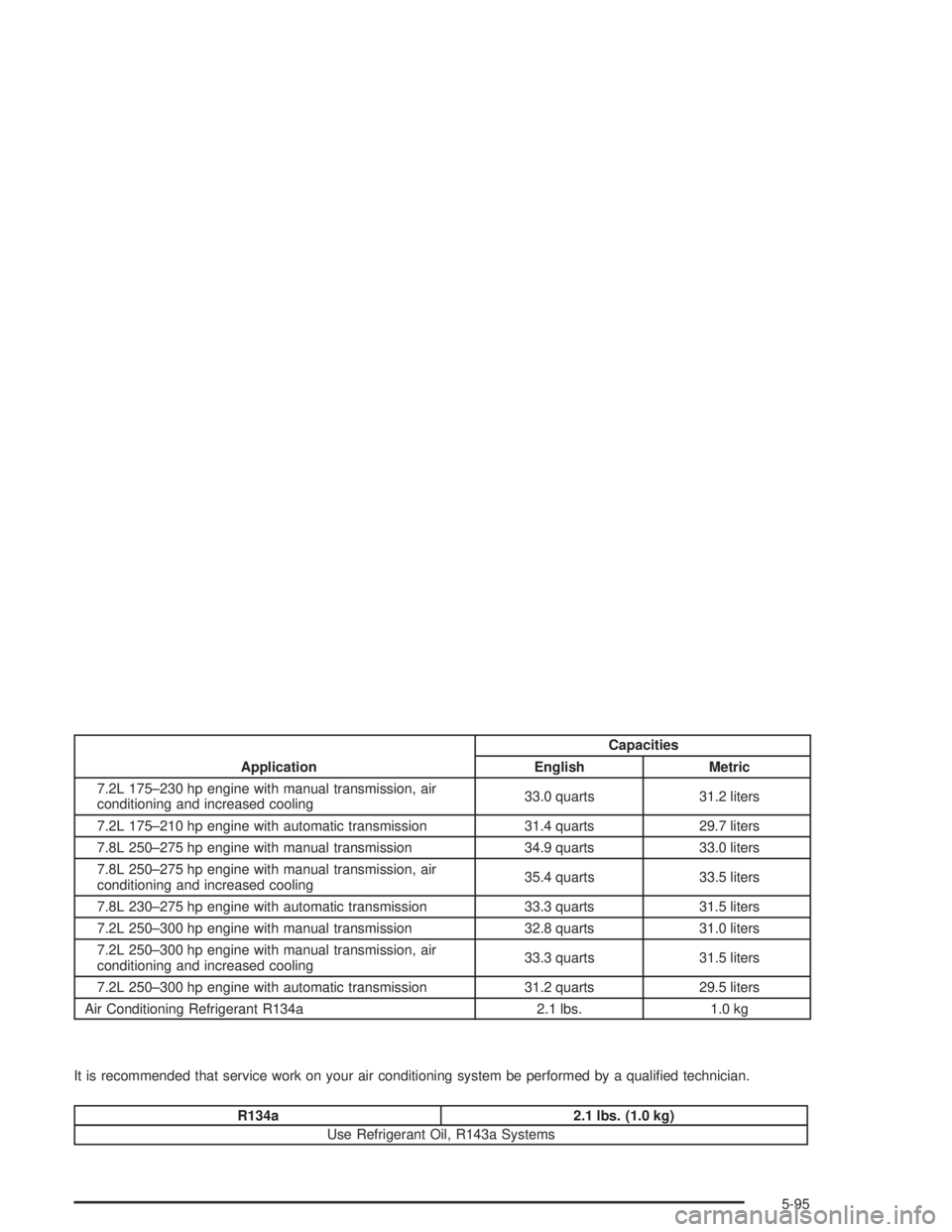
ApplicationCapacities
English Metric
7.2L 175–230 hp engine with manual transmission, air
conditioning and increased cooling33.0 quarts 31.2 liters
7.2L 175–210 hp engine with automatic transmission 31.4 quarts 29.7 liters
7.8L 250–275 hp engine with manual transmission 34.9 quarts 33.0 liters
7.8L 250–275 hp engine with manual transmission, air
conditioning and increased cooling35.4 quarts 33.5 liters
7.8L 230–275 hp engine with automatic transmission 33.3 quarts 31.5 liters
7.2L 250–300 hp engine with manual transmission 32.8 quarts 31.0 liters
7.2L 250–300 hp engine with manual transmission, air
conditioning and increased cooling33.3 quarts 31.5 liters
7.2L 250–300 hp engine with automatic transmission 31.2 quarts 29.5 liters
Air Conditioning Refrigerant R134a 2.1 lbs. 1.0 kg
It is recommended that service work on your air conditioning system be performed by a qualified technician.
R134a 2.1 lbs. (1.0 kg)
Use Refrigerant Oil, R143a Systems
5-95
Page 302 of 366
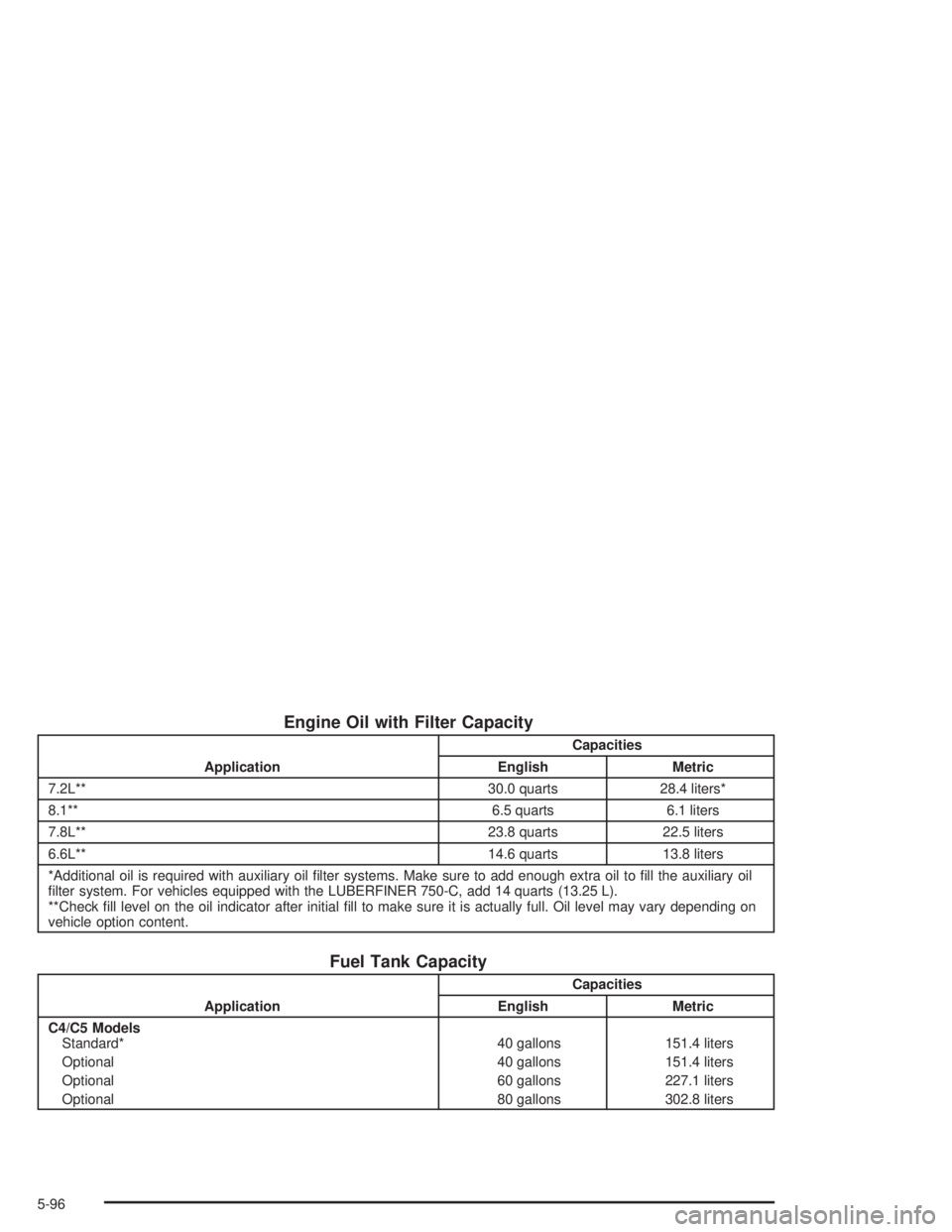
Engine Oil with Filter Capacity
ApplicationCapacities
English Metric
7.2L** 30.0 quarts 28.4 liters*
8.1** 6.5 quarts 6.1 liters
7.8L** 23.8 quarts 22.5 liters
6.6L** 14.6 quarts 13.8 liters
*Additional oil is required with auxiliary oil filter systems. Make sure to add enough extra oil to fill the auxiliary oil
filter system. For vehicles equipped with the LUBERFINER 750-C, add 14 quarts (13.25 L).
**Check fill level on the oil indicator after initial fill to make sure it is actually full. Oil level may vary depending on
vehicle option content.
Fuel Tank Capacity
ApplicationCapacities
English Metric
C4/C5 Models
Standard*
Optional
Optional
Optional40 gallons
40 gallons
60 gallons
80 gallons151.4 liters
151.4 liters
227.1 liters
302.8 liters
5-96