light CHEVROLET KODIAK 2004 Manual PDF
[x] Cancel search | Manufacturer: CHEVROLET, Model Year: 2004, Model line: KODIAK, Model: CHEVROLET KODIAK 2004Pages: 366, PDF Size: 6.87 MB
Page 191 of 366
•Besides slowing down, allow some extra following
distance. And be especially careful when you
pass another vehicle. Allow yourself more clear
room ahead, and be prepared to have your
view restricted by road spray.
•Have good tires with proper tread depth. SeeTires
on page 5-68.
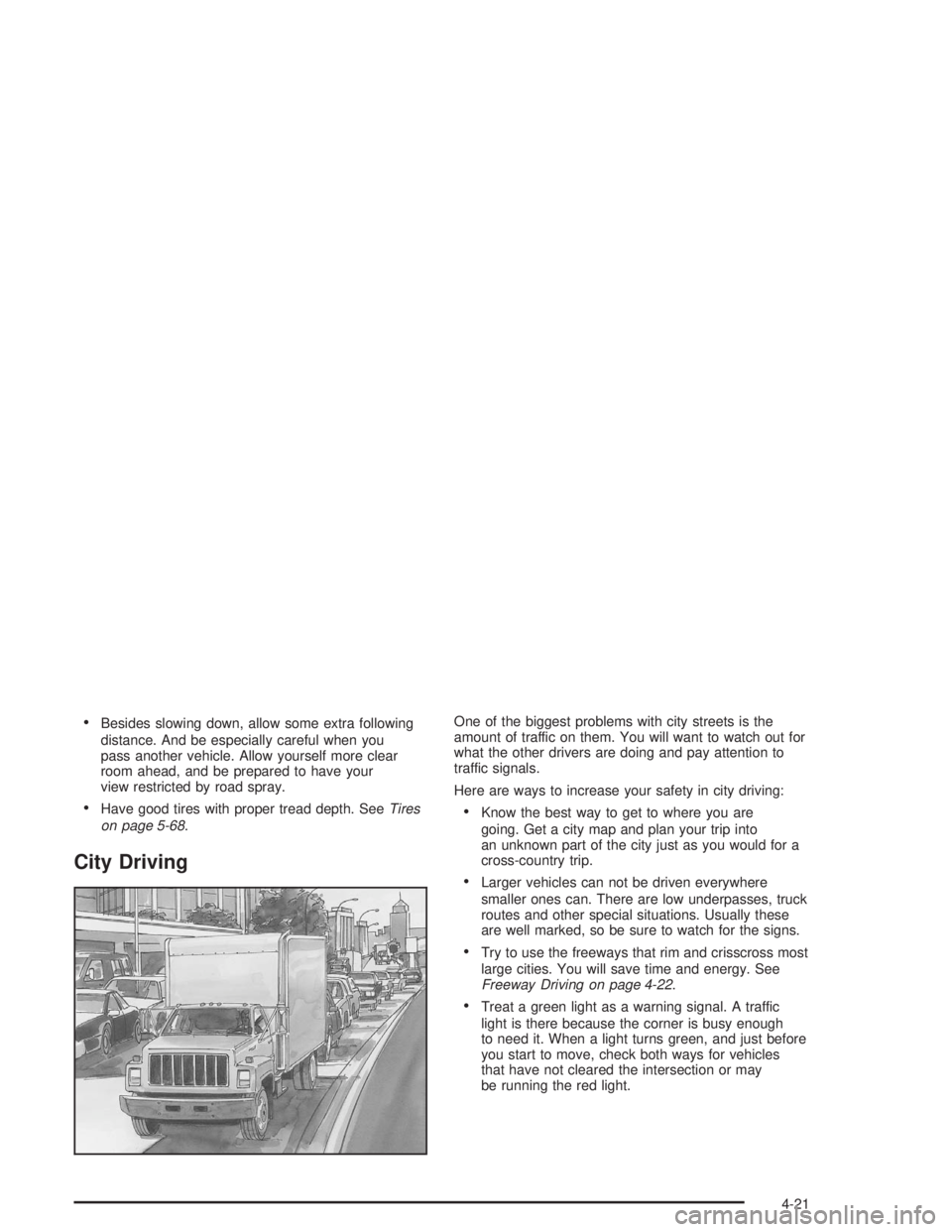
City Driving
One of the biggest problems with city streets is the
amount of traffic on them. You will want to watch out for
what the other drivers are doing and pay attention to
traffic signals.
Here are ways to increase your safety in city driving:
•Know the best way to get to where you are
going. Get a city map and plan your trip into
an unknown part of the city just as you would for a
cross-country trip.
•Larger vehicles can not be driven everywhere
smaller ones can. There are low underpasses, truck
routes and other special situations. Usually these
are well marked, so be sure to watch for the signs.
•Try to use the freeways that rim and crisscross most
large cities. You will save time and energy. See
Freeway Driving on page 4-22.
•Treat a green light as a warning signal. A traffic
light is there because the corner is busy enough
to need it. When a light turns green, and just before
you start to move, check both ways for vehicles
that have not cleared the intersection or may
be running the red light.
4-21
Page 192 of 366
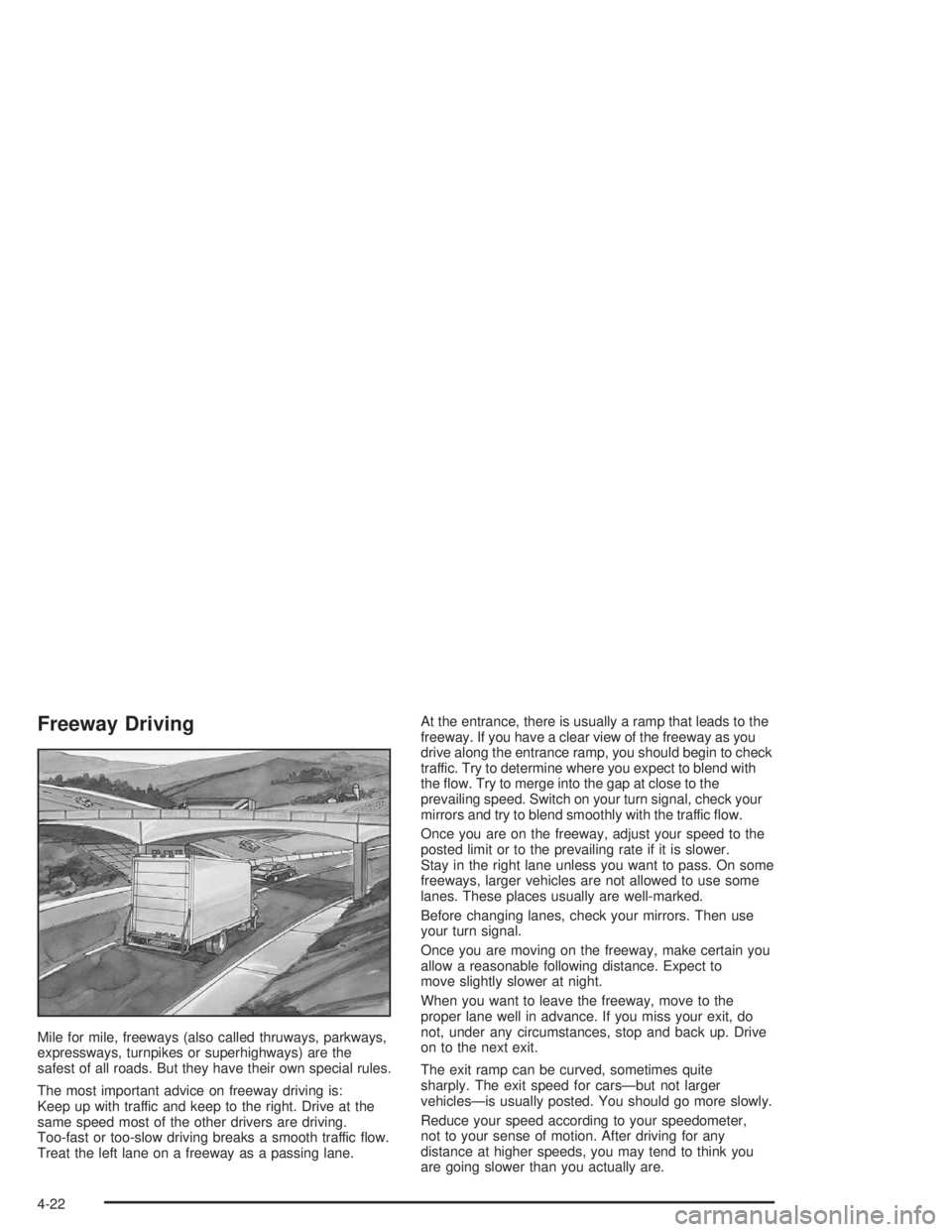
Freeway Driving
Mile for mile, freeways (also called thruways, parkways,
expressways, turnpikes or superhighways) are the
safest of all roads. But they have their own special rules.
The most important advice on freeway driving is:
Keep up with traffic and keep to the right. Drive at the
same speed most of the other drivers are driving.
Too-fast or too-slow driving breaks a smooth traffic flow.
Treat the left lane on a freeway as a passing lane.At the entrance, there is usually a ramp that leads to the
freeway. If you have a clear view of the freeway as you
drive along the entrance ramp, you should begin to check
traffic. Try to determine where you expect to blend with
the flow. Try to merge into the gap at close to the
prevailing speed. Switch on your turn signal, check your
mirrors and try to blend smoothly with the traffic flow.
Once you are on the freeway, adjust your speed to the
posted limit or to the prevailing rate if it is slower.
Stay in the right lane unless you want to pass. On some
freeways, larger vehicles are not allowed to use some
lanes. These places usually are well-marked.
Before changing lanes, check your mirrors. Then use
your turn signal.
Once you are moving on the freeway, make certain you
allow a reasonable following distance. Expect to
move slightly slower at night.
When you want to leave the freeway, move to the
proper lane well in advance. If you miss your exit, do
not, under any circumstances, stop and back up. Drive
on to the next exit.
The exit ramp can be curved, sometimes quite
sharply. The exit speed for cars—but not larger
vehicles—is usually posted. You should go more slowly.
Reduce your speed according to your speedometer,
not to your sense of motion. After driving for any
distance at higher speeds, you may tend to think you
are going slower than you actually are.
4-22
Page 195 of 366
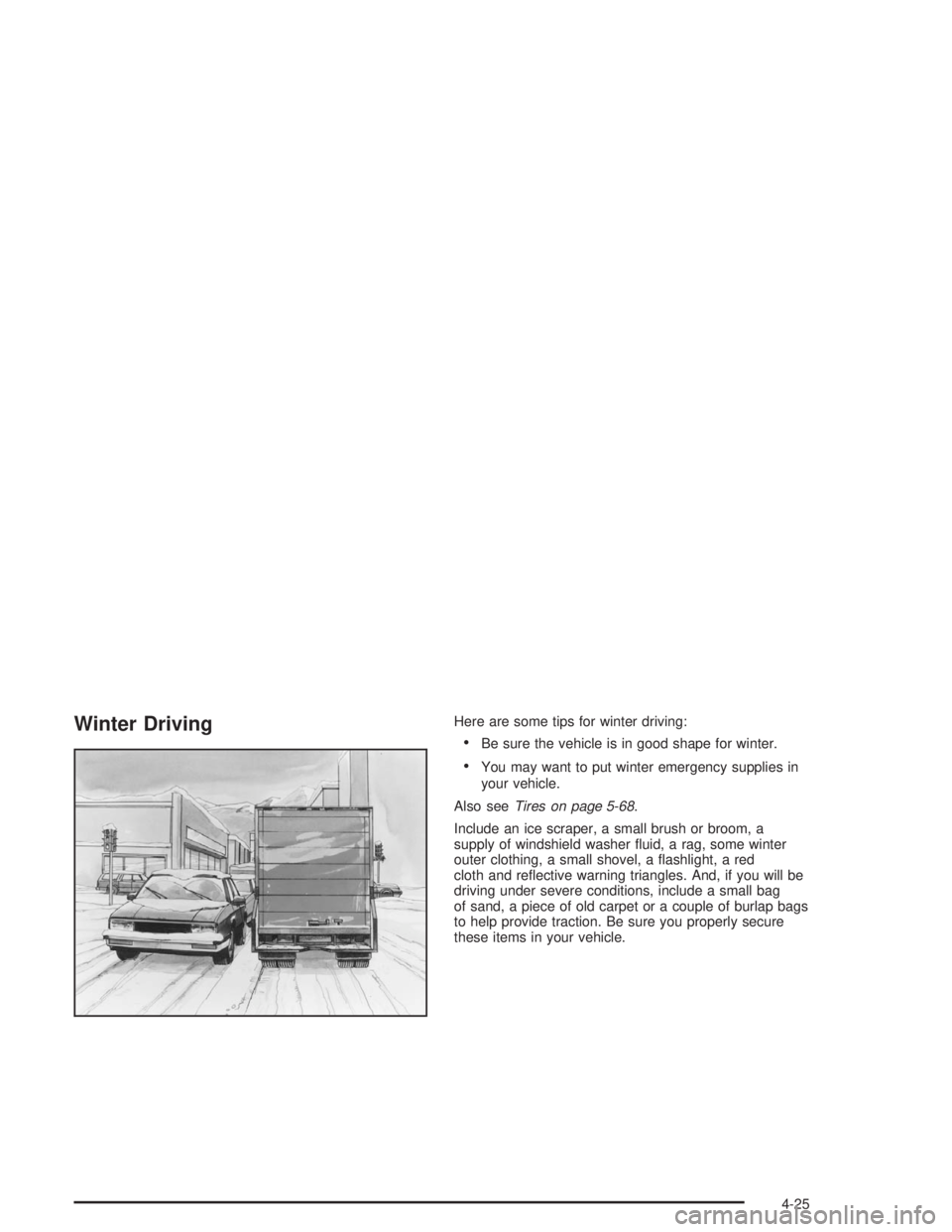
Winter DrivingHere are some tips for winter driving:
•Be sure the vehicle is in good shape for winter.
•You may want to put winter emergency supplies in
your vehicle.
Also seeTires on page 5-68.
Include an ice scraper, a small brush or broom, a
supply of windshield washer fluid, a rag, some winter
outer clothing, a small shovel, a flashlight, a red
cloth and reflective warning triangles. And, if you will be
driving under severe conditions, include a small bag
of sand, a piece of old carpet or a couple of burlap bags
to help provide traction. Be sure you properly secure
these items in your vehicle.
4-25
Page 198 of 366
•Put on extra clothing or wrap a blanket around you.
If you have no blankets or extra clothing, make
body insulators from newspapers, burlap bags, rags,
floor mats — anything you can wrap around
yourself or tuck under your clothing to keep warm.
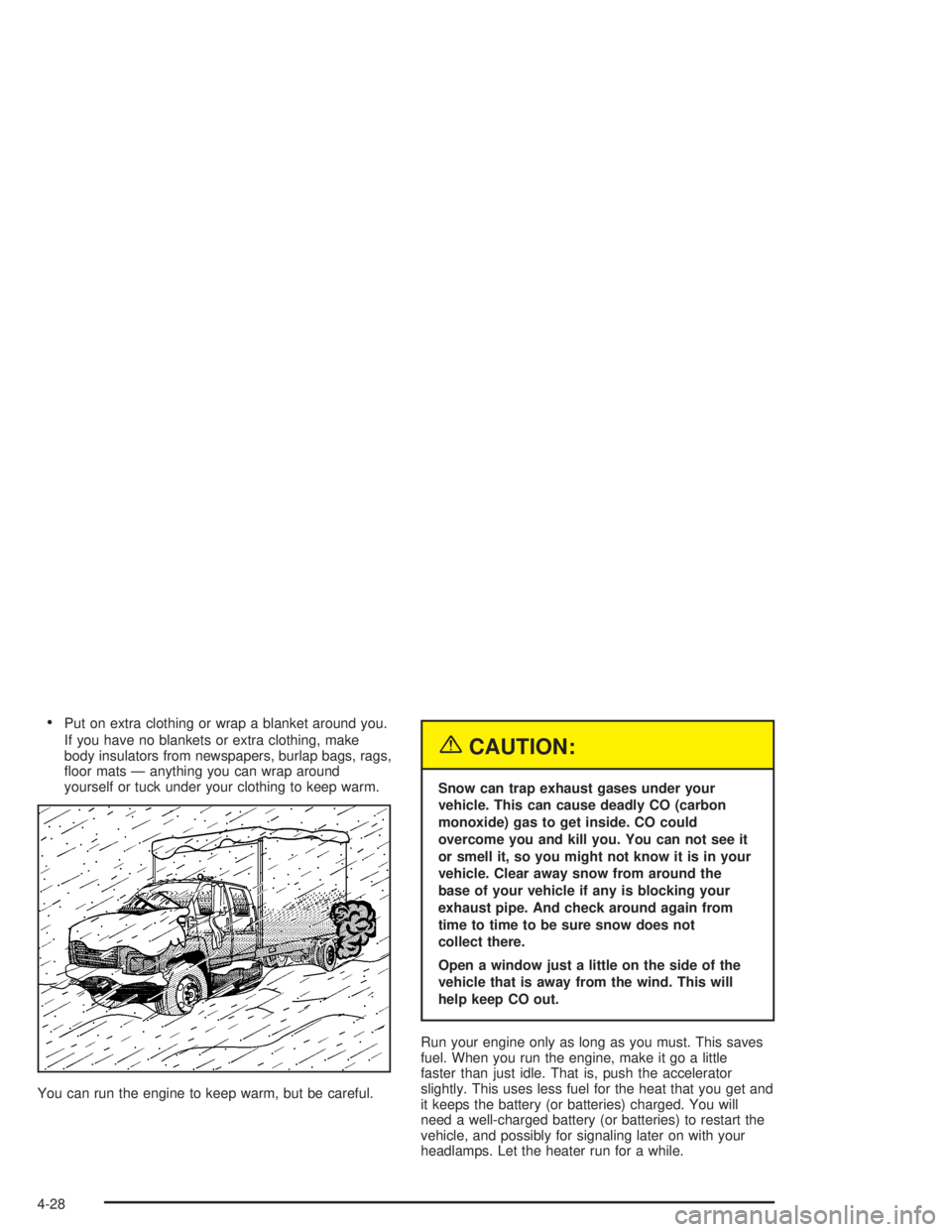
You can run the engine to keep warm, but be careful.
{CAUTION:
Snow can trap exhaust gases under your
vehicle. This can cause deadly CO (carbon
monoxide) gas to get inside. CO could
overcome you and kill you. You can not see it
or smell it, so you might not know it is in your
vehicle. Clear away snow from around the
base of your vehicle if any is blocking your
exhaust pipe. And check around again from
time to time to be sure snow does not
collect there.
Open a window just a little on the side of the
vehicle that is away from the wind. This will
help keep CO out.
Run your engine only as long as you must. This saves
fuel. When you run the engine, make it go a little
faster than just idle. That is, push the accelerator
slightly. This uses less fuel for the heat that you get and
it keeps the battery (or batteries) charged. You will
need a well-charged battery (or batteries) to restart the
vehicle, and possibly for signaling later on with your
headlamps. Let the heater run for a while.
4-28
Page 200 of 366
Rocking Your Vehicle To Get It Out
First, turn your steering wheel left and right. That will
clear the area around your front wheels. If your vehicle
has traction control, you should turn the traction
control system off. SeeTraction Control System (TCS)
on page 4-11. Then shift back and forth between
REVERSE (R) and a forward gear (or with a manual
transmission, between FIRST (1) or SECOND (2)
and REVERSE (R)), spinning the wheels as little as
possible. Release the accelerator pedal while you shift,
and press lightly on the accelerator pedal when the
transmission is in gear. By slowly spinning your wheels
in the forward and reverse directions, you will cause
a rocking motion that may free your vehicle. If that does
not get you out after a few tries, you may need to be
towed out. If you do need to be towed out, seeTowing
Your Vehicle on page 4-31.
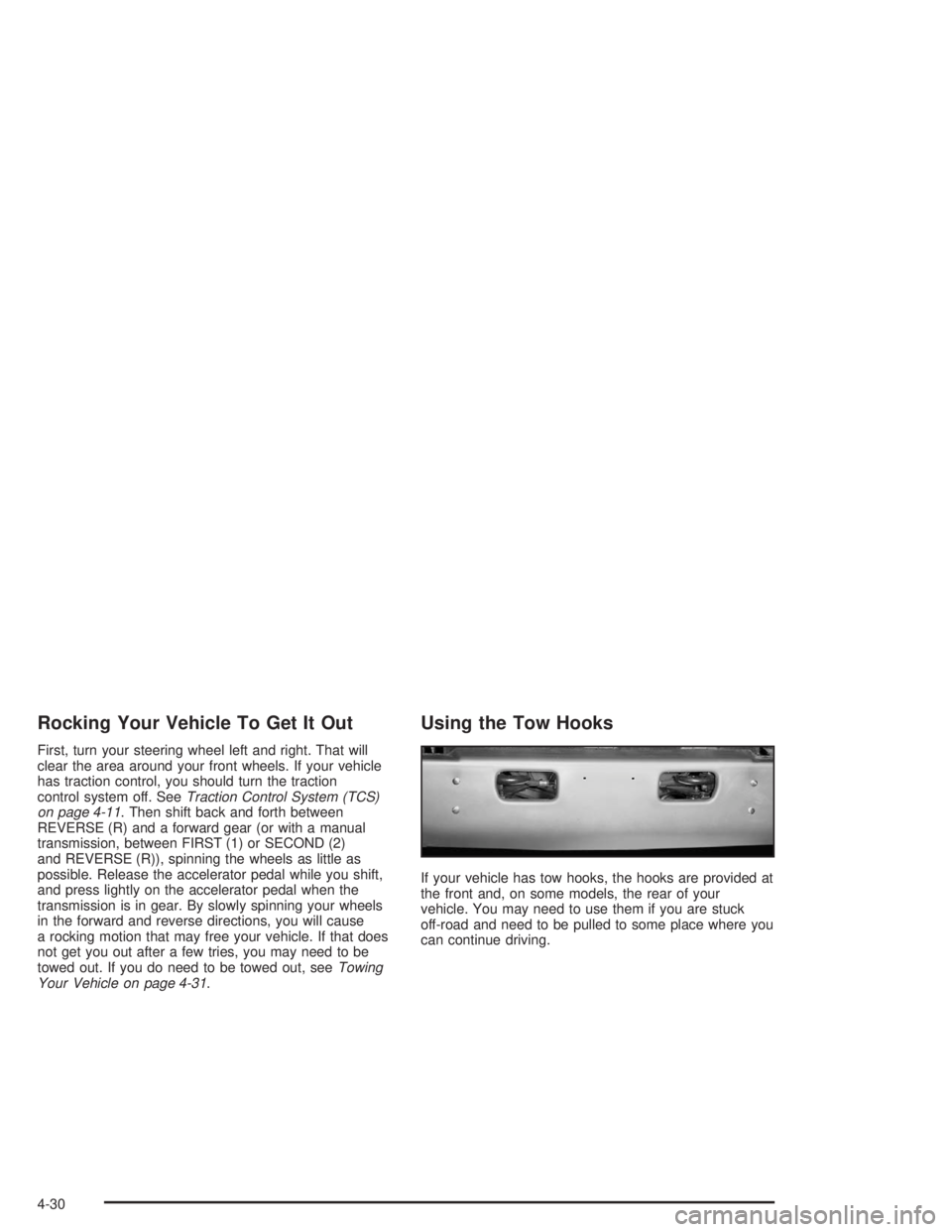
Using the Tow Hooks
If your vehicle has tow hooks, the hooks are provided at
the front and, on some models, the rear of your
vehicle. You may need to use them if you are stuck
off-road and need to be pulled to some place where you
can continue driving.
4-30
Page 205 of 366
Trailer Connections
(C4/C5 Models Only)
Heavy-Duty Trailer Wiring Package
Your vehicle may be equipped with an eight-wire trailer
towing harness. This harness, with a seven-pin
universal heavy-duty trailer connector, is attached to a
bracket on the platform hitch.
The Center High-Mounted Stoplamp (CHMSL) wire is
tied next to the trailer wiring harness for use with a
trailer.The eight-wire harness contains the following trailer
circuits:
•Yellow: Left Stop/Turn Signal
•Dark Green: Right Stop/Turn Signal
•Brown: Taillamps
•White: Ground
•Light Green: Back-up Lamps
•Light Blue: CHMSL
•Red: Battery Feed
•Dark Blue: Trailer Brake
4-35
Page 206 of 366
Trailer Connections
(C7/C8 Models Only)
If your vehicle has these trailer connections, they are
located at the rear of the cab for a tractor and at the rear
of the chassis when towing a trailer. There will be an
air connection and an electrical connection.
Be sure that the couplings to the trailer are made
correctly.
Air Connections
If you are not connecting the trailer air line connections
to another piece of equipment, be sure to replace
their protective caps.
Electrical Connections
This system is a seven-wire cable that will connect to
the trailer, supplying power to the trailer’s lighting
system. When not in use, it is stored in the trailer
air-hose storage bracket.
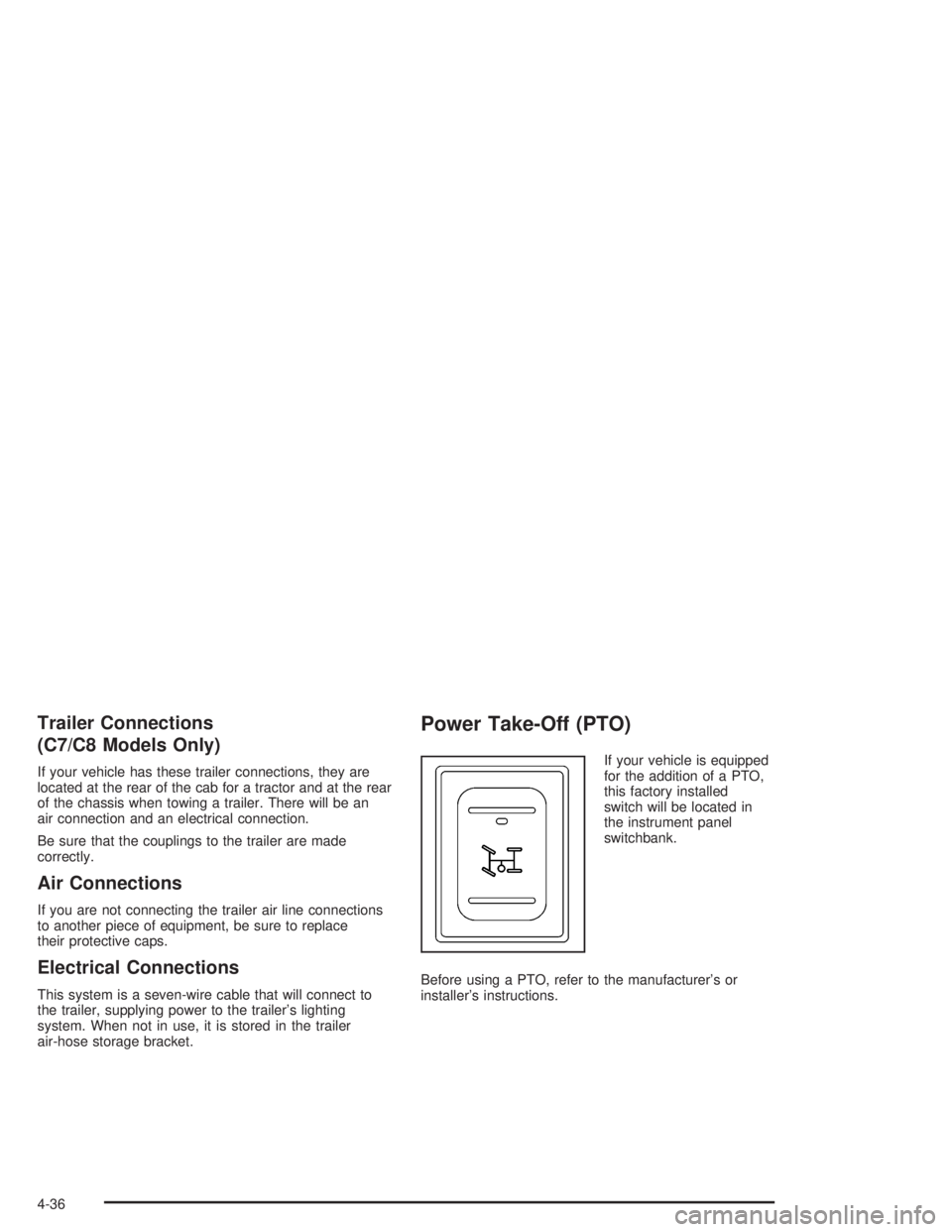
Power Take-Off (PTO)
If your vehicle is equipped
for the addition of a PTO,
this factory installed
switch will be located in
the instrument panel
switchbank.
Before using a PTO, refer to the manufacturer’s or
installer’s instructions.
4-36
Page 217 of 366
Sometimes, water can be pumped into your fuel tank
along with your diesel fuel. This can happen if a service
station doesn’t regularly inspect and clean its fuel
tanks, or if it gets contaminated fuel from its suppliers.
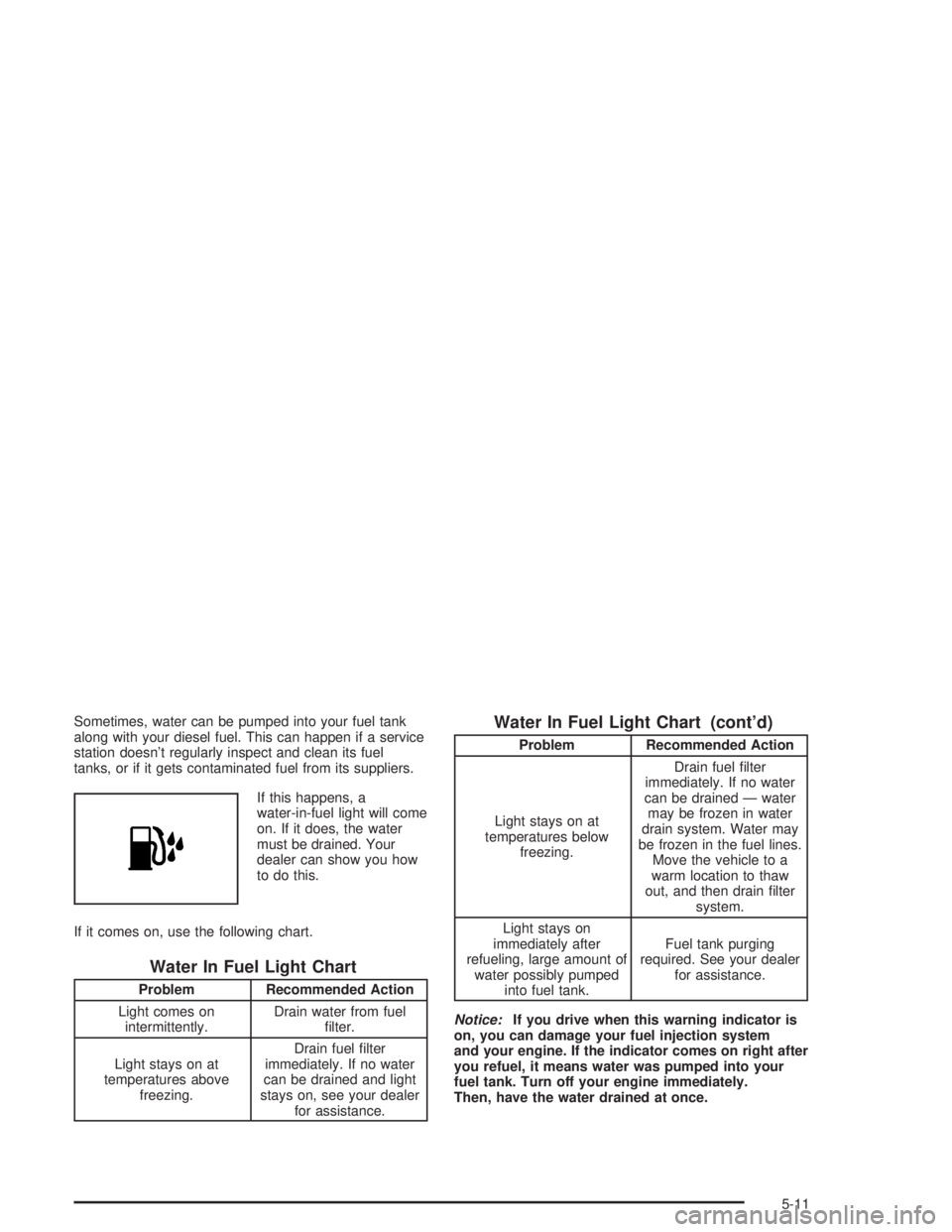
If this happens, a
water-in-fuel light will come
on. If it does, the water
must be drained. Your
dealer can show you how
to do this.
If it comes on, use the following chart.
Water In Fuel Light Chart
Problem Recommended Action
Light comes on
intermittently.Drain water from fuel
filter.
Light stays on at
temperatures above
freezing.Drain fuel filter
immediately. If no water
can be drained and light
stays on, see your dealer
for assistance.
Water In Fuel Light Chart (cont’d)
Problem Recommended Action
Light stays on at
temperatures below
freezing.Drain fuel filter
immediately. If no water
can be drained — water
may be frozen in water
drain system. Water may
be frozen in the fuel lines.
Move the vehicle to a
warm location to thaw
out, and then drain filter
system.
Light stays on
immediately after
refueling, large amount of
water possibly pumped
into fuel tank.Fuel tank purging
required. See your dealer
for assistance.
Notice:If you drive when this warning indicator is
on, you can damage your fuel injection system
and your engine. If the indicator comes on right after
you refuel, it means water was pumped into your
fuel tank. Turn off your engine immediately.
Then, have the water drained at once.
5-11
Page 218 of 366
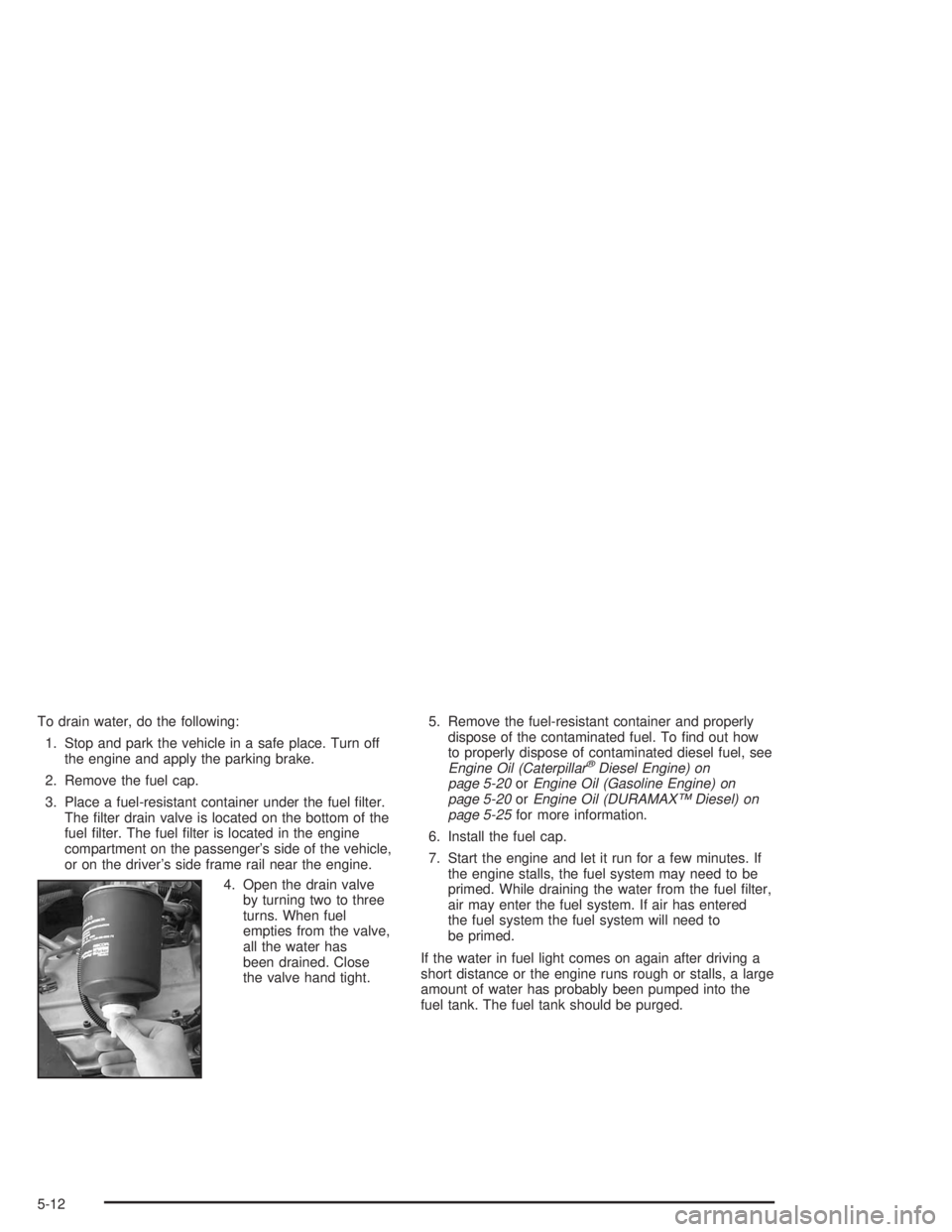
To drain water, do the following:
1. Stop and park the vehicle in a safe place. Turn off
the engine and apply the parking brake.
2. Remove the fuel cap.
3. Place a fuel-resistant container under the fuel filter.
The filter drain valve is located on the bottom of the
fuel filter. The fuel filter is located in the engine
compartment on the passenger’s side of the vehicle,
or on the driver’s side frame rail near the engine.
4. Open the drain valve
by turning two to three
turns. When fuel
empties from the valve,
all the water has
been drained. Close
the valve hand tight.5. Remove the fuel-resistant container and properly
dispose of the contaminated fuel. To find out how
to properly dispose of contaminated diesel fuel, see
Engine Oil (Caterpillar
®Diesel Engine) on
page 5-20orEngine Oil (Gasoline Engine) on
page 5-20orEngine Oil (DURAMAX™ Diesel) on
page 5-25for more information.
6. Install the fuel cap.
7. Start the engine and let it run for a few minutes. If
the engine stalls, the fuel system may need to be
primed. While draining the water from the fuel filter,
air may enter the fuel system. If air has entered
the fuel system the fuel system will need to
be primed.
If the water in fuel light comes on again after driving a
short distance or the engine runs rough or stalls, a large
amount of water has probably been pumped into the
fuel tank. The fuel tank should be purged.
5-12
Page 223 of 366
Filling Your Tank
{CAUTION:
Fuel vapor is highly ammable. It burns
violently, and that can cause very bad injuries.
Do not smoke if you are near fuel or refueling
your vehicle. Keep sparks, ames and smoking
materials away from fuel.
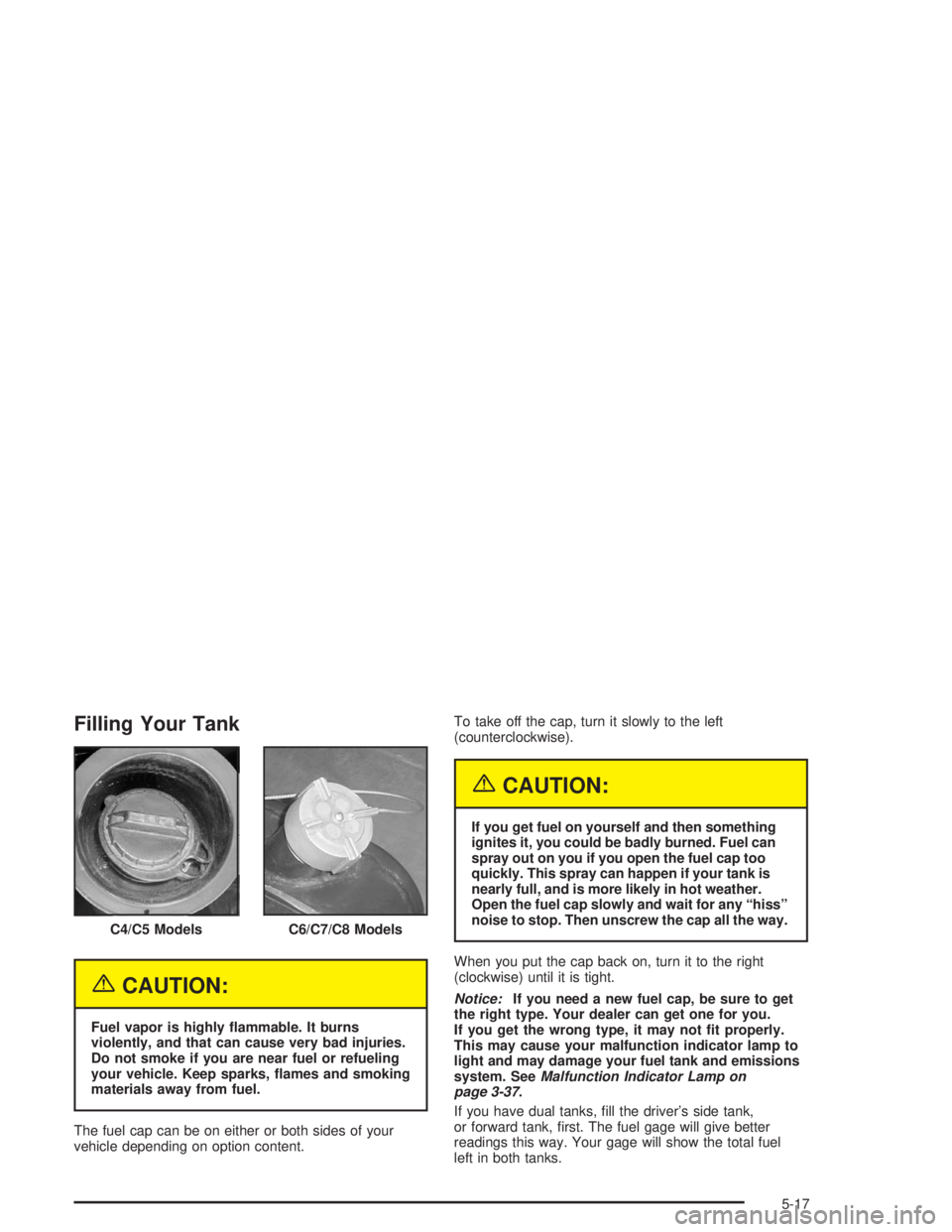
The fuel cap can be on either or both sides of your
vehicle depending on option content.To take off the cap, turn it slowly to the left
(counterclockwise).
{CAUTION:
If you get fuel on yourself and then something
ignites it, you could be badly burned. Fuel can
spray out on you if you open the fuel cap too
quickly. This spray can happen if your tank is
nearly full, and is more likely in hot weather.
Open the fuel cap slowly and wait for any “hiss”
noise to stop. Then unscrew the cap all the way.
When you put the cap back on, turn it to the right
(clockwise) until it is tight.
Notice:If you need a new fuel cap, be sure to get
the right type. Your dealer can get one for you.
If you get the wrong type, it may not t properly.
This may cause your malfunction indicator lamp to
light and may damage your fuel tank and emissions
system. SeeMalfunction Indicator Lamp on
page 3-37.
If you have dual tanks, fill the driver’s side tank,
or forward tank, first. The fuel gage will give better
readings this way. Your gage will show the total fuel
left in both tanks. C4/C5 Models
C6/C7/C8 Models
5-17