rear brakes CHEVROLET KODIAK 2004 Owners Manual
[x] Cancel search | Manufacturer: CHEVROLET, Model Year: 2004, Model line: KODIAK, Model: CHEVROLET KODIAK 2004Pages: 366, PDF Size: 6.87 MB
Page 101 of 366
Parking
{CAUTION:
If you don’t park your vehicle properly, it can
roll. If you’ve left the engine running, it can
move very quickly. You or others could be
injured. To be sure your vehicle won’t move,
even when you’re on level ground, follow the
steps below.
Two-Speed Rear Axle
1. With the engine running, shift the two-speed rear
axle into low. To be sure it’s in low, you’ll need to
move the vehicle in gear just a little.
2. Hold the regular brake pedal down with your
right foot.
3. Apply the parking brake.
4. Shift the transmission to NEUTRAL or PARK (P).
Hydraulic Brakes
If your vehicle has hydraulic brakes, it has either a
parking brake foot pedal or hand lever. If you have the
parking brake foot pedal, it is located below the
instrument panel to the left of the steering column.
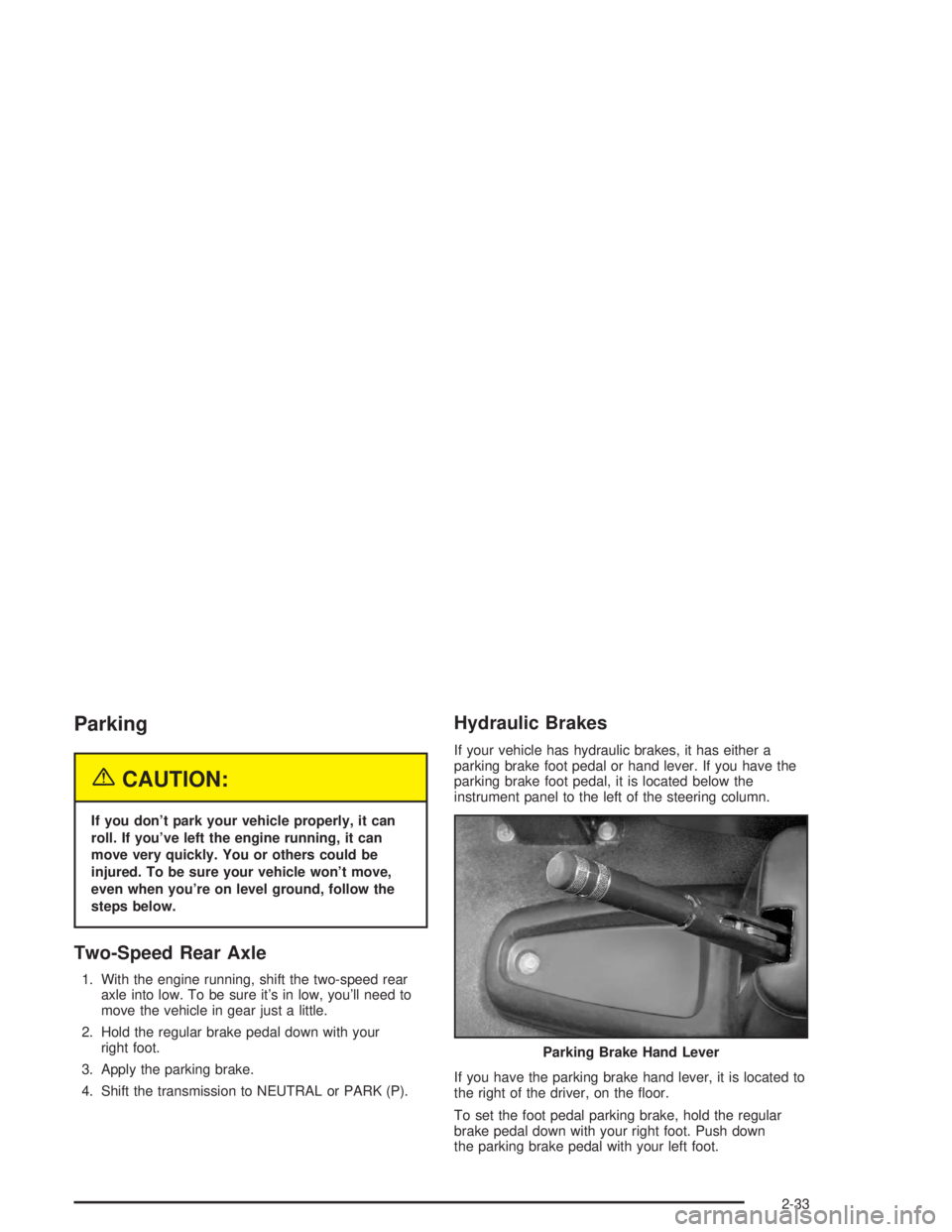
If you have the parking brake hand lever, it is located to
the right of the driver, on the floor.
To set the foot pedal parking brake, hold the regular
brake pedal down with your right foot. Push down
the parking brake pedal with your left foot.Parking Brake Hand Lever
2-33
Page 116 of 366
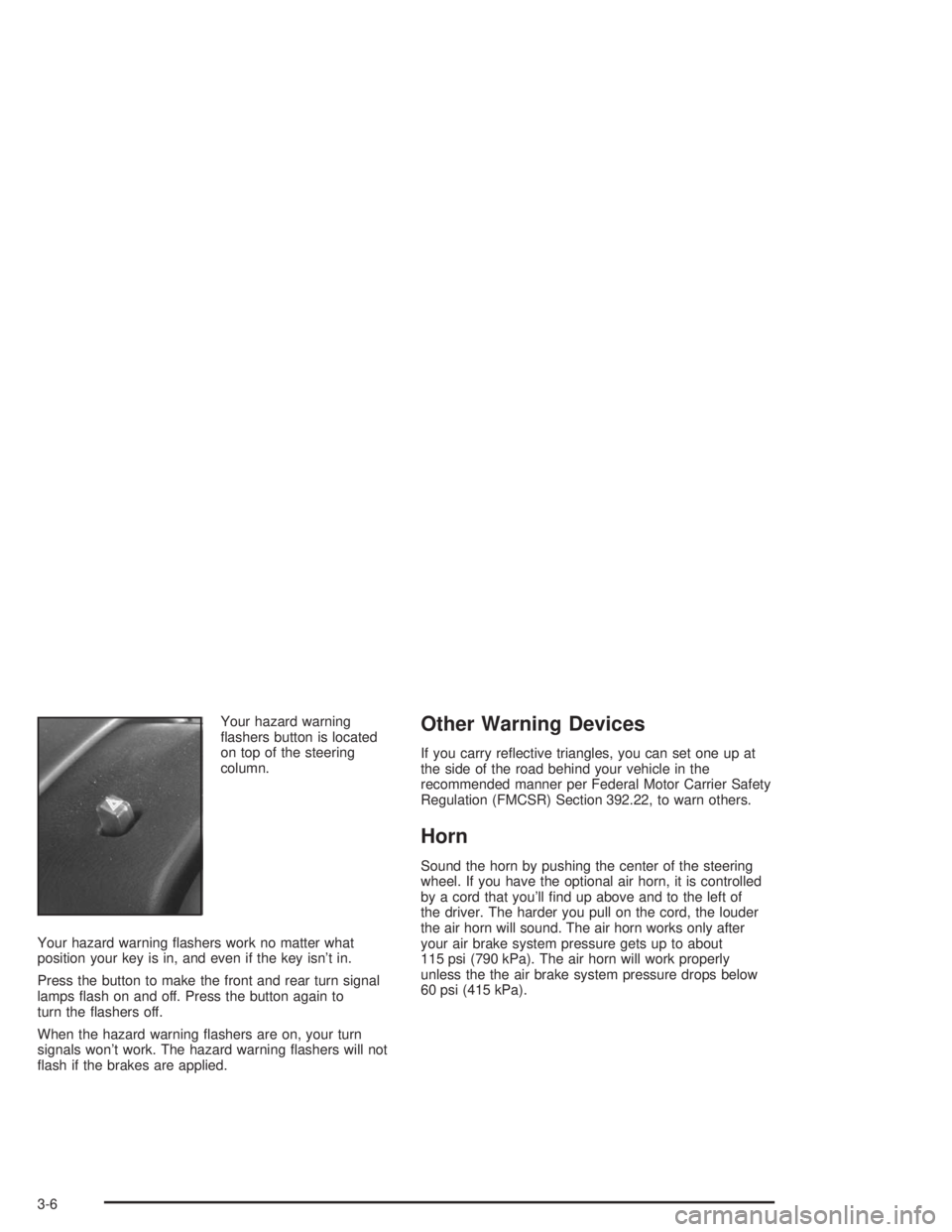
Your hazard warning
flashers button is located
on top of the steering
column.
Your hazard warning flashers work no matter what
position your key is in, and even if the key isn’t in.
Press the button to make the front and rear turn signal
lamps flash on and off. Press the button again to
turn the flashers off.
When the hazard warning flashers are on, your turn
signals won’t work. The hazard warning flashers will not
flash if the brakes are applied.Other Warning Devices
If you carry reflective triangles, you can set one up at
the side of the road behind your vehicle in the
recommended manner per Federal Motor Carrier Safety
Regulation (FMCSR) Section 392.22, to warn others.
Horn
Sound the horn by pushing the center of the steering
wheel. If you have the optional air horn, it is controlled
by a cord that you’ll find up above and to the left of
the driver. The harder you pull on the cord, the louder
the air horn will sound. The air horn works only after
your air brake system pressure gets up to about
115 psi (790 kPa). The air horn will work properly
unless the the air brake system pressure drops below
60 psi (415 kPa).
3-6
Page 154 of 366
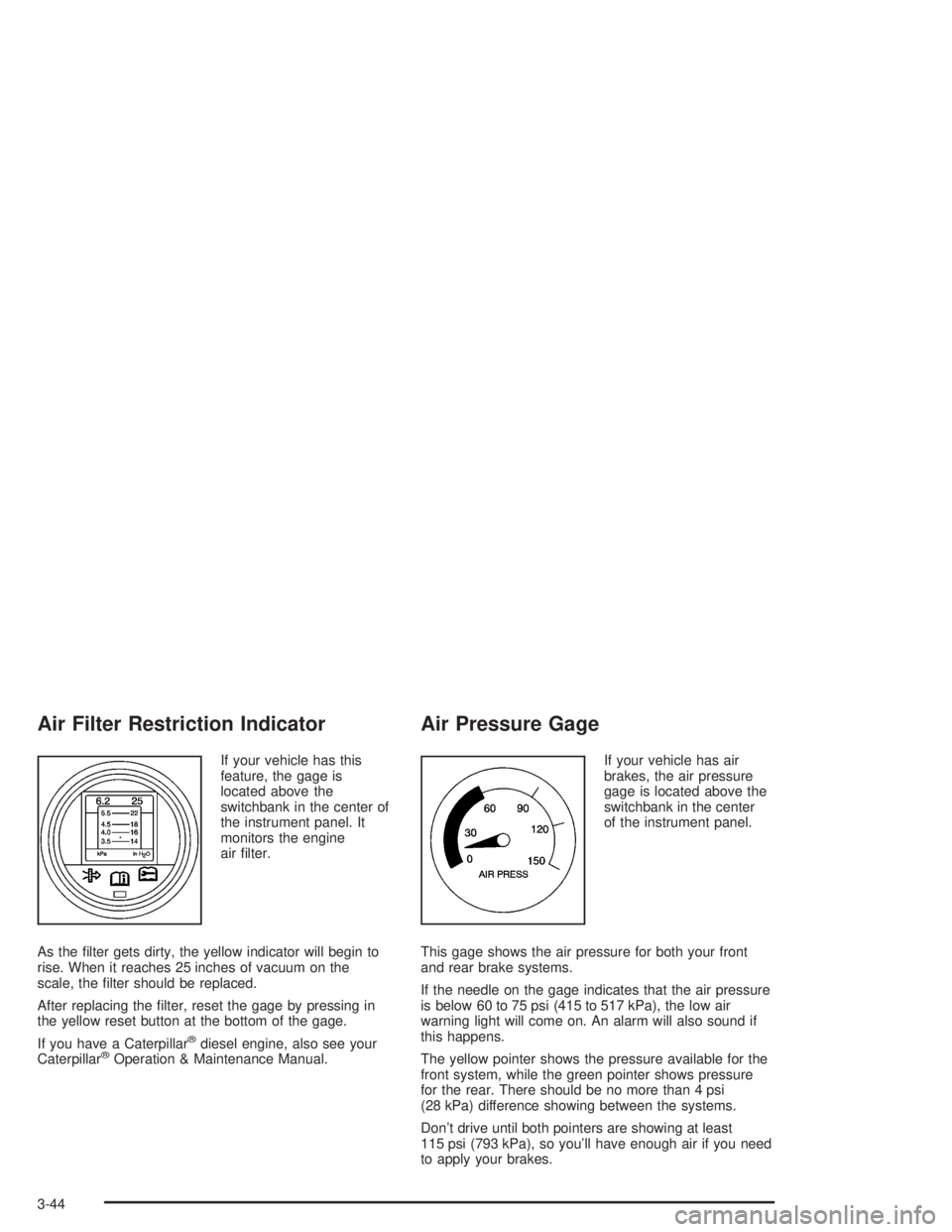
Air Filter Restriction Indicator
If your vehicle has this
feature, the gage is
located above the
switchbank in the center of
the instrument panel. It
monitors the engine
air filter.
As the filter gets dirty, the yellow indicator will begin to
rise. When it reaches 25 inches of vacuum on the
scale, the filter should be replaced.
After replacing the filter, reset the gage by pressing in
the yellow reset button at the bottom of the gage.
If you have a Caterpillar
®diesel engine, also see your
Caterpillar®Operation & Maintenance Manual.
Air Pressure Gage
If your vehicle has air
brakes, the air pressure
gage is located above the
switchbank in the center
of the instrument panel.
This gage shows the air pressure for both your front
and rear brake systems.
If the needle on the gage indicates that the air pressure
is below 60 to 75 psi (415 to 517 kPa), the low air
warning light will come on. An alarm will also sound if
this happens.
The yellow pointer shows the pressure available for the
front system, while the green pointer shows pressure
for the rear. There should be no more than 4 psi
(28 kPa) difference showing between the systems.
Don’t drive until both pointers are showing at least
115 psi (793 kPa), so you’ll have enough air if you need
to apply your brakes.
3-44
Page 201 of 366
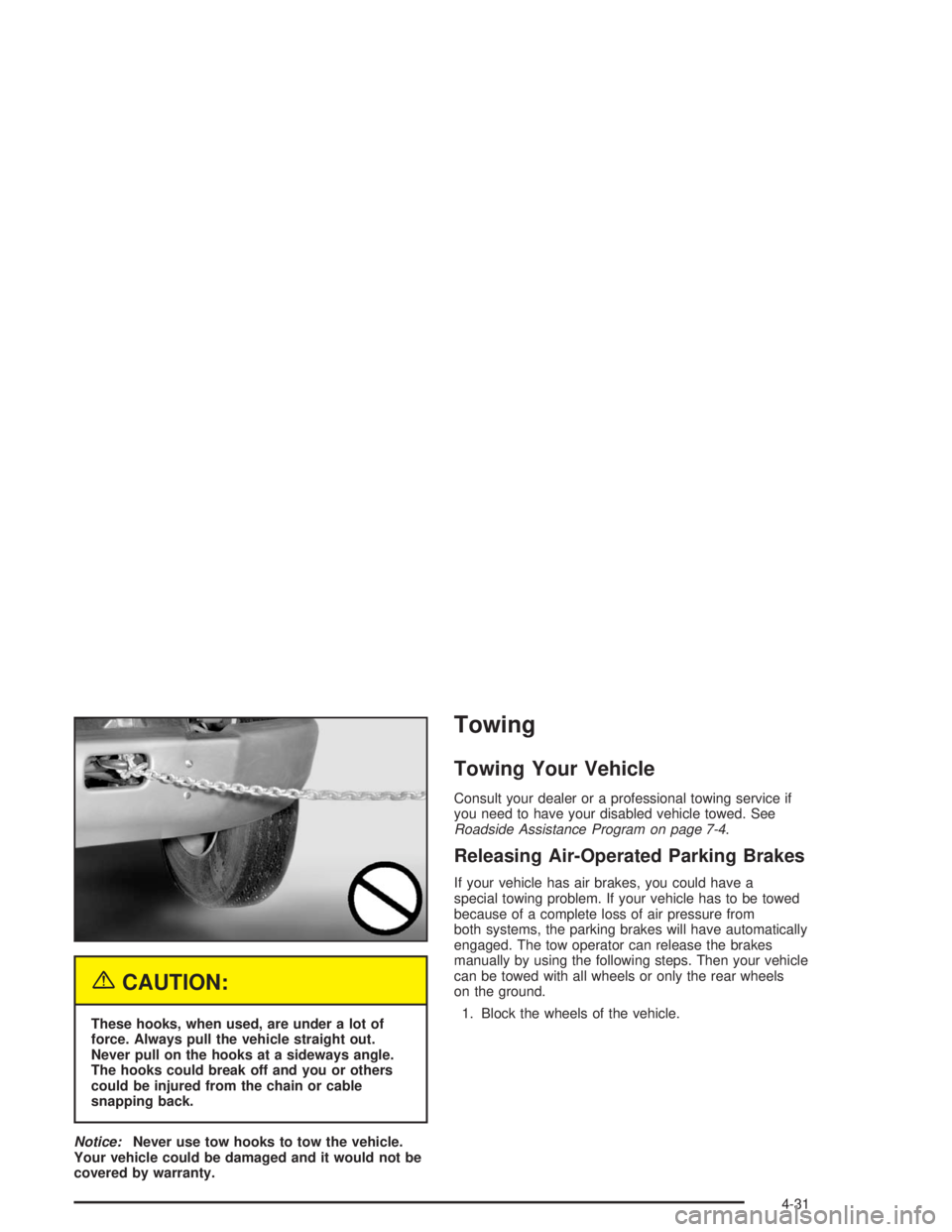
{CAUTION:
These hooks, when used, are under a lot of
force. Always pull the vehicle straight out.
Never pull on the hooks at a sideways angle.
The hooks could break off and you or others
could be injured from the chain or cable
snapping back.
Notice:Never use tow hooks to tow the vehicle.
Your vehicle could be damaged and it would not be
covered by warranty.
Towing
Towing Your Vehicle
Consult your dealer or a professional towing service if
you need to have your disabled vehicle towed. See
Roadside Assistance Program on page 7-4.
Releasing Air-Operated Parking Brakes
If your vehicle has air brakes, you could have a
special towing problem. If your vehicle has to be towed
because of a complete loss of air pressure from
both systems, the parking brakes will have automatically
engaged. The tow operator can release the brakes
manually by using the following steps. Then your vehicle
can be towed with all wheels or only the rear wheels
on the ground.
1. Block the wheels of the vehicle.
4-31
Page 207 of 366
Service............................................................5-3
Doing Your Own Service Work.........................5-4
Two Safety Cautions about Engine Fan
Breakage...................................................5-5
Fuel................................................................5-6
Gasoline Octane............................................5-6
Gasoline Specifications....................................5-6
Additives.......................................................5-7
Diesel Engine Fuel.........................................5-8
What Fuel to Use...........................................5-8
Very Cold Weather Operation.........................5-10
Water in Fuel...............................................5-10
Running Out of Fuel.....................................5-15
Fuel Filter Replacement.................................5-15
Fuels in Foreign Countries.............................5-16
Filling Your Tank..........................................5-17
Filling a Portable Fuel Container.....................5-18
Checking Things Under the Hood....................5-18
Hood Latches...............................................5-19
Engine Oil (Caterpillar
®Diesel Engine).............5-20
Engine Oil (Gasoline Engine)..........................5-20
Engine Oil (DURAMAX™ Diesel).....................5-25
Engine Air Cleaner/Filter................................5-30
Automatic Transmission Fluid.........................5-31
Manual Transmission Fluid.............................5-32Engine Coolant (Gas and
DURAMAX™ engines)................................5-32
Engine Coolant (Caterpillar
®Diesel Engines).....5-35
Coolant Surge Tank Pressure Cap..................5-35
Engine Overheating.......................................5-36
Cooling System............................................5-38
Engine Fan Noise.........................................5-43
Power Steering Fluid.....................................5-43
Windshield Washer Fluid................................5-44
Brakes........................................................5-46
Battery........................................................5-55
Jump Starting...............................................5-56
Rear Axle.......................................................5-61
Rear Axle Shift Motor....................................5-61
Noise Control System.....................................5-62
Tampering with Noise Control System
Prohibited.................................................5-62
Bulb Replacement..........................................5-63
Replacement Bulbs.......................................5-63
Windshield Wiper Blade Replacement..............5-63
Other Service Items........................................5-64
Fuel Filter....................................................5-64
Primary Fuel Filter and Water Separator..........5-65
Secondary Fuel Filter and Water
Separator/Heater.......................................5-66
Section 5 Service and Appearance Care
5-1
Page 255 of 366
Four-Wheel Disc Brakes
(Hydraulic Only)
Your vehicle has four-wheel disc brakes.
Some driving conditions or climates may cause a brake
squeal when the brakes are first applied or lightly
applied. This does not mean something is wrong with
your brakes.
Brake linings should always be replaced as complete
axle sets.
Four-Wheel and Six-Wheel Drum
Brakes (Air Only)
The brake drums should be removed and inspected
each time the tires are removed for rotation or changing.
When you have the front brakes replaced, have the
rear brakes inspected, too.
Brake linings should always be replaced as complete
axle sets.
Brake Pedal Travel
See your dealer if the brake pedal does not return to
normal height, or if there is a rapid increase in
pedal travel. This could be a sign of brake trouble.
Brake Adjustment
Every time you make a brake stop, your brakes adjust
for wear.
Replacing Brake System Parts
The braking system on a vehicle is complex. Its many
parts have to be of top quality and work well together if
the vehicle is to have really good braking. Your
vehicle was designed and tested with top-quality GM
brake parts. When you replace parts of your braking
system — for example, when your brake linings
wear down and you need new ones put in — be sure
you get new approved GM replacement parts. If you do
not, your brakes may no longer work properly. For
example, if someone puts in brake linings that are wrong
for your vehicle, the balance between your front and
rear brakes can change — for the worse. The braking
performance you have come to expect can change
in many other ways if someone puts in the wrong
replacement brake parts.
5-49
Page 260 of 366
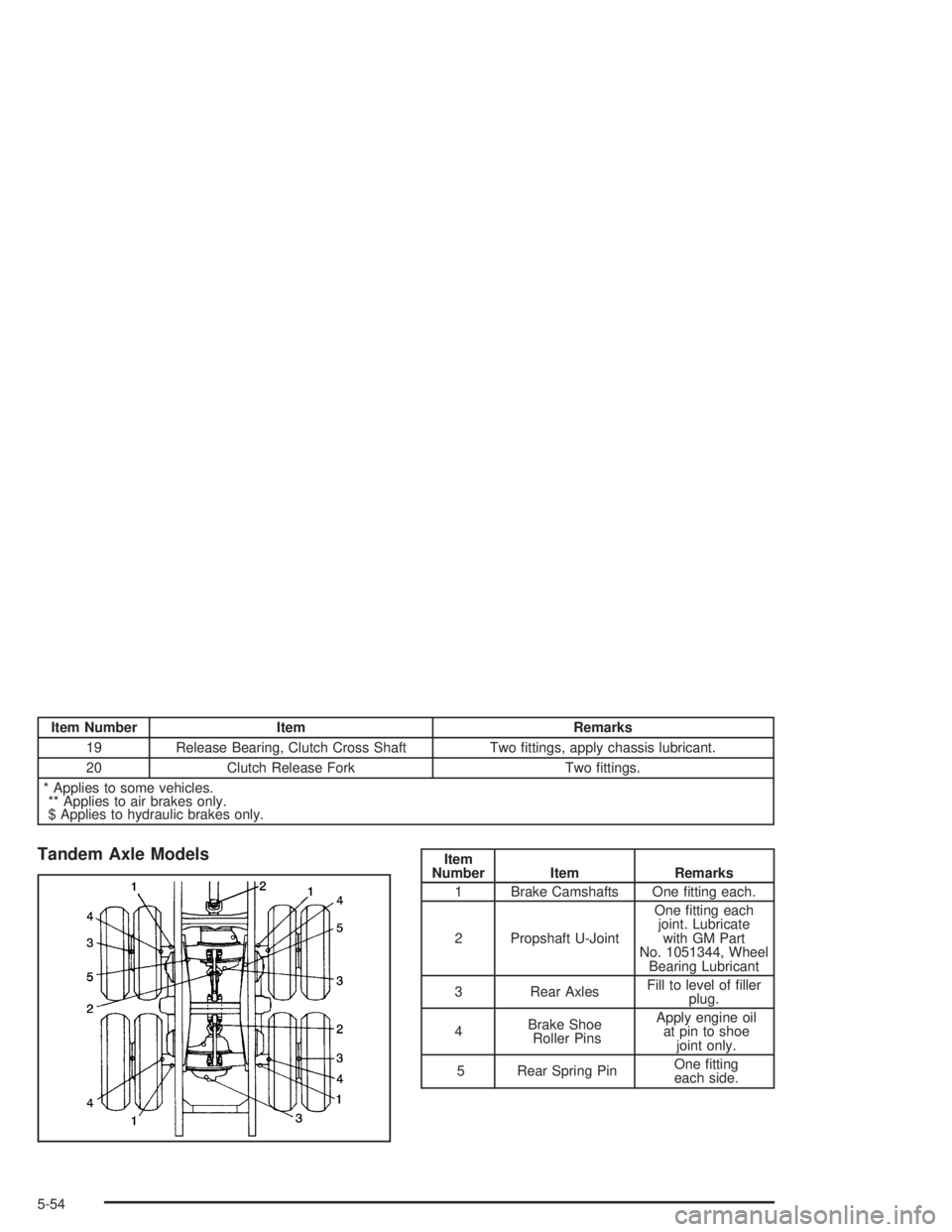
Item Number Item Remarks
19 Release Bearing, Clutch Cross Shaft Two fittings, apply chassis lubricant.
20 Clutch Release Fork Two fittings.
* Applies to some vehicles.
** Applies to air brakes only.
$ Applies to hydraulic brakes only.
Tandem Axle ModelsItem
Number Item Remarks
1 Brake Camshafts One fitting each.
2 Propshaft U-JointOne fitting each
joint. Lubricate
with GM Part
No. 1051344, Wheel
Bearing Lubricant
3 Rear AxlesFill to level of filler
plug.
4Brake Shoe
Roller PinsApply engine oil
at pin to shoe
joint only.
5 Rear Spring PinOne fitting
each side.
5-54
Page 333 of 366
(39)= Air brake service:
•Inspect brake lines and hoses for proper hook-up,
binding, leaks, cracks, chafing, etc. Inspect drum
brake linings for wear or cracks. Inspect other brake
parts at each wheel, including drums and wheel
speed sensor wiring. Check brake pedal for
excessive free play or travel (or every 6 months,
whichever occurs first) and have serviced if needed.
Check brakes more often if driving habits and
conditions result in frequent braking. Replace air
dryer cartridge only if excessive oil or moisture
is present. A small amount of oil in the system is
normal and should not be considered as a reason to
replace the cartridge.
•Test air lines for leaks; tighten as needed. Replace
compressor filter.
•Inspect air parking brake chamber for leaks and
damage. Inspect lines and hoses for leaks,
cracks, chafing, etc. Also check all attachments for
tightness, wear or damage. Note: The spring
brake section of the rear brake diaphragms are
non-serviceable.
•Replace the air compressor filter element, mounted
on the air compressor. For remote air compressor
intake service, refer to engine air cleaner filter
replacement.
•Remove, disassemble, clean and inspect the safety
valve, standard brake chambers, quick release
valves, quick release/double check valve
combinations, parking brake control valve, double
check valves, pressure protection valves and
alcohol injector (if equipped).
•Remove, disassemble and clean the application
valve; replace parts showing wear.
•Remove, disassemble, clean and inspect the spring
brake control valve; replace rubber parts.
(40)= Clean and lubricate air brake automatic slack
adjuster. Check pushrod travel and auto adjustment
operation. Have serviced if needed.
(41)= Air brake chamber service: Check operation,
mounting, clamps and air lines and check for leaks.
(42)= Trailer brake hand control valve service: Check
operation; lubricate cam and follower.
(46)= Tighten the wheel stud nuts to the specified
torque values at 100 miles (160 km). Thereafter, tighten
them 1,000 miles (1 600 km) after each time the
wheel is removed. SeeTightening the Wheel Nuts on
page 5-71.
6-23
Page 352 of 366
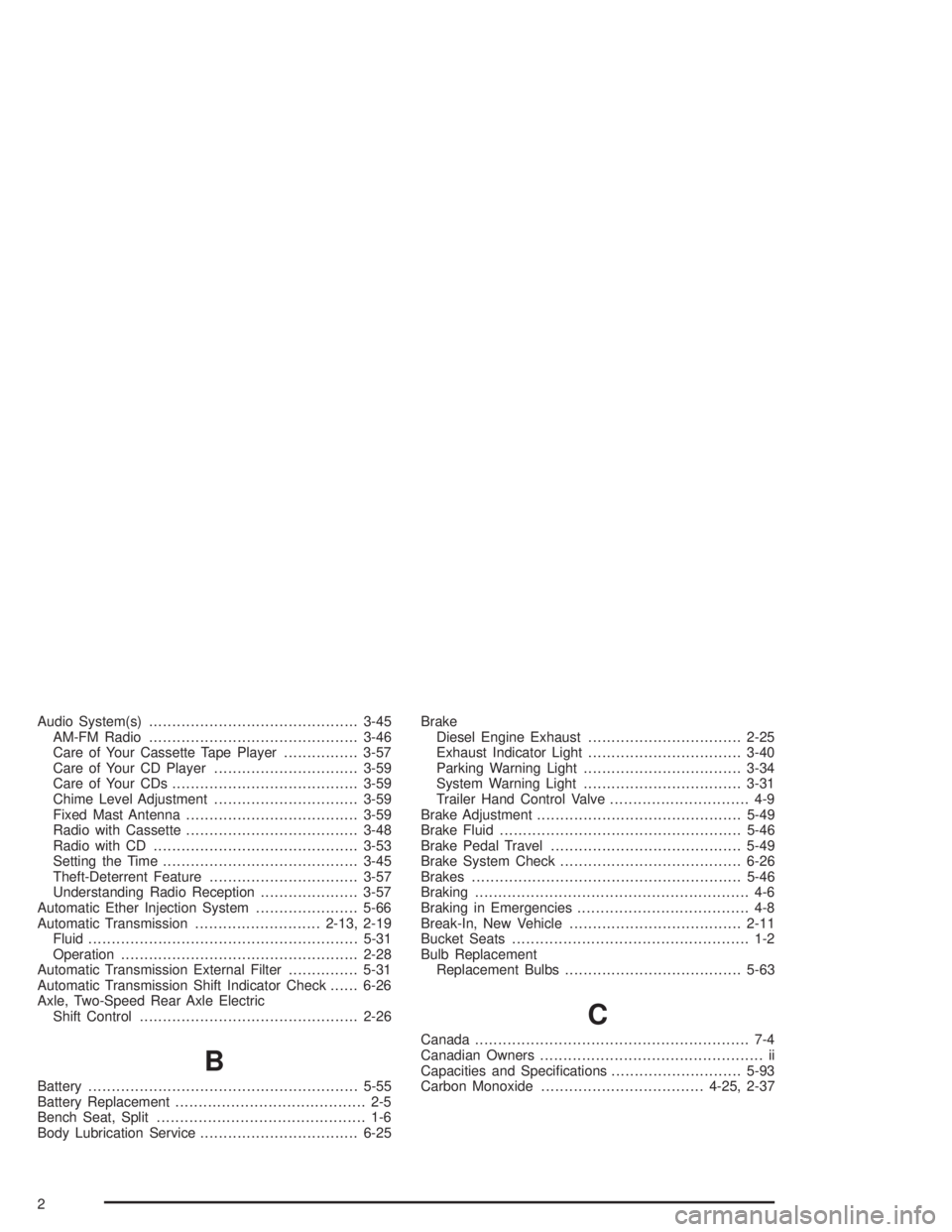
Audio System(s).............................................3-45
AM-FM Radio.............................................3-46
Care of Your Cassette Tape Player................3-57
Care of Your CD Player...............................3-59
Care of Your CDs........................................3-59
Chime Level Adjustment...............................3-59
Fixed Mast Antenna.....................................3-59
Radio with Cassette.....................................3-48
Radio with CD............................................3-53
Setting the Time..........................................3-45
Theft-Deterrent Feature................................3-57
Understanding Radio Reception.....................3-57
Automatic Ether Injection System......................5-66
Automatic Transmission...........................2-13, 2-19
Fluid..........................................................5-31
Operation...................................................2-28
Automatic Transmission External Filter...............5-31
Automatic Transmission Shift Indicator Check......6-26
Axle, Two-Speed Rear Axle Electric
Shift Control...............................................2-26
B
Battery..........................................................5-55
Battery Replacement......................................... 2-5
Bench Seat, Split............................................. 1-6
Body Lubrication Service..................................6-25Brake
Diesel Engine Exhaust.................................2-25
Exhaust Indicator Light.................................3-40
Parking Warning Light..................................3-34
System Warning Light..................................3-31
Trailer Hand Control Valve.............................. 4-9
Brake Adjustment............................................5-49
Brake Fluid....................................................5-46
Brake Pedal Travel.........................................5-49
Brake System Check.......................................6-26
Brakes..........................................................5-46
Braking........................................................... 4-6
Braking in Emergencies..................................... 4-8
Break-In, New Vehicle.....................................2-11
Bucket Seats................................................... 1-2
Bulb Replacement
Replacement Bulbs......................................5-63
C
Canada........................................................... 7-4
Canadian Owners................................................ ii
Capacities and Specifications............................5-93
Carbon Monoxide...................................4-25, 2-37
2
Page 356 of 366
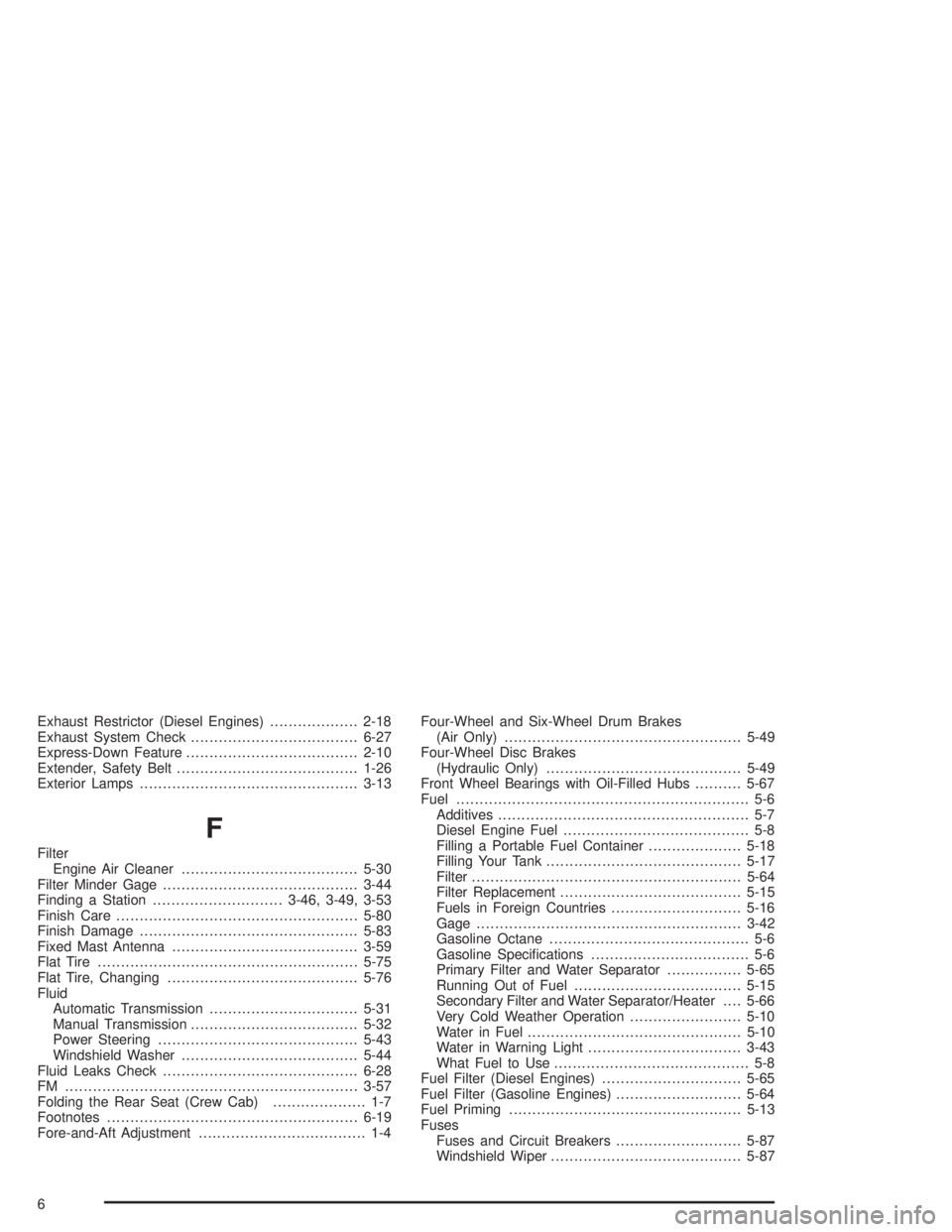
Exhaust Restrictor (Diesel Engines)...................2-18
Exhaust System Check....................................6-27
Express-Down Feature.....................................2-10
Extender, Safety Belt.......................................1-26
Exterior Lamps...............................................3-13
F
Filter
Engine Air Cleaner......................................5-30
Filter Minder Gage..........................................3-44
Finding a Station............................3-46, 3-49, 3-53
Finish Care....................................................5-80
Finish Damage...............................................5-83
Fixed Mast Antenna........................................3-59
Flat Tire........................................................5-75
Flat Tire, Changing.........................................5-76
Fluid
Automatic Transmission................................5-31
Manual Transmission....................................5-32
Power Steering...........................................5-43
Windshield Washer......................................5-44
Fluid Leaks Check..........................................6-28
FM ...............................................................3-57
Folding the Rear Seat (Crew Cab).................... 1-7
Footnotes......................................................6-19
Fore-and-Aft Adjustment.................................... 1-4Four-Wheel and Six-Wheel Drum Brakes
(Air Only)...................................................5-49
Four-Wheel Disc Brakes
(Hydraulic Only)..........................................5-49
Front Wheel Bearings with Oil-Filled Hubs..........5-67
Fuel............................................................... 5-6
Additives...................................................... 5-7
Diesel Engine Fuel........................................ 5-8
Filling a Portable Fuel Container....................5-18
Filling Your Tank..........................................5-17
Filter..........................................................5-64
Filter Replacement.......................................5-15
Fuels in Foreign Countries............................5-16
Gage.........................................................3-42
Gasoline Octane........................................... 5-6
Gasoline Specifications.................................. 5-6
Primary Filter and Water Separator................5-65
Running Out of Fuel....................................5-15
Secondary Filter and Water Separator/Heater....5-66
Very Cold Weather Operation........................5-10
Water in Fuel..............................................5-10
Water in Warning Light.................................3-43
What Fuel to Use.......................................... 5-8
Fuel Filter (Diesel Engines)..............................5-65
Fuel Filter (Gasoline Engines)...........................5-64
Fuel Priming..................................................5-13
Fuses
Fuses and Circuit Breakers...........................5-87
Windshield Wiper.........................................5-87
6