airbag CHEVROLET KODIAK 2006 User Guide
[x] Cancel search | Manufacturer: CHEVROLET, Model Year: 2006, Model line: KODIAK, Model: CHEVROLET KODIAK 2006Pages: 398, PDF Size: 5.72 MB
Page 54 of 398
You will be using the lap-shoulder belt. Be sure to follow
the instructions that came with the child restraint.
Secure the child in the child restraint when and as the
instructions say.
1. If your vehicle has a right front passenger’s airbag
seeAirbag Off Switch on page 1-58. If your vehicle
has a right front passenger’s airbag and your
child restraint is forward-facing, always move the
seat as far back as it will go before securing it in this
seat. SeeBucket Seats on page 1-2. Never use a
rear-facing child restraint in this seat unless the
airbag is off.
2. Put the child restraint on the seat.
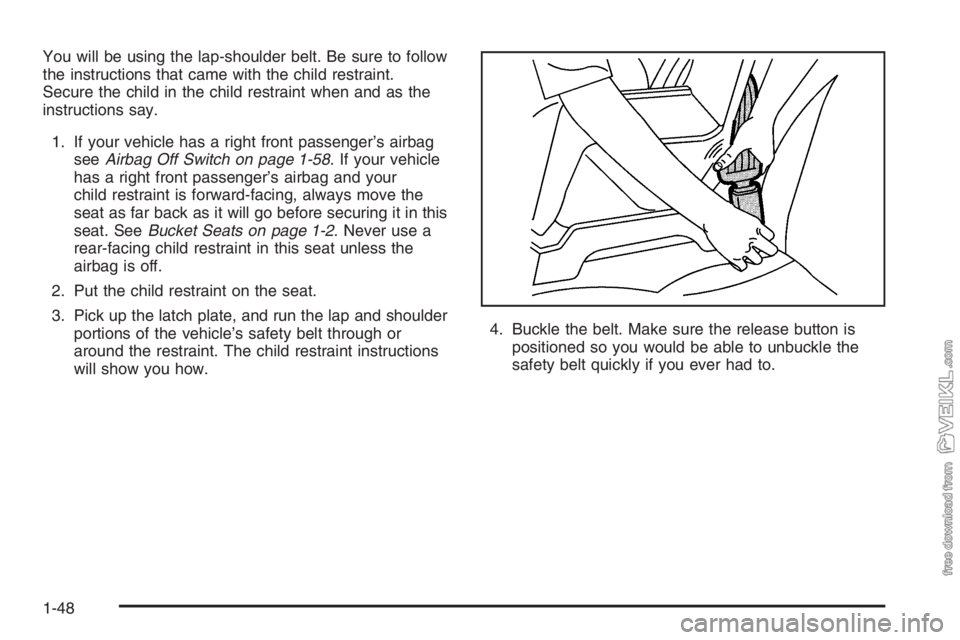
3. Pick up the latch plate, and run the lap and shoulder
portions of the vehicle’s safety belt through or
around the restraint. The child restraint instructions
will show you how.4. Buckle the belt. Make sure the release button is
positioned so you would be able to unbuckle the
safety belt quickly if you ever had to.
1-48
Page 56 of 398

If you were using a child restraint in a vehicle equipped
with a right front passenger’s airbag, turn on the
right front passenger’s airbag when you remove the
child restraint from the vehicle unless the person who
will be sitting there is a member of a passenger
airbag risk group. SeeAirbag Off Switch on page 1-58.
{CAUTION:
If the right front passenger’s airbag is turned
off for a person who is not in a risk group
identied by the national government, that
person will not have the extra protection of an
airbag. In a crash, the airbag will not be able to
inate and help protect the person sitting
there. Do not turn off the passenger’s airbag
unless the person sitting there is in a risk
group. SeeAirbag Off Switch on page 1-58for
more on this, including important safety
information.
Airbag System
1-50
Page 57 of 398

If it says AIR BAG on the middle part of the steering
wheel and AIR BAG on the instrument panel in front of
the right front passenger’s seat, your vehicle has an
airbag for the driver and an airbag for the right
front passenger.If it says AIR BAG on the middle part of the steering
wheel, but it does not say AIR BAG on the instrument
panel in front of the right front passenger’s seat,
your vehicle has an airbag for the driver only.
If it says AIR BAG on the middle part of the steering
wheel, but there is no right front passenger seat,
your vehicle has an airbag for the driver only.
If it does not say AIR BAG on the middle part of the
steering wheel, your vehicle does not have airbags.
1-51
Page 58 of 398
Frontal airbags are designed to help reduce the risk of
injury from the force of an inflating airbag. But these
airbags must inflate very quickly to do their job
and comply with federal regulations.
Here are the most important things to know about the
airbag system:
{CAUTION:
You can be severely injured or killed in a crash
if you are not wearing your safety belt — even
if you have airbags. Wearing your safety belt
during a crash helps reduce your chance of
hitting things inside the vehicle or being
ejected from it. Airbags are “supplemental
restraints” to the safety belts. Airbags are
designed to work with safety belts, but do not
replace them. Airbags are designed to deploy
in moderate to severe frontal and near frontal
crashes. They are not designed to inate in
rollover, rear crashes, or in many side crashes.
CAUTION: (Continued)
CAUTION: (Continued)
And, for some unrestrained occupants, airbags
may provide less protection in frontal crashes
than more forceful airbags have provided in
the past. Everyone in your vehicle should wear
a safety belt properly — whether or not there
is an airbag for that person.
{CAUTION:
Airbags inate with great force, faster than the
blink of an eye. If you are too close to an
inating airbag, as you would be if you were
leaning forward, it could seriously injure you.
Safety belts help keep you in position before
and during a crash. Always wear your safety
belt, even with airbags. The driver should sit
as far back as possible while still maintaining
control of the vehicle.
1-52
Page 59 of 398
If your vehicle has an airbag for the right front
passenger, please read this:
{CAUTION:
Anyone who is up against, or very close to,
any airbag when it inates can be seriously
injured or killed. Airbags plus lap-shoulder
belts offer the best protection for adults, but
not for young children and infants. Neither the
vehicle’s safety belt system nor its airbag
system is designed for them. Young children
and infants need the protection that a child
restraint system can provide. Always secure
children properly in your vehicle. To read how,
seeOlder Children on page 1-28andInfants
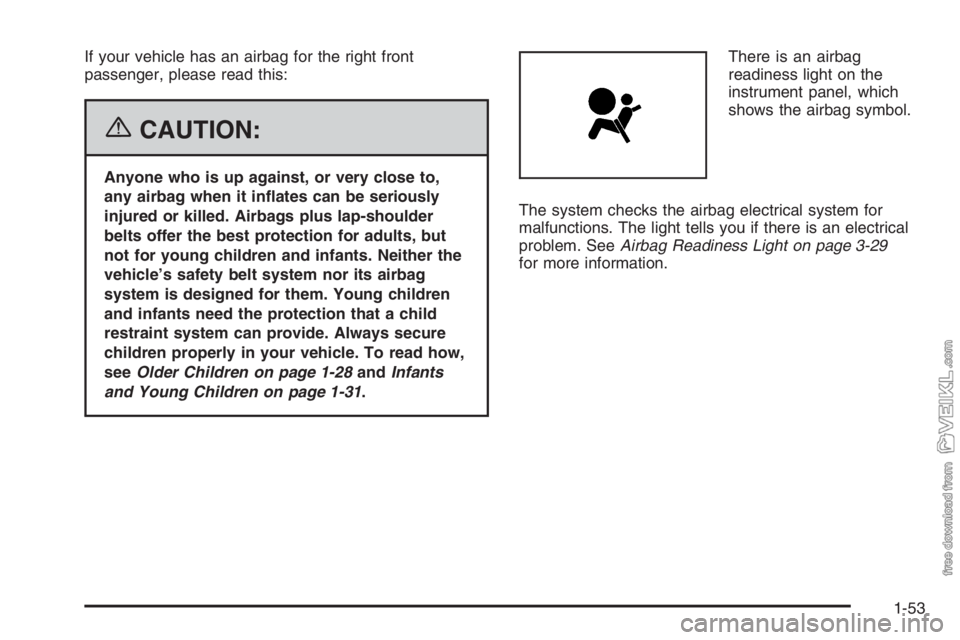
and Young Children on page 1-31.There is an airbag
readiness light on the
instrument panel, which
shows the airbag symbol.
The system checks the airbag electrical system for
malfunctions. The light tells you if there is an electrical
problem. SeeAirbag Readiness Light on page 3-29
for more information.
1-53
Page 60 of 398

Where Are the Airbags?
The driver’s airbag is in the middle of the steering
wheel.The right front passenger’s airbag is in the instrument
panel on the passenger’s side.
1-54
Page 61 of 398

{CAUTION:
If something is between an occupant and an
airbag, the bag might not inate properly or it
might force the object into that person causing
severe injury or even death. The path of an
inating airbag must be kept clear. Do not put
anything between an occupant and an airbag,
and do not attach or put anything on the
steering wheel hub or on or near any other
airbag covering.
When Should an Airbag Inate?
Airbags are designed to inflate in moderate to severe
frontal or near-frontal crashes. But they are designed to
inflate only if the impact exceeds a predetermined
deployment threshold. Deployment thresholds take into
account a variety of desired deployment and
non-deployment events and are used to predict how
severe a crash is likely to be in time for the airbags to
inflate and help restrain the occupants.Whether your frontal airbags will or should deploy is not
based on how fast your vehicle is traveling. It depends
largely on what you hit, the direction of the impact
and how quickly your vehicle slows down. (The
threshold level can vary, however, with specific vehicle
design, so that it can be somewhat above or below
this range.)
Frontal airbags may inflate at different crash speeds.
For example:
•If the vehicle hits a stationary object, the airbags
could inflate at a different crash speed than if the
vehicle hits a moving object.
•If the vehicle hits an object that deforms, the
airbags could inflate at a different crash speed than
if the vehicle hits an object that does not deform.
•If the vehicle hits a narrow object (like a pole) the
airbags could inflate at a different crash speed
than if the vehicle hits a wide object (like a wall).
•If the vehicle goes into an object at an angle the
airbags could inflate at a different crash speed
than if the vehicle goes straight into the object.
1-55
Page 62 of 398
The frontal airbags are not intended to inflate during
vehicle rollovers, rear impacts, or in many side impacts.
In any particular crash, no one can say whether an
airbag should have inflated simply because of the
damage to a vehicle or because of what the repair costs
were. Inflation is determined by what the vehicle hits,
the angle of the impact, and how quickly the vehicle
slows down.
What Makes an Airbag Inate?
In an impact of sufficient severity, the airbag sensing
system detects that the vehicle is in a crash. The
sensing system triggers a release of gas from the
inflator, which inflates the airbag. The inflator, airbag,
and related hardware are all part of the airbag modules
inside the steering wheel and in the instrument panel
in front of the right front passenger.
How Does an Airbag Restrain?
In moderate to severe frontal or near-frontal collisions,
even belted occupants can contact the steering wheel or
the instrument panel. Airbags supplement the protection
provided by safety belts. Airbags distribute the force
of the impact more evenly over the occupant’s upper
body, stopping the occupant more gradually. But airbags
would not help you in many types of collisions, including
rollovers, rear impacts and many side impacts, primarily
because an occupant’s motion is not toward those
airbags. Airbags should never be regarded as anything
more than a supplement to safety belts, and then only in
moderate to severe frontal or near-frontal collisions.
What Will You See After an Airbag
Inates?
After an airbag inflates, it quickly deflates, so quickly that
some people may not even realize the airbag inflated.
Some components of the airbag module — the steering
wheel hub for the driver’s airbag or the instrument panel
for the right front passenger’s bag — may be hot for a
short time.
1-56
Page 63 of 398
The parts of the airbag that come into contact with you
may be warm, but not too hot to touch. There will be
some smoke and dust coming from the vents in the
deflated airbags. Airbag inflation does not prevent the
driver from seeing out of the windshield or being able to
steer the vehicle, nor does it stop people from leaving the
vehicle.
{CAUTION:
When an airbag inates, there is dust in the
air. This dust could cause breathing problems
for people with a history of asthma or other
breathing trouble. To avoid this, everyone in
the vehicle should get out as soon as it is safe
to do so. If you have breathing problems but
cannot get out of the vehicle after an airbag
inates, then get fresh air by opening a
window or a door. If you experience breathing
problems following an airbag deployment, you
should seek medical attention.In many crashes severe enough to inflate an airbag,
windshields are broken by vehicle deformation.
Additional windshield breakage may also occur from the
right front passenger airbag.
•Airbags are designed to inflate only once. After they
inflate, you will need some new parts for your
airbag system. If you do not get them, the airbag
system will not be there to help protect you in
another crash. A new system will include airbag
modules and possibly other parts. The service
manual for your vehicle covers the need to replace
other parts.
•Your vehicle has a crash sensing and diagnostic
module which records information after a crash.
SeeVehicle Data Collection and Event Data
Recorders on page 7-6.
•Let only qualified technicians work on your airbag
system. Improper service can mean that an
airbag system will not work properly. See your
dealer for service.
1-57
Page 64 of 398

Airbag Off Switch
If your vehicle has a right front passenger airbag, it has
a switch on the instrument panel that you can use to
turn off the right front passenger’s airbag.
This switch should only be turned to the off position if
the person in the right front passenger’s position is
a member of a passenger risk group identified by the
national government as follows:
Infant.An infant (less than 1 year old) must
ride in the front seat because:
•
my vehicle has no rear seat;
•my vehicle has a rear seat too small to
accommodate a rear-facing infant seat; or
•the infant has a medical condition which, according
to the infant’s physician, makes it necessary for the
infant to ride in the front seat so that the driver
can constantly monitor the child’s condition.
Child age 1 to 12.A child age 1 to 12 must
ride in the front seat because:
•
my vehicle has no rear seat;
•although children ages 1 to 12 ride in the rear
seat(s) whenever possible, children ages 1 to 12
sometimes must ride in the front because no space
is available in the rear seat(s) of my vehicle; or
•the child has a medical condition which, according
to the child’s physician, makes it necessary for the
child to ride in the front seat so that the driver
can constantly monitor the child’s condition. United States
Canada
1-58