automatic transmission CHEVROLET KODIAK 2006 User Guide
[x] Cancel search | Manufacturer: CHEVROLET, Model Year: 2006, Model line: KODIAK, Model: CHEVROLET KODIAK 2006Pages: 398, PDF Size: 5.72 MB
Page 100 of 398
Automatic Transmission Operation
We build vehicles with Allison®five and six-speed
automatic transmissions. This part of the manual covers
the basics of these. With these transmissions, you
will find another Allison
®manual in your vehicle that
goes into more detail. On the headliner, in front of and
above the driver, or in some other place near the
driver, you will see a label that describes important
operating facts about the automatic transmission in
your vehicle. Make sure you follow the instructions on
this label.
Be sure to keep your parking brake set until you are
ready to shift into DRIVE (D), and press the brake pedal
while shifting from NEUTRAL (N) or PARK (P) to a
drive gear.
All vehicles equipped with automatic transmissions can
be started in PARK (P), if equipped, or in NEUTRAL (N).
See the Allison
®Transmission Operator’s Manual in
your vehicle for more information about this.
{CAUTION:
It can be dangerous to get out of your vehicle
without the parking brake rmly set. Your
vehicle can roll. If you have left the engine
running, the vehicle can move suddenly. You
or others could be injured. To be sure your
vehicle will not move, even when you are on
fairly level ground, always set the parking
brake.
{CAUTION:
Shifting into a drive gear while your engine is
running at high speed is dangerous. Unless
your foot is rmly on the brake pedal, your
vehicle could move very rapidly. You could
lose control and hit people or objects. Do not
shift into a drive gear while your engine is
running at high speed.
2-30
Page 102 of 398
Eaton®Fuller®Five and Six-Speed
Transmissions and TTC Spicer
Seven-Speed Transmissions
These transmissions have gears that automatically
synchronize when you shift up or down (except
FIRST (1) gear on the five-speed and seven-speed
transmission which is unsynchronized). Choose the gear
that will maintain the road speed you want while
keeping the engine above two-thirds of the governed
speed. When the engine speed drops below two-thirds
of the governed speed, shift into the next lower gear
before your engine begins to lug. When you shift down,
be sure to double-clutch if required.
ZF Six-Speed Transmission
Here is how to operate your transmission.
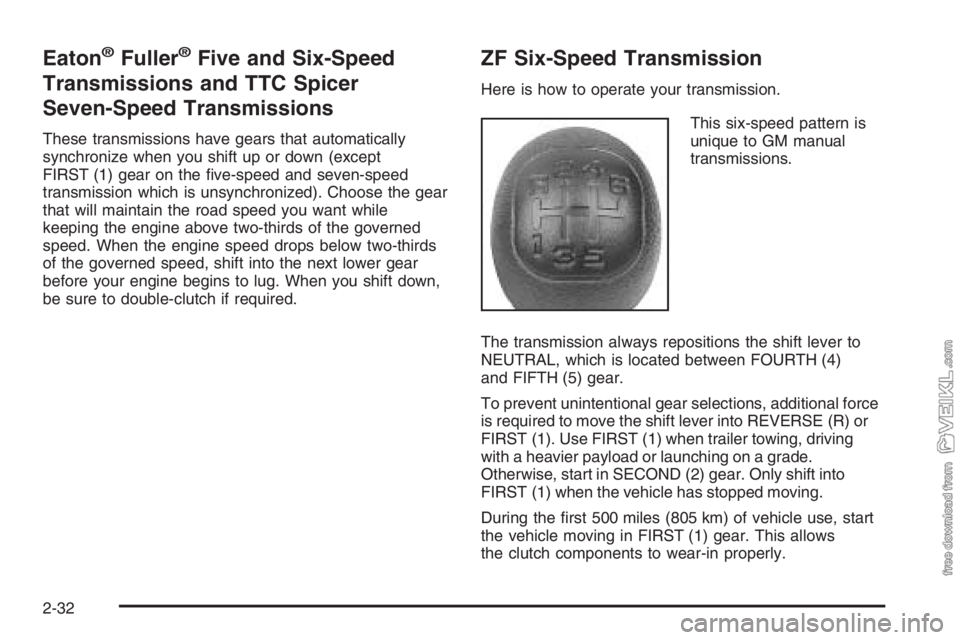
This six-speed pattern is
unique to GM manual
transmissions.
The transmission always repositions the shift lever to
NEUTRAL, which is located between FOURTH (4)
and FIFTH (5) gear.
To prevent unintentional gear selections, additional force
is required to move the shift lever into REVERSE (R) or
FIRST (1). Use FIRST (1) when trailer towing, driving
with a heavier payload or launching on a grade.
Otherwise, start in SECOND (2) gear. Only shift into
FIRST (1) when the vehicle has stopped moving.
During the first 500 miles (805 km) of vehicle use, start
the vehicle moving in FIRST (1) gear. This allows
the clutch components to wear-in properly.
2-32
Page 110 of 398
Parking
{CAUTION:
If you do not park your vehicle properly, it can
roll. If you have left the engine running, it can
move very quickly. You or others could be
injured. To be sure your vehicle will not move,
even when you are on level ground, follow the
steps below.
Two-Speed Rear Axle
1. With the engine running, shift the two-speed rear
axle into low. To be sure it is in low, you will need
to move the vehicle in gear just a little.
2. Hold the regular brake pedal down with your
right foot.
3. Apply the parking brake.
4. Shift the transmission to NEUTRAL for manual
transmission or PARK (P) for automatic
transmission.
Hydraulic Brakes
(Parking Brake Operation)
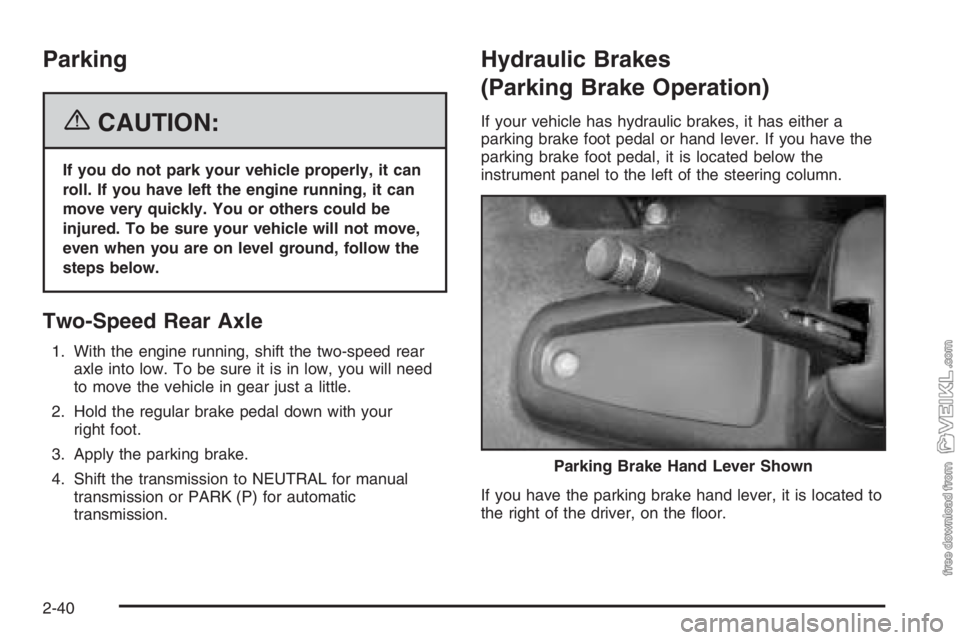
If your vehicle has hydraulic brakes, it has either a
parking brake foot pedal or hand lever. If you have the
parking brake foot pedal, it is located below the
instrument panel to the left of the steering column.
If you have the parking brake hand lever, it is located to
the right of the driver, on the floor.Parking Brake Hand Lever Shown
2-40
Page 116 of 398
Running the Engine While Parked
It is better not to park with the engine running. But if you
ever have to, here are some things to know.
{CAUTION:
Idling the engine with the climate control
system off could allow dangerous exhaust into
your vehicle. See the earlier caution under
Engine Exhaust on page 2-45.
Also, idling in a closed-in place can let deadly
carbon monoxide (CO) into your vehicle even if
the climate control fan is at the highest setting.
One place this can happen is a garage.
Exhaust — with CO — can come in easily.
NEVER park in a garage with the engine
running.
Another closed-in place can be a blizzard. See
Winter Driving on page 4-27.
{CAUTION:
It can be dangerous to get out of your vehicle
if the automatic transmission shift lever is not
fully in PARK (P) with the parking brake rmly
set. Your vehicle can roll. Do not leave your
vehicle when the engine is running unless you
have to. If you have left the engine running,
the vehicle can move suddenly. You or others
could be injured. To be sure your vehicle will
not move, even when it is on fairly level
ground, always set the parking brake and
move the automatic transmission shift lever to
PARK (P), or the manual transmission shift
lever to NEUTRAL.
Follow the proper steps to be sure your vehicle will
not move.
2-46
Page 124 of 398
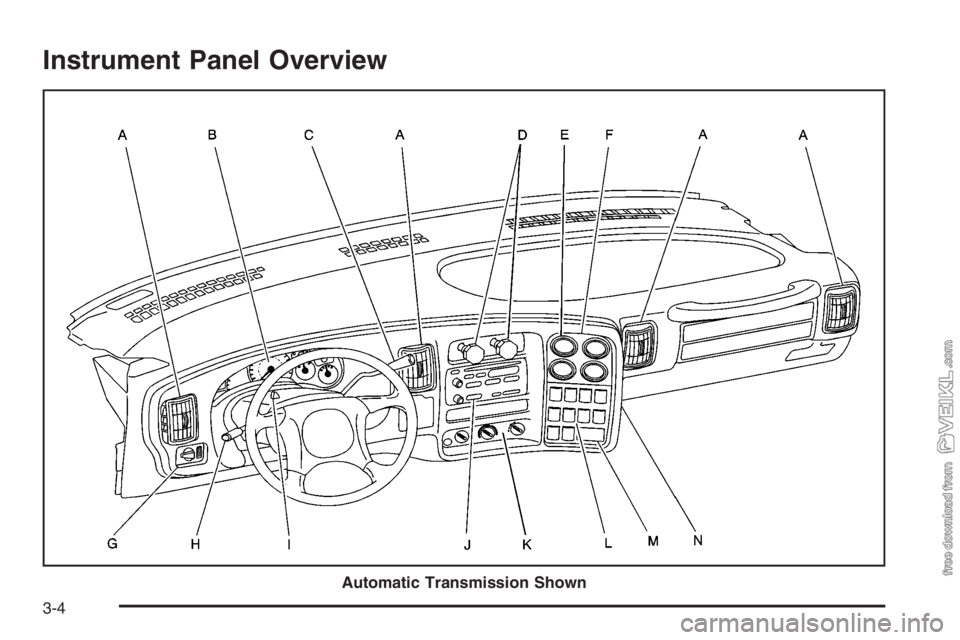
Instrument Panel Overview
Automatic Transmission Shown
3-4
Page 125 of 398
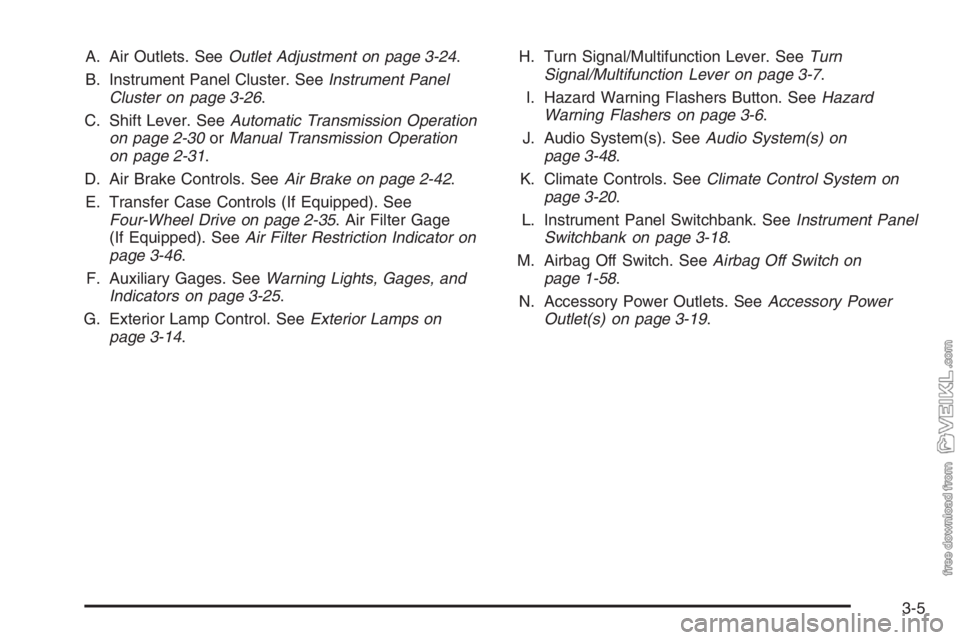
A. Air Outlets. SeeOutlet Adjustment on page 3-24.
B. Instrument Panel Cluster. SeeInstrument Panel
Cluster on page 3-26.
C. Shift Lever. SeeAutomatic Transmission Operation
on page 2-30orManual Transmission Operation
on page 2-31.
D. Air Brake Controls. SeeAir Brake on page 2-42.
E. Transfer Case Controls (If Equipped). See
Four-Wheel Drive on page 2-35. Air Filter Gage
(If Equipped). SeeAir Filter Restriction Indicator on
page 3-46.
F. Auxiliary Gages. SeeWarning Lights, Gages, and
Indicators on page 3-25.
G. Exterior Lamp Control. SeeExterior Lamps on
page 3-14.H. Turn Signal/Multifunction Lever. SeeTurn
Signal/Multifunction Lever on page 3-7.
I. Hazard Warning Flashers Button. SeeHazard
Warning Flashers on page 3-6.
J. Audio System(s). SeeAudio System(s) on
page 3-48.
K. Climate Controls. SeeClimate Control System on
page 3-20.
L. Instrument Panel Switchbank. SeeInstrument Panel
Switchbank on page 3-18.
M. Airbag Off Switch. SeeAirbag Off Switch on
page 1-58.
N. Accessory Power Outlets. SeeAccessory Power
Outlet(s) on page 3-19.
3-5
Page 131 of 398
With cruise control, you can maintain a speed of about
30 mph (48 km/h) or more without keeping your foot
on the accelerator. Cruise control does not work
at speeds below about 30 mph (48 km/h).
If you have an automatic transmission and you apply
your brakes, the cruise control will shut off.
If you have a manual transmission and you apply your
brakes or push the clutch pedal, the cruise control
will shut off.
{CAUTION:
Cruise control can be dangerous where you
cannot drive safely at a steady speed. So, do
not use your cruise control on winding roads
or in heavy traffic.
Cruise control can be dangerous on slippery
roads. On such roads, fast changes in tire
traction can cause excessive wheel slip, and
you could lose control. Do not use cruise
control on slippery roads.
Setting Cruise Control
{CAUTION:
If you leave your cruise control on when you
are not using cruise, you might hit a button
and go into cruise when you do not want to.
You could be startled and even lose control.
Keep the cruise control switch off until you
want to use cruise control.
1. Move the cruise control switch to on.
2. Get up to the speed you want.
3. Press in the set button at the end of the lever and
release it.
4. Take your foot off the accelerator pedal. The
accelerator pedal will not go down.
3-11
Page 133 of 398
Passing Another Vehicle While Using
Cruise Control
Use the accelerator pedal to increase your speed.
When you take your foot off the pedal, your vehicle will
slow down to the cruise control speed you set earlier.
Using Cruise Control on Hills
How well your cruise control will work on hills depends
upon your speed, load and the steepness of the
hills. When going up steep hills, you may want to step
on the accelerator pedal to maintain your speed.
When going downhill, you may have to brake or shift to
a lower gear to keep your speed down. Of course,
applying the brake or clutch takes you out of cruise
control. Many drivers find this to be too much trouble
and don’t use cruise control on steep hills.
If your vehicle is equipped with the exhaust brake option
and the exhaust brake is turned on, the exhaust
brake may come on and try to slow down the vehicle to
the set cruise control speed if the vehicle has
accelerated past the set cruise control speed while
going downhill.
Ending Cruise Control
There are four different ways to turn off the cruise
control:
•Step lightly on the brake pedal (manual and
automatic transmissions).
•Press the clutch pedal to the floor (manual
transmissions).
•Move the cruise switch to off, or
•Shift the transmission to NEUTRAL (N).
Erasing Speed Memory
When you turn off the ignition, your cruise control set
speed memory is erased.
3-13
Page 138 of 398
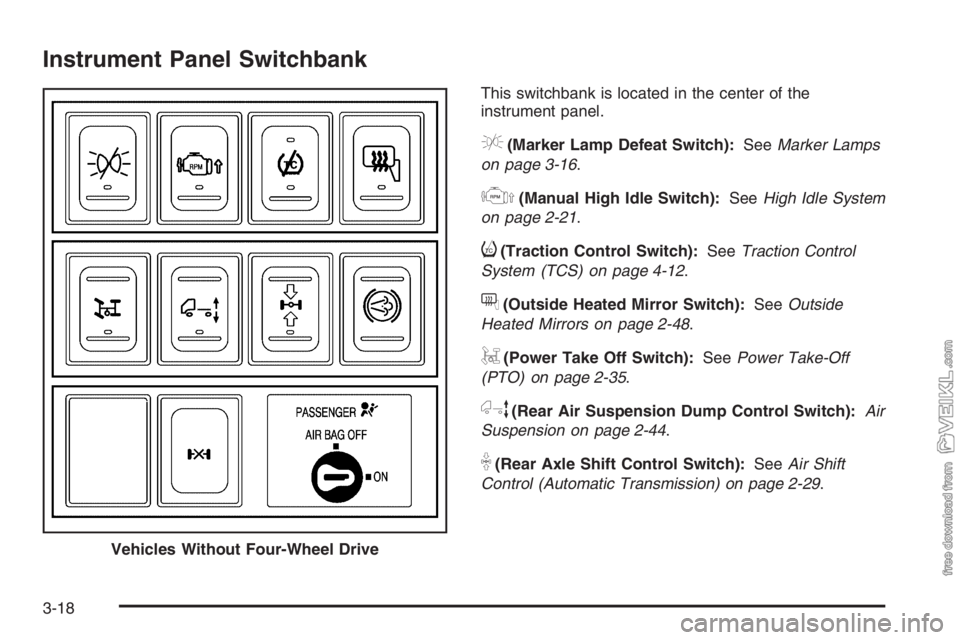
Instrument Panel Switchbank
This switchbank is located in the center of the
instrument panel.
e(Marker Lamp Defeat Switch):SeeMarker Lamps
on page 3-16.
j(Manual High Idle Switch):SeeHigh Idle System
on page 2-21.
i(Traction Control Switch):SeeTraction Control
System (TCS) on page 4-12.
f(Outside Heated Mirror Switch):SeeOutside
Heated Mirrors on page 2-48.
g(Power Take Off Switch):SeePower Take-Off
(PTO) on page 2-35.
h(Rear Air Suspension Dump Control Switch):Air
Suspension on page 2-44.
k(Rear Axle Shift Control Switch):SeeAir Shift
Control (Automatic Transmission) on page 2-29.
Vehicles Without Four-Wheel Drive
3-18
Page 152 of 398
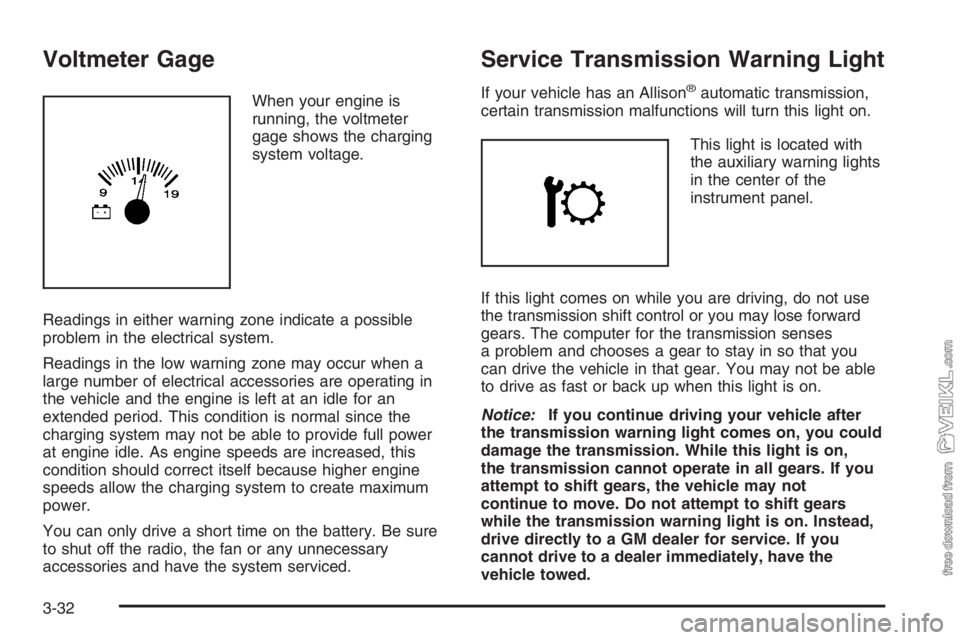
Voltmeter Gage
When your engine is
running, the voltmeter
gage shows the charging
system voltage.
Readings in either warning zone indicate a possible
problem in the electrical system.
Readings in the low warning zone may occur when a
large number of electrical accessories are operating in
the vehicle and the engine is left at an idle for an
extended period. This condition is normal since the
charging system may not be able to provide full power
at engine idle. As engine speeds are increased, this
condition should correct itself because higher engine
speeds allow the charging system to create maximum
power.
You can only drive a short time on the battery. Be sure
to shut off the radio, the fan or any unnecessary
accessories and have the system serviced.
Service Transmission Warning Light
If your vehicle has an Allison®automatic transmission,
certain transmission malfunctions will turn this light on.
This light is located with
the auxiliary warning lights
in the center of the
instrument panel.
If this light comes on while you are driving, do not use
the transmission shift control or you may lose forward
gears. The computer for the transmission senses
a problem and chooses a gear to stay in so that you
can drive the vehicle in that gear. You may not be able
to drive as fast or back up when this light is on.
Notice:If you continue driving your vehicle after
the transmission warning light comes on, you could
damage the transmission. While this light is on,
the transmission cannot operate in all gears. If you
attempt to shift gears, the vehicle may not
continue to move. Do not attempt to shift gears
while the transmission warning light is on. Instead,
drive directly to a GM dealer for service. If you
cannot drive to a dealer immediately, have the
vehicle towed.
3-32