clutch CHEVROLET KODIAK 2006 User Guide
[x] Cancel search | Manufacturer: CHEVROLET, Model Year: 2006, Model line: KODIAK, Model: CHEVROLET KODIAK 2006Pages: 398, PDF Size: 5.72 MB
Page 103 of 398
FIRST (1):With the vehicle at a stop, release the
brake, press the clutch pedal and shift into FIRST (1).
Then, slowly let up on the clutch pedal as you press the
accelerator pedal. Only downshift into FIRST (1)
when the vehicle has come to a complete stop. If the
shift lever will not go into FIRST (1), put the lever
in NEUTRAL and let up on the clutch pedal to fully
engage the clutch. Press the clutch pedal again. Then,
shift into FIRST (1).
SECOND (2):With the vehicle at a stop, release the
brake, press the clutch pedal and shift into SECOND (2).
Then, slowly let up on the clutch pedal as you press
the accelerator pedal. With the vehicle moving, press
the clutch pedal and upshift into SECOND (2) from
FIRST (1) while applying light pressure to the right on
the shifter. Then, slowly let up on the clutch pedal
as you press the accelerator pedal. If you come to a
complete stop and the shift lever will not go into
SECOND (2), put the lever in NEUTRAL and let up on
the clutch pedal to fully engage the clutch. Press
the clutch pedal again. Then, shift into SECOND (2).THIRD (3):Press the clutch pedal and upshift into
THIRD (3). Then, slowly let up on the clutch pedal as
you press the accelerator pedal.
FOURTH (4), FIFTH (5) and SIXTH (6):Upshift into
the higher forward gears the same way as you do
THIRD (3). Slowly let up on the clutch pedal as you
press the accelerator pedal.
NEUTRAL:Use this position when you start or idle
your engine.
REVERSE (R):To back up, press the clutch pedal.
Wait for the vehicle to stop moving and then, shift
to REVERSE (R). Let up on the clutch slowly while
pressing the accelerator pedal. Also, use REVERSE (R),
along with the parking brake, when turning off your
engine and parking your vehicle.
2-33
Page 104 of 398
Eaton®Fuller®Nine and Ten-Speed
Non-Synchronized Manual
Transmissions
If your vehicle has one of these transmissions the
engine rpm and road speed must match when upshifting
and downshifting. The label above the windshield will
tell you the operating basics you need to know.
The following are driving tips.
•Always choose an initial starting gear suitable for
the load and terrain.
•Always use double-clutching procedures when
shifting.
•Never move the range shift lever to the LO speed
gear position after HI range preselection, or
anytime the transmission is in the HI range.
•Never move the range knob or lever with the shift
lever in NEUTRAL while the vehicle is moving.
•Never make a range shift while moving in
REVERSE (R).
Clutch Brake (Vehicles with
Non-Synchronized Transmission)
A clutch brake is used to stop transmission input shaft
rotation so that FIRST (1) or REVERSE (R) gear
selection can be initiated when the vehicle is at a
standstill and the engine is idling.
Press the clutch pedal all the way down to the floorboard
to apply the clutch brake.
When using the clutch brake, disengage the clutch
pedal and shift the transmission into either the initial
starting gear or REVERSE (R). If the tooth-butting
occurs between the clutching teeth, re-engage the clutch
while applying light pressure to the shift lever. This
will provide for a smooth shift into either FIRST (1) or
REVERSE (R) gear.
Notice:Using the clutch brake for shifting into any
gear other than FIRST (1) or REVERSE (R) may
cause premature wear of the clutch brake and make
gear shift effort more difficult. Do not use the
clutch brake for shifting after engaging FIRST (1) or
REVERSE (R).
2-34
Page 131 of 398
With cruise control, you can maintain a speed of about
30 mph (48 km/h) or more without keeping your foot
on the accelerator. Cruise control does not work
at speeds below about 30 mph (48 km/h).
If you have an automatic transmission and you apply
your brakes, the cruise control will shut off.
If you have a manual transmission and you apply your
brakes or push the clutch pedal, the cruise control
will shut off.
{CAUTION:
Cruise control can be dangerous where you
cannot drive safely at a steady speed. So, do
not use your cruise control on winding roads
or in heavy traffic.
Cruise control can be dangerous on slippery
roads. On such roads, fast changes in tire
traction can cause excessive wheel slip, and
you could lose control. Do not use cruise
control on slippery roads.
Setting Cruise Control
{CAUTION:
If you leave your cruise control on when you
are not using cruise, you might hit a button
and go into cruise when you do not want to.
You could be startled and even lose control.
Keep the cruise control switch off until you
want to use cruise control.
1. Move the cruise control switch to on.
2. Get up to the speed you want.
3. Press in the set button at the end of the lever and
release it.
4. Take your foot off the accelerator pedal. The
accelerator pedal will not go down.
3-11
Page 133 of 398
Passing Another Vehicle While Using
Cruise Control
Use the accelerator pedal to increase your speed.
When you take your foot off the pedal, your vehicle will
slow down to the cruise control speed you set earlier.
Using Cruise Control on Hills
How well your cruise control will work on hills depends
upon your speed, load and the steepness of the
hills. When going up steep hills, you may want to step
on the accelerator pedal to maintain your speed.
When going downhill, you may have to brake or shift to
a lower gear to keep your speed down. Of course,
applying the brake or clutch takes you out of cruise
control. Many drivers find this to be too much trouble
and don’t use cruise control on steep hills.
If your vehicle is equipped with the exhaust brake option
and the exhaust brake is turned on, the exhaust
brake may come on and try to slow down the vehicle to
the set cruise control speed if the vehicle has
accelerated past the set cruise control speed while
going downhill.
Ending Cruise Control
There are four different ways to turn off the cruise
control:
•Step lightly on the brake pedal (manual and
automatic transmissions).
•Press the clutch pedal to the floor (manual
transmissions).
•Move the cruise switch to off, or
•Shift the transmission to NEUTRAL (N).
Erasing Speed Memory
When you turn off the ignition, your cruise control set
speed memory is erased.
3-13
Page 275 of 398
Engine Fan Noise
Your vehicle has a clutched engine cooling fan. When
the clutch is engaged, the fan spins faster to provide
more air to cool the engine. In most everyday driving
conditions, the clutch is not fully engaged. This improves
fuel economy and reduces fan noise. Under heavy
vehicle loading, trailer towing and/or high outside
temperatures, the fan speed increases when the clutch
engages. So you may hear an increase in fan noise.
This is normal and should not be mistaken as the
transmission slipping or making extra shifts. It is merely
the cooling system functioning properly. The fan will
slow down when additional cooling is not required and
the clutch disengages.
You may also hear this fan noise when you start the
engine. It will go away as the fan clutch disengages.
Power Steering Fluid
SeeScheduled Maintenance on page 6-5to determine
when to check your power steering fluid.
How To Check Power Steering Fluid
Check your power steering fluid only when the engine is
warm. If the engine is not warm, you probably will not
get an accurate reading.
If the fluid level is between the MIN (Minimum) and
MAX (Maximum) marks, you have enough. If you need
fluid, add only enough of the proper fluid to bring it
in between the MIN and MAX marks.
If your power steering fluid level is low, this can cause
the brake or service brakes soon warning lights to come
on. In addition, the steering effort and emergency
brake distance could increase.
If either light remains on after you have added power
steering fluid to the proper level, then shut off the engine
for 10 seconds. This should reset the brake warning
lights. If one or both lights stay on, see “Hydraulic Brake
System Warning Lights” underBrake System Warning
Light on page 3-33for more information.
What to Use
To determine what kind of fluid to use, seePart C:
Recommended Fluids and Lubricants on page 6-33.
Notice:When adding power steering uid or
making a complete uid change, always use the
proper uid. Failure to use the proper uid can
cause leaks and damage hoses and seals.
5-47
Page 281 of 398
Electric Air Compressor
Your vehicle may have an electric air compressor. This
compressor is used to run options that require
pressurized air, such as air horn, air seat, 7.8L engine
exhaust restrictor, or 7.8L engine exhaust brake.
The air compressor is used when vehicles are not
equipped with an air brake system.
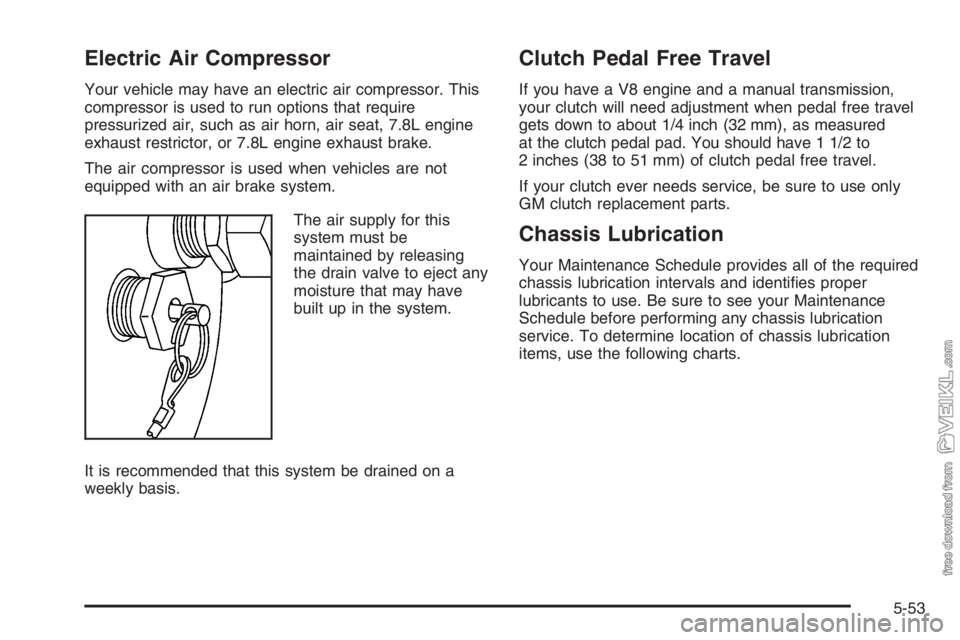
The air supply for this
system must be
maintained by releasing
the drain valve to eject any
moisture that may have
built up in the system.
It is recommended that this system be drained on a
weekly basis.
Clutch Pedal Free Travel
If you have a V8 engine and a manual transmission,
your clutch will need adjustment when pedal free travel
gets down to about 1/4 inch (32 mm), as measured
at the clutch pedal pad. You should have 1 1/2 to
2 inches (38 to 51 mm) of clutch pedal free travel.
If your clutch ever needs service, be sure to use only
GM clutch replacement parts.
Chassis Lubrication
Your Maintenance Schedule provides all of the required
chassis lubrication intervals and identifies proper
lubricants to use. Be sure to see your Maintenance
Schedule before performing any chassis lubrication
service. To determine location of chassis lubrication
items, use the following charts.
5-53
Page 283 of 398
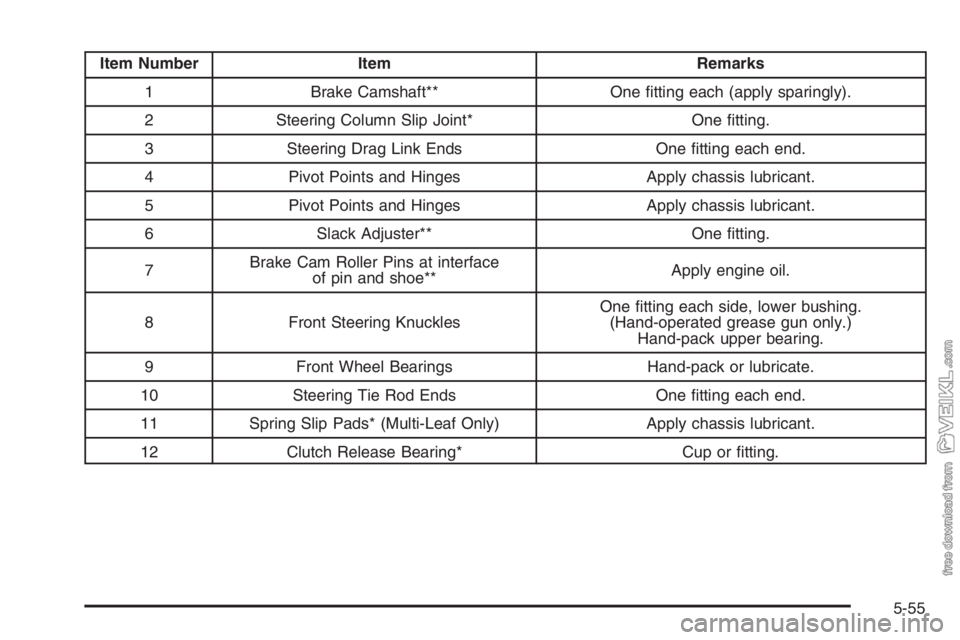
Item Number Item Remarks
1 Brake Camshaft** One fitting each (apply sparingly).
2 Steering Column Slip Joint* One fitting.
3 Steering Drag Link Ends One fitting each end.
4 Pivot Points and Hinges Apply chassis lubricant.
5 Pivot Points and Hinges Apply chassis lubricant.
6 Slack Adjuster** One fitting.
7Brake Cam Roller Pins at interface
of pin and shoe**Apply engine oil.
8 Front Steering KnucklesOne fitting each side, lower bushing.
(Hand-operated grease gun only.)
Hand-pack upper bearing.
9 Front Wheel Bearings Hand-pack or lubricate.
10 Steering Tie Rod Ends One fitting each end.
11 Spring Slip Pads* (Multi-Leaf Only) Apply chassis lubricant.
12 Clutch Release Bearing* Cup or fitting.
5-55
Page 284 of 398
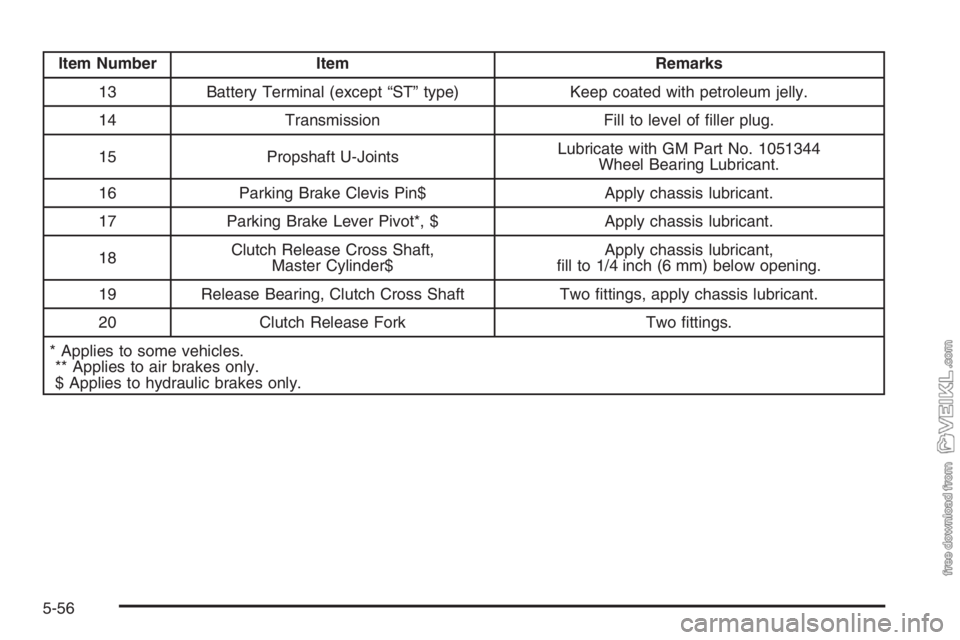
Item Number Item Remarks
13 Battery Terminal (except “ST” type) Keep coated with petroleum jelly.
14 Transmission Fill to level of filler plug.
15 Propshaft U-JointsLubricate with GM Part No. 1051344
Wheel Bearing Lubricant.
16 Parking Brake Clevis Pin$ Apply chassis lubricant.
17 Parking Brake Lever Pivot*, $ Apply chassis lubricant.
18Clutch Release Cross Shaft,
Master Cylinder$Apply chassis lubricant,
fill to 1/4 inch (6 mm) below opening.
19 Release Bearing, Clutch Cross Shaft Two fittings, apply chassis lubricant.
20 Clutch Release Fork Two fittings.
* Applies to some vehicles.
** Applies to air brakes only.
$ Applies to hydraulic brakes only.
5-56
Page 296 of 398
Federal law prohibits the following acts or the causing
thereof:
1. The removal or rendering inoperative by any
person, other than for purposes of maintenance,
repair or replacement, of any device or element of
design incorporated into any new vehicle for
the purpose of noise control, prior to its sale or
delivery to the ultimate purchaser or while it is in
use; or
2. The use of the vehicle after such device or element
of design has been removed or rendered inoperative
by any person.
Among those acts presumed to constitute tampering are
the acts listed below.
Insulation:
•
Removal of the noise shields or any underhood
insulation.
Engine:
•
Removal or rendering engine speed governor
(if equipped) inoperative so as to allow engine
speed to exceed manufacturer specifications.
Fan and Drive:
•
Removal of fan clutch (if equipped) or rendering
clutch inoperative.
•Removal of the fan shroud (if equipped).
Air Intake:
•
Removal of the air cleaner silencer.
•Modification of the air cleaner.
Exhaust:
•
Removal of the muffler and/or resonator.
•Removal of the exhaust pipes and exhaust pipe
clamps.
Bulb Replacement
It is recommended that all bulbs be replaced by your
dealer.
5-68
Page 358 of 398
(11)= Chassis Lubrication Service: Lubricate all grease
fittings in front suspension, front axle, and steering
linkage. DO NOT lubricate kingpin bushings with
air pressure equipment; instead, use a hand grease gun
to ensure complete purge and eliminate sealer cap
distortion. Front axle tie rod ends, both upper and lower
kingpin fittings, and both steering linkage relay rod
ends should be greased with the vehicle loaded on the
ground and wheels turned straight ahead, NOT with
the vehicle on a hoist. Apply kingpin bushing lubricant to
both upper and lower kingpin grease fittings until new
lubricant purges from between the upper shim pack and
thrust bearing. Lubricate transmission and shift
linkage, hood latches and hood hinges, parking brake
lever pivot, clevis pins and linkage, disc brake caliper
rails, clutch linkage and release bearing (if equipped),
bearing pads, propshaft universal joints, brake camshaft
bracket, slack adjusters, pedal shaft, clutch cross
shaft, clutch pedal springs, and clutch cable bushing at
transmission. Lubricate suspension, axle, and steering
linkage more often when operating under dusty or
muddy conditions and in excessive off-road use.
Frequently power-washed vehicles will require more
frequent lubrication.(12)= Check steering system:
•Look for damaged, loose, or missing parts. Inspect
the steering linkage relay rod and tie rod ends for
looseness or lack of lubricant. Also look for
parts showing signs of wear or lack of lubrication.
Replace parts as needed. Also check steering gear
mounting bolts, pitman arm nut, gear housing
upper cover and side cover attaching bolts, steering
column mounting bolts and cardan joint clamp
bolts; tighten if necessary. See the service manual.
•Inspect power steering hoses, tubes, and fittings for
leaks. Hoses and lines must not be twisted, kinked,
or tightly bent. Make sure clips, clamps, supporting
tubes, and hoses are in place and properly
secured.
•Check steering gear for leakage around pitman
shaft and housing. If leakage is evident (lubricant
oozing out, not just oily film), leak should be
corrected immediately.
(13)= Check front and rear suspension. Look for
damaged, loose, or missing parts or parts showing signs
of wear or lack of lubrication. Replace parts as
needed.
6-24