key CHEVROLET KODIAK 2006 User Guide
[x] Cancel search | Manufacturer: CHEVROLET, Model Year: 2006, Model line: KODIAK, Model: CHEVROLET KODIAK 2006Pages: 398, PDF Size: 5.72 MB
Page 77 of 398
There are several ways to lock and unlock your vehicle.
If your vehicle is equipped with keyless entry, you
can use your transmitter to lock or unlock your vehicle.
SeeRemote Keyless Entry System Operation on
page 2-4.
To lock or unlock your door from the outside, use
your key.
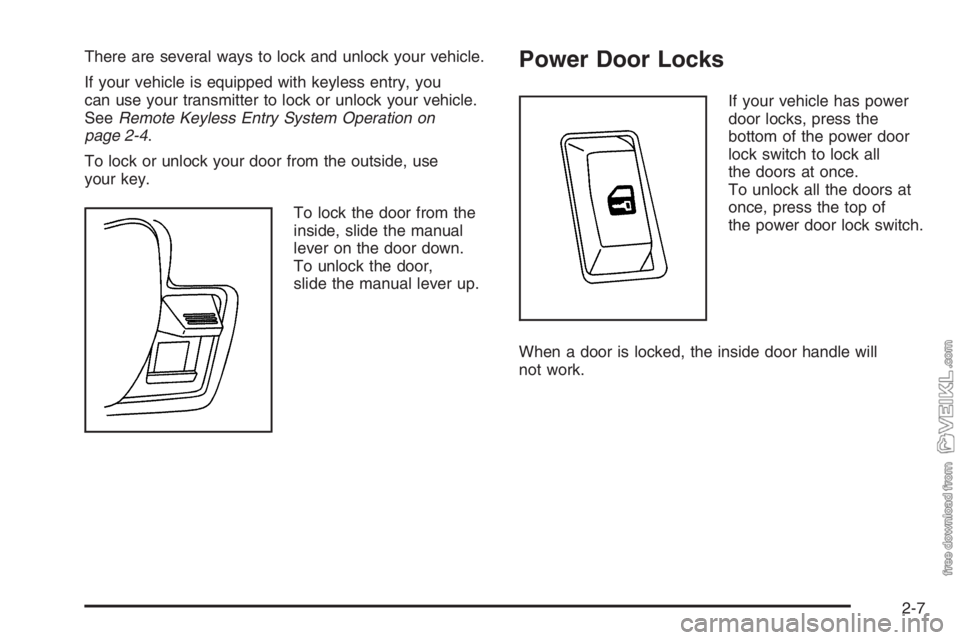
To lock the door from the
inside, slide the manual
lever on the door down.
To unlock the door,
slide the manual lever up.Power Door Locks
If your vehicle has power
door locks, press the
bottom of the power door
lock switch to lock all
the doors at once.
To unlock all the doors at
once, press the top of
the power door lock switch.
When a door is locked, the inside door handle will
not work.
2-7
Page 82 of 398
Ignition Positions
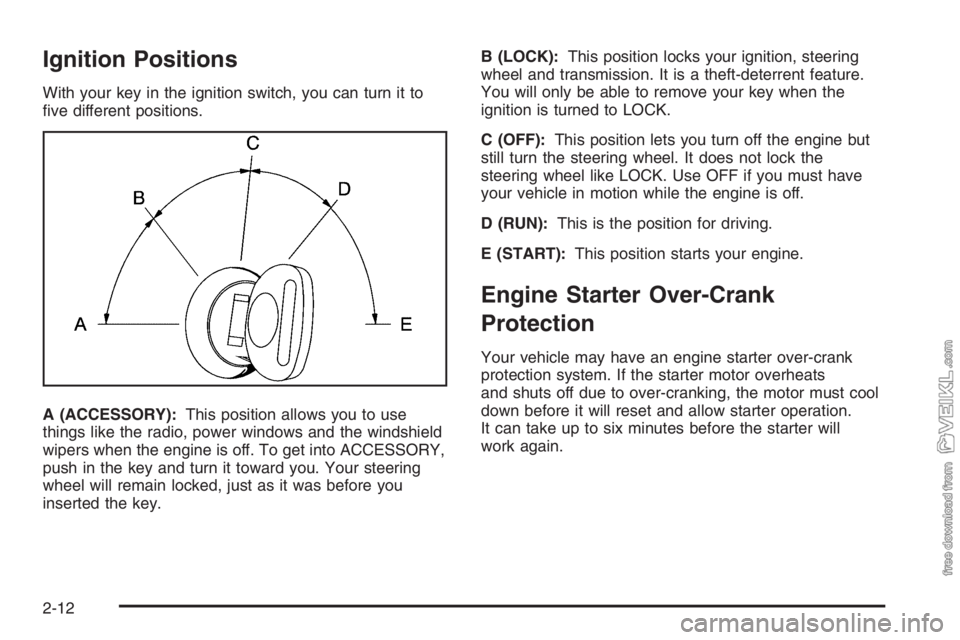
With your key in the ignition switch, you can turn it to
five different positions.
A (ACCESSORY):This position allows you to use
things like the radio, power windows and the windshield
wipers when the engine is off. To get into ACCESSORY,
push in the key and turn it toward you. Your steering
wheel will remain locked, just as it was before you
inserted the key.B (LOCK):This position locks your ignition, steering
wheel and transmission. It is a theft-deterrent feature.
You will only be able to remove your key when the
ignition is turned to LOCK.
C (OFF):This position lets you turn off the engine but
still turn the steering wheel. It does not lock the
steering wheel like LOCK. Use OFF if you must have
your vehicle in motion while the engine is off.
D (RUN):This is the position for driving.
E (START):This position starts your engine.
Engine Starter Over-Crank
Protection
Your vehicle may have an engine starter over-crank
protection system. If the starter motor overheats
and shuts off due to over-cranking, the motor must cool
down before it will reset and allow starter operation.
It can take up to six minutes before the starter will
work again.
2-12
Page 83 of 398
Starting the Gasoline Engine
The 8th digit of your Vehicle Identification Number (VIN)
shows the code letter for your engine. Use this number to
verify the type of engine in your vehicle. SeeVehicle
Identication Number (VIN) on page 5-91. Follow the
proper steps to start the engine.
To start a diesel engine, seeStarting the Diesel Engine
on page 2-15.
Automatic Transmission
Set the parking brake and move your shift lever to
NEUTRAL (N) or PARK (P), if so equipped. Your engine
will not start in any other position — that is a safety
feature.
Manual Transmission
Set the parking brake, shift to neutral NEUTRAL (N)
and hold the clutch pedal to the floor while starting the
engine.
Starter Motor Operation
•The starter motor will disengage if you release the
key or the engine reaches a predetermined engine
speed.
•To prevent overheating, the starter motor will
disengage after continuously operating for
15 seconds. You must release the key from the
start position to re-engage the starter.
•The starter motor will not engage if the engine is
already running.
•The starter motor will disengage if, after
two seconds, the starter pinion gear does not
engage the flywheel or there is no engine rpm signal
from the engine speed sensor.
2-13
Page 84 of 398
Starting Your Engine
1. Without pushing the accelerator pedal, turn your
ignition key to START. When the engine starts, let
go of the key. The idle speed will go down as
your engine gets warm.
2. If the engine does not start in 10 seconds, push the
accelerator pedal all the way down and crank the
engine for five more seconds, unless it starts
sooner.
3. If your engine still will not start, or starts but then
stops, it could be flooded with too much gasoline.
Wait 15 seconds to let the starter motor cool down.
Do Steps 1 through 3 again.
When the engine starts, let go of the key and the
accelerator pedal.
Notice:Your engine is designed to work with the
electronics in your vehicle. If you add electrical
parts or accessories, you could change the way the
engine operates. Before adding electrical equipment,
check with your dealer. If you do not, your engine
might not perform properly. Any resulting damage
would not be covered by your vehicle’s warranty.
If you ever need to have your vehicle towed, seeTowing
Your Vehicle on page 4-37.
Gasoline Engine Warm-Up
When you have started your engine, let it run for
20 or 30 seconds to warm up before you put a load on
the engine.
Drive at moderate speeds for the first 2 to 3 miles
(3.2 to 4.8 km), especially in cold weather. SeeHigh
Idle System on page 2-21.
Restarting the Gasoline Engine While
Moving (Automatic Transmission)
If you have to restart the engine while the vehicle is
moving, you will first have to shift to NEUTRAL (N). This
safety feature prevents starting the engine when the
transmission is in a drive gear.
Stopping the Gasoline Engine
Let your engine idle for a few seconds before turning it
off after you have finished driving your vehicle.
If you shift to NEUTRAL (N) or PARK (P), set the
parking brake.
If your vehicle has a two-speed axle, put the range
selector in low. To be sure the axle has shifted into low,
engage the clutch and transmission; the vehicle may
move slightly when you do this.
2-14
Page 86 of 398
Starting Your Engine
1. Turn your ignition key to RUN.
Observe the wait to start light. SeeWait to Start
Indicator (Diesel Engine) on page 3-37. This
light may not come on if the engine is hot.
If you have a Caterpillar
®diesel engine, see your
Caterpillar®Diesel Engine Operation & Maintenance
Manual for proper wait to start light operation.
2. As soon as the wait to start light goes off,
immediately turn the ignition key to START. When
the engine starts, let go of the key.
If your vehicle is equipped with a DURAMAX
®6600
engine, it has a fast warm-up glow plug system.
The wait to start light will illuminate for a much
shorter time than most diesel engines, due to the
rapid heating of the glow plug system.
Notice:Holding your key in START for longer than
15 seconds at a time will cause your battery to
be drained much sooner. And the excessive heat
can damage your starter motor.Notice:If the wait to start light stays on after
starting your vehicle, your vehicle may not run
properly. Have your vehicle serviced right away.
3. If the engine does not start after 15 seconds
of cranking, turn the ignition key to OFF. Wait
one minute for the starter to cool, then try the same
steps again.
If you are trying to start your engine after you have run
out of fuel, seeRunning Out of Fuel on page 5-17.
When your engine is cold, let it run for a few minutes
before you move your vehicle. This lets oil pressure
build up. Your engine will sound louder when it is cold.
Notice:If you are not in an idling vehicle and
the engine overheats, you would not be there to see
the overheated engine indication. This could
damage your vehicle. Do not let your engine run
when you are not in your vehicle.
2-16
Page 88 of 398
Cold Weather Starting
(Caterpillar®Diesel)
Because the diesel engine uses compression ignition, it
is harder to start in cold weather than a gasoline engine.
The air intake heater and use of the proper engine oil,
optional engine coolant heaters and optional ether
injection systems help cold weather starting. See the
Caterpillar
®Diesel Engine Operation & Maintenance
Manual for more information.
Restarting the Diesel Engine While
Moving (Automatic Transmission)
If you have to restart the engine while the vehicle is
moving, you will first have to shift to NEUTRAL (N). This
safety feature prevents starting the engine when the
transmission is in a drive gear for more information.
Stopping the Diesel Engine
1. Set the parking brake and shift to NEUTRAL (N) or
PARK (P).
2. Turn the ignition key to OFF.
If your vehicle has a two-speed axle, see
Two-Speed Rear Axle Electric Shift Control on
page 2-28.
If you have a Caterpillar
®diesel engine, see your
Caterpillar®Diesel Engine Operation & Maintenance
Manual for additional information.
Diesel Engine Warm-Up
Several factors affect how quickly your diesel engine
warms up. These can include outside temperature,
engine load, idle time and your vehicle’s option content.
Your vehicle may be equipped with some features
that can help the engine reach operating temperature
sooner. Some of these features are discussed below.
Also, remember that an automatic transmission
adds heat to the cooling system through the heat
exchanger in the radiator. Because of this, vehicles
equipped with automatic transmissions are often able to
retain engine coolant heat better than manual
transmission vehicles.
See your Caterpillar
®Operation & Maintenance manual
for additional diesel engine warm-up information.
2-18
Page 89 of 398
If Your Diesel Engine Will Not Start
If you have run out of fuel, seeRunning Out of Fuel on
page 5-17.
If you are not out of fuel, and your engine will not start,
do this:
Turn your ignition key to RUN. Immediately after the
wait to start light goes off, turn the ignition key to
START.
If the light does not go off, wait a few seconds, then try
starting your engine again. And, see your dealer as
soon as you can for a starting system check.
If the light comes on and then goes off and you know
your batteries are charged, but your engine still will not
start, your vehicle needs service.
If the light does not come on when the engine is cold,
your vehicle needs service.
If your batteries do not have enough charge to start
your engine, seeBattery on page 5-58.Be sure you have the right oil for your engine, and that
you have changed the oil at the proper times. If you
use the wrong oil, your engine may be harder to start.
Be sure you are using the proper fuel for existing
weather conditions. SeeWhat Fuel to Use on page 5-8.
If the engine starts, runs a short time, then stops,
your vehicle needs service.
{CAUTION:
Do not use gasoline or starting aids, such as
ether, in the air intake. They could damage
your engine. There could also be a re, which
could cause serious personal injury.
2-19
Page 95 of 398
•The charging system light should come on when
the ignition key is turned to RUN or START and
should go out when the engine is running above
idle. If the light does not go out or comes back on
during normal engine operation, have the charging
system checked right away. (This light tells you
if the generator is not charging; it does not reflect
the condition of the battery.) SeeCharging System
Light on page 3-31for more information.
•The voltmeter charge indicator gage tells you the
condition of your battery’s charge. The gage
should be in the center area during engine
operation. The red area on the left indicates an
undercharge condition; the red area on the
right indicates an overcharge. If the gage is in
either red area, have the battery and charging
system checked right away. SeeVoltmeter Gage
on page 3-32for more information.Notice:Do not allow the engine to operate at low
idle for more than ve minutes. This can cause
low engine operating temperatures which can affect
engine operation and reduce engine life. Engine
idle speed should be increased to 1200 rpm
whenever extended idle is required. Once started,
the engine should be placed under load to allow the
engine coolant temperature to reach 150°F (66°C)
before shutting off the engine.
2-25
Page 126 of 398
Hazard Warning Flashers
The hazard warning flashers warn others. They also let
police know you have a problem. Your front and rear
turn signal lamps will flash on and off.
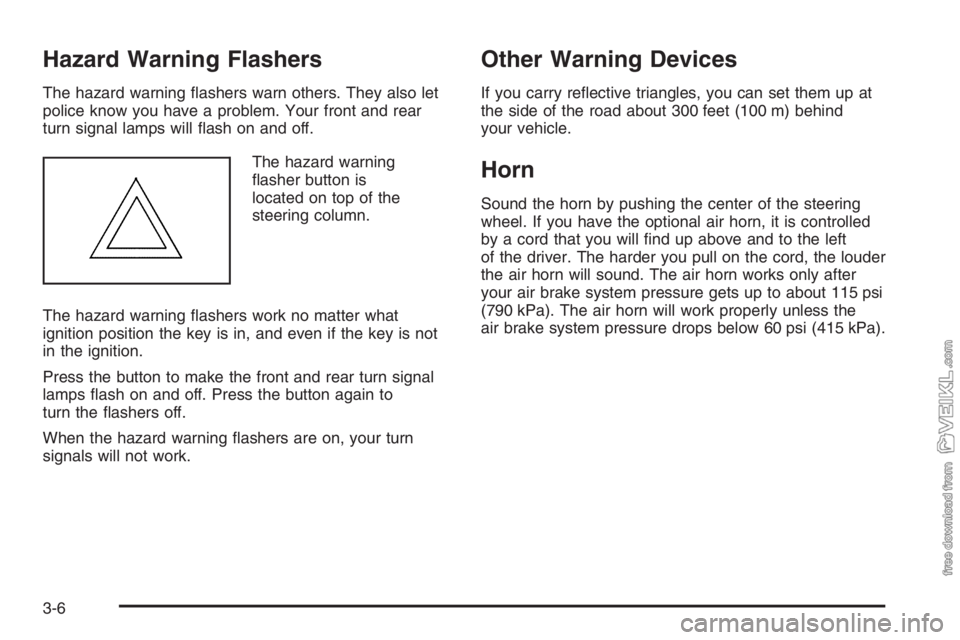
The hazard warning
flasher button is
located on top of the
steering column.
The hazard warning flashers work no matter what
ignition position the key is in, and even if the key is not
in the ignition.
Press the button to make the front and rear turn signal
lamps flash on and off. Press the button again to
turn the flashers off.
When the hazard warning flashers are on, your turn
signals will not work.
Other Warning Devices
If you carry reflective triangles, you can set them up at
the side of the road about 300 feet (100 m) behind
your vehicle.
Horn
Sound the horn by pushing the center of the steering
wheel. If you have the optional air horn, it is controlled
by a cord that you will find up above and to the left
of the driver. The harder you pull on the cord, the louder
the air horn will sound. The air horn works only after
your air brake system pressure gets up to about 115 psi
(790 kPa). The air horn will work properly unless the
air brake system pressure drops below 60 psi (415 kPa).
3-6
Page 148 of 398
Engine Speed Limiter
All engines have electronic engine speed limiting.
The engine limited speeds range between
2,900 and 4,400 rpm depending on engine
option content.
Engine Road Speed Governor
This system controls maximum vehicle speed
automatically and reduces engine power until vehicle
speed gets down to maximum governed speed.
The default setting for C4500 and C5500 models up to
19,500 lbs GVWR is 80 to 85 mph (128 to 136 km/h).
Most other models have a default setting of 75 mph
(120 km/h), although some tire sizes and tread patterns
may limit maximum speed to 55 to 65 mph (86 to
105 km/h). You may have a label on the headliner of your
vehicle with more information on your engine road speed
governor. See your GM dealer for assistance with
programming your engine limited speed.
Safety Belt Reminder Light
When the key is turned to RUN or START, a light will
come on for several seconds to remind people to fasten
their safety belts.
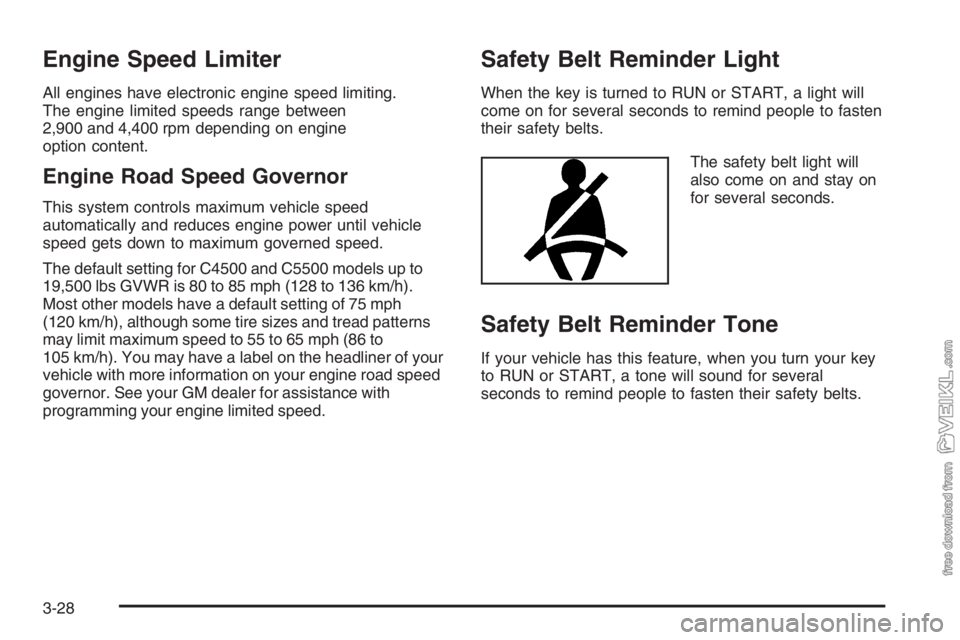
The safety belt light will
also come on and stay on
for several seconds.
Safety Belt Reminder Tone
If your vehicle has this feature, when you turn your key
to RUN or START, a tone will sound for several
seconds to remind people to fasten their safety belts.
3-28