light CHEVROLET KODIAK 2006 User Guide
[x] Cancel search | Manufacturer: CHEVROLET, Model Year: 2006, Model line: KODIAK, Model: CHEVROLET KODIAK 2006Pages: 398, PDF Size: 5.72 MB
Page 86 of 398
Starting Your Engine
1. Turn your ignition key to RUN.
Observe the wait to start light. SeeWait to Start
Indicator (Diesel Engine) on page 3-37. This
light may not come on if the engine is hot.
If you have a Caterpillar
®diesel engine, see your
Caterpillar®Diesel Engine Operation & Maintenance
Manual for proper wait to start light operation.
2. As soon as the wait to start light goes off,
immediately turn the ignition key to START. When
the engine starts, let go of the key.
If your vehicle is equipped with a DURAMAX
®6600
engine, it has a fast warm-up glow plug system.
The wait to start light will illuminate for a much
shorter time than most diesel engines, due to the
rapid heating of the glow plug system.
Notice:Holding your key in START for longer than
15 seconds at a time will cause your battery to
be drained much sooner. And the excessive heat
can damage your starter motor.Notice:If the wait to start light stays on after
starting your vehicle, your vehicle may not run
properly. Have your vehicle serviced right away.
3. If the engine does not start after 15 seconds
of cranking, turn the ignition key to OFF. Wait
one minute for the starter to cool, then try the same
steps again.
If you are trying to start your engine after you have run
out of fuel, seeRunning Out of Fuel on page 5-17.
When your engine is cold, let it run for a few minutes
before you move your vehicle. This lets oil pressure
build up. Your engine will sound louder when it is cold.
Notice:If you are not in an idling vehicle and
the engine overheats, you would not be there to see
the overheated engine indication. This could
damage your vehicle. Do not let your engine run
when you are not in your vehicle.
2-16
Page 89 of 398
If Your Diesel Engine Will Not Start
If you have run out of fuel, seeRunning Out of Fuel on
page 5-17.
If you are not out of fuel, and your engine will not start,
do this:
Turn your ignition key to RUN. Immediately after the
wait to start light goes off, turn the ignition key to
START.
If the light does not go off, wait a few seconds, then try
starting your engine again. And, see your dealer as
soon as you can for a starting system check.
If the light comes on and then goes off and you know
your batteries are charged, but your engine still will not
start, your vehicle needs service.
If the light does not come on when the engine is cold,
your vehicle needs service.
If your batteries do not have enough charge to start
your engine, seeBattery on page 5-58.Be sure you have the right oil for your engine, and that
you have changed the oil at the proper times. If you
use the wrong oil, your engine may be harder to start.
Be sure you are using the proper fuel for existing
weather conditions. SeeWhat Fuel to Use on page 5-8.
If the engine starts, runs a short time, then stops,
your vehicle needs service.
{CAUTION:
Do not use gasoline or starting aids, such as
ether, in the air intake. They could damage
your engine. There could also be a re, which
could cause serious personal injury.
2-19
Page 90 of 398
Engine Alarm and Automatic
Shutdown
Your check gages warning light will come on if the
system senses high engine temperature or low engine
oil pressure. If high engine temperature or low engine oil
pressure is detected, you will also hear a tone alarm
at two beats per second. The alarm and the light
will remain on until the condition is fixed. If the engine
temperature or oil pressure condition worsens, the
tone alarm will go to five beats per second.
If the system senses low engine coolant, the five beat
per second alarm and the low coolant warning light
will come on.
The five beats per second tone alarm means that your
engine will shut down in about 25 to 30 seconds.
There is also an engine shutdown light to indicate that
the engine will shut down. SeeEngine Shutdown
Warning Light on page 3-40.
Pull off the road and shut off the engine. Do not start it
until the reason for the problem is known, and the
problem is fixed. If the engine shuts down when you
are still in traffic, you can restart the engine and
get another 25 to 30 seconds of operation.Do this only if you have to, since there is a problem that
can harm the engine if it is not fixed. Engine automatic
shutdown, for gasoline engines, requires activation
by your dealer.
Notice:If you try to operate the vehicle after the
engine automatically shuts down, you may damage
the vehicle. Have your vehicle repaired as soon
as possible.
Ambulance, Fire, and Rescue Packages
Your check gages warning light will come on if the
system senses high engine temperature or low engine
oil pressure. If high engine temperature or low engine oil
pressure is detected, you will also hear a tone alarm
at two beats per second. The alarm and the light
will remain on until the condition is fixed. If the engine
temperature or oil pressure condition worsens, the
tone alarm will go to five beats per second.
If the system senses low engine coolant, the five beat
per second alarm and the low coolant warning light
will come on.
The engine will not shutdown, but you should have the
vehicle checked as soon as you can.
2-20
Page 93 of 398
For all engines this feature is already turned on. The
automatic quick warm-up on the DURAMAX®engine
can be turned off and on by doing the following
procedure:
1. Turn the ignition to RUN, with the vehicle off.
2. Press the accelerator pedal to the floor and hold it
while quickly pressing and fully releasing the brake
pedal three times in less than eight seconds.
3. Release the accelerator pedal and start the engine.
The green exhaust brake/restrictor light below the
radio controls will be lit for 10 seconds.
If this feature is turned off, by doing the procedure
described previously, and then the engine is
started, the exhaust brake/restrictor light will flash
for 10 seconds and then it will turn off.
When the engine is started, it will slowly increase to the
high idle speed after a delay of a few seconds; up to
about two minutes. For this method to work properly
there must be no throttle or brake pedal faults, and the
throttle pedal must not fall below 75 percent of wide
open throttle while pressing the brake pedal.The engine idle speed will return to normal once the
following conditions are met:
•Once engine coolant temperature reaches about
150°F (65°C).
•The intake temperature reaches a certain level.
The high idle speed will be temporarily interrupted and
the engine speed will return to normal if any of the
following conditions occur:
•The brake pedal is applied.
•The accelerator pedal is pressed.
•The automatic transmission is shifted out of
PARK (P) or NEUTRAL (N).
•The clutch pedal on the manual transmission is
pressed.
•Vehicle speed is detected.
Once these conditions no longer exist, the engine
idle speed will slowly increase to high idle after the
normal delay, if the conditions for engine coolant
temperature and air intake temperature are still met.
2-23
Page 94 of 398
Engine Checks Before Operating
When you have started your engine, let it run for
20 to 30 seconds before you put a load on the engine.
But do not leave the vehicle while the engine is running.
Avoid unnecessary idling of diesel engine equipped
vehicles.
If the engine idles too long, the temperature of the
engine coolant will fall below the normal operating
range. Low engine operating temperature causes
several conditions which affect engine operation and
reduce engine life.
The engine should be permitted to go through a
warm-up period. Operate the vehicle at a minimum
of 600 rpm during the warm-up period. During this period
and during operation, the following observations
should be made.During this warm-up period, check your warning lights
and gages:•If oil pressure does not begin to rise within
15 seconds of starting, stop the engine and find the
cause. SeeOil Pressure Gage on page 3-38for
more information.
•If the engine coolant temperature gage needle goes
into the hot area on the gage, stop the engine and
find the cause of the overheating. SeeEngine
Coolant Temperature Gage on page 3-36for more
information.
•If you have air brakes, the dual-needle air pressure
gage should read at least 115 psi (790 kPa) for
both service systems before you try to move
the vehicle. When air pressure is below 60 psi
(420 kPa), the LOW AIR light will come on and you
will hear a tone alarm. SeeBrake System Warning
Light on page 3-33for more information. If the
pressure does not build up or drops during warm-up,
stop the engine and find the cause before you try
to move the vehicle. Recommended air pressure
before driving is 120 psi (830 kPa). SeeAir
Pressure Gage on page 3-47for more information.
2-24
Page 95 of 398
•The charging system light should come on when
the ignition key is turned to RUN or START and
should go out when the engine is running above
idle. If the light does not go out or comes back on
during normal engine operation, have the charging
system checked right away. (This light tells you
if the generator is not charging; it does not reflect
the condition of the battery.) SeeCharging System
Light on page 3-31for more information.
•The voltmeter charge indicator gage tells you the
condition of your battery’s charge. The gage
should be in the center area during engine
operation. The red area on the left indicates an
undercharge condition; the red area on the
right indicates an overcharge. If the gage is in
either red area, have the battery and charging
system checked right away. SeeVoltmeter Gage
on page 3-32for more information.Notice:Do not allow the engine to operate at low
idle for more than ve minutes. This can cause
low engine operating temperatures which can affect
engine operation and reduce engine life. Engine
idle speed should be increased to 1200 rpm
whenever extended idle is required. Once started,
the engine should be placed under load to allow the
engine coolant temperature to reach 150°F (66°C)
before shutting off the engine.
2-25
Page 97 of 398
Diesel Engine Exhaust Brake
If your vehicle has a DURAMAX®7800 or Caterpillar®
diesel engine, it may have an exhaust brake, which
is located in the exhaust system.
If your vehicle has a 6.6L DURAMAX
®6600 diesel
engine, it may have an exhaust brake, which is
controlled through the turbocharger.
The exhaust brake for both engines operates the same.
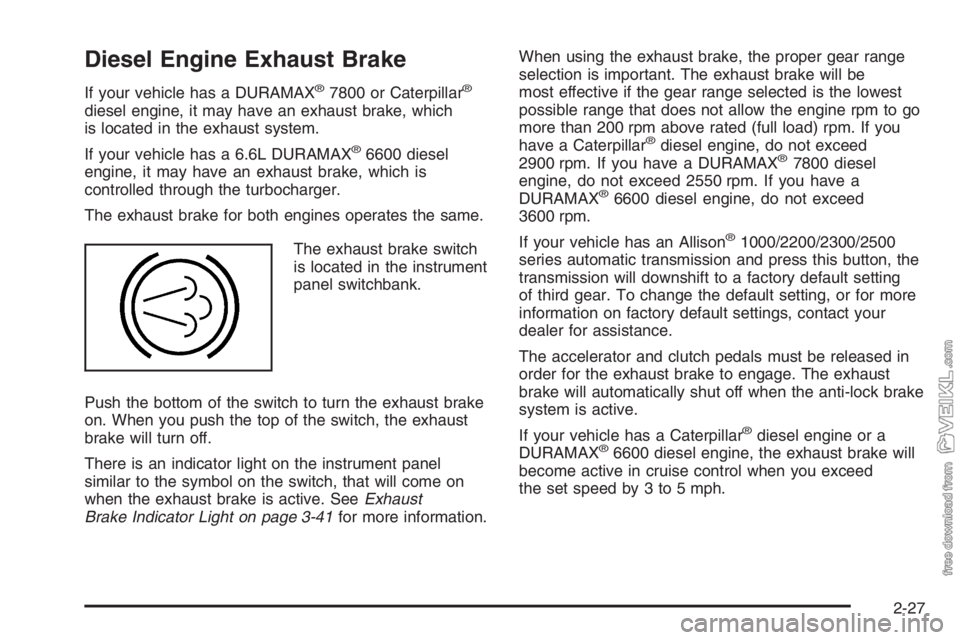
The exhaust brake switch
is located in the instrument
panel switchbank.
Push the bottom of the switch to turn the exhaust brake
on. When you push the top of the switch, the exhaust
brake will turn off.
There is an indicator light on the instrument panel
similar to the symbol on the switch, that will come on
when the exhaust brake is active. SeeExhaust
Brake Indicator Light on page 3-41for more information.When using the exhaust brake, the proper gear range
selection is important. The exhaust brake will be
most effective if the gear range selected is the lowest
possible range that does not allow the engine rpm to go
more than 200 rpm above rated (full load) rpm. If you
have a Caterpillar®diesel engine, do not exceed
2900 rpm. If you have a DURAMAX®7800 diesel
engine, do not exceed 2550 rpm. If you have a
DURAMAX
®6600 diesel engine, do not exceed
3600 rpm.
If your vehicle has an Allison
®1000/2200/2300/2500
series automatic transmission and press this button, the
transmission will downshift to a factory default setting
of third gear. To change the default setting, or for more
information on factory default settings, contact your
dealer for assistance.
The accelerator and clutch pedals must be released in
order for the exhaust brake to engage. The exhaust
brake will automatically shut off when the anti-lock brake
system is active.
If your vehicle has a Caterpillar
®diesel engine or a
DURAMAX®6600 diesel engine, the exhaust brake will
become active in cruise control when you exceed
the set speed by 3 to 5 mph.
2-27
Page 99 of 398
Air Shift Control
(Automatic Transmission)
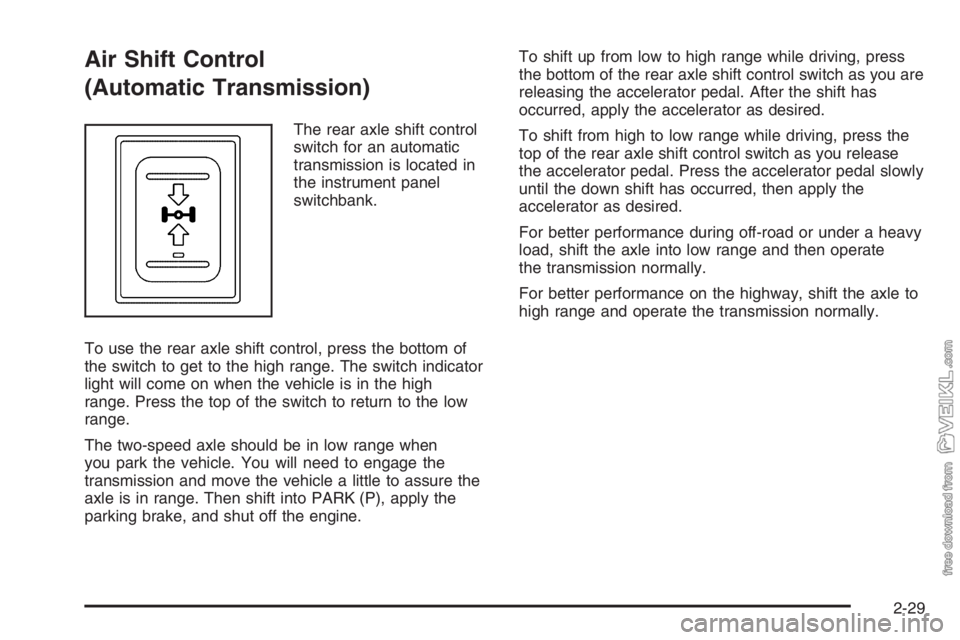
The rear axle shift control
switch for an automatic
transmission is located in
the instrument panel
switchbank.
To use the rear axle shift control, press the bottom of
the switch to get to the high range. The switch indicator
light will come on when the vehicle is in the high
range. Press the top of the switch to return to the low
range.
The two-speed axle should be in low range when
you park the vehicle. You will need to engage the
transmission and move the vehicle a little to assure the
axle is in range. Then shift into PARK (P), apply the
parking brake, and shut off the engine.To shift up from low to high range while driving, press
the bottom of the rear axle shift control switch as you are
releasing the accelerator pedal. After the shift has
occurred, apply the accelerator as desired.
To shift from high to low range while driving, press the
top of the rear axle shift control switch as you release
the accelerator pedal. Press the accelerator pedal slowly
until the down shift has occurred, then apply the
accelerator as desired.
For better performance during off-road or under a heavy
load, shift the axle into low range and then operate
the transmission normally.
For better performance on the highway, shift the axle to
high range and operate the transmission normally.
2-29
Page 101 of 398
Overdrive Defeat
If your vehicle has this feature, you can select not to
shift up to fifth gear. This is useful when towing or under
a heavy load.
The overdrive defeat
switch is located in the
instrument panel to
the right of the steering
column.
Press the switch to limit the transmission to fourth gear.
This will allow for fewer downshifts while pulling a
trailer or under a heavy load. The indicator light in the
switch will come on whenever overdrive defeat is active.
Manual Transmission Operation
Using the Clutch
When you are starting to move the vehicle, it is
important to begin with the engine speed at idle. Then
start to engage the clutch and listen for an engine speed
drop of about 100 rpm. At this point, the clutch is
engaging, so you should increase the engine speed and
fully engage the clutch. It is important not to increase
the engine speed sooner or before the clutch begins its
engagement. If you do, you can cause damage to
your vehicle.
Double-Clutching
You must use the double-clutching method when you
shift an unsynchronized gear set. Disengage the clutch,
shift to NEUTRAL and engage the clutch. When
upshifting, slow the engine until the engine rpm and
road speed match. When downshifting, accelerate the
engine until the engine rpm and road speed match. Then
quickly disengage the clutch and move the shift lever
to the next gear position and engage the clutch.
2-31
Page 103 of 398
FIRST (1):With the vehicle at a stop, release the
brake, press the clutch pedal and shift into FIRST (1).
Then, slowly let up on the clutch pedal as you press the
accelerator pedal. Only downshift into FIRST (1)
when the vehicle has come to a complete stop. If the
shift lever will not go into FIRST (1), put the lever
in NEUTRAL and let up on the clutch pedal to fully
engage the clutch. Press the clutch pedal again. Then,
shift into FIRST (1).
SECOND (2):With the vehicle at a stop, release the
brake, press the clutch pedal and shift into SECOND (2).
Then, slowly let up on the clutch pedal as you press
the accelerator pedal. With the vehicle moving, press
the clutch pedal and upshift into SECOND (2) from
FIRST (1) while applying light pressure to the right on
the shifter. Then, slowly let up on the clutch pedal
as you press the accelerator pedal. If you come to a
complete stop and the shift lever will not go into
SECOND (2), put the lever in NEUTRAL and let up on
the clutch pedal to fully engage the clutch. Press
the clutch pedal again. Then, shift into SECOND (2).THIRD (3):Press the clutch pedal and upshift into
THIRD (3). Then, slowly let up on the clutch pedal as
you press the accelerator pedal.
FOURTH (4), FIFTH (5) and SIXTH (6):Upshift into
the higher forward gears the same way as you do
THIRD (3). Slowly let up on the clutch pedal as you
press the accelerator pedal.
NEUTRAL:Use this position when you start or idle
your engine.
REVERSE (R):To back up, press the clutch pedal.
Wait for the vehicle to stop moving and then, shift
to REVERSE (R). Let up on the clutch slowly while
pressing the accelerator pedal. Also, use REVERSE (R),
along with the parking brake, when turning off your
engine and parking your vehicle.
2-33