tires CHEVROLET KODIAK 2006 User Guide
[x] Cancel search | Manufacturer: CHEVROLET, Model Year: 2006, Model line: KODIAK, Model: CHEVROLET KODIAK 2006Pages: 398, PDF Size: 5.72 MB
Page 213 of 398
Once you are moving on the freeway, make certain you
allow a reasonable following distance. Expect to
move slightly slower at night.
When you want to leave the freeway, move to the
proper lane well in advance. If you miss your exit, do
not, under any circumstances, stop and back up. Drive
on to the next exit.
The exit ramp can be curved, sometimes quite
sharply. The exit speed for cars — but not larger
vehicles — is usually posted. You should go more
slowly.
Reduce your speed according to your speedometer, not
to your sense of motion. After driving for any distance
at higher speeds, you may tend to think you are
going slower than you actually are.Highway Hypnosis
Is there actually such a condition as highway hypnosis?
Or is it just plain falling asleep at the wheel? Call it
highway hypnosis, lack of awareness, or whatever.
When you drive the vehicle for a long distance, there is
something about an easy stretch of road with the
same scenery, along with the hum of the tires on the
road, the drone of the engine, and the rush of the wind
against the vehicle that can make you sleepy. Do
not let it happen to you! If it does, your vehicle can leave
the road in less than a second, and you could crash
and be injured.
What can you do about highway hypnosis? First, be
aware that it can happen.
Then here are some tips:
•Make sure your vehicle is well ventilated, with a
comfortably cool interior.
•Keep your eyes moving. Scan the road ahead and
to the sides. Check your mirrors and your
instruments frequently.
•If you get sleepy, pull off the road into a rest,
service, or parking area and take a nap, get some
exercise, or both. For safety, treat drowsiness
on the highway as an emergency.
4-25
Page 214 of 398
Hill and Mountain Roads
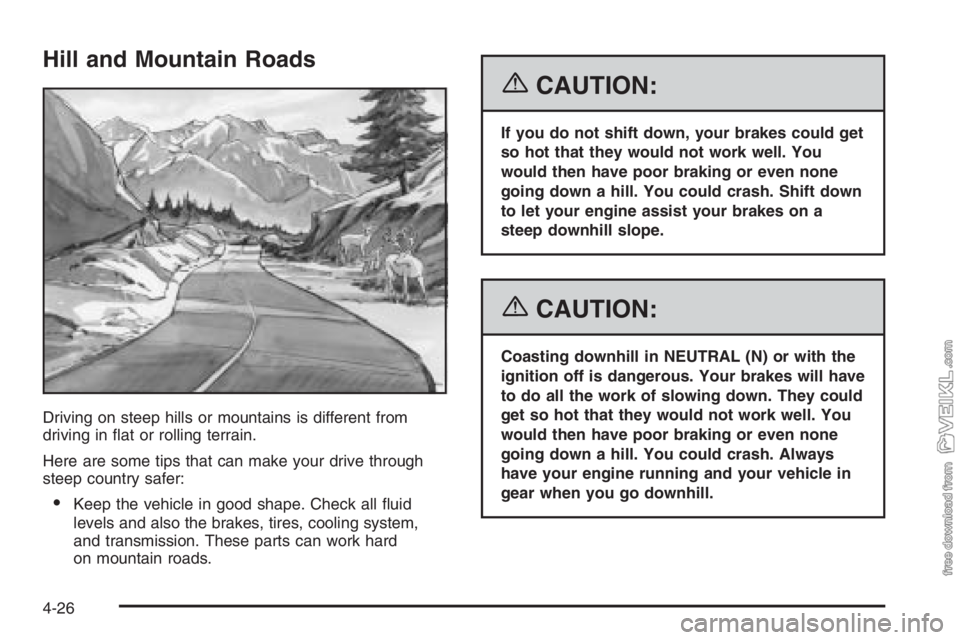
Driving on steep hills or mountains is different from
driving in flat or rolling terrain.
Here are some tips that can make your drive through
steep country safer:
•Keep the vehicle in good shape. Check all fluid
levels and also the brakes, tires, cooling system,
and transmission. These parts can work hard
on mountain roads.
{CAUTION:
If you do not shift down, your brakes could get
so hot that they would not work well. You
would then have poor braking or even none
going down a hill. You could crash. Shift down
to let your engine assist your brakes on a
steep downhill slope.
{CAUTION:
Coasting downhill in NEUTRAL (N) or with the
ignition off is dangerous. Your brakes will have
to do all the work of slowing down. They could
get so hot that they would not work well. You
would then have poor braking or even none
going down a hill. You could crash. Always
have your engine running and your vehicle in
gear when you go downhill.
4-26
Page 215 of 398
•Know how to go down hills. The most important
thing to know is this: let your engine do some of
the slowing down. Shift to a lower gear when you go
down a steep or long hill.
•Know how to go uphill. Use lower gears. They help
cool your engine and transmission, and you can
climb the hill better.
•Stay in your own lane when driving on two-lane
roads in hills or mountains. Do not swing wide
or cut across the center of the road. Drive at speeds
that let you stay in your own lane.
•As you go over the top of a hill, be alert. There
could be something in your lane, like a stalled car or
an accident.
•You may see highway signs on mountains that
warn of special problems. Examples are long
grades, passing or no-passing zones, a falling rocks
area, winding roads, and special truck lanes. Be
alert to these and take appropriate action.
Winter Driving
Here are some tips for winter driving:
•Be sure the vehicle is in good shape for winter.
•You may want to put winter emergency supplies in
your vehicle.
Also seeTires on page 5-74.
4-27
Page 216 of 398
Include an ice scraper, a small brush or broom, a
supply of windshield washer fluid, a rag, some winter
outer clothing, a small shovel, a flashlight, a red
cloth, and reflective warning triangles. And, if you will be
driving under severe conditions, include a small bag
of sand, a piece of old carpet, or a couple of burlap bags
to help provide traction. Be sure you properly secure
these items in your vehicle.
Driving on Snow or Ice
Most of the time, those places where the tires meet the
road probably have good traction.
However, if there is snow or ice between the tires and
the road, you can have a very slippery situation. You will
have a lot less traction, or grip, and will need to be
very careful.
What is the worst time for this? Wet ice. Very cold snow
or ice can be slick and hard to drive on. But wet ice
can be even more trouble because it may offer the least
traction of all. You can get wet ice when it is about
freezing, 32°F (0°C), and freezing rain begins to fall. Try
to avoid driving on wet ice until salt and sand crews
can get there.
Whatever the condition — smooth ice, packed, blowing,
or loose snow — drive with caution.
4-28
Page 217 of 398
If you have a four-wheel-drive vehicle, shift into 4HI.
SeeFour-Wheel Drive on page 2-35.
If you have the Traction Control System (TCS), it will
improve your ability to accelerate when driving on
a slippery road. But you can turn the TCS off if you ever
need to. You should turn the system off if your vehicle
ever gets stuck in sand, mud, ice, or snow. SeeIf
Your Vehicle is Stuck in Sand, Mud, Ice, or Snow on
page 4-32. Even though your vehicle has TCS, you will
want to slow down and adjust your driving to the
road conditions. Under certain conditions, you may want
to turn the TCS off, such as when driving through
deep snow and loose gravel, to help maintain vehicle
motion at lower speeds. SeeTraction Control System
(TCS) on page 4-12.
If you do not have TCS, accelerate gently. Try not to
break the fragile traction. If you accelerate too fast, the
drive wheels will spin and polish the surface under
the tires even more.
Unless you have the Anti-Lock Brake System (ABS),
you will want to brake very gently, too. If you do
have ABS, seeAnti-Lock Brake System (ABS) on
page 4-8. ABS improves your vehicle’s stability when
you make a hard stop on a slippery road.Whether you have ABS or not, you will want to begin
stopping sooner than you would on dry pavement.
Without ABS, if you feel your vehicle begin to slide, let
up on the brakes a little. Push the brake pedal down
steadily to get the most traction you can.
Remember, unless you have ABS, if you brake so hard
that your wheels stop rolling, you will just slide. Brake
so your wheels always keep rolling and you can
still steer.
•Whatever your braking system, allow greater
following distance on any slippery road.
•Watch for slippery spots. The road might be fine
until you hit a spot that is covered with ice. On
an otherwise clear road, ice patches may appear in
shaded areas where the sun cannot reach, such
as around clumps of trees, behind buildings,
or under bridges. Sometimes the surface of a curve
or an overpass may remain icy when the
surrounding roads are clear. If you see a patch of
ice ahead of you, brake before you are on it. Try not
to brake while you are actually on the ice, and
avoid sudden steering maneuvers.
4-29
Page 220 of 398
If Your Vehicle is Stuck in Sand,
Mud, Ice, or Snow
In order to free your vehicle when it is stuck, you will
need to spin the wheels, but you do not want to
spin your wheels too fast. The method known as rocking
can help you get out when you are stuck, but you
must use caution.
{CAUTION:
If you let your tires spin at high speed, they
can explode, and you or others could be
injured. And, the transmission or other parts of
the vehicle can overheat. That could cause an
engine compartment re or other damage.
When you are stuck, spin the wheels as little
as possible. Do not spin the wheels above
35 mph (55 km/h) as shown on the
speedometer.
Notice:Spinning your wheels can destroy parts of
your vehicle as well as the tires. If you spin the
wheels too fast while shifting your transmission
back and forth, you can destroy your transmission.
Rocking Your Vehicle to Get It Out
First, turn the steering wheel left and right. That will
clear the area around the front wheels. If you have a
four-wheel-drive vehicle, shift into 4HI. SeeFour-Wheel
Drive on page 2-35. If your vehicle has traction
control, you should turn the traction control system off.
SeeTraction Control System (TCS) on page 4-12.
Then shift back and forth between REVERSE (R) and a
forward gear, or with a manual transmission, between
FIRST (1) or SECOND (2) and REVERSE (R), spinning
the wheels as little as possible. Release the accelerator
pedal while you shift, and press lightly on the
accelerator pedal when the transmission is in gear. By
slowly spinning your wheels in the forward and
reverse directions, you will cause a rocking motion that
may free your vehicle. If that does not get you out
after a few tries, you may need to be towed out. If you
do need to be towed out, seeTowing Your Vehicle
on page 4-37.
4-32
Page 222 of 398
Loading Your Vehicle
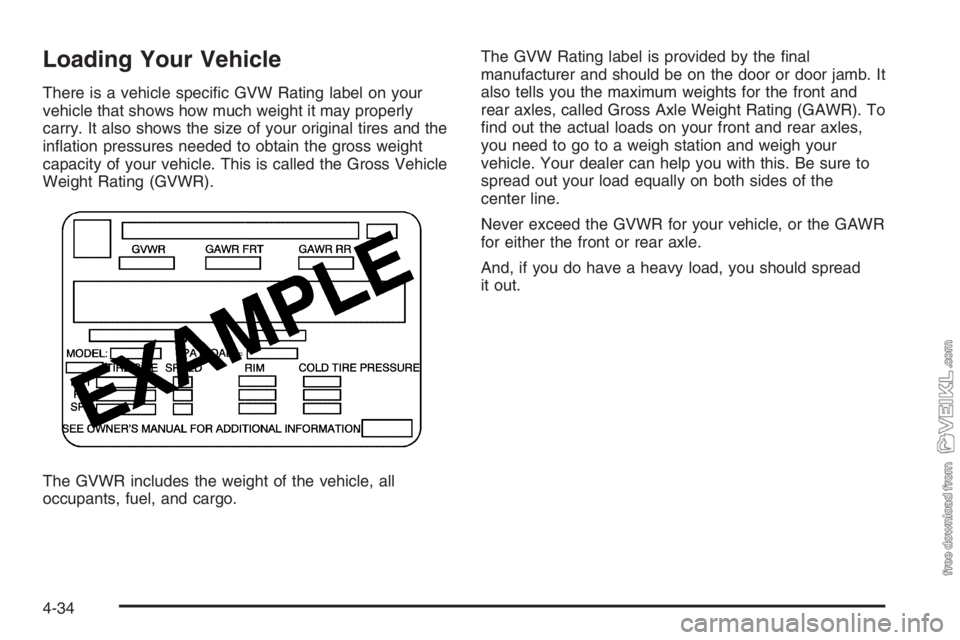
There is a vehicle specific GVW Rating label on your
vehicle that shows how much weight it may properly
carry. It also shows the size of your original tires and the
inflation pressures needed to obtain the gross weight
capacity of your vehicle. This is called the Gross Vehicle
Weight Rating (GVWR).
The GVWR includes the weight of the vehicle, all
occupants, fuel, and cargo.The GVW Rating label is provided by the final
manufacturer and should be on the door or door jamb. It
also tells you the maximum weights for the front and
rear axles, called Gross Axle Weight Rating (GAWR). To
find out the actual loads on your front and rear axles,
you need to go to a weigh station and weigh your
vehicle. Your dealer can help you with this. Be sure to
spread out your load equally on both sides of the
center line.
Never exceed the GVWR for your vehicle, or the GAWR
for either the front or rear axle.
And, if you do have a heavy load, you should spread
it out.
4-34
Page 230 of 398
Other Service Items........................................5-70
Fuel Filter....................................................5-70
Primary Fuel Filter and Water Separator..........5-71
Secondary Fuel Filter and Water
Separator/Heater (Caterpillar
®Diesel)...........5-71
Automatic Ether Injection System
(Caterpillar
®Diesel)....................................5-72
Front Wheel Bearings with Oil-Filled Hubs........5-73
Air Conditioning System.................................5-74
Tires..............................................................5-74
Inflation - Tire Pressure.................................5-75
Wheel Loading.............................................5-75
Dual Tire Operation.......................................5-76
When It Is Time for New Tires.......................5-76
Wheel Alignment and Tire Balance..................5-77
Tightening the Wheel Nuts.............................5-77
Wheel Replacement......................................5-81
If a Tire Goes Flat........................................5-82
Appearance Care............................................5-83
Cleaning the Inside of Your Vehicle.................5-83
Fabric/Carpet...............................................5-85
Instrument Panel, Vinyl, and Other Plastic
Surfaces..................................................5-86
Care of Safety Belts......................................5-86
Weatherstrips...............................................5-86
Washing Your Vehicle...................................5-87Cleaning Exterior Lamps/Lenses.....................5-87
Finish Care..................................................5-87
Windshield and Wiper Blades.........................5-88
Aluminum or Chrome-Plated Wheels................5-89
Tires...........................................................5-89
Sheet Metal Damage.....................................5-89
Finish Damage.............................................5-89
Underbody Maintenance................................5-90
Chemical Paint Spotting.................................5-90
Vehicle Identication......................................5-91
Vehicle Identification Number (VIN).................5-91
Service Statement.........................................5-92
Service Parts Identification Label.....................5-92
Electrical System............................................5-92
Add-On Electrical Equipment..........................5-92
Headlamp Wiring..........................................5-93
Windshield Wiper Fuses................................5-93
Fusible Links................................................5-93
Power Windows and Other Power Options.......5-93
Fuses and Circuit Breakers............................5-93
Instrument Panel Fuse Block..........................5-94
Underhood Fuse Block..................................5-96
Capacities and Specications..........................5-99
Normal Maintenance Replacement Parts.........5-104
Section 5 Service and Appearance Care
5-2
Page 279 of 398
Four-Wheel Disc Brakes
(Hydraulic Only)
Your vehicle has four-wheel disc brakes.
Some driving conditions or climates may cause a brake
squeal when the brakes are first applied or lightly
applied. This does not mean something is wrong with
your brakes.
Brake linings should always be replaced as complete
axle sets.
Four-Wheel and Six-Wheel Drum
Brakes (Air Only)
The brake drums should be removed and inspected
each time the tires are removed for rotation or changing.
When you have the front brakes replaced, have the
rear brakes inspected, too.
Brake linings should always be replaced as complete
axle sets.
Brake Pedal Travel
See your dealer if the brake pedal does not return to
normal height, or if there is a rapid increase in
pedal travel. This could be a sign of brake trouble.
Brake Adjustment
Every time you make a brake stop, your brakes adjust
for wear.
Replacing Brake System Parts
The braking system on a vehicle is complex. Its many
parts have to be of top quality and work well together
if the vehicle is to have really good braking. Your
vehicle was designed and tested with top-quality
GM brake parts. When you replace parts of your braking
system — for example, when your brake linings wear
down and you need new ones put in — be sure you get
new approved GM replacement parts. If you do not,
your brakes may no longer work properly. For example,
if someone puts in brake linings that are wrong for
your vehicle, the balance between your front and rear
brakes can change — for the worse. The braking
performance you have come to expect can change in
many other ways if someone puts in the wrong
replacement brake parts.
5-51
Page 302 of 398
Air Conditioning System
Every now and then, have your dealership check your
air conditioning system to be sure it has not lost
any cooling ability. If you think the system is not working
properly, have your GM dealer check it out as soon
as possible.
Tires
Your new vehicle comes with high-quality tires made by
a leading tire manufacturer. If you ever have questions
about your tire warranty and where to obtain service,
see your GM Warranty booklet for details. For additional
information refer to the tire manufacturer’s booklet
included with your vehicle.
{CAUTION:
Poorly maintained and improperly used tires
are dangerous.
Overloading your tires can cause
overheating as a result of too much
friction. You could have an air-out and a
serious accident. SeeLoading Your
Vehicle on page 4-34.
Underinated tires pose the same danger
as overloaded tires. The resulting accident
could cause serious injury. Check all tires
frequently to maintain the recommended
pressure. Tire pressure should be checked
when your tires are cold. SeeInflation - Tire
Pressure on page 5-75.
Overinated tires are more likely to be
cut, punctured, or broken by a sudden
impact — such as when you hit a pothole.
Keep tires at the recommended pressure.
Worn, old tires can cause accidents. If your
tread is badly worn, or if your tires have
been damaged, replace them.
5-74