display CHEVROLET KODIAK 2006 Owner's Manual
[x] Cancel search | Manufacturer: CHEVROLET, Model Year: 2006, Model line: KODIAK, Model: CHEVROLET KODIAK 2006Pages: 398, PDF Size: 5.72 MB
Page 185 of 398
AM
The range for most AM stations is greater than for FM,
especially at night. The longer range can cause
station frequencies to interfere with each other. For
better radio reception, most AM radio stations will boost
the power levels during the day, and then reduce
these levels during the night. Static can also occur when
things like storms and power lines interfere with radio
reception. When this happens, try reducing the treble on
your radio.
FM Stereo
FM stereo will give the best sound, but FM signals will
reach only about 10 to 40 miles (16 to 65 km). Tall
buildings or hills can interfere with FM signals, causing
the sound to fade in and out.
Care of the Cassette Tape Player
A tape player that is not cleaned regularly can cause
reduced sound quality, ruined cassettes or a damaged
mechanism. Cassette tapes should be stored in their
cases away from contaminants, direct sunlight and
extreme heat. If they aren’t, they may not operate
properly or may cause failure of the tape player.
The tape player should be cleaned regularly after every
50 hours of use. The radio may display CLN to
indicate that the tape player has been used for 50 hours
without resetting the tape clean timer. If this message
appears on the display, the cassette tape player
needs to be cleaned. It will still play tapes, but it should
be cleaned as soon as possible to prevent damage
to the tapes and player. If there is a reduction in sound
quality, try a known good cassette to see if the tape
or the tape player is at fault. If this other cassette has no
improvement in sound quality, clean the tape player.
For best results, use a scrubbing action, non-abrasive
cleaning cassette with pads which scrub the tape
head as the hubs of the cleaner cassette turn. The
recommended cleaning cassette is available through
your dealer.
3-65
Page 186 of 398
The cut tape detection feature of the cassette tape
player may identify the cleaning cassette as a damaged
tape. To prevent the cleaning cassette from being
ejected, use the following steps:
1. Turn the ignition on.
2. Turn the radio off.
3. Press and hold the TAPE button for two seconds
until the radio produces one beep. CAS will flash
on the display for five seconds.
4. Insert the scrubbing action cleaning cassette.
5. Eject the cleaning cassette after the manufacturer’s
recommended cleaning time.
After the cleaning cassette is ejected, the cut tape
detection feature will be active again.
A non-scrubbing action, wet-type cleaner which uses a
cassette with a fabric belt to clean the tape head
can be used. This type of cleaning cassette will not
eject on its own. A non-scrubbing action cleaner may not
clean as thoroughly as the scrubbing type cleaner.
The use of a non-scrubbing action, dry-type cleaning
cassette is not recommended.After the player is cleaned, press and hold the eject
button for three seconds to reset the CLN indicator. The
radio will display --- to show the indicator was reset.
Cassettes are subject to wear and the sound quality may
degrade over time. Always make sure the cassette
tape is in good condition before the tape player
is serviced.
Care of Your CDs
Handle CDs carefully. Store them in their original cases
or other protective cases and away from direct
sunlight and dust. The CD player scans the bottom
surface of the disc. If the surface of a CD is damaged,
such as cracked, broken, or scratched, the CD will
not play properly or not at all. If the surface of a CD is
soiled, take a soft, lint free cloth or dampen a clean, soft
cloth in a mild, neutral detergent solution mixed with
water, and clean it. Make sure the wiping process starts
from the center to the edge.
Do not touch the bottom side of a CD while handling it;
this could damage the surface. Pick up CDs by
grasping the outer edges or the edge of the hole and
the outer edge.
3-66
Page 187 of 398
Care of the CD Player
The use of CD lens cleaners for CD players is not
advised, due to the risk of contaminating the internal
lens of the CD optics with lubricants.
Fixed Mast Antenna
The fixed mast antenna can withstand most vehicle
washes without being damaged. If the mast should ever
become slightly bent, straighten it out by hand. If the
mast is badly bent, replace it.
Check occasionally to make sure the mast is still
tightened to the fender. If tightening is required, tighten
by hand, then with a wrench one quarter turn.
Chime Level Adjustment
The radio is used to adjust the vehicle’s chime level. To
change the volume level of the chime, press and
hold pushbutton 6 with the ignition on and the radio
power off. The volume level will change from the normal
level to loud, and HI will appear on the radio display.
To change back to the default or normal setting, press
and hold pushbutton 6 again. The volume level will
change from the loud level to normal, and LO will appear
on the radio display. Each time the chime volume is
changed, three chimes will sound as an example of the
new volume selected. Removing the radio and not
replacing it with a factory radio or chime module will
disable vehicle chimes.
3-67
Page 255 of 398
•SAE 15W-40
As shown in the viscosity chart, SAE 15W-40 is
best for your vehicle. However, you can use
SAE 10W-30 at temperatures above 0°F (−18°C).
When it is very cold, below 0°F (−18°C), you should
use SAE 5W-40 to improve cold starting. 5W-40
is not recommended for use at high temperatures,
above 100°F (38°C).
These numbers on the oil container show its
viscosity, or thickness. Do not use other viscosity
oils such as SAE 10W-40 or SAE 20W-50.
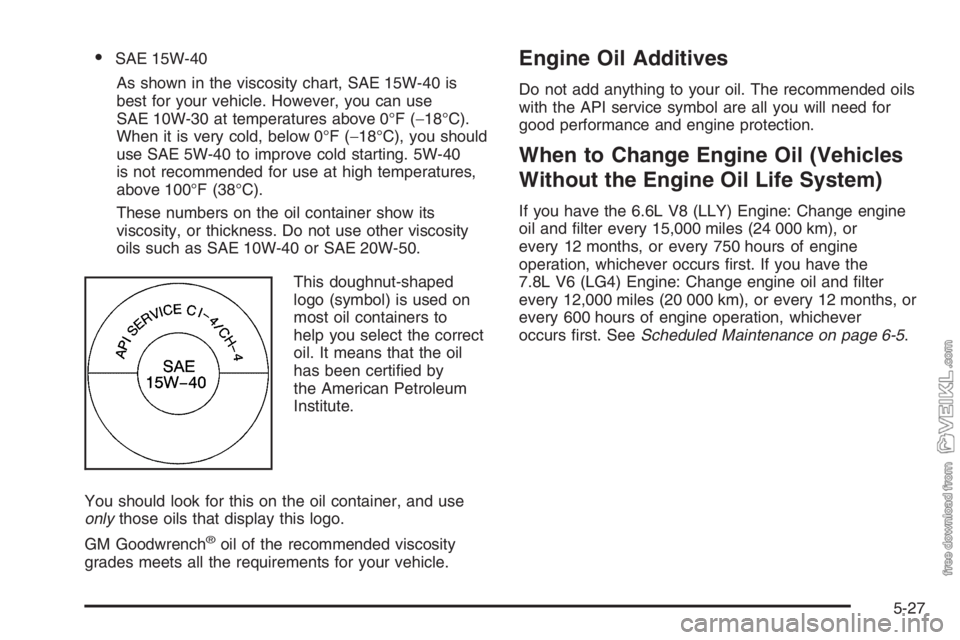
This doughnut-shaped
logo (symbol) is used on
most oil containers to
help you select the correct
oil. It means that the oil
has been certified by
the American Petroleum
Institute.
You should look for this on the oil container, and use
onlythose oils that display this logo.
GM Goodwrench
®oil of the recommended viscosity
grades meets all the requirements for your vehicle.
Engine Oil Additives
Do not add anything to your oil. The recommended oils
with the API service symbol are all you will need for
good performance and engine protection.
When to Change Engine Oil (Vehicles
Without the Engine Oil Life System)
If you have the 6.6L V8 (LLY) Engine: Change engine
oil and filter every 15,000 miles (24 000 km), or
every 12 months, or every 750 hours of engine
operation, whichever occurs first. If you have the
7.8L V6 (LG4) Engine: Change engine oil and filter
every 12,000 miles (20 000 km), or every 12 months, or
every 600 hours of engine operation, whichever
occurs first. SeeScheduled Maintenance on page 6-5.
5-27
Page 367 of 398
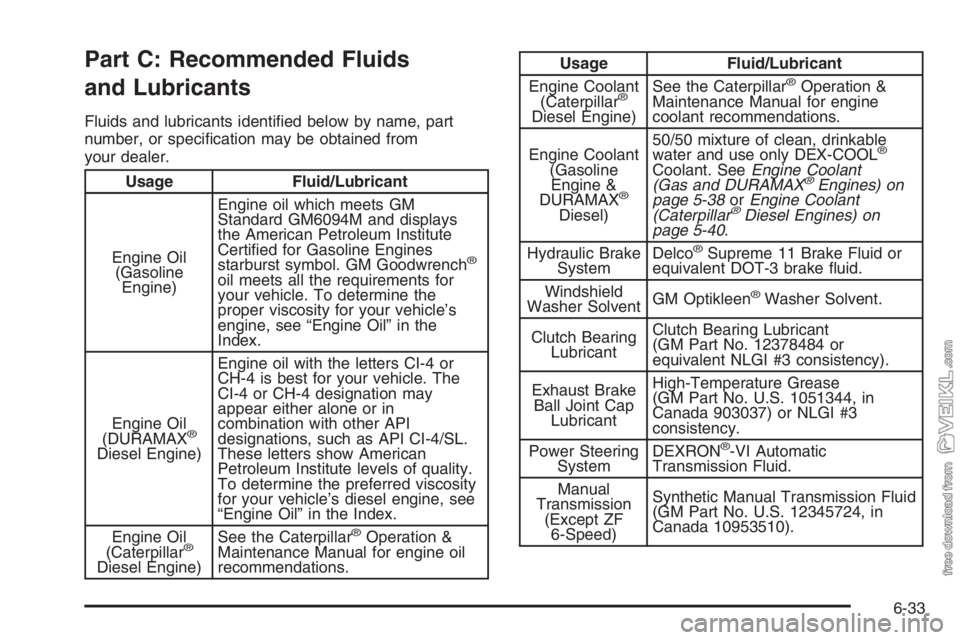
Part C: Recommended Fluids
and Lubricants
Fluids and lubricants identified below by name, part
number, or specification may be obtained from
your dealer.
Usage Fluid/Lubricant
Engine Oil
(Gasoline
Engine)Engine oil which meets GM
Standard GM6094M and displays
the American Petroleum Institute
Certified for Gasoline Engines
starburst symbol. GM Goodwrench
®
oil meets all the requirements for
your vehicle. To determine the
proper viscosity for your vehicle’s
engine, see “Engine Oil” in the
Index.
Engine Oil
(DURAMAX
®
Diesel Engine)Engine oil with the letters CI-4 or
CH-4 is best for your vehicle. The
CI-4 or CH-4 designation may
appear either alone or in
combination with other API
designations, such as API CI-4/SL.
These letters show American
Petroleum Institute levels of quality.
To determine the preferred viscosity
for your vehicle’s diesel engine, see
“Engine Oil” in the Index.
Engine Oil
(Caterpillar
®
Diesel Engine)See the Caterpillar
®Operation &
Maintenance Manual for engine oil
recommendations.
Usage Fluid/Lubricant
Engine Coolant
(Caterpillar
®
Diesel Engine)See the Caterpillar
®Operation &
Maintenance Manual for engine
coolant recommendations.
Engine Coolant
(Gasoline
Engine &
DURAMAX
®
Diesel)50/50 mixture of clean, drinkable
water and use only DEX-COOL
®
Coolant. SeeEngine Coolant
(Gas and DURAMAX®Engines) on
page 5-38orEngine Coolant
(Caterpillar
®Diesel Engines) on
page 5-40.
Hydraulic Brake
SystemDelco
®Supreme 11 Brake Fluid or
equivalent DOT-3 brake fluid.
Windshield
Washer SolventGM Optikleen
®Washer Solvent.
Clutch Bearing
LubricantClutch Bearing Lubricant
(GM Part No. 12378484 or
equivalent NLGI #3 consistency).
Exhaust Brake
Ball Joint Cap
LubricantHigh-Temperature Grease
(GM Part No. U.S. 1051344, in
Canada 903037) or NLGI #3
consistency.
Power Steering
SystemDEXRON
®-VI Automatic
Transmission Fluid.
Manual
Transmission
(Except ZF
6-Speed)Synthetic Manual Transmission Fluid
(GM Part No. U.S. 12345724, in
Canada 10953510).
6-33