belt CHEVROLET KODIAK 2006 Workshop Manual
[x] Cancel search | Manufacturer: CHEVROLET, Model Year: 2006, Model line: KODIAK, Model: CHEVROLET KODIAK 2006Pages: 398, PDF Size: 5.72 MB
Page 203 of 398
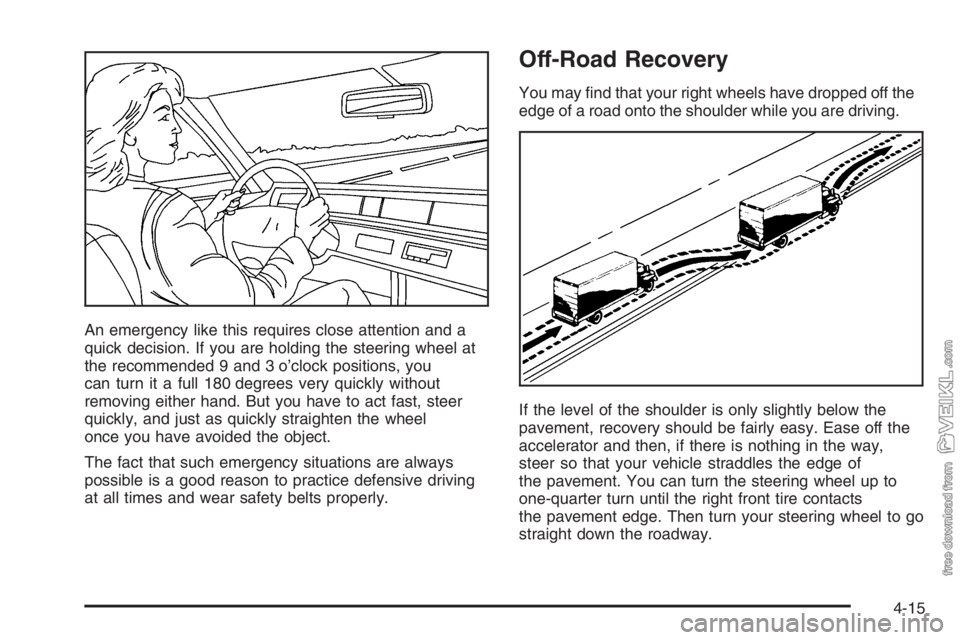
An emergency like this requires close attention and a
quick decision. If you are holding the steering wheel at
the recommended 9 and 3 o’clock positions, you
can turn it a full 180 degrees very quickly without
removing either hand. But you have to act fast, steer
quickly, and just as quickly straighten the wheel
once you have avoided the object.
The fact that such emergency situations are always
possible is a good reason to practice defensive driving
at all times and wear safety belts properly.
Off-Road Recovery
You may find that your right wheels have dropped off the
edge of a road onto the shoulder while you are driving.
If the level of the shoulder is only slightly below the
pavement, recovery should be fairly easy. Ease off the
accelerator and then, if there is nothing in the way,
steer so that your vehicle straddles the edge of
the pavement. You can turn the steering wheel up to
one-quarter turn until the right front tire contacts
the pavement edge. Then turn your steering wheel to go
straight down the roadway.
4-15
Page 230 of 398
Other Service Items........................................5-70
Fuel Filter....................................................5-70
Primary Fuel Filter and Water Separator..........5-71
Secondary Fuel Filter and Water
Separator/Heater (Caterpillar
®Diesel)...........5-71
Automatic Ether Injection System
(Caterpillar
®Diesel)....................................5-72
Front Wheel Bearings with Oil-Filled Hubs........5-73
Air Conditioning System.................................5-74
Tires..............................................................5-74
Inflation - Tire Pressure.................................5-75
Wheel Loading.............................................5-75
Dual Tire Operation.......................................5-76
When It Is Time for New Tires.......................5-76
Wheel Alignment and Tire Balance..................5-77
Tightening the Wheel Nuts.............................5-77
Wheel Replacement......................................5-81
If a Tire Goes Flat........................................5-82
Appearance Care............................................5-83
Cleaning the Inside of Your Vehicle.................5-83
Fabric/Carpet...............................................5-85
Instrument Panel, Vinyl, and Other Plastic
Surfaces..................................................5-86
Care of Safety Belts......................................5-86
Weatherstrips...............................................5-86
Washing Your Vehicle...................................5-87Cleaning Exterior Lamps/Lenses.....................5-87
Finish Care..................................................5-87
Windshield and Wiper Blades.........................5-88
Aluminum or Chrome-Plated Wheels................5-89
Tires...........................................................5-89
Sheet Metal Damage.....................................5-89
Finish Damage.............................................5-89
Underbody Maintenance................................5-90
Chemical Paint Spotting.................................5-90
Vehicle Identication......................................5-91
Vehicle Identification Number (VIN).................5-91
Service Statement.........................................5-92
Service Parts Identification Label.....................5-92
Electrical System............................................5-92
Add-On Electrical Equipment..........................5-92
Headlamp Wiring..........................................5-93
Windshield Wiper Fuses................................5-93
Fusible Links................................................5-93
Power Windows and Other Power Options.......5-93
Fuses and Circuit Breakers............................5-93
Instrument Panel Fuse Block..........................5-94
Underhood Fuse Block..................................5-96
Capacities and Specications..........................5-99
Normal Maintenance Replacement Parts.........5-104
Section 5 Service and Appearance Care
5-2
Page 304 of 398
Dual Tire Operation
When the vehicle is new, check the wheel nut tightness
on all wheels with a torque wrench after your first
100 miles (160 km) and then 1,000 miles (1 600 km)
after that. Whenever a wheel, wheel bolt or wheel nut is
removed or serviced, repeat the 100 miles (160 km),
and then 1,000 mile (1 600 km) wheel nut tightness
check.
SeeTightening the Wheel Nuts on page 5-77for wheel
nut tightening information and proper torque values.
{CAUTION:
If you operate your vehicle with a tire that is
badly underinated, the tire can overheat. An
overheated tire can lose air suddenly or catch
re. You or others could be injured. Be sure all
tires (including the spare, if any) are properly
inated.
SeeTires on page 5-74andInation - Tire Pressure on
page 5-75for more information on proper tire inflation.
When It Is Time for New Tires
Replace your tires when the tread depth is down to
1/8 of an inch (3.2 mm) for the front tires, or 1/16 of an
inch (1.6 mm) for a rear tire. Also, you need a new
tire if:
•You can see cord or fabric showing through the
tire’s rubber.
•The tread or sidewall is cracked, cut or snagged
deep enough to show cord or fabric.
•The tire has a bump, bulge or split.
•The tire has a puncture, cut or other damage that
cannot be repaired well because of the size or
location of the damage.
{CAUTION:
Mixing tires could cause you to lose control
while driving. If you mix tires of different
types — like radial and bias-belted tires — the
vehicle may not handle properly, and you
could have a crash. Be sure to use the same
type of tires all around.
5-76
Page 305 of 398
When you replace tires, make sure they are the same
size, load range, speed rating and construction type
(bias, bias-belted or radial) as your original tires.
If your vehicle has four-wheel drive, the axle differentials,
propshafts and transfer case may be damaged if tires
of different sizes, brands or tread types are installed on
the front and rear axles. That damage would not be
covered under your warranty.
Wheel Alignment and Tire Balance
The wheels on your vehicle were aligned at the
factory to give you the longest tire life and best overall
performance.
Proper front wheel alignment must be maintained in
order to ensure efficient steering, good directional
stability, and prevent abnormal tire wear. If you notice
unusual tire wear or your vehicle is pulling one way
or the other, the alignment may need to be reset. If you
notice your vehicle vibrating when driving on a smooth
road, your wheels may need to be balanced.
Tightening the Wheel Nuts
{CAUTION:
Wheel nuts that are not tight can work loose. If
all the nuts on a wheel come off, the wheel can
come off the vehicle, causing a crash. All
wheel nuts must be properly tightened. Follow
the rules in this section to be sure they are.
This section lets you know how often to check the
tightness of the wheel nuts on your vehicle and how tight
they must be.
5-77
Page 314 of 398
Instrument Panel, Vinyl, and
Other Plastic Surfaces
A soft cloth dampened with water may be used to
remove dust. If a more thorough cleaning is necessary,
a clean soft cloth dampened with a mild soap solution
can be used to gently remove dust and dirt. Never use
spot lifters or removers on plastic surfaces. Many
commercial cleaners and coatings that are sold to
preserve and protect soft plastic surfaces may
permanently change the appearance and feel of your
interior and are not recommended. Do not use silicone
or wax-based products, or those containing organic
solvents to clean your vehicle’s interior because
they can alter the appearance by increasing the gloss in
a non-uniform manner.
Some commercial products may increase gloss on your
instrument panel. The increase in gloss may cause
annoying reflections in the windshield and even make it
difficult to see through the windshield under certain
conditions.
Care of Safety Belts
Keep belts clean and dry.
{CAUTION:
Do not bleach or dye safety belts. If you do, it
may severely weaken them. In a crash, they
might not be able to provide adequate
protection. Clean safety belts only with mild
soap and lukewarm water.
Weatherstrips
Silicone grease on weatherstrips will make them last
longer, seal better, and not stick or squeak. Apply
silicone grease with a clean cloth. During very cold,
damp weather frequent application may be required. See
Part C: Recommended Fluids and Lubricants on
page 6-33.
5-86
Page 344 of 398
❑Clean air brake application valve (or every 3 months,
or every 300 hours, whichever occurs first). Lubricate
linkage.
❑Air brake chamber service (or every 2 months,
whichever occurs first).(34)
❑C600, C700, and C800 Gasoline Engines
Only: Engine drive belts service (or every 12 months,
whichever occurs first.)(17)
❑Thermostatically controlled engine cooling fan
service.(3) (19)
❑Shields and underhood insulation service.(3) (4) (20)
❑Air compressor dry element pleated paper air
strainer service (or every 2 months or every
800 hours, whichever occurs first).
36,000 Miles (55 000 km)
❑7.8L DURAMAX®Diesel Without Engine Oil Life
System Only: Change engine oil and filter
(or every 12 months, or every 600 hours of engine
operation, whichever occurs first).(2)
❑7.8L DURAMAX
®Diesel With Engine Oil Life System
Only: Check oil life system (or every 12 months, or
every 600 hours of engine operation, whichever
occurs first). If engine oil and filter are changed, reset
system. See “Engine Oil (DURAMAX
®Diesel)” in
the Index.(2) (7)
37,500 Miles (60 000 km)
❑Gasoline Engine Only: Check engine oil life system.
If engine oil and filter are changed, reset system.
See “Engine Oil (Gasoline Engine)” in the
Index.(2) (8)
❑Check fluid levels (or every 3 months, whichever
occurs first).(1) (5)
❑Chassis lubrication service (or every 6 months,
whichever occurs first).(11)
❑Wheels and tires service.(14)
❑Hydraulic brake service (or every 6 months,
whichever occurs first).(6) (36)
❑Parking brake service (or every 6 months, whichever
occurs first).(21)
❑Air brake service (or every 6 months, whichever
occurs first).(32)
❑Air brake automatic slack adjuster service (or every
500 hours, whichever occurs first).(33)
❑Check air brake relay valve operation and check for
leaks (or every month, or every 300 hours, whichever
occurs first).
❑Clean air brake application valve (or every 3 months,
or every 300 hours, whichever occurs first). Lubricate
linkage.
❑Air brake chamber service (or every 2 months,
whichever occurs first).(34)
6-10
Page 348 of 398
❑Check fluid levels (or every 3 months, whichever
occurs first).(1) (5)
❑Gasoline Engine: Inspect engine air cleaner filter. If
necessary, replace the filter. If vehicle is driven in
dusty/dirty conditions, inspect filter at every engine oil
change. SeeEngine Air Cleaner/Filter on page 5-35
for more information.
❑Diesel Engine: Inspect engine air cleaner filter
change indicator. If necessary, replace the filter. If
vehicle is driven in dusty/dirty conditions, inspect filter
change indicator at every engine oil change. See
Engine Air Cleaner/Filter on page 5-35for more
information.
❑DURAMAX
®Diesel Only: Replace fuel filter
(or every 750 hours of engine operation, whichever
occurs first).
❑Chassis lubrication service (or every 6 months,
whichever occurs first).(11)
❑Replace fuel filter(s) (or every 12 months, whichever
occurs first).(2)
❑Inspect door hinge pins and bushings and replace as
necessary.
❑Steering system service.(12)
❑Front and rear suspension service.(13)
❑Spring-to-axle U-bolts and shackle bolts service.(15)
❑Exhaust system service (or every 6 months,
whichever occurs first).(2) (3) (16)❑Wheel bearing (grease type) service (and whenever
hubs are removed).(22) (36)
❑Wheels and tires service.(14)
❑Hydraulic brake service (or every 6 months,
whichever occurs first).(6) (36)
❑Parking brake service (or every 6 months, whichever
occurs first).(21)
❑Air brake service (or every 6 months, whichever
occurs first).(32)
❑Air brake automatic slack adjuster service (or every
500 hours, whichever occurs first).(33)
❑Check air brake relay valve operation and check for
leaks (or every month, or every 300 hours, whichever
occurs first).
❑Clean air brake application valve (or every 3 months,
or every 300 hours, whichever occurs first). Lubricate
linkage.
❑Air brake chamber service (or every 2 months,
whichever occurs first).(34)
❑C600, C700, and C800 Gasoline Engines
Only: Engine drive belts service (or every 12 months,
whichever occurs first).(17)
❑Thermostatically controlled engine cooling fan
service.(3) (19)
❑Shields and underhood insulation service.(3) (4) (20)
❑Air compressor dry element pleated paper air
strainer service (or every 2 months or every
800 hours, whichever occurs first).
6-14
Page 353 of 398
❑Replace fuel filter(s) (or every 12 months, whichever
occurs first).(2)
❑Steering system service.(12)
❑Front and rear suspension service.(13)
❑Spring-to-axle U-bolts and shackle bolts service.(15)
❑Exhaust system service (or every 6 months,
whichever occurs first).(2) (3) (16)
❑Inspect door hinge pins and bushings and replace as
necessary.
❑Wheel bearing (grease type) service (and whenever
hubs are removed).(22) (36)
❑Wheels and tires service.(14)
❑Hydraulic brake service (or every 6 months,
whichever occurs first).(6) (36)
❑Parking brake service (or every 6 months, whichever
occurs first).(21)
❑Air brake service (or every 6 months, whichever
occurs first).(32)
❑Air brake automatic slack adjuster service (or every
500 hours, whichever occurs first).(33)
❑Check air brake relay valve operation and check for
leaks (or every month, or every 300 hours, whichever
occurs first).❑Clean air brake application valve (or every 3 months,
or every 300 hours, whichever occurs first). Lubricate
linkage.
❑Air brake chamber service (or every 2 months,
whichever occurs first).(34)
❑Air brake system valve service (or every 3 months,
or every 900 hours, whichever occurs first).(37)
❑C600, C700, and C800 Gasoline Engines
Only: Engine drive belts service (or every 12 months,
whichever occurs first).(17)
❑Thermostatically controlled engine cooling fan
service.(3) (19)
❑Shields and underhood insulation service.(3) (4) (20)
❑Rear axle air shift motor service.(10)
❑Air intake system service (or every 24 months,
whichever occurs first).(3) (4) (23)
❑Evaporative Control System service, if equipped, (or
every 24 months, whichever occurs first).(2) (24) †
❑Air compressor dry element pleated paper air strainer
service (or every 2 months or every 800 hours,
whichever occurs first).
6-19
Page 354 of 398
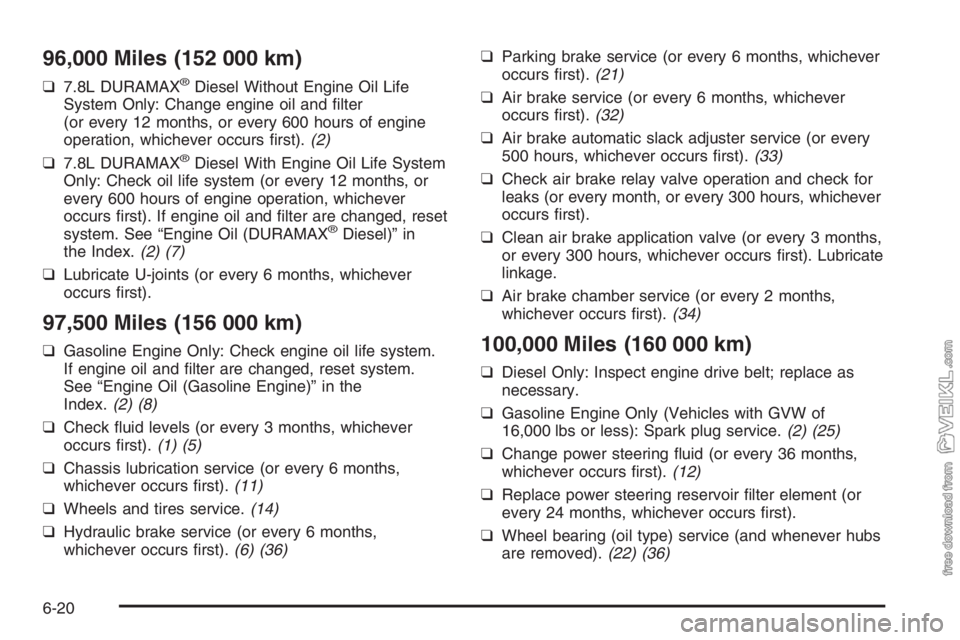
96,000 Miles (152 000 km)
❑7.8L DURAMAX®Diesel Without Engine Oil Life
System Only: Change engine oil and filter
(or every 12 months, or every 600 hours of engine
operation, whichever occurs first).(2)
❑7.8L DURAMAX
®Diesel With Engine Oil Life System
Only: Check oil life system (or every 12 months, or
every 600 hours of engine operation, whichever
occurs first). If engine oil and filter are changed, reset
system. See “Engine Oil (DURAMAX
®Diesel)” in
the Index.(2) (7)
❑Lubricate U-joints (or every 6 months, whichever
occurs first).
97,500 Miles (156 000 km)
❑Gasoline Engine Only: Check engine oil life system.
If engine oil and filter are changed, reset system.
See “Engine Oil (Gasoline Engine)” in the
Index.(2) (8)
❑Check fluid levels (or every 3 months, whichever
occurs first).(1) (5)
❑Chassis lubrication service (or every 6 months,
whichever occurs first).(11)
❑Wheels and tires service.(14)
❑Hydraulic brake service (or every 6 months,
whichever occurs first).(6) (36)❑Parking brake service (or every 6 months, whichever
occurs first).(21)
❑Air brake service (or every 6 months, whichever
occurs first).(32)
❑Air brake automatic slack adjuster service (or every
500 hours, whichever occurs first).(33)
❑Check air brake relay valve operation and check for
leaks (or every month, or every 300 hours, whichever
occurs first).
❑Clean air brake application valve (or every 3 months,
or every 300 hours, whichever occurs first). Lubricate
linkage.
❑Air brake chamber service (or every 2 months,
whichever occurs first).(34)100,000 Miles (160 000 km)
❑Diesel Only: Inspect engine drive belt; replace as
necessary.
❑Gasoline Engine Only (Vehicles with GVW of
16,000 lbs or less): Spark plug service.(2) (25)
❑Change power steering fluid (or every 36 months,
whichever occurs first).(12)
❑Replace power steering reservoir filter element (or
every 24 months, whichever occurs first).
❑Wheel bearing (oil type) service (and whenever hubs
are removed).(22) (36)
6-20
Page 355 of 398
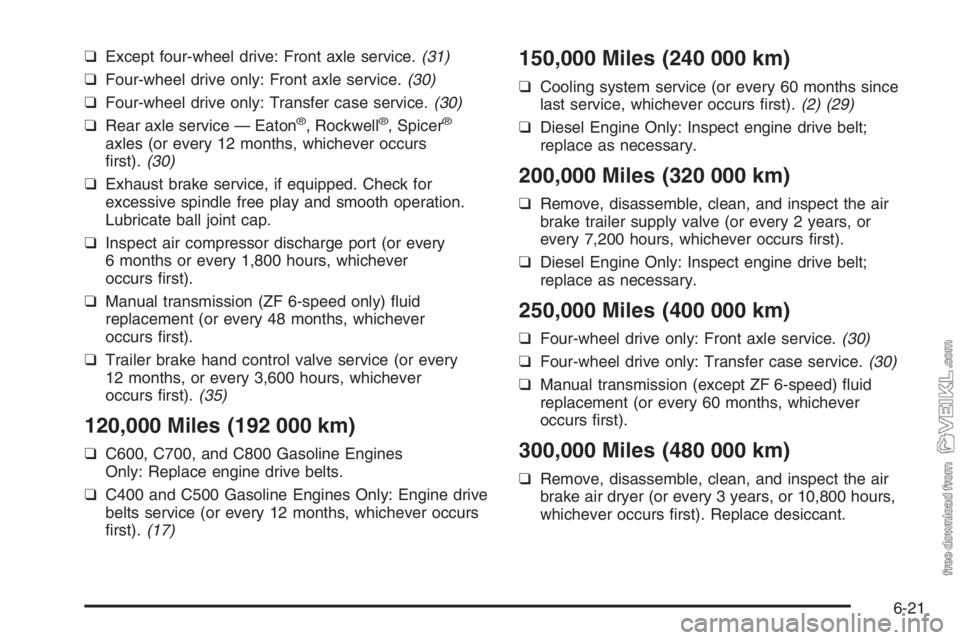
❑Except four-wheel drive: Front axle service.(31)
❑Four-wheel drive only: Front axle service.(30)
❑Four-wheel drive only: Transfer case service.(30)
❑Rear axle service — Eaton
®, Rockwell®, Spicer®
axles (or every 12 months, whichever occurs
first).(30)
❑Exhaust brake service, if equipped. Check for
excessive spindle free play and smooth operation.
Lubricate ball joint cap.
❑Inspect air compressor discharge port (or every
6 months or every 1,800 hours, whichever
occurs first).
❑Manual transmission (ZF 6-speed only) fluid
replacement (or every 48 months, whichever
occurs first).
❑Trailer brake hand control valve service (or every
12 months, or every 3,600 hours, whichever
occurs first).(35)
120,000 Miles (192 000 km)
❑C600, C700, and C800 Gasoline Engines
Only: Replace engine drive belts.
❑C400 and C500 Gasoline Engines Only: Engine drive
belts service (or every 12 months, whichever occurs
first).(17)
150,000 Miles (240 000 km)
❑Cooling system service (or every 60 months since
last service, whichever occurs first).(2) (29)
❑Diesel Engine Only: Inspect engine drive belt;
replace as necessary.
200,000 Miles (320 000 km)
❑Remove, disassemble, clean, and inspect the air
brake trailer supply valve (or every 2 years, or
every 7,200 hours, whichever occurs first).
❑Diesel Engine Only: Inspect engine drive belt;
replace as necessary.
250,000 Miles (400 000 km)
❑Four-wheel drive only: Front axle service.(30)
❑Four-wheel drive only: Transfer case service.(30)
❑Manual transmission (except ZF 6-speed) fluid
replacement (or every 60 months, whichever
occurs first).
300,000 Miles (480 000 km)
❑Remove, disassemble, clean, and inspect the air
brake air dryer (or every 3 years, or 10,800 hours,
whichever occurs first). Replace desiccant.
6-21