ignition CHEVROLET KODIAK 2006 Workshop Manual
[x] Cancel search | Manufacturer: CHEVROLET, Model Year: 2006, Model line: KODIAK, Model: CHEVROLET KODIAK 2006Pages: 398, PDF Size: 5.72 MB
Page 262 of 398
What to Do with Used Oil
Used engine oil contains certain elements that may be
unhealthy for your skin and could even cause cancer.
Do not let used oil stay on your skin for very long. Clean
your skin and nails with soap and water, or a good
hand cleaner. Wash or properly dispose of clothing or
rags containing used engine oil. See the manufacturer’s
warnings about the use and disposal of oil products.
Used oil can be a threat to the environment. If you
change your own oil, be sure to drain all the oil from the
filter before disposal. Never dispose of oil by putting it
in the trash, pouring it on the ground, into sewers, or into
streams or bodies of water. Instead, recycle it by
taking it to a place that collects used oil. If you have a
problem properly disposing of your used oil, ask
your dealer, a service station, or a local recycling center
for help.
Engine Oil Life System
(Caterpillar
®Diesel Engine)
How to Reset the Engine Oil
Life System
The Engine Oil Life System calculates when to change
your engine oil and filter based on vehicle use.
Anytime your oil is changed, reset the system so it can
calculate when the next oil change is required. If a
situation occurs where you change your oil prior to a
change engine oil light being turned on, reset the
system.
To reset the Engine Oil Life System, do the following:
1. Turn the ignition key to RUN with the engine off.
2. Fully apply and hold the brake pedal while you fully
press and release the accelerator pedal, pausing
slightly at each press and each release, three times
within five seconds.
3. Turn the key to OFF.
If the change engine oil light comes back on when you
start your vehicle, the Engine Oil Life System has
not reset. Repeat the procedure.
5-34
Page 277 of 398
Brakes
Brake Fluid
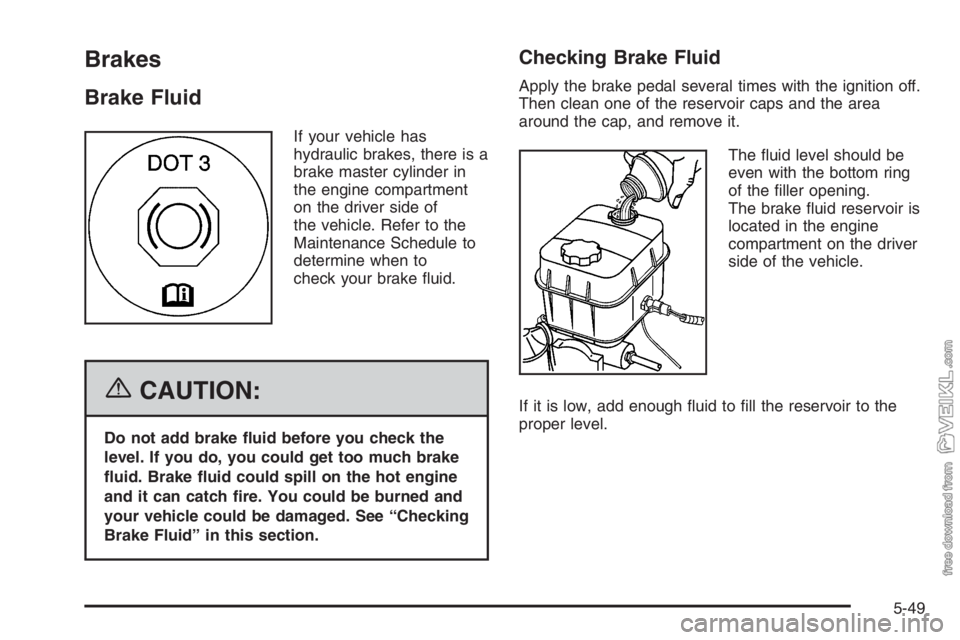
If your vehicle has
hydraulic brakes, there is a
brake master cylinder in
the engine compartment
on the driver side of
the vehicle. Refer to the
Maintenance Schedule to
determine when to
check your brake fluid.
{CAUTION:
Do not add brake uid before you check the
level. If you do, you could get too much brake
uid. Brake uid could spill on the hot engine
and it can catch re. You could be burned and
your vehicle could be damaged. See “Checking
Brake Fluid” in this section.
Checking Brake Fluid
Apply the brake pedal several times with the ignition off.
Then clean one of the reservoir caps and the area
around the cap, and remove it.
The fluid level should be
even with the bottom ring
of the filler opening.
The brake fluid reservoir is
located in the engine
compartment on the driver
side of the vehicle.
If it is low, add enough fluid to fill the reservoir to the
proper level.
5-49
Page 288 of 398
2. Get the vehicles close enough so the jumper cables
can reach, but be sure the vehicles are not touching
each other. If they are, it could cause a ground
connection you do not want. You would not be able
to start your vehicle, and the bad grounding
could damage the electrical systems.
To avoid the possibility of the vehicles rolling, set
the parking brake firmly on both vehicles involved
in the jump start procedure. Put an automatic
transmission in PARK (P) or a manual transmission
in NEUTRAL before setting the parking brake.
If you have a four-wheel-drive vehicle, be sure the
transfer case is in a drive gear, not in NEUTRAL.
Notice:If you leave your radio or other accessories
on during the jump starting procedure, they could
be damaged. The repairs would not be covered
by your warranty. Always turn off your radio and
other accessories when jump starting your vehicle.
3. Turn off the ignition on both vehicles. Unplug
unnecessary accessories plugged into the cigarette
lighter or accessory power outlets. Turn off the
radio and all lamps that are not needed. This will
avoid sparks and help save both batteries, and
it could save the radio!4. Open the hood on the other vehicle and locate the
positive (+) and the negative (−) terminal locations
on that vehicle.
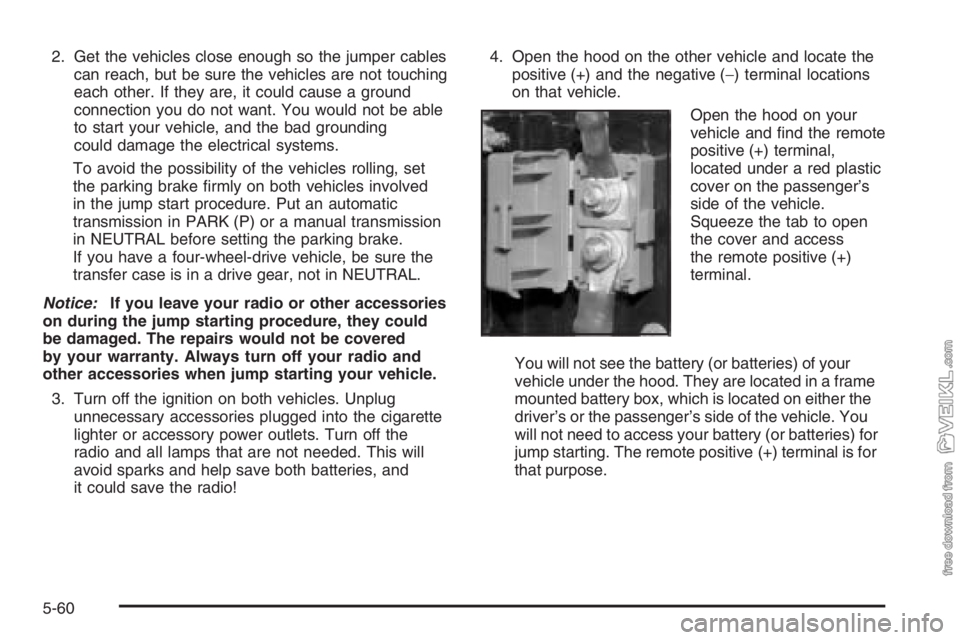
Open the hood on your
vehicle and find the remote
positive (+) terminal,
located under a red plastic
cover on the passenger’s
side of the vehicle.
Squeeze the tab to open
the cover and access
the remote positive (+)
terminal.
You will not see the battery (or batteries) of your
vehicle under the hood. They are located in a frame
mounted battery box, which is located on either the
driver’s or the passenger’s side of the vehicle. You
will not need to access your battery (or batteries) for
jump starting. The remote positive (+) terminal is for
that purpose.
5-60
Page 323 of 398
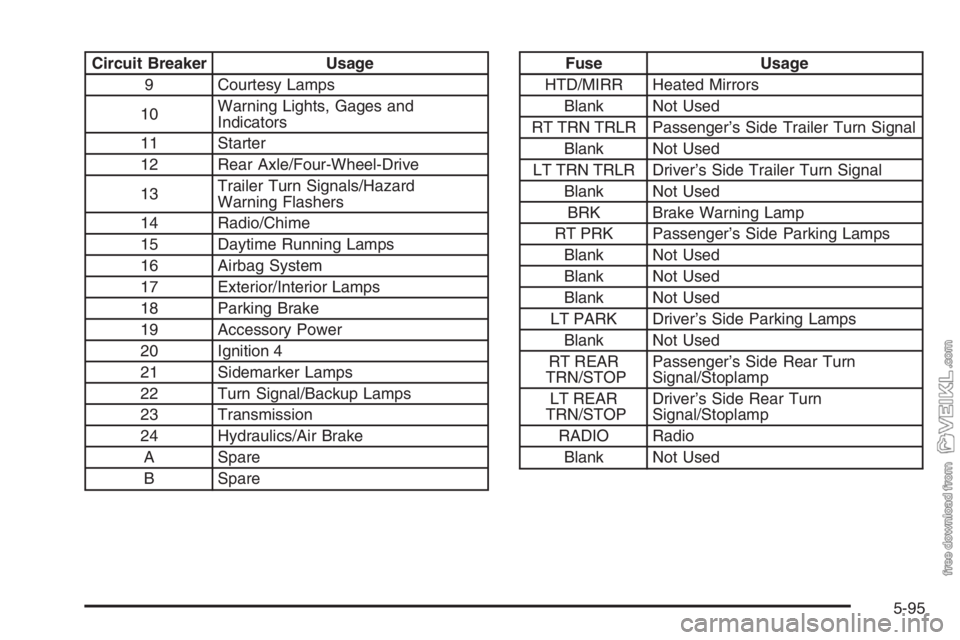
Circuit Breaker Usage
9 Courtesy Lamps
10Warning Lights, Gages and
Indicators
11 Starter
12 Rear Axle/Four-Wheel-Drive
13Trailer Turn Signals/Hazard
Warning Flashers
14 Radio/Chime
15 Daytime Running Lamps
16 Airbag System
17 Exterior/Interior Lamps
18 Parking Brake
19 Accessory Power
20 Ignition 4
21 Sidemarker Lamps
22 Turn Signal/Backup Lamps
23 Transmission
24 Hydraulics/Air Brake
A Spare
B SpareFuse Usage
HTD/MIRR Heated Mirrors
Blank Not Used
RT TRN TRLR Passenger’s Side Trailer Turn Signal
Blank Not Used
LT TRN TRLR Driver’s Side Trailer Turn Signal
Blank Not Used
BRK Brake Warning Lamp
RT PRK Passenger’s Side Parking Lamps
Blank Not Used
Blank Not Used
Blank Not Used
LT PARK Driver’s Side Parking Lamps
Blank Not Used
RT REAR
TRN/STOPPassenger’s Side Rear Turn
Signal/Stoplamp
LT REAR
TRN/STOPDriver’s Side Rear Turn
Signal/Stoplamp
RADIO Radio
Blank Not Used
5-95
Page 324 of 398
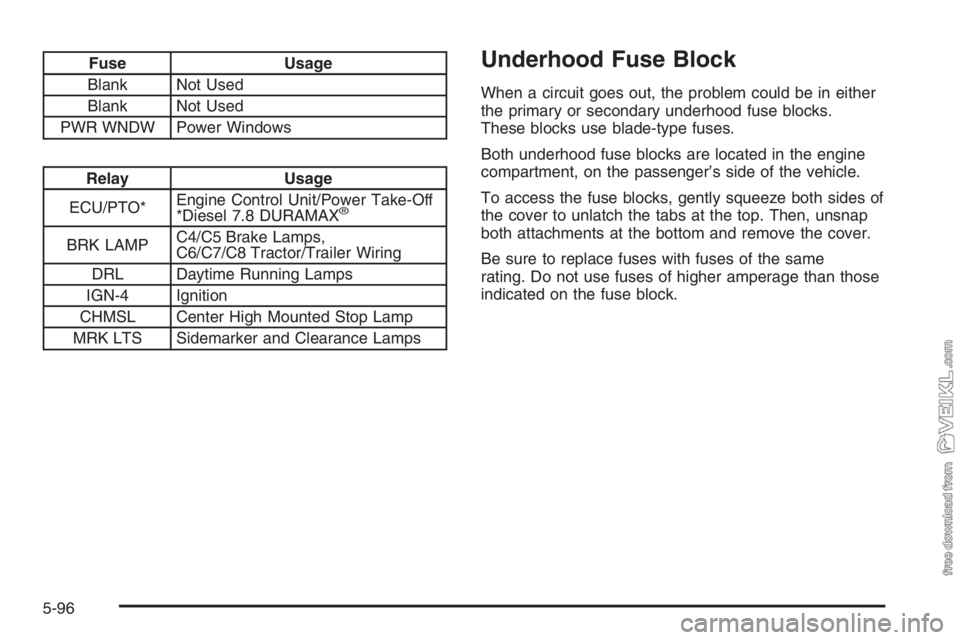
Fuse Usage
Blank Not Used
Blank Not Used
PWR WNDW Power Windows
Relay Usage
ECU/PTO*Engine Control Unit/Power Take-Off
*Diesel 7.8 DURAMAX
®
BRK LAMPC4/C5 Brake Lamps,
C6/C7/C8 Tractor/Trailer Wiring
DRL Daytime Running Lamps
IGN-4 Ignition
CHMSL Center High Mounted Stop Lamp
MRK LTS Sidemarker and Clearance Lamps
Underhood Fuse Block
When a circuit goes out, the problem could be in either
the primary or secondary underhood fuse blocks.
These blocks use blade-type fuses.
Both underhood fuse blocks are located in the engine
compartment, on the passenger’s side of the vehicle.
To access the fuse blocks, gently squeeze both sides of
the cover to unlatch the tabs at the top. Then, unsnap
both attachments at the bottom and remove the cover.
Be sure to replace fuses with fuses of the same
rating. Do not use fuses of higher amperage than those
indicated on the fuse block.
5-96
Page 326 of 398
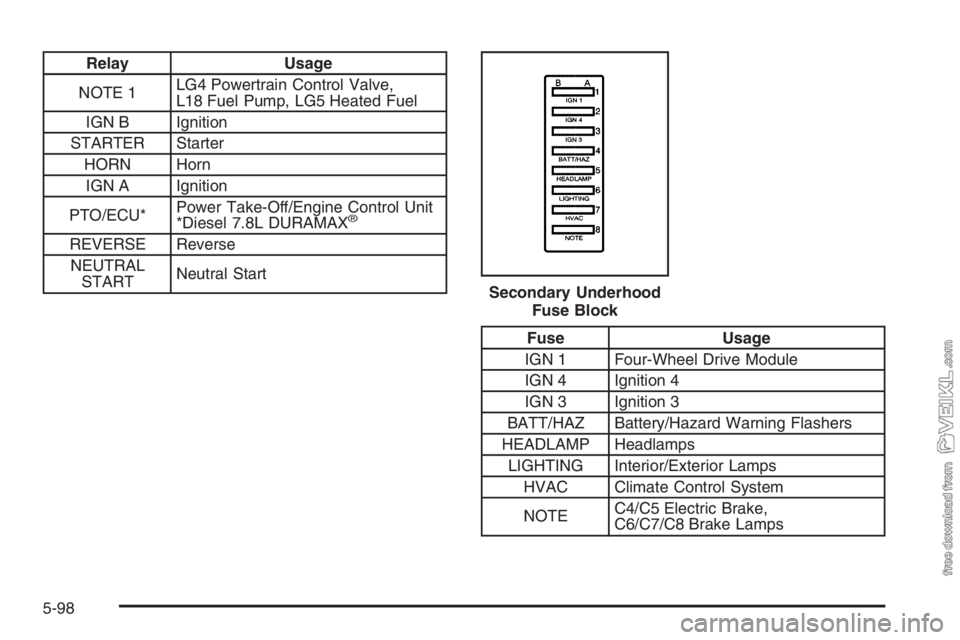
Relay Usage
NOTE 1LG4 Powertrain Control Valve,
L18 Fuel Pump, LG5 Heated Fuel
IGN B Ignition
STARTER Starter
HORN Horn
IGN A Ignition
PTO/ECU*Power Take-Off/Engine Control Unit
*Diesel 7.8L DURAMAX
®
REVERSE Reverse
NEUTRAL
STARTNeutral Start
Fuse Usage
IGN 1 Four-Wheel Drive Module
IGN 4 Ignition 4
IGN 3 Ignition 3
BATT/HAZ Battery/Hazard Warning Flashers
HEADLAMP Headlamps
LIGHTING Interior/Exterior Lamps
HVAC Climate Control System
NOTEC4/C5 Electric Brake,
C6/C7/C8 Brake Lamps Secondary Underhood
Fuse Block
5-98
Page 391 of 398
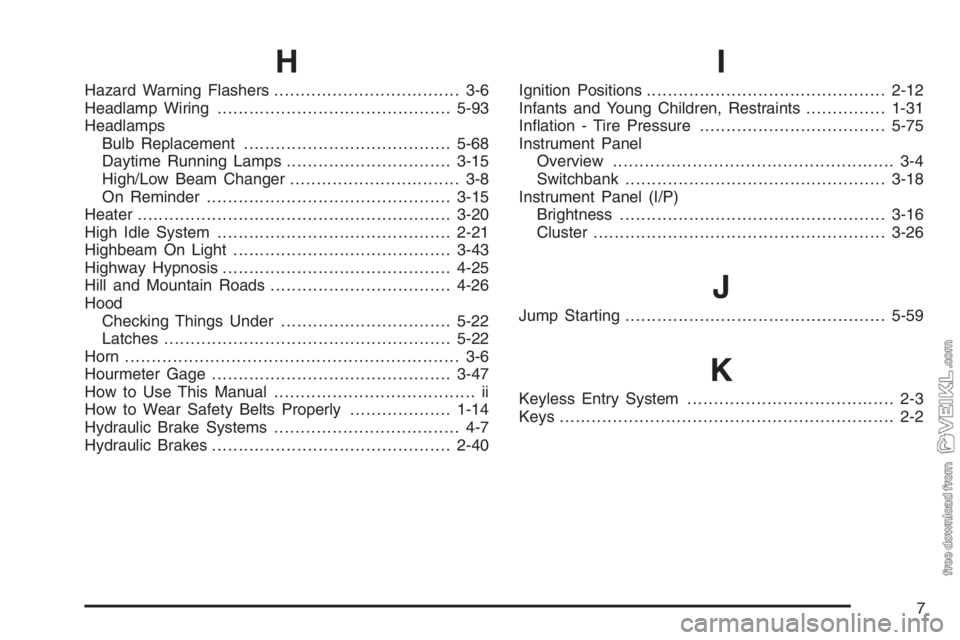
H
Hazard Warning Flashers................................... 3-6
Headlamp Wiring............................................5-93
Headlamps
Bulb Replacement.......................................5-68
Daytime Running Lamps...............................3-15
High/Low Beam Changer................................ 3-8
On Reminder..............................................3-15
Heater...........................................................3-20
High Idle System............................................2-21
Highbeam On Light.........................................3-43
Highway Hypnosis...........................................4-25
Hill and Mountain Roads..................................4-26
Hood
Checking Things Under................................5-22
Latches......................................................5-22
Horn ............................................................... 3-6
Hourmeter Gage.............................................3-47
How to Use This Manual...................................... ii
How to Wear Safety Belts Properly...................1-14
Hydraulic Brake Systems................................... 4-7
Hydraulic Brakes.............................................2-40
I
Ignition Positions.............................................2-12
Infants and Young Children, Restraints...............1-31
Inflation - Tire Pressure...................................5-75
Instrument Panel
Overview..................................................... 3-4
Switchbank.................................................3-18
Instrument Panel (I/P)
Brightness..................................................3-16
Cluster.......................................................3-26
J
Jump Starting.................................................5-59
K
Keyless Entry System....................................... 2-3
Keys............................................................... 2-2
7