engine CHEVROLET KODIAK 2006 Repair Manual
[x] Cancel search | Manufacturer: CHEVROLET, Model Year: 2006, Model line: KODIAK, Model: CHEVROLET KODIAK 2006Pages: 398, PDF Size: 5.72 MB
Page 213 of 398
Once you are moving on the freeway, make certain you
allow a reasonable following distance. Expect to
move slightly slower at night.
When you want to leave the freeway, move to the
proper lane well in advance. If you miss your exit, do
not, under any circumstances, stop and back up. Drive
on to the next exit.
The exit ramp can be curved, sometimes quite
sharply. The exit speed for cars — but not larger
vehicles — is usually posted. You should go more
slowly.
Reduce your speed according to your speedometer, not
to your sense of motion. After driving for any distance
at higher speeds, you may tend to think you are
going slower than you actually are.Highway Hypnosis
Is there actually such a condition as highway hypnosis?
Or is it just plain falling asleep at the wheel? Call it
highway hypnosis, lack of awareness, or whatever.
When you drive the vehicle for a long distance, there is
something about an easy stretch of road with the
same scenery, along with the hum of the tires on the
road, the drone of the engine, and the rush of the wind
against the vehicle that can make you sleepy. Do
not let it happen to you! If it does, your vehicle can leave
the road in less than a second, and you could crash
and be injured.
What can you do about highway hypnosis? First, be
aware that it can happen.
Then here are some tips:
•Make sure your vehicle is well ventilated, with a
comfortably cool interior.
•Keep your eyes moving. Scan the road ahead and
to the sides. Check your mirrors and your
instruments frequently.
•If you get sleepy, pull off the road into a rest,
service, or parking area and take a nap, get some
exercise, or both. For safety, treat drowsiness
on the highway as an emergency.
4-25
Page 214 of 398
Hill and Mountain Roads
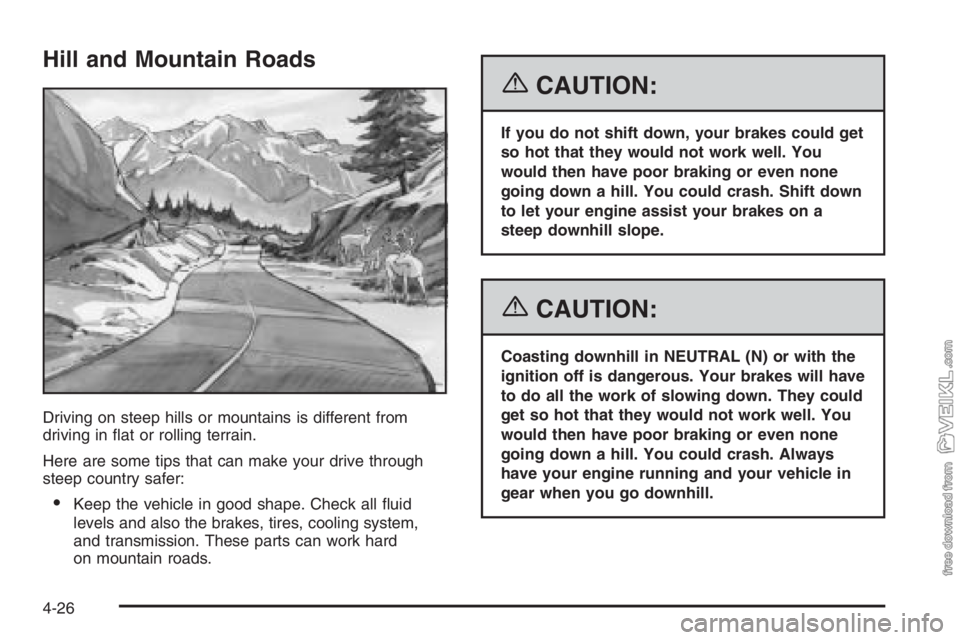
Driving on steep hills or mountains is different from
driving in flat or rolling terrain.
Here are some tips that can make your drive through
steep country safer:
•Keep the vehicle in good shape. Check all fluid
levels and also the brakes, tires, cooling system,
and transmission. These parts can work hard
on mountain roads.
{CAUTION:
If you do not shift down, your brakes could get
so hot that they would not work well. You
would then have poor braking or even none
going down a hill. You could crash. Shift down
to let your engine assist your brakes on a
steep downhill slope.
{CAUTION:
Coasting downhill in NEUTRAL (N) or with the
ignition off is dangerous. Your brakes will have
to do all the work of slowing down. They could
get so hot that they would not work well. You
would then have poor braking or even none
going down a hill. You could crash. Always
have your engine running and your vehicle in
gear when you go downhill.
4-26
Page 215 of 398
•Know how to go down hills. The most important
thing to know is this: let your engine do some of
the slowing down. Shift to a lower gear when you go
down a steep or long hill.
•Know how to go uphill. Use lower gears. They help
cool your engine and transmission, and you can
climb the hill better.
•Stay in your own lane when driving on two-lane
roads in hills or mountains. Do not swing wide
or cut across the center of the road. Drive at speeds
that let you stay in your own lane.
•As you go over the top of a hill, be alert. There
could be something in your lane, like a stalled car or
an accident.
•You may see highway signs on mountains that
warn of special problems. Examples are long
grades, passing or no-passing zones, a falling rocks
area, winding roads, and special truck lanes. Be
alert to these and take appropriate action.
Winter Driving
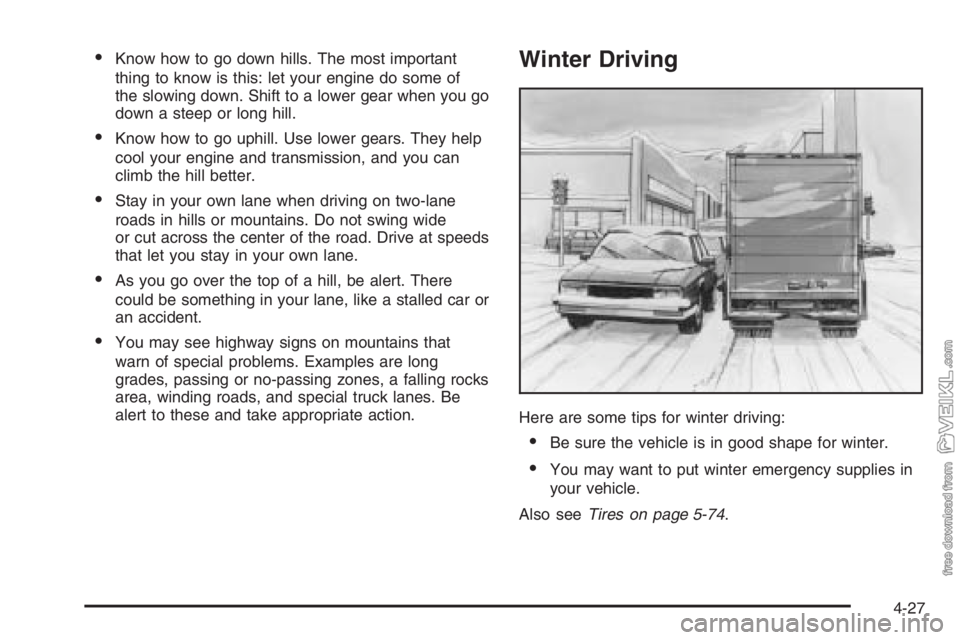
Here are some tips for winter driving:
•Be sure the vehicle is in good shape for winter.
•You may want to put winter emergency supplies in
your vehicle.
Also seeTires on page 5-74.
4-27
Page 218 of 398
If You Are Caught in a Blizzard
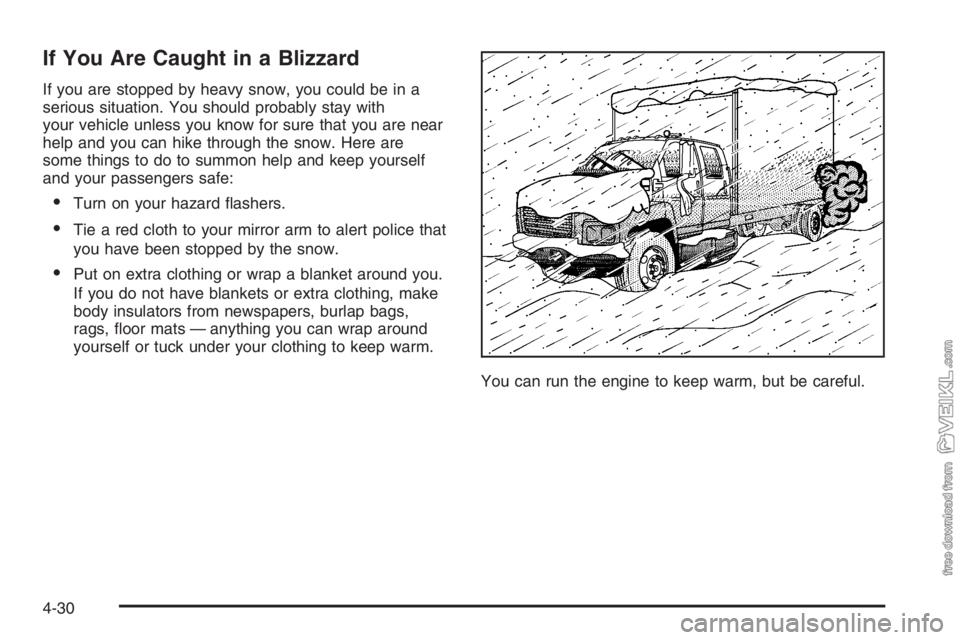
If you are stopped by heavy snow, you could be in a
serious situation. You should probably stay with
your vehicle unless you know for sure that you are near
help and you can hike through the snow. Here are
some things to do to summon help and keep yourself
and your passengers safe:
•Turn on your hazard flashers.
•Tie a red cloth to your mirror arm to alert police that
you have been stopped by the snow.
•Put on extra clothing or wrap a blanket around you.
If you do not have blankets or extra clothing, make
body insulators from newspapers, burlap bags,
rags, floor mats — anything you can wrap around
yourself or tuck under your clothing to keep warm.
You can run the engine to keep warm, but be careful.
4-30
Page 219 of 398
{CAUTION:
Snow can trap exhaust gases under your
vehicle. This can cause deadly CO (carbon
monoxide) gas to get inside. CO could
overcome you and kill you. You cannot see it or
smell it, so you might not know it is in your
vehicle. Clear away snow from around the base
of your vehicle if any is blocking your exhaust
pipe. And check around again from time to time
to be sure snow does not collect there.
Open a window just a little on the side of the
vehicle that is away from the wind. This will help
keep CO out.Run your engine only as long as you must. This saves
fuel. When you run the engine, make it go a little
faster than just idle. That is, push the accelerator
slightly. This uses less fuel for the heat that you get and
it keeps the battery (or batteries) charged. You will
need a well-charged battery (or batteries) to restart the
vehicle, and possibly for signaling later on with your
headlamps. Let the heater run for a while.
If you have a diesel engine, you may have to run it at a
higher speed to get enough heat.
Then, shut the engine off and close the window almost
all the way to preserve the heat. Start the engine
again and repeat this only when you feel really
uncomfortable from the cold. But do it as little as
possible. Preserve the fuel as long as you can. To help
keep warm, you can get out of the vehicle and do
some fairly vigorous exercises every half hour or so until
help comes.
4-31
Page 220 of 398
If Your Vehicle is Stuck in Sand,
Mud, Ice, or Snow
In order to free your vehicle when it is stuck, you will
need to spin the wheels, but you do not want to
spin your wheels too fast. The method known as rocking
can help you get out when you are stuck, but you
must use caution.
{CAUTION:
If you let your tires spin at high speed, they
can explode, and you or others could be
injured. And, the transmission or other parts of
the vehicle can overheat. That could cause an
engine compartment re or other damage.
When you are stuck, spin the wheels as little
as possible. Do not spin the wheels above
35 mph (55 km/h) as shown on the
speedometer.
Notice:Spinning your wheels can destroy parts of
your vehicle as well as the tires. If you spin the
wheels too fast while shifting your transmission
back and forth, you can destroy your transmission.
Rocking Your Vehicle to Get It Out
First, turn the steering wheel left and right. That will
clear the area around the front wheels. If you have a
four-wheel-drive vehicle, shift into 4HI. SeeFour-Wheel
Drive on page 2-35. If your vehicle has traction
control, you should turn the traction control system off.
SeeTraction Control System (TCS) on page 4-12.
Then shift back and forth between REVERSE (R) and a
forward gear, or with a manual transmission, between
FIRST (1) or SECOND (2) and REVERSE (R), spinning
the wheels as little as possible. Release the accelerator
pedal while you shift, and press lightly on the
accelerator pedal when the transmission is in gear. By
slowly spinning your wheels in the forward and
reverse directions, you will cause a rocking motion that
may free your vehicle. If that does not get you out
after a few tries, you may need to be towed out. If you
do need to be towed out, seeTowing Your Vehicle
on page 4-37.
4-32
Page 229 of 398
Service............................................................5-3
California Proposition 65 Warning.....................5-3
Doing Your Own Service Work.........................5-4
Engine Fan Breakage.....................................5-5
Fuel................................................................5-6
Gasoline Octane............................................5-6
Gasoline Specifications....................................5-6
Additives.......................................................5-6
Diesel Engine Fuel.........................................5-7
What Fuel to Use...........................................5-8
Very Cold Weather Operation.........................5-10
Water in Fuel...............................................5-10
Running Out of Fuel.....................................5-17
Fuel Filter Replacement.................................5-18
Fuels in Foreign Countries.............................5-19
Filling the Tank............................................5-20
Filling a Portable Fuel Container.....................5-21
Checking Things Under the Hood....................5-22
Hood Latches...............................................5-22
Engine Oil (Caterpillar
®Diesel Engine).............5-24
Engine Oil (DURAMAX®Diesel)......................5-24
Engine Oil (Gasoline Engine)..........................5-28
Engine Oil Life System (Gasoline Engine)........5-31
Engine Oil Life System (DURAMAX
®Diesel).....5-33
Engine Oil Life System
(Caterpillar
®Diesel Engine).........................5-34Engine Air Cleaner/Filter................................5-35
Automatic Transmission Fluid.........................5-36
Manual Transmission Fluid.............................5-37
Engine Coolant
(Gas and DURAMAX
®Engines)...................5-38
Engine Coolant (Caterpillar®Diesel Engines).....5-40
Coolant Surge Tank Pressure Cap..................5-40
Engine Overheating.......................................5-40
Cooling System
(Gas and DURAMAX
®Engines)...................5-42
Engine Fan Noise.........................................5-47
Power Steering Fluid.....................................5-47
Windshield Washer Fluid................................5-48
Brakes........................................................5-49
Battery........................................................5-58
Jump Starting...............................................5-59
Rear Axle.......................................................5-64
Rear Axle Shift Motor....................................5-65
Four-Wheel Drive............................................5-65
Front Axle......................................................5-66
Noise Control System.....................................5-67
Tampering with Noise Control System
Prohibited.................................................5-67
Bulb Replacement..........................................5-68
Windshield Wiper Blade Replacement..............5-69
Section 5 Service and Appearance Care
5-1
Page 231 of 398
Service
Your dealer knows your vehicle best and wants you to
be happy with it. We hope you will go to your dealer
for all your service needs. You will get genuine GM parts
and GM-trained and supported service people.
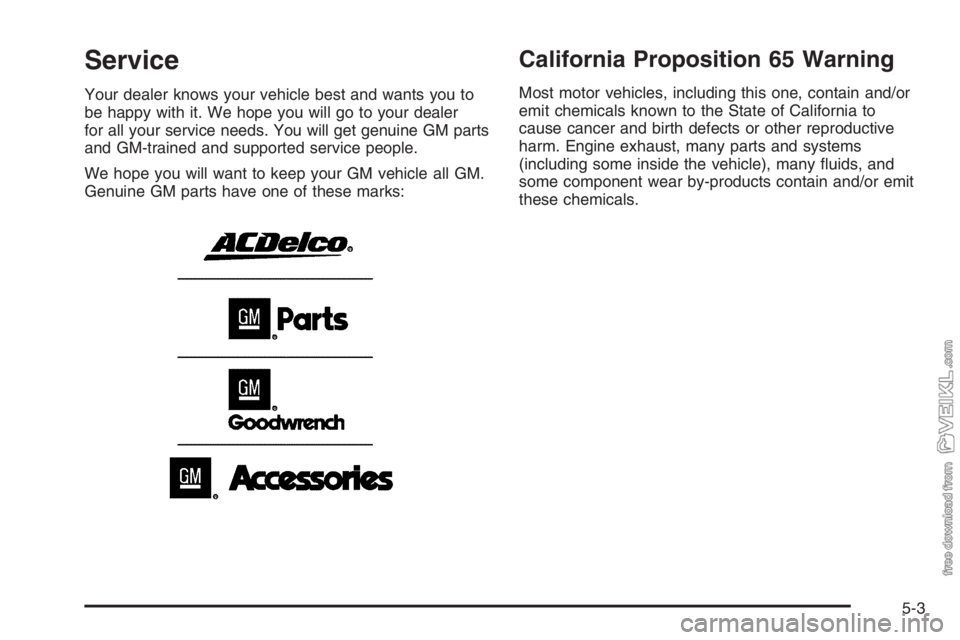
We hope you will want to keep your GM vehicle all GM.
Genuine GM parts have one of these marks:
California Proposition 65 Warning
Most motor vehicles, including this one, contain and/or
emit chemicals known to the State of California to
cause cancer and birth defects or other reproductive
harm. Engine exhaust, many parts and systems
(including some inside the vehicle), many fluids, and
some component wear by-products contain and/or emit
these chemicals.
5-3
Page 233 of 398
Engine Fan Breakage
{CAUTION:
Changing the Fan Drive Ratio or Engine
Governed Speed:
If you change the fan drive ratio or increase
the governed speed of the engine, you may
increase stress and the fan could eventually
fail. If the fan breaks apart while it is
rotating, pieces can cause severe injury to
anyone — such as a service technician — who
is nearby. And, of course, the pieces can
severely damage the vehicle. Do not change
the fan drive ratio or increase the governed
speed of the vehicle without getting the
necessary information from your dealer.
CAUTION: (Continued)
CAUTION: (Continued)
Winter Fronts, Grille Covers or Obstructions:
Winter Fronts, grille covers or other add-on
equipment causing obstructions in front or
behind the fan should not be used on this
vehicle. If this causes the fan to eventually
break apart while it is rotating, the pieces can
cause severe injury to anyone nearby, such as
a service technician working on the engine,
and of course the pieces can severely damage
the vehicle.
5-5
Page 234 of 398
Fuel
If your vehicle has a diesel engine, seeDiesel Engine
Fuel on page 5-7.
For vehicles with gasoline engines, please read this.
Gasoline Octane
Use regular unleaded gasoline with a posted octane
rating of 87 or higher. If the octane rating is less than 87,
you may notice an audible knocking noise when you
drive, commonly referred to as spark knock. If this
occurs, use a gasoline rated at 87 octane or higher as
soon as possible. If you are using gasoline rated at
87 octane or higher and you hear heavy knocking, your
engine needs service.
Gasoline Specications
At a minimum, gasoline should meet ASTM
specification D 4814 in the United States or
CAN/CGSB-3.5 in Canada. Some gasolines may
contain an octane-enhancing additive called
methylcyclopentadienyl manganese tricarbonyl (MMT).
General Motors recommends against the use of
gasolines containing MMT. SeeAdditives on page 5-6
for additional information.
Additives
To provide cleaner air, all gasolines in the United States
are now required to contain additives that will help
prevent engine and fuel system deposits from forming,
allowing your emission control system to work
properly. In most cases, you should not have to add
anything to your fuel. However, some gasolines contain
only the minimum amount of additive required to
meet U.S. Environmental Protection Agency regulations.
To help keep fuel injectors and intake valves clean,
or if your vehicle experiences problems due to
dirty injectors or valves, look for gasoline that is
advertised as TOP TIER Detergent Gasoline. Also, your
GM dealer has additives that will help correct and
prevent most deposit-related problems.
Gasolines containing oxygenates, such as ethers and
ethanol, and reformulated gasolines may be available in
your area. General Motors recommends that you use
these gasolines if they comply with the specifications
described earlier. However, E85 (85% ethanol)
and other fuels containing more than 10% ethanol must
not be used in vehicles that were not designed for
those fuels.
5-6