manual transmission CHEVROLET KODIAK 2006 Owners Manual
[x] Cancel search | Manufacturer: CHEVROLET, Model Year: 2006, Model line: KODIAK, Model: CHEVROLET KODIAK 2006Pages: 398, PDF Size: 5.72 MB
Page 71 of 398
Keys...............................................................2-2
Remote Keyless Entry System.........................2-3
Remote Keyless Entry System Operation...........2-4
Doors and Locks.............................................2-6
Door Locks....................................................2-6
Power Door Locks..........................................2-7
Windows.........................................................2-8
Manual Windows............................................2-9
Power Windows.............................................2-9
Sliding Rear Window.....................................2-10
Sun Visors...................................................2-10
Starting and Operating Your Vehicle................2-11
New Vehicle Break-In....................................2-11
Ignition Positions..........................................2-12
Engine Starter Over-Crank Protection..............2-12
Starting the Gasoline Engine..........................2-13
Starting the Diesel Engine..............................2-15
Engine Alarm and Automatic Shutdown............2-20
High Idle System..........................................2-21
Exhaust Restrictor (Engine Warm-Up)..............2-22
Engine Checks Before Operating....................2-24
Engine Coolant Heater..................................2-26
Diesel Engine Exhaust Brake.........................2-27Two-Speed Rear Axle Electric Shift Control......2-28
Air Shift Control (Automatic Transmission)........2-29
Automatic Transmission Operation...................2-30
Manual Transmission Operation......................2-31
Power Take-Off (PTO)...................................2-35
Four-Wheel Drive..........................................2-35
Parking.......................................................2-40
Hydraulic Brakes (Parking Brake Operation)......2-40
Propshaft Brake Burnish Procedure.................2-41
Air Brake.....................................................2-42
Air Suspension.............................................2-44
Parking Over Things That Burn.......................2-45
Engine Exhaust............................................2-45
Running the Engine While Parked...................2-46
Mirrors...........................................................2-47
Manual Rearview Mirror.................................2-47
Outside Manual Mirrors..................................2-47
Outside Power Mirrors...................................2-47
Outside Convex Mirrors.................................2-48
Outside Heated Mirrors..................................2-48
Storage Areas................................................2-49
Center Console Storage Area.........................2-49
Section 2 Features and Controls
2-1
Page 81 of 398
Starting and Operating
Your Vehicle
New Vehicle Break-In
Notice:Your vehicle does not need an elaborate
break-in. But it will perform better in the long run if
you follow these guidelines:
Let your engine warm up before you operate
your vehicle under load.
Keep your speed at 55 mph (88 km/h) or less for
the rst 500 miles (805 km).
Do not drive at any one speed, fast or slow, for
the rst 500 miles (805 km). Do not make
full-throttle starts.
Avoid making hard stops for the rst 200 miles
(322 km) or so. During this time your new
brake linings are not yet broken in. Hard stops
with new linings can mean premature wear
and earlier replacement. Follow this breaking-in
guideline every time you get new brake
linings.
Use the lowest gear you can when you start a
loaded vehicle in motion and when going up
hills to avoid overloading the engine.
Check and adjust engine and transmission uid
levels often and be sure tires are properly
inated for the load you are carrying.
If you have a Caterpillar®diesel engine, see the
Caterpillar®Diesel Engine Operation and
Maintenance Manual.
2-11
Page 83 of 398
Starting the Gasoline Engine
The 8th digit of your Vehicle Identification Number (VIN)
shows the code letter for your engine. Use this number to
verify the type of engine in your vehicle. SeeVehicle
Identication Number (VIN) on page 5-91. Follow the
proper steps to start the engine.
To start a diesel engine, seeStarting the Diesel Engine
on page 2-15.
Automatic Transmission
Set the parking brake and move your shift lever to
NEUTRAL (N) or PARK (P), if so equipped. Your engine
will not start in any other position — that is a safety
feature.
Manual Transmission
Set the parking brake, shift to neutral NEUTRAL (N)
and hold the clutch pedal to the floor while starting the
engine.
Starter Motor Operation
•The starter motor will disengage if you release the
key or the engine reaches a predetermined engine
speed.
•To prevent overheating, the starter motor will
disengage after continuously operating for
15 seconds. You must release the key from the
start position to re-engage the starter.
•The starter motor will not engage if the engine is
already running.
•The starter motor will disengage if, after
two seconds, the starter pinion gear does not
engage the flywheel or there is no engine rpm signal
from the engine speed sensor.
2-13
Page 85 of 398
While your engine is idling and before you turn it off,
you can make a list of any operational or handling
concerns to give to responsible maintenance personnel
so they can handle them right away.
Moisture will condense in a fuel tank that is almost
empty if the engine has not run for a while, even just
overnight under some conditions. So, it is always best to
refuel your vehicle at the end of each run.
Starting the Diesel Engine
Your vehicle’s diesel engine starts differently than a
gasoline engine. Read the following pages to learn how
to start, restart, warm-up, and stop your diesel engine.
The information applies to both Caterpillar
®diesel
engine and DURAMAX®diesel engine unless otherwise
noted.
If you have a Caterpillar
®diesel engine, also refer to
your Caterpillar®diesel engine Operation & Maintenance
Manual for the starting procedure.
Automatic Transmission
Move your shift lever to PARK (P) or NEUTRAL (N).
Your engine will not start in any other position — that is
a safety feature. To restart when you are already
moving, use NEUTRAL (N) only.
Notice:Do not try to shift to PARK (P) if your
vehicle is moving. If you do, you could damage the
transmission. Shift to PARK (P) only when your
vehicle is stopped.
Manual Transmission
Move your shift lever to NEUTRAL and hold the clutch
pedal to the floor while starting the engine. Your
vehicle will not start if the clutch pedal is not all the way
down — that is a safety feature.
2-15
Page 88 of 398
Cold Weather Starting
(Caterpillar®Diesel)
Because the diesel engine uses compression ignition, it
is harder to start in cold weather than a gasoline engine.
The air intake heater and use of the proper engine oil,
optional engine coolant heaters and optional ether
injection systems help cold weather starting. See the
Caterpillar
®Diesel Engine Operation & Maintenance
Manual for more information.
Restarting the Diesel Engine While
Moving (Automatic Transmission)
If you have to restart the engine while the vehicle is
moving, you will first have to shift to NEUTRAL (N). This
safety feature prevents starting the engine when the
transmission is in a drive gear for more information.
Stopping the Diesel Engine
1. Set the parking brake and shift to NEUTRAL (N) or
PARK (P).
2. Turn the ignition key to OFF.
If your vehicle has a two-speed axle, see
Two-Speed Rear Axle Electric Shift Control on
page 2-28.
If you have a Caterpillar
®diesel engine, see your
Caterpillar®Diesel Engine Operation & Maintenance
Manual for additional information.
Diesel Engine Warm-Up
Several factors affect how quickly your diesel engine
warms up. These can include outside temperature,
engine load, idle time and your vehicle’s option content.
Your vehicle may be equipped with some features
that can help the engine reach operating temperature
sooner. Some of these features are discussed below.
Also, remember that an automatic transmission
adds heat to the cooling system through the heat
exchanger in the radiator. Because of this, vehicles
equipped with automatic transmissions are often able to
retain engine coolant heat better than manual
transmission vehicles.
See your Caterpillar
®Operation & Maintenance manual
for additional diesel engine warm-up information.
2-18
Page 91 of 398
High Idle System
High Idle System with Switch
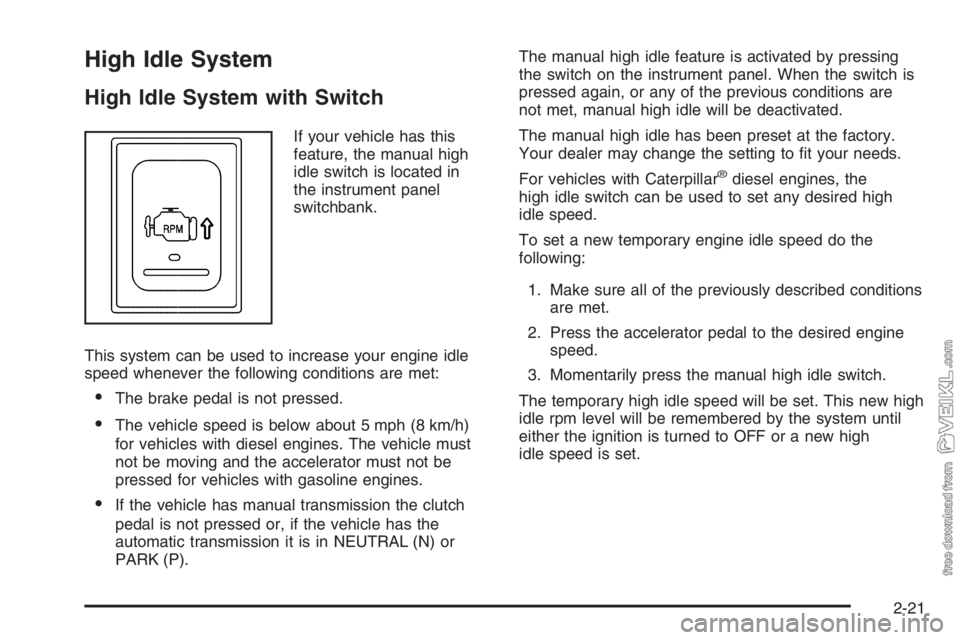
If your vehicle has this
feature, the manual high
idle switch is located in
the instrument panel
switchbank.
This system can be used to increase your engine idle
speed whenever the following conditions are met:
•The brake pedal is not pressed.
•The vehicle speed is below about 5 mph (8 km/h)
for vehicles with diesel engines. The vehicle must
not be moving and the accelerator must not be
pressed for vehicles with gasoline engines.
•If the vehicle has manual transmission the clutch
pedal is not pressed or, if the vehicle has the
automatic transmission it is in NEUTRAL (N) or
PARK (P).The manual high idle feature is activated by pressing
the switch on the instrument panel. When the switch is
pressed again, or any of the previous conditions are
not met, manual high idle will be deactivated.
The manual high idle has been preset at the factory.
Your dealer may change the setting to fit your needs.
For vehicles with Caterpillar
®diesel engines, the
high idle switch can be used to set any desired high
idle speed.
To set a new temporary engine idle speed do the
following:
1. Make sure all of the previously described conditions
are met.
2. Press the accelerator pedal to the desired engine
speed.
3. Momentarily press the manual high idle switch.
The temporary high idle speed will be set. This new high
idle rpm level will be remembered by the system until
either the ignition is turned to OFF or a new high
idle speed is set.
2-21
Page 92 of 398
Automatic High Idle System
The automatic high idle feature will engage whenever
you start your vehicle and the engine is below the preset
operating temperature. This will help decrease engine
warm-up time.
On vehicles that have the Caterpillar
®diesel engine you
may have an exhaust restrictor that will operate in
High Idle mode. The exhaust brake switch must be on
for this feature to operate. SeeDiesel Engine Exhaust
Brake on page 2-27for more information.
Idle speed will then return to normal under any of the
following conditions:
•The engine reaches the preset operating
temperature or has been operating for at least
10 minutes.
•The brake pedal is pressed.
•The manual transmission clutch pedal is pressed
or, if the vehicle has automatic transmission, it is
shifted from NEUTRAL (N) or PARK (P).
•The vehicle speed exceeds about 5 mph (8 km/h).
•The throttle is pressed.
Exhaust Restrictor
(Engine Warm-Up)
Exhaust Restrictor
If your vehicle has a DURAMAX®7800 or Caterpillar®
diesel engine, it may have a feature called an Exhaust
Restrictor (NPE), which uses an air actuated valve
in the exhaust system to restrict exhaust gas flow which
enhances the engine and heater warm-up.
Automatic Quick Warm-Up
If your vehicle has with a DURAMAX®6600 engine, it
has a feature called an Automatic Quick Warm-Up,
which uses the turbocharger to restrict the exhaust gas
flow which enhances the engine and heater warm-up.
In both systems, exhaust restrictor or automatic
quick warm-up, the cold temperature high idle feature
elevates the engines idle speed, up to 1500 rpm,
and restricts the exhaust gas flow, when outside
temperatures are below 32°F (0°C), and the engine
coolant temperature is below certain levels. This feature
enhances heater performance by raising the engine
coolant temperature faster.
2-22
Page 93 of 398
For all engines this feature is already turned on. The
automatic quick warm-up on the DURAMAX®engine
can be turned off and on by doing the following
procedure:
1. Turn the ignition to RUN, with the vehicle off.
2. Press the accelerator pedal to the floor and hold it
while quickly pressing and fully releasing the brake
pedal three times in less than eight seconds.
3. Release the accelerator pedal and start the engine.
The green exhaust brake/restrictor light below the
radio controls will be lit for 10 seconds.
If this feature is turned off, by doing the procedure
described previously, and then the engine is
started, the exhaust brake/restrictor light will flash
for 10 seconds and then it will turn off.
When the engine is started, it will slowly increase to the
high idle speed after a delay of a few seconds; up to
about two minutes. For this method to work properly
there must be no throttle or brake pedal faults, and the
throttle pedal must not fall below 75 percent of wide
open throttle while pressing the brake pedal.The engine idle speed will return to normal once the
following conditions are met:
•Once engine coolant temperature reaches about
150°F (65°C).
•The intake temperature reaches a certain level.
The high idle speed will be temporarily interrupted and
the engine speed will return to normal if any of the
following conditions occur:
•The brake pedal is applied.
•The accelerator pedal is pressed.
•The automatic transmission is shifted out of
PARK (P) or NEUTRAL (N).
•The clutch pedal on the manual transmission is
pressed.
•Vehicle speed is detected.
Once these conditions no longer exist, the engine
idle speed will slowly increase to high idle after the
normal delay, if the conditions for engine coolant
temperature and air intake temperature are still met.
2-23
Page 98 of 398
Two-Speed Rear Axle Electric Shift
Control
If your vehicle has this feature, you will find a label on
the headliner above the windshield or in another
place near the driver that shows how to use it. Be sure
to follow the directions carefully.
Use the following directions based on the type of shift
control the vehicle has.
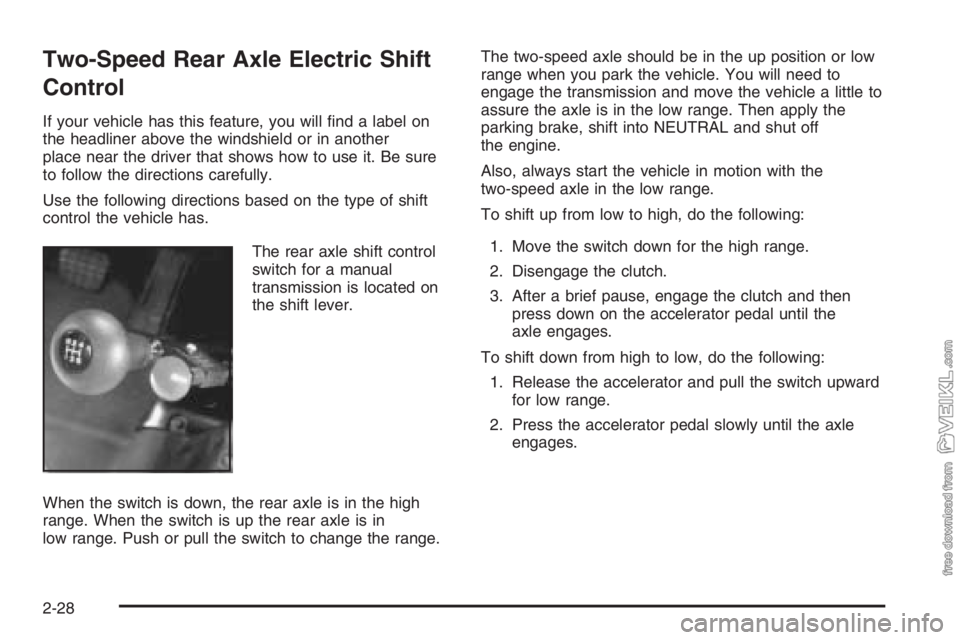
The rear axle shift control
switch for a manual
transmission is located on
the shift lever.
When the switch is down, the rear axle is in the high
range. When the switch is up the rear axle is in
low range. Push or pull the switch to change the range.The two-speed axle should be in the up position or low
range when you park the vehicle. You will need to
engage the transmission and move the vehicle a little to
assure the axle is in the low range. Then apply the
parking brake, shift into NEUTRAL and shut off
the engine.
Also, always start the vehicle in motion with the
two-speed axle in the low range.
To shift up from low to high, do the following:
1. Move the switch down for the high range.
2. Disengage the clutch.
3. After a brief pause, engage the clutch and then
press down on the accelerator pedal until the
axle engages.
To shift down from high to low, do the following:
1. Release the accelerator and pull the switch upward
for low range.
2. Press the accelerator pedal slowly until the axle
engages.
2-28
Page 100 of 398
Automatic Transmission Operation
We build vehicles with Allison®five and six-speed
automatic transmissions. This part of the manual covers
the basics of these. With these transmissions, you
will find another Allison
®manual in your vehicle that
goes into more detail. On the headliner, in front of and
above the driver, or in some other place near the
driver, you will see a label that describes important
operating facts about the automatic transmission in
your vehicle. Make sure you follow the instructions on
this label.
Be sure to keep your parking brake set until you are
ready to shift into DRIVE (D), and press the brake pedal
while shifting from NEUTRAL (N) or PARK (P) to a
drive gear.
All vehicles equipped with automatic transmissions can
be started in PARK (P), if equipped, or in NEUTRAL (N).
See the Allison
®Transmission Operator’s Manual in
your vehicle for more information about this.
{CAUTION:
It can be dangerous to get out of your vehicle
without the parking brake rmly set. Your
vehicle can roll. If you have left the engine
running, the vehicle can move suddenly. You
or others could be injured. To be sure your
vehicle will not move, even when you are on
fairly level ground, always set the parking
brake.
{CAUTION:
Shifting into a drive gear while your engine is
running at high speed is dangerous. Unless
your foot is rmly on the brake pedal, your
vehicle could move very rapidly. You could
lose control and hit people or objects. Do not
shift into a drive gear while your engine is
running at high speed.
2-30