battery CHEVROLET KODIAK 2007 Owner's Manual
[x] Cancel search | Manufacturer: CHEVROLET, Model Year: 2007, Model line: KODIAK, Model: CHEVROLET KODIAK 2007Pages: 430, PDF Size: 6.06 MB
Page 306 of 430
Notice:Ignoring these steps could result in
costly damage to your vehicle that would
not be covered by your warranty.
Trying to start your vehicle by pushing or
pulling it will not work, and it could damage
your vehicle.
1. Check the other vehicle. It must have a
12-volt battery (or batteries) with a negative
ground system.
Notice:If the other vehicle’s system is not a
12-volt system with a negative ground,
both vehicles can be damaged. Only use
vehicles with 12-volt systems with negative
grounds to jump start your vehicle.
If you have a diesel engine vehicle with
two batteries (or more), you should know
before you begin that, especially in cold
weather, you may not be able to get enough
power from a single battery in another
vehicle to start your diesel engine.
If your vehicle has more than one battery, use
the one closest to the starter — this will
reduce electrical resistance.2. Get the vehicles close enough so the jumper
cables can reach, but be sure the vehicles are
not touching each other. If they are, it could
cause a ground connection you do not
want. You would not be able to start your
vehicle, and the bad grounding could damage
the electrical systems.
To avoid the possibility of the vehicles rolling,
set the parking brake firmly on both vehicles
involved in the jump start procedure. Put
an automatic transmission in PARK (P) or a
manual transmission in NEUTRAL before
setting the parking brake. If you have a
four-wheel-drive vehicle, be sure the transfer
case is in a drive gear, not in NEUTRAL.
Notice:If you leave your radio or other
accessories on during the jump starting
procedure, they could be damaged. The repairs
would not be covered by your warranty.
Always turn off your radio and other
accessories when jump starting your vehicle.
3. Turn off the ignition on both vehicles. Unplug
unnecessary accessories plugged into the
cigarette lighter or accessory power outlets.
306
Page 307 of 430
Turn off the radio and all lamps that are not
needed. This will avoid sparks and help save
both batteries, and it could save the radio!
4. Open the hood on the other vehicle and
locate the positive (+) and the negative (−)
terminal locations on that vehicle.
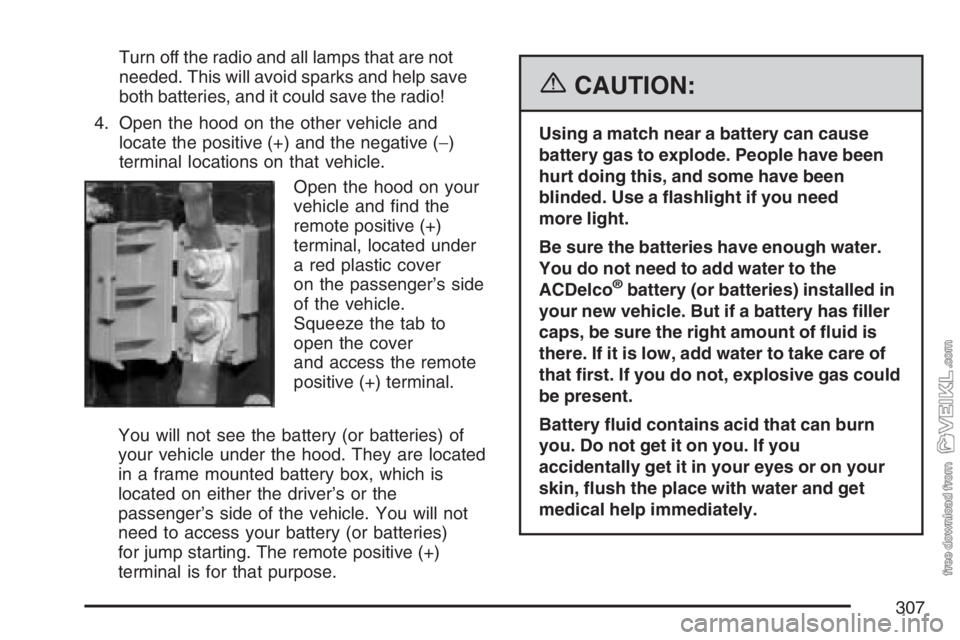
Open the hood on your
vehicle and find the
remote positive (+)
terminal, located under
a red plastic cover
on the passenger’s side
of the vehicle.
Squeeze the tab to
open the cover
and access the remote
positive (+) terminal.
You will not see the battery (or batteries) of
your vehicle under the hood. They are located
in a frame mounted battery box, which is
located on either the driver’s or the
passenger’s side of the vehicle. You will not
need to access your battery (or batteries)
for jump starting. The remote positive (+)
terminal is for that purpose.
{CAUTION:
Using a match near a battery can cause
battery gas to explode. People have been
hurt doing this, and some have been
blinded. Use a ashlight if you need
more light.
Be sure the batteries have enough water.
You do not need to add water to the
ACDelco
®battery (or batteries) installed in
your new vehicle. But if a battery has ller
caps, be sure the right amount of uid is
there. If it is low, add water to take care of
that rst. If you do not, explosive gas could
be present.
Battery uid contains acid that can burn
you. Do not get it on you. If you
accidentally get it in your eyes or on your
skin, ush the place with water and get
medical help immediately.
307
Page 308 of 430
{CAUTION:
Fans or other moving engine parts can
injure you badly. Keep your hands away
from moving parts once the engine is
running.
5. Check that the jumper cables do not have
loose or missing insulation. If they do, you
could get a shock. The vehicles could
be damaged too.
Before you connect the cables, here are some
basic things you should know. Positive (+)
will go to positive (+) or to a remote positive (+)
terminal if the vehicle has one. Negative (−)
will go to a heavy, unpainted metal engine part
or to a remote negative (−) terminal if the
vehicle has one.Do not connect positive (+) to negative (−)or
you will get a short that would damage
the battery and maybe other parts too. And do
not connect the negative (−) cable to the
negative (−) terminal on the dead battery
because this can cause sparks.
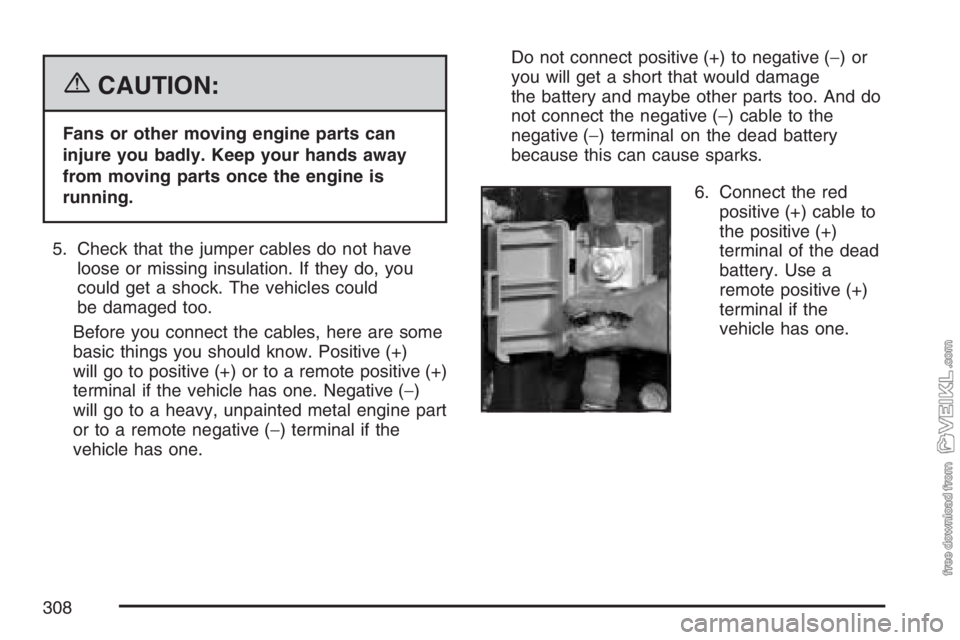
6. Connect the red
positive (+) cable to
the positive (+)
terminal of the dead
battery. Use a
remote positive (+)
terminal if the
vehicle has one.
308
Page 309 of 430
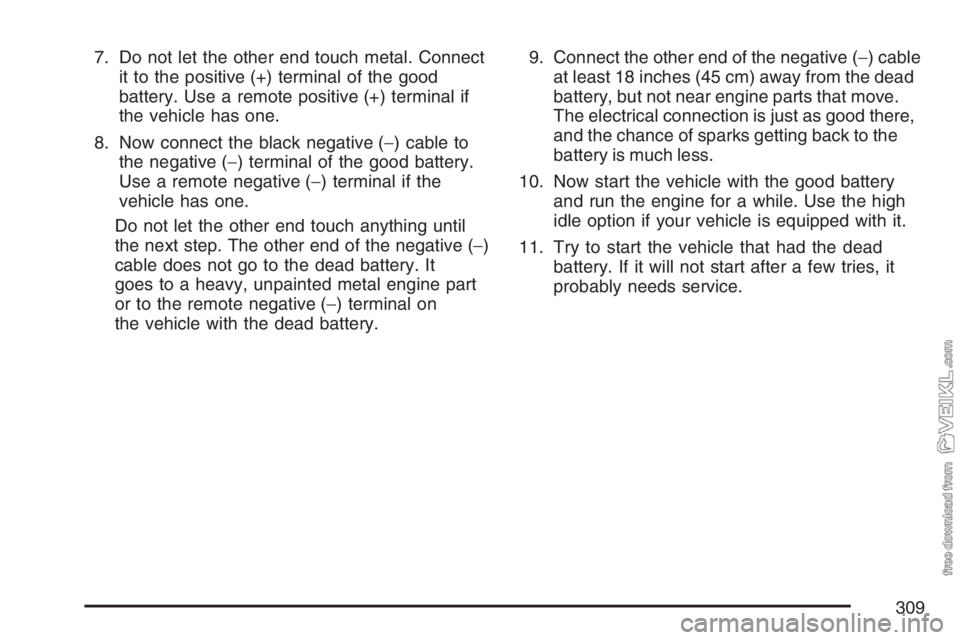
7. Do not let the other end touch metal. Connect
it to the positive (+) terminal of the good
battery. Use a remote positive (+) terminal if
the vehicle has one.
8. Now connect the black negative (−) cable to
the negative (−) terminal of the good battery.
Use a remote negative (−) terminal if the
vehicle has one.
Do not let the other end touch anything until
the next step. The other end of the negative (−)
cable does not go to the dead battery. It
goes to a heavy, unpainted metal engine part
or to the remote negative (−) terminal on
the vehicle with the dead battery.9. Connect the other end of the negative (−) cable
at least 18 inches (45 cm) away from the dead
battery, but not near engine parts that move.
The electrical connection is just as good there,
and the chance of sparks getting back to the
battery is much less.
10. Now start the vehicle with the good battery
and run the engine for a while. Use the high
idle option if your vehicle is equipped with it.
11. Try to start the vehicle that had the dead
battery. If it will not start after a few tries, it
probably needs service.
309
Page 310 of 430
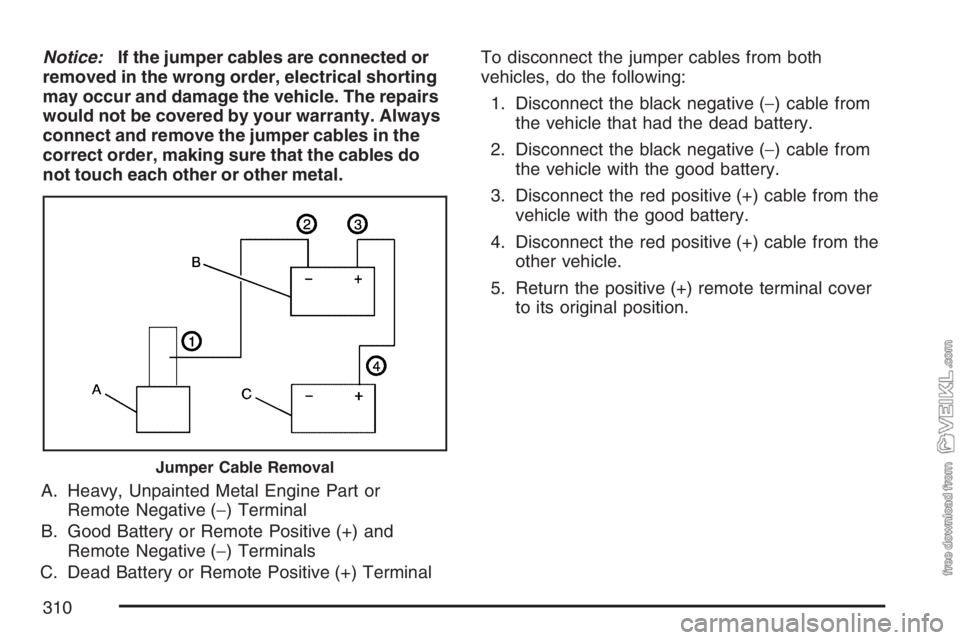
Notice:If the jumper cables are connected or
removed in the wrong order, electrical shorting
may occur and damage the vehicle. The repairs
would not be covered by your warranty. Always
connect and remove the jumper cables in the
correct order, making sure that the cables do
not touch each other or other metal.
A. Heavy, Unpainted Metal Engine Part or
Remote Negative (−) Terminal
B. Good Battery or Remote Positive (+) and
Remote Negative (−) Terminals
C. Dead Battery or Remote Positive (+) TerminalTo disconnect the jumper cables from both
vehicles, do the following:
1. Disconnect the black negative (−) cable from
the vehicle that had the dead battery.
2. Disconnect the black negative (−) cable from
the vehicle with the good battery.
3. Disconnect the red positive (+) cable from the
vehicle with the good battery.
4. Disconnect the red positive (+) cable from the
other vehicle.
5. Return the positive (+) remote terminal cover
to its original position.
Jumper Cable Removal
310
Page 346 of 430
Fuse Usage
NOTE 3L18 Fuel, LG4 Powertrain Control
Valve, LG5 Electronic Control
Module
STUD A Spare
STUD B Spare
Relay Usage
NOTE 1LLY/L18 Fuel Pump Relay, LG4/LG5
Heated Fuel Relay
IGN B Ignition Relay
STARTER Starter Relay
HORN Horn Relay
IGN A Ignition Relay
PTO/ECU*Power Take-Off/Engine Control Unit
(*Diesel 7.8L LG4)
REVERSE Reverse Relay
NEUTRAL
STARTNeutral Start (LG4 Allison Automatic
Transmission Series 3000/3500)
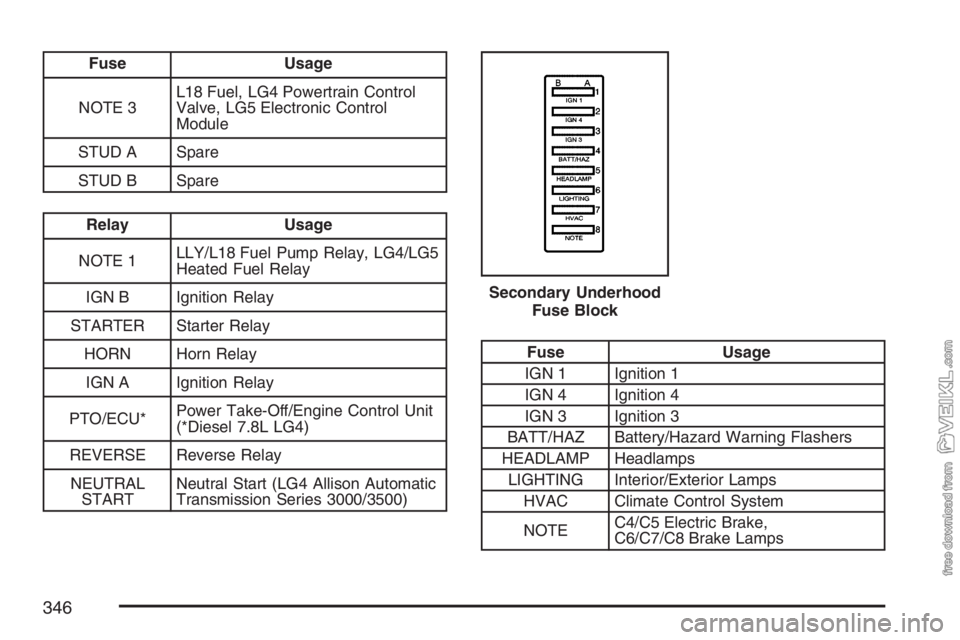
Fuse Usage
IGN 1 Ignition 1
IGN 4 Ignition 4
IGN 3 Ignition 3
BATT/HAZ Battery/Hazard Warning Flashers
HEADLAMP Headlamps
LIGHTING Interior/Exterior Lamps
HVAC Climate Control System
NOTEC4/C5 Electric Brake,
C6/C7/C8 Brake Lamps Secondary Underhood
Fuse Block
346
Page 418 of 430
Appearance Care (cont.)
Washing Your Vehicle.............................. 335
Weatherstrips........................................... 334
Windshield and Wiper Blades................... 336
Ashtray(s).................................................... 157
Audio System(s).......................................... 184
AM-FM Radio.......................................... 186
Care of Your Cassette Tape Player.......... 202
Care of Your CD Player........................... 204
Care of Your CDs.................................... 203
Chime Level Adjustment........................... 204
Fixed Mast Antenna................................. 204
Radio with Cassette................................. 189
Radio with CD......................................... 195
Setting the Time...................................... 185
Theft-Deterrent Feature............................ 201
Understanding Radio Reception............... 201
Automatic Ether Injection System................ 318
Automatic Transmission
Fluid........................................................ 282
Operation................................................. 115
Axle, Two-Speed Rear Axle Electric Shift
Control..................................................... 113B
Battery........................................................ 304
Bench Seat, Split.......................................... 13
Brake
Anti-Lock Brake System (ABS)................. 212
Diesel Engine Exhaust............................. 112
Emergencies............................................ 213
Exhaust Indicator Light............................. 178
Hydraulic Systems................................... 211
Parking...........................................125, 126
System Warning Light.............................. 169
Trailer Hand Control Valve....................... 214
Brakes........................................................ 297
Parking Brake Burnish Procedure............. 128
Braking....................................................... 210
Braking in Emergencies............................... 213
Break-In, New Vehicle................................... 95
Bucket Seats.................................................. 9
Bulb Replacement....................................... 315
C
California Proposition 65 Warning................ 248
Canadian Owners........................................... 3
Capacities and Specifications...................... 347
Carbon Monoxide...............................131, 231
418
Page 421 of 430
E
Electrical System
Add-On Equipment................................... 340
Fuses and Circuit Breakers...................... 341
Fusible Links............................................ 341
Headlamp Wiring..................................... 341
Instrument Panel Fuse Block................... 342
Power Windows and Other Power
Options................................................. 341
Underhood Fuse Block............................. 344
Windshield Wiper Fuses........................... 341
Engine
Air Cleaner/Filter...................................... 280
Alarm and Automatic Shutdown................ 104
Battery..................................................... 304
Change Engine Oil Light.......................... 176
Check and Service Engine Soon Light..... 174
Checks Before Operating......................... 109
Coolant...........................................284, 287
Coolant Heater......................................... 111
Coolant Temperature Gage...................... 173
Diesel Engine Exhaust Brake................... 112
Drive Belt Routing.................................... 355
Exhaust................................................... 131
Exhaust Restrictor.................................... 108
Fan Breakage.......................................... 250Engine (cont.)
Fan Noise................................................ 294
High Idle System..................................... 106
Oil ...................................................268, 272
Oil Life System.......................276, 278, 279
Overheating............................................. 288
Overspeed Warning Light......................... 177
Reduced Power Light............................... 179
Shutdown Warning Light.......................... 177
Speed Limiter.......................................... 164
Starter Over-Crank Protection.................... 97
Starting Your Diesel................................. 100
Starting Your Gasoline............................... 97
Entry Lighting.............................................. 154
Event Data Recorders (EDR)...................... 409
Exhaust Brake Indicator Light...................... 178
Exhaust Restrictor....................................... 108
Extender, Safety Belt..................................... 41
Exterior Lamps............................................ 150
F
Filter
Engine Air Cleaner................................... 280
Filter Minder Gage...................................... 182
Finish Damage............................................ 338
Fixed Mast Antenna.................................... 204
421