brakes CHEVROLET KODIAK 2007 Owner's Guide
[x] Cancel search | Manufacturer: CHEVROLET, Model Year: 2007, Model line: KODIAK, Model: CHEVROLET KODIAK 2007Pages: 430, PDF Size: 6.06 MB
Page 299 of 430
Four-Wheel Disc Brakes
(Hydraulic Only)
Your vehicle has four-wheel disc brakes.
Some driving conditions or climates may cause a
brake squeal when the brakes are first applied
or lightly applied. This does not mean something
is wrong with the brakes.
Brake linings should always be replaced as
complete axle sets.
Four-Wheel and Six-Wheel Drum
Brakes (Air Only)
The brake drums should be removed and
inspected each time the tires are removed for
rotation or changing. When you have the
front brakes replaced, have the rear brakes
inspected, too.
Brake linings should always be replaced as
complete axle sets.
Brake Pedal Travel
See your dealer if the brake pedal does not return
to normal height, or if there is a rapid increase in
pedal travel. This could be a sign that brake service
is needed.
Brake Adjustment
Every time you make a brake stop, the brakes
adjust for wear.
Brake Adjustment on Air Braked
Vehicles
Your vehicle has automatic slack adjusters.
Every time you make a brake stop, the brakes
automatically adjust for wear. Slack adjusters
should never be manually adjusted to correct
excessive brake chamber pushrod stroke.
Excessive brake chamber pushrod stroke means
that the brake system needs to be serviced by
a qualified service technician.
Notice:Do not manually adjust automatic slack
adjusters. Manual adjustment of the automatic
slack adjusters can result in a degradation of
the slack adjuster performance over time.
If the brake chamber pushrod stroke is out of
adjustment, the brake system needs to be
serviced by a qualied service technician.
299
Page 300 of 430
Replacing Brake System Parts
The braking system on a vehicle is complex.
Its many parts have to be of top quality and work
well together if the vehicle is to have really
good braking. Your vehicle was designed and
tested with top-quality GM brake parts. When
you replace parts of the braking system — for
example, when the brake linings wear down and
you need new ones put in — be sure you get
new approved GM replacement parts. If you do
not, the brakes may no longer work properly.
For example, if someone puts in brake linings that
are wrong for your vehicle, the balance between
the front and rear brakes can change — for
the worse. The braking performance you have
come to expect can change in many other ways
if someone puts in the wrong replacement
brake parts.
Air Brake Systems
If your vehicle has air brakes, it is important to
get rid of moisture in the system. Moisture will
damage the system if it is not removed daily.There are two ways to do this. One is automatic
through the air brake vehicle’s air dryer with integral
automatic moisture ejector that purges air from the
system through a self-contained reservoir. The
other way to drain moisture from the air brake
system is to manually activate drain valves at each
reservoir. Drain the air reservoirs occasionally to be
sure the air dryer is working properly.
Drain the air brakes at full system pressure. To be
sure you are at full pressure, check the air pressure
gage. It should read at least 100 psi (692 kPa).
Air Dryer
If your vehicle has air brakes, it has an air dryer
mounted on the passenger side frame rail. This
collects and removes dirt, moisture, or other foreign
matter from the air prior to entering the brake
system. The dryer also acts as a moisture ejector.
It automatically ejects the moisture when the
compressor cycles. The purge tank has a manual
drain valve that must be drained every day. See
“Air Brake Systems” for the manual drain procedure.
The dryer has a filter that you need to change at
intervals. SeeScheduled Maintenance on page 363
for more about servicing this filter.
300
Page 303 of 430
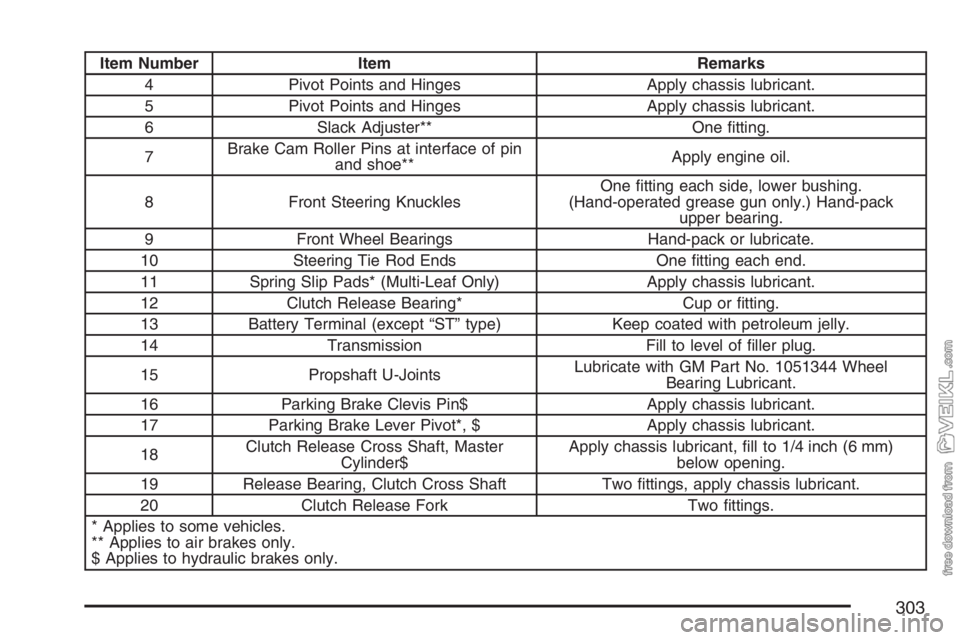
Item Number Item Remarks
4 Pivot Points and Hinges Apply chassis lubricant.
5 Pivot Points and Hinges Apply chassis lubricant.
6 Slack Adjuster** One fitting.
7Brake Cam Roller Pins at interface of pin
and shoe**Apply engine oil.
8 Front Steering KnucklesOne fitting each side, lower bushing.
(Hand-operated grease gun only.) Hand-pack
upper bearing.
9 Front Wheel Bearings Hand-pack or lubricate.
10 Steering Tie Rod Ends One fitting each end.
11 Spring Slip Pads* (Multi-Leaf Only) Apply chassis lubricant.
12 Clutch Release Bearing* Cup or fitting.
13 Battery Terminal (except “ST” type) Keep coated with petroleum jelly.
14 Transmission Fill to level of filler plug.
15 Propshaft U-JointsLubricate with GM Part No. 1051344 Wheel
Bearing Lubricant.
16 Parking Brake Clevis Pin$ Apply chassis lubricant.
17 Parking Brake Lever Pivot*, $ Apply chassis lubricant.
18Clutch Release Cross Shaft, Master
Cylinder$Apply chassis lubricant, fill to 1/4 inch (6 mm)
below opening.
19 Release Bearing, Clutch Cross Shaft Two fittings, apply chassis lubricant.
20 Clutch Release Fork Two fittings.
* Applies to some vehicles.
** Applies to air brakes only.
$ Applies to hydraulic brakes only.
303
Page 384 of 430
(2)= An Emission Control Service.
(3)= A Noise Emission Control Device.
(4)= Applies to vehicles sold in the United States
and is recommended for vehicles sold in Canada.
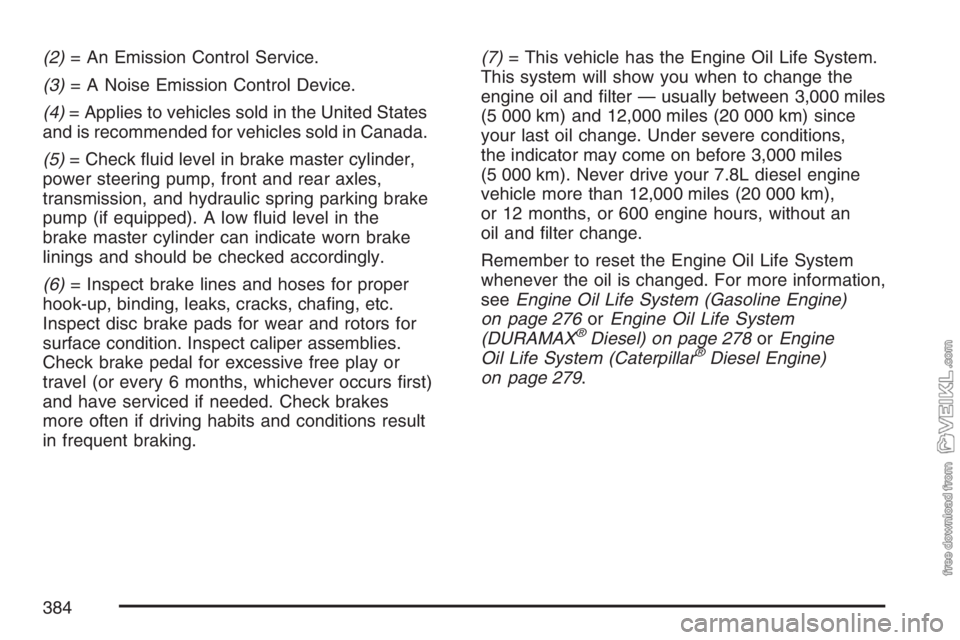
(5)= Check fluid level in brake master cylinder,
power steering pump, front and rear axles,
transmission, and hydraulic spring parking brake
pump (if equipped). A low fluid level in the
brake master cylinder can indicate worn brake
linings and should be checked accordingly.
(6)= Inspect brake lines and hoses for proper
hook-up, binding, leaks, cracks, chafing, etc.
Inspect disc brake pads for wear and rotors for
surface condition. Inspect caliper assemblies.
Check brake pedal for excessive free play or
travel (or every 6 months, whichever occurs first)
and have serviced if needed. Check brakes
more often if driving habits and conditions result
in frequent braking.(7)= This vehicle has the Engine Oil Life System.
This system will show you when to change the
engine oil and filter — usually between 3,000 miles
(5 000 km) and 12,000 miles (20 000 km) since
your last oil change. Under severe conditions,
the indicator may come on before 3,000 miles
(5 000 km). Never drive your 7.8L diesel engine
vehicle more than 12,000 miles (20 000 km),
or 12 months, or 600 engine hours, without an
oil and filter change.
Remember to reset the Engine Oil Life System
whenever the oil is changed. For more information,
seeEngine Oil Life System (Gasoline Engine)
on page 276orEngine Oil Life System
(DURAMAX
®Diesel) on page 278orEngine
Oil Life System (Caterpillar®Diesel Engine)
on page 279.
384
Page 389 of 430
(28)= Inspect Electronic Vacuum Regulator
Valve (EVRV) filter for excessive contamination
or plugging. If needed, clean filter with solution
of soap and water, let dry and install.
(29)= Drain, flush, and refill cooling system.
This service can be complex; you should
have your dealer perform this service. See
Part C: Recommended Fluids and Lubricants
on page 397for what to use. Inspect hoses.
Clean radiator, condenser, pressure cap, and
neck. Pressure test cooling system and pressure
cap. For Caterpillar
®diesel engines, always
refer to the Caterpillar®Diesel Engine Operation &
Maintenance Manual for coolant recommendations
and change intervals.
(30)= Change the lubricant. See
Part C: Recommended Fluids and
Lubricants on page 397.
(31)= Front axle service: Re-pack upper
kingpin roller bearing.(32)= Air brake service:
•Inspect brake lines and hoses for proper
hook-up, binding, leaks, cracks, chafing,
etc. Inspect drum brake linings for wear or
cracks. Inspect other brake parts at each
wheel, including drums and wheel speed
sensor wiring. Check brake pedal for
excessive free play or travel (or every
6 months, whichever occurs first) and have
serviced if needed. Check brakes more often
if driving habits and conditions result in
frequent braking. Replace air dryer cartridge
only if excessive oil or moisture is present.
A small amount of oil in the system is normal
and should not be considered as a reason
to replace the cartridge.
•Test air lines for leaks; tighten as needed.
Replace compressor filter.
•Inspect air parking brake chamber for leaks
and damage. Inspect lines and hoses for
leaks, cracks, chafing, etc. Also check
all attachments for tightness, wear, or damage.
Note: The spring brake section of the rear
brake diaphragms are non-serviceable.
389
Page 393 of 430
Starter Switch Check
{CAUTION:
When you are doing this inspection, the
vehicle could move suddenly. If the vehicle
moves, you or others could be injured.
1. Before you start, be sure you have enough
room around the vehicle.
2. Firmly apply both the parking brake and the
regular brakes.
Do not use the accelerator pedal, and be ready
to turn off the engine immediately if it starts.
3. On automatic transmission vehicles, try to
start the engine in each gear. The starter
should work only in PARK (P), if equipped,
or NEUTRAL (N). If the starter works in
any other position, your vehicle needs service.
On manual transmission vehicles, the starter
should work only when the clutch pedal is
all the way down.
Automatic Transmission Shift
Indicator Check
Check that the indicator points to the gear chosen.
Steering Check
Be alert for any changes in steering action,
abnormal front tire wear or steering wheel position.
An inspection or service is needed when the
steering wheel is harder to turn or has too much
free play, or if there are strange sounds when
turning or parking.
Brake System Check
Be alert to illumination of the low air warning lamp
or for the tone alarm, or changes in braking
action, such as repeated pulling to one side,
unusual sounds when braking or increased
brake pedal travel. Make sure air brake system
reservoirs are drained daily with full system
air pressure, and check system for leaks.
Any of these conditions could indicate the need
for brake system inspection and/or service.
393
Page 415 of 430
Reporting Safety Defects to
General Motors
In addition to notifying NHTSA (or Transport
Canada) in a situation like this, we certainly hope
you’ll notify us. Please call us at 1-800-862-4389,
or write:
GM Medium Duty Truck
Customer Assistance Center
P.O. Box 44947
Detroit, MI 48244
In Canada, please call us at 1-800-263-3777
(English) or 1-800-263-7854 (French). Or, write:
General Motors of Canada Limited
Customer Communication Centre, CA1-163-005
1908 Colonel Sam Drive
Oshawa, Ontario L1H 8P7
Service Publications Ordering
Information
Service Manuals
Service Manuals have the diagnosis and repair
information on engines, transmission, axle
suspension, brakes, electrical, steering, body, etc.
Transmission, Transaxle, Transfer
Case Unit Repair Manual
This manual provides information on unit
repair service procedures, adjustments, and
specifications for GM transmissions, transaxles,
and transfer cases.
Service Bulletins
Service Bulletins give technical service
information needed to knowledgeably service
General Motors cars and trucks. Each bulletin
contains instructions to assist in the diagnosis
and service of your vehicle.
In Canada, the service bulletin reference number
can be obtained by contacting your General
Motors dealer or by calling 1-800-GM-DRIVE
(1-800-463-7483). This reference number is
needed to order the service bulletin
from Helm, Inc.
RETAIL SELL PRICE: $6.00 US +
Processing Fee
415
Page 417 of 430
A
Accessory Power Outlet(s).......................... 156
Adding a Snow Plow or Similar
Equipment................................................ 240
Adding Equipment to Your Airbag-Equipped
Vehicle....................................................... 81
Additives, Fuel............................................ 252
Add-On Electrical Equipment....................... 340
Air Cleaner/Filter, Engine............................. 280
Air Conditioning........................................... 157
Air Conditioning System.............................. 320
Air Pressure Gage...................................... 183
Air Shift Control........................................... 114
Air Suspension............................................ 129
Air Suspension Seats.................................... 13
Airbag
Off Light.................................................. 166
Readiness Light....................................... 165
Airbag Sensing and Diagnostic
Module (SDM).......................................... 409
Airbag System............................................... 68
Adding Equipment to Your
Airbag-Equipped Vehicle......................... 81
Airbag Off Switch....................................... 76
How Does an Airbag Restrain?.................. 73
Servicing Your Airbag-Equipped Vehicle..... 80Airbag System (cont.)
What Makes an Airbag Inflate?.................. 73
What Will You See After an Airbag
Inflates?................................................. 74
When Should an Airbag Inflate?................. 72
Where Are the Airbags?............................. 70
AM-FM Radio.............................................. 186
Antenna, Fixed Mast................................... 204
Anti-Lock Brake System (ABS).................... 212
Anti-Lock Brake, System Warning Light....... 172
Anti-Lock Brakes, Trailer System
Warning Light........................................... 172
Appearance Care
Aluminum or Chrome-Plated Wheels........ 337
Care of Safety Belts................................ 334
Chemical Paint Spotting........................... 338
Cleaning Exterior Lamps/Lenses.............. 335
Cleaning the Inside of Your Vehicle.......... 331
Fabric/Carpet........................................... 333
Finish Care.............................................. 335
Finish Damage......................................... 338
Instrument Panel, Vinyl, and Other
Plastic Surfaces.................................... 334
Sheet Metal Damage............................... 337
Tires........................................................ 337
Underbody Maintenance........................... 338
Vehicle Care/Appearance Materials.......... 339
417
Page 418 of 430
Appearance Care (cont.)
Washing Your Vehicle.............................. 335
Weatherstrips........................................... 334
Windshield and Wiper Blades................... 336
Ashtray(s).................................................... 157
Audio System(s).......................................... 184
AM-FM Radio.......................................... 186
Care of Your Cassette Tape Player.......... 202
Care of Your CD Player........................... 204
Care of Your CDs.................................... 203
Chime Level Adjustment........................... 204
Fixed Mast Antenna................................. 204
Radio with Cassette................................. 189
Radio with CD......................................... 195
Setting the Time...................................... 185
Theft-Deterrent Feature............................ 201
Understanding Radio Reception............... 201
Automatic Ether Injection System................ 318
Automatic Transmission
Fluid........................................................ 282
Operation................................................. 115
Axle, Two-Speed Rear Axle Electric Shift
Control..................................................... 113B
Battery........................................................ 304
Bench Seat, Split.......................................... 13
Brake
Anti-Lock Brake System (ABS)................. 212
Diesel Engine Exhaust............................. 112
Emergencies............................................ 213
Exhaust Indicator Light............................. 178
Hydraulic Systems................................... 211
Parking...........................................125, 126
System Warning Light.............................. 169
Trailer Hand Control Valve....................... 214
Brakes........................................................ 297
Parking Brake Burnish Procedure............. 128
Braking....................................................... 210
Braking in Emergencies............................... 213
Break-In, New Vehicle................................... 95
Bucket Seats.................................................. 9
Bulb Replacement....................................... 315
C
California Proposition 65 Warning................ 248
Canadian Owners........................................... 3
Capacities and Specifications...................... 347
Carbon Monoxide...............................131, 231
418