parking brake CHEVROLET KODIAK 2007 Owners Manual
[x] Cancel search | Manufacturer: CHEVROLET, Model Year: 2007, Model line: KODIAK, Model: CHEVROLET KODIAK 2007Pages: 430, PDF Size: 6.06 MB
Page 85 of 430
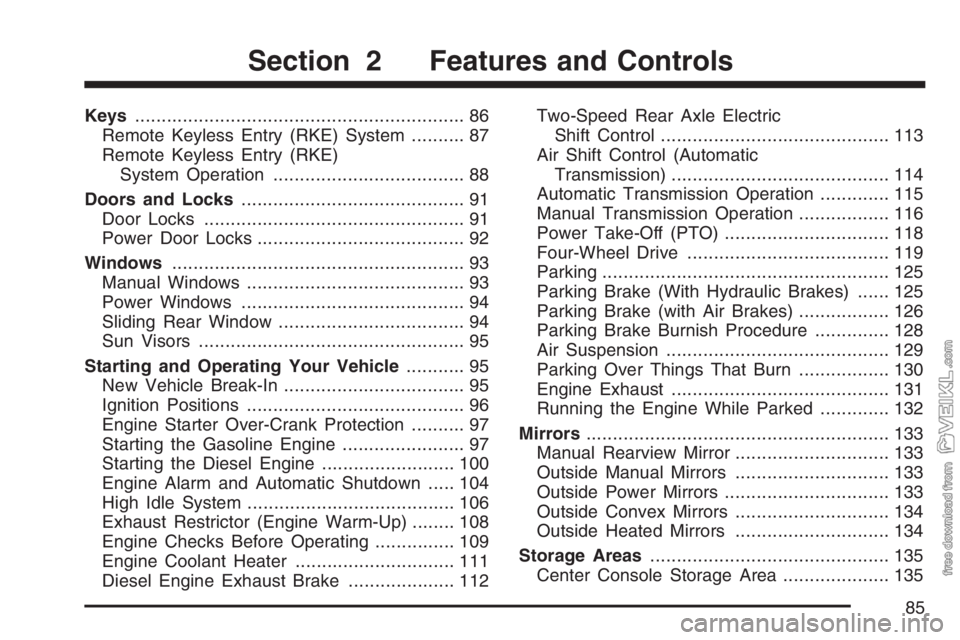
Keys.............................................................. 86
Remote Keyless Entry (RKE) System.......... 87
Remote Keyless Entry (RKE)
System Operation.................................... 88
Doors and Locks.......................................... 91
Door Locks................................................. 91
Power Door Locks....................................... 92
Windows....................................................... 93
Manual Windows......................................... 93
Power Windows.......................................... 94
Sliding Rear Window................................... 94
Sun Visors.................................................. 95
Starting and Operating Your Vehicle........... 95
New Vehicle Break-In.................................. 95
Ignition Positions......................................... 96
Engine Starter Over-Crank Protection.......... 97
Starting the Gasoline Engine....................... 97
Starting the Diesel Engine......................... 100
Engine Alarm and Automatic Shutdown..... 104
High Idle System....................................... 106
Exhaust Restrictor (Engine Warm-Up)........ 108
Engine Checks Before Operating............... 109
Engine Coolant Heater.............................. 111
Diesel Engine Exhaust Brake.................... 112Two-Speed Rear Axle Electric
Shift Control........................................... 113
Air Shift Control (Automatic
Transmission)......................................... 114
Automatic Transmission Operation............. 115
Manual Transmission Operation................. 116
Power Take-Off (PTO)............................... 118
Four-Wheel Drive...................................... 119
Parking...................................................... 125
Parking Brake (With Hydraulic Brakes)...... 125
Parking Brake (with Air Brakes)................. 126
Parking Brake Burnish Procedure.............. 128
Air Suspension.......................................... 129
Parking Over Things That Burn................. 130
Engine Exhaust......................................... 131
Running the Engine While Parked............. 132
Mirrors......................................................... 133
Manual Rearview Mirror............................. 133
Outside Manual Mirrors............................. 133
Outside Power Mirrors............................... 133
Outside Convex Mirrors............................. 134
Outside Heated Mirrors............................. 134
Storage Areas............................................. 135
Center Console Storage Area.................... 135
Section 2 Features and Controls
85
Page 97 of 430
Key In the Ignition
Never leave your vehicle with the keys inside, as it
is an easy target for joy riders or thieves. If you
leave the key in the ignition and park your vehicle,
a chime will sound, when you open the driver’s
door. Always remember to remove your key from
the ignition and take it with you. This will lock
your ignition and transaxle. Also, always remember
to lock the doors.
The battery could be drained if you leave the
key in the ignition while your vehicle is parked.
You may not be able to start your vehicle after it has
been parked for an extended period of time.
Engine Starter Over-Crank
Protection
Your vehicle may have an engine starter
over-crank protection system. If the starter motor
overheats and shuts off due to over-cranking,
the motor must cool down before it will reset and
allow starter operation. It can take up to
six minutes before the starter will work again.
Starting the Gasoline Engine
The 8th digit of your Vehicle Identification
Number (VIN) shows the code letter for your
engine. Use this number to verify the type of
engine in your vehicle. SeeVehicle Identication
Number (VIN) on page 340. Follow the proper steps
to start the engine.
To start a diesel engine, seeStarting the Diesel
Engine on page 100.
Automatic Transmission
Set the parking brake and move your shift lever to
NEUTRAL (N) or PARK (P), if so equipped. Your
engine will not start in any other position — that is a
safety feature.
Manual Transmission
Set the parking brake, shift to neutral NEUTRAL (N)
and hold the clutch pedal to the floor while starting
the engine.
97
Page 99 of 430
Gasoline Engine Warm-Up
When you have started your engine, let it run for
20 or 30 seconds to warm up before you put a
load on the engine.
Drive at moderate speeds for the first 2 to 3 miles
(3.2 to 4.8 km), especially in cold weather. See
High Idle System on page 106.
Restarting the Gasoline Engine While
Moving (Automatic Transmission)
If you have to restart the engine while the
vehicle is moving, you will first have to shift to
NEUTRAL (N). This safety feature prevents
starting the engine when the transmission is in a
drive gear.
Stopping the Gasoline Engine
Let your engine idle for a few seconds before
turning it off after you have finished driving your
vehicle.
If you shift to NEUTRAL (N) or PARK (P), set the
parking brake.
If your vehicle has a two-speed axle, put the
range selector in low. To be sure the axle has
shifted into low, engage the clutch and
transmission; the vehicle may move slightly
when you do this.
While your engine is idling and before you turn it
off, you can make a list of any operational or
handling concerns to give to responsible
maintenance personnel so they can handle them
right away.
Moisture will condense in a fuel tank that is almost
empty if the engine has not run for a while,
even just overnight under some conditions. So, it
is always best to refuel your vehicle at the end
of each run.
99
Page 103 of 430
Stopping the Diesel Engine
1. Set the parking brake and shift to
NEUTRAL (N) or PARK (P).
2. Turn the ignition key to OFF.
If your vehicle has a two-speed axle, see
Two-Speed Rear Axle Electric Shift Control on
page 113.
If you have a Caterpillar
®diesel engine, see your
Caterpillar®Diesel Engine Operation &
Maintenance Manual for additional information.
Diesel Engine Warm-Up
Several factors affect how quickly your diesel
engine warms up. These can include outside
temperature, engine load, idle time and your
vehicle’s option content. Your vehicle may be
equipped with some features that can help
the engine reach operating temperature sooner.
Some of these features are discussed below.Also, remember that an automatic transmission
adds heat to the cooling system through the heat
exchanger in the radiator. Because of this,
vehicles equipped with automatic transmissions
are often able to retain engine coolant heat better
than manual transmission vehicles.
See your Caterpillar
®Operation & Maintenance
manual for additional diesel engine warm-up
information.
If Your Diesel Engine Will Not Start
If you have run out of fuel, seeRunning Out of
Fuel on page 262.
If you are not out of fuel, and your engine will not
start, do this:
Turn your ignition key to RUN. Immediately after
the wait to start light goes off, turn the ignition key
to START.
If the light does not go off, wait a few seconds, then
try starting your engine again. And, see your dealer
as soon as you can for a starting system check.
If the light comes on and then goes off and you
know your batteries are charged, but your engine
still will not start, your vehicle needs service.
103
Page 113 of 430
Two-Speed Rear Axle Electric
Shift Control
If your vehicle has this feature, you will find a label
on the headliner above the windshield or in
another place near the driver that shows how to
use it. Be sure to follow the directions carefully.
Use the following directions based on the type of
shift control the vehicle has.
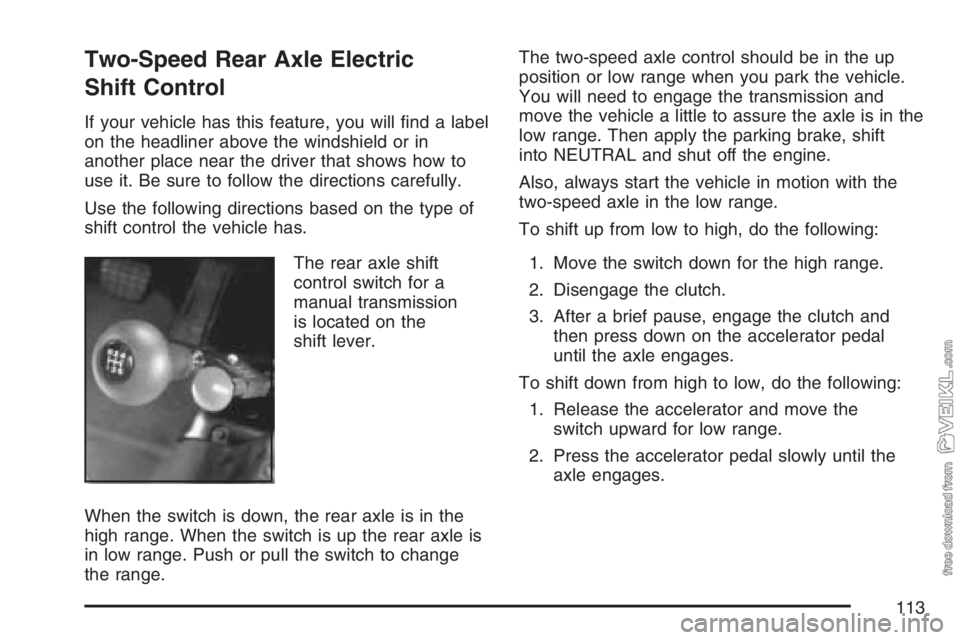
The rear axle shift
control switch for a
manual transmission
is located on the
shift lever.
When the switch is down, the rear axle is in the
high range. When the switch is up the rear axle is
in low range. Push or pull the switch to change
the range.The two-speed axle control should be in the up
position or low range when you park the vehicle.
You will need to engage the transmission and
move the vehicle a little to assure the axle is in the
low range. Then apply the parking brake, shift
into NEUTRAL and shut off the engine.
Also, always start the vehicle in motion with the
two-speed axle in the low range.
To shift up from low to high, do the following:
1. Move the switch down for the high range.
2. Disengage the clutch.
3. After a brief pause, engage the clutch and
then press down on the accelerator pedal
until the axle engages.
To shift down from high to low, do the following:
1. Release the accelerator and move the
switch upward for low range.
2. Press the accelerator pedal slowly until the
axle engages.
113
Page 114 of 430
Air Shift Control (Automatic
Transmission)
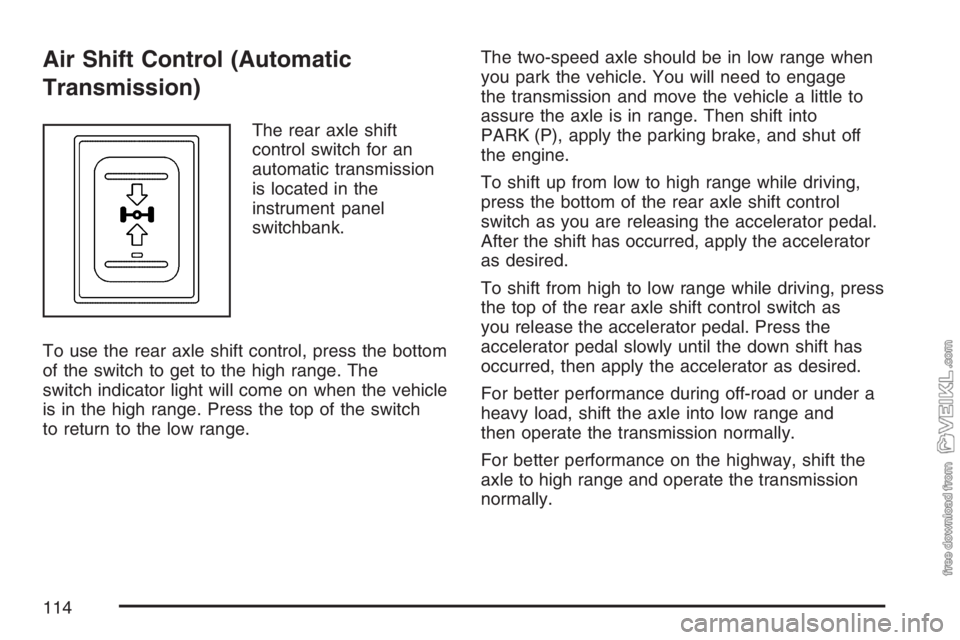
The rear axle shift
control switch for an
automatic transmission
is located in the
instrument panel
switchbank.
To use the rear axle shift control, press the bottom
of the switch to get to the high range. The
switch indicator light will come on when the vehicle
is in the high range. Press the top of the switch
to return to the low range.The two-speed axle should be in low range when
you park the vehicle. You will need to engage
the transmission and move the vehicle a little to
assure the axle is in range. Then shift into
PARK (P), apply the parking brake, and shut off
the engine.
To shift up from low to high range while driving,
press the bottom of the rear axle shift control
switch as you are releasing the accelerator pedal.
After the shift has occurred, apply the accelerator
as desired.
To shift from high to low range while driving, press
the top of the rear axle shift control switch as
you release the accelerator pedal. Press the
accelerator pedal slowly until the down shift has
occurred, then apply the accelerator as desired.
For better performance during off-road or under a
heavy load, shift the axle into low range and
then operate the transmission normally.
For better performance on the highway, shift the
axle to high range and operate the transmission
normally.
114
Page 115 of 430
Automatic Transmission Operation
We build vehicles with Allison®five and
six-speed automatic transmissions. This part of
the manual covers the basics of these. With these
transmissions, you will find another Allison
®
manual in your vehicle that goes into more detail.
On the headliner, in front of and above the
driver, or in some other place near the driver, you
will see a label that describes important operating
facts about the automatic transmission in your
vehicle. Make sure you follow the instructions on
this label.
Be sure to keep your parking brake set until you
are ready to shift into DRIVE (D), and press
the brake pedal while shifting from NEUTRAL (N)
or PARK (P) to a drive gear.
All vehicles equipped with automatic transmissions
can be started in PARK (P), if equipped, or in
NEUTRAL (N). See the Allison
®Transmission
Operator’s Manual in your vehicle for more
information about this.
{CAUTION:
It can be dangerous to get out of your
vehicle without the parking brake rmly
set. Your vehicle can roll. If you have left
the engine running, the vehicle can move
suddenly. You or others could be injured.
To be sure your vehicle will not move,
even when you are on fairly level ground,
always set the parking brake.
{CAUTION:
Shifting into a drive gear while your
engine is running at high speed is
dangerous. Unless your foot is rmly on
the brake pedal, your vehicle could move
very rapidly. You could lose control and
hit people or objects. Do not shift into a
drive gear while your engine is running at
high speed.
115
Page 121 of 430
4n(Four-Wheel Low):This setting sends
maximum power to all four wheels. You might
choose Four-Wheel Low if you are driving off-road
in deep sand, deep mud, and climbing or
descending steep hills. Be sure the front wheel
hubs are locked when you want to drive in
Four-Wheel Low.
{CAUTION:
Shifting the transfer case to NEUTRAL
can cause your vehicle to roll even if the
transmission is in PARK (P). You or
someone else could be injured. If you are
going to leave your vehicle, set the
parking brake and shift the transmission
to PARK (P) and make sure the transfer
case is in a drive gear.Notice:If your vehicle has an Allison
®
transmission and you try to put the
transmission in PARK (P) while the transfer
case is in Four-Wheel Low, the transmission
might not go into PARK (P) and could damage
your vehicle. When parking your vehicle,
make sure the transfer case is in Two-Wheel
High or Four-Wheel High.
NEUTRAL:Shift the vehicle’s transfer case to
NEUTRAL only when towing your vehicle.
Shifting Into Four-Wheel High
Turn the knob to four-wheel high. This can be
done at 3 mph or less, while you are shifting out
of Four-Wheel Low. The indicator light flashes
while shifting. It remains on after the shift is
complete. Be sure to lock your front hubs.
121
Page 123 of 430
Shifting Out of Four-Wheel Low
To shift from Four-Wheel Low to Four-Wheel High
or Two-Wheel High, your vehicle must be
stopped or moving less than 3 mph (5 km/h) with
the transmission in NEUTRAL (N) and the
engine running. The preferred method for shifting
out of Four-Wheel Low is to have your vehicle
moving 1 or 2 mph (1.6 to 3.2 km/h). Turn the knob
to Four-Wheel High or Two-Wheel High. You
must wait for the Four-Wheel High or Two-Wheel
High indicator light to stop flashing and remain
on before shifting the transmission into gear.
Notice:Shifting the transmission into gear
before the Four-Wheel High or Two-Wheel High
indicator light has stopped ashing could
damage the transfer case. To help avoid
damaging your vehicle, always wait for the
Four-Wheel High or Two-Wheel High indicator
light to stop ashing before shifting the
transmission into gear.
If the knob is turned to Four-Wheel High or
Two-Wheel High while your vehicle is in gear and/or
moving, the Four-Wheel High or Two-Wheel high
indicator light flashes for 30 seconds. It will not
complete the shift unless your vehicle is moving
less than 3 mph (5 km/h) with the transmission in
NEUTRAL (N).
Shifting Into NEUTRAL
Before shifting the transfer case to NEUTRAL, first
make sure the vehicle is parked so that it will
not roll.
1. Set the parking brake.
2. Start the vehicle.
3. Put the transmission in NEUTRAL (N).
4. Shift the transfer case to Two-Wheel High.
5. Turn the transfer case knob all of the way past
Four-Wheel Low and hold it there for a
minimum of 10 seconds. The NEUTRAL
indicator light comes on.
6. Shift the transmission to REVERSE (R) for
one second, then shift the transmission to
DRIVE (D) for one second.
7. Turn the ignition to OFF.
8. Place the transmission shift lever in
PARK. (P).
9. Turn the ignition to LOCK.
123
Page 124 of 430
Shifting Out of NEUTRAL
To shift the transfer case out of NEUTRAL, do the
following:
1. Set the parking brake and apply the regular
brake pedal.
2. Turn the ignition to RUN with the engine off.
3. Put the transmission in NEUTRAL (N).
4. Turn the transfer case knob to the desired
shift position (Two-Wheel High, Four-Wheel
High, Four-Wheel Low).
5. After the transfer case has shifted out of
NEUTRAL, the indicator light goes out.Notice:Driving with the parking brake on can
overheat the brake system and cause
premature wear or damage to brake system
parts. Verify that the parking brake is fully
released and the brake warning light is
off before driving.
6. Release the parking brake.
7. Start the engine and shift the transmission
lever to the desired position.
Excessively shifting the transfer case into or out of
the different modes can cause the transfer case
to enter the shift protection mode. This protects the
transfer case from possible damage and only
allows the transfer case to respond to one shift per
10 seconds. The transfer case can stay in this
mode for up to three minutes.
124