brake light CHEVROLET KODIAK 2008 User Guide
[x] Cancel search | Manufacturer: CHEVROLET, Model Year: 2008, Model line: KODIAK, Model: CHEVROLET KODIAK 2008Pages: 384, PDF Size: 5.4 MB
Page 107 of 384
4. Check to see if the vehicle moves by slowly
removing your foot from the regular brake pedal.
5. If the vehicle moves, press the regular brake and
repeat the adjustment procedure.
Notice:Over-tightening the park brake lever can
cause damage to the park brake system.
Over-tightening is possible by turning the knob
more than half a turn.
Over-tightening is similar to driving down the road with
your regular brakes applied. If your park brake system is
over-tightened your vehicle may seem sluggish to
accelerate, and/or your park brake hand lever maybe
very hard to pull up and apply the park brake.
If the park brake is over-tightened turn the knob to the
left until it stops and follow the parking brake adjustment
procedure.
Vehicles with a foot-pedal park brake system must be
serviced to make this adjustment. SeeScheduled
Maintenance on page 6-5for more information.Parking Brake (With Air Brakes)
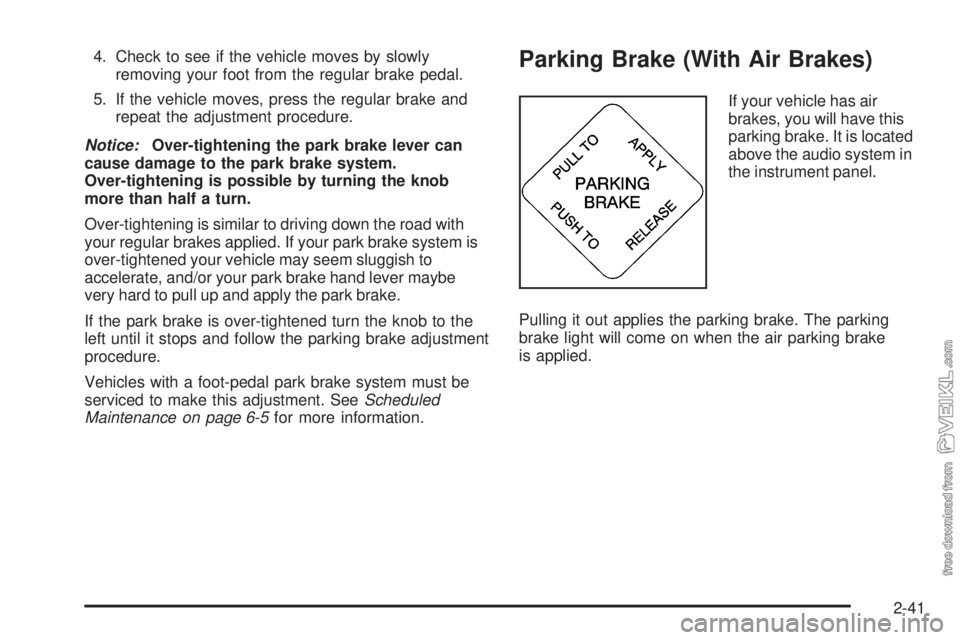
If your vehicle has air
brakes, you will have this
parking brake. It is located
above the audio system in
the instrument panel.
Pulling it out applies the parking brake. The parking
brake light will come on when the air parking brake
is applied.
2-41
Page 109 of 384
{CAUTION:
If you apply any one of the air brake parking
controls while the vehicle is moving, your rig
will stop suddenly. If you are not ready for
this, you or others could be injured. Do not
apply any one of these controls while you are
driving, unless you have to make an
emergency stop.
If the air pressure drops below 60 to 70 psi
(413 to 482 kPa), the primary brake light and warning
buzzer will come on. If the air pressure drops to
35 to 45 psi (241 to 310 kPa), the red trailer air supply
knob will automatically pop out and apply the spring
brakes on the trailer.
If the air pressure drops to 35 to 45 psi (241 to 310 kPa),
the yellow park brake knob will automatically pop out
and apply the spring brakes on the truck or tractor.
If you ever have a complete loss of air so that your air
brakes automatically apply, there is a way that the
tow operator can release the parking brakes to tow the
vehicle. SeeTowing Your Vehicle on page 4-24.
Parking Brake Burnish Procedure
All vehicles which have hydraulic brakes have a parking
brake. It is recommended that the parking brake be
burnished as part of the new vehicle break-in. The
parking brake will work best after it has been burnished
following these instructions:
1. Make sure that there is no other traffic around,
bring the vehicle speed up to 20 mph (32 km/h)
and apply the parking brake. Let the vehicle come
to a complete stop. Apply the base brakes and
disengage the parking brake.
2. Repeat the burnishing procedure in Step 1 a total
of 10 times
3. Between stops, drive the vehicle about
2.5 miles (4 km)
Notice:Driving with the parking brake on can
damage the transmission and brake system parts.
Verify that the parking brake is fully released and the
brake warning light is off before driving.
2-43
Page 115 of 384
4. Fully set the parking brake.
5. Shift the transmission to PARK (P) or
NEUTRAL (N).
6. Idle the engine. If you used the idling control knob
to increase the engine speed, restore it all the way
to the left to reduce the engine speed.
7. If the vehicle has Power Take Off (PTO), turn the
PTO off. SeePower Take-Off (PTO) on page 2-32.
8. Press the DPF switch in the instrument panel
switchbank. SeeInstrument Panel Switchbank
on page 3-18. The green DPF indicator light comes
on, the exhaust gas control valve operates,
engine idle speed automatically increases, and DPF
regeneration begins. Do not leave the vehicle
unattended during manual regeneration.
9. When both the green and the yellow or red DPF
indicator lights go off, regeneration is completed.
Regeneration is normally completed in about
30 minutes.Under certain operating conditions, manual regeneration
might not be able to be performed, even if the soot
level in the DPF requires regeneration. This can occur
because of low coolant temperature, low battery voltage,
or high exhaust temperature or immediately after
starting the vehicle. When manual regeneration is
requested, by pressing the DPF switch, when coolant
temperature is low, engine warm-up is started, the green
indicator light will come on, the exhaust gas control
valve operates, and engine rpm increases to help raise
engine coolant temperature. When operating conditions
allow, regeneration will start.
2-49
Page 121 of 384
Instrument Panel Overview...............................3-4
Hazard Warning Flashers................................3-6
Other Warning Devices...................................3-6
Horn.............................................................3-6
Tilt Wheel.....................................................3-7
Turn Signal/Multifunction Lever.........................3-7
Turn and Lane-Change Signals........................3-8
Headlamp High/Low-Beam Changer..................3-8
Windshield Wipers..........................................3-9
Windshield Washer.......................................3-10
Cruise Control..............................................3-10
Exterior Lamps.............................................3-14
Headlamps on Reminder................................3-15
Daytime Running Lamps (DRL).......................3-15
Marker Lamps..............................................3-16
Instrument Panel Brightness...........................3-16
Dome Lamps...............................................3-16
Entry Lighting...............................................3-17
Reading Lamps............................................3-17
Instrument Panel Switchbank..........................3-18
Accessory Power Outlet(s).............................3-19
Ashtray(s) and Cigarette Lighter......................3-20
Climate Controls............................................3-20
Climate Control System.................................3-20
Outlet Adjustment.........................................3-23
Rear Heating System....................................3-24Warning Lights, Gages, and Indicators............3-24
Instrument Panel Cluster................................3-25
Speedometer and Odometer...........................3-26
Trip Odometer..............................................3-26
Tachometer.................................................3-26
Engine Speed Limiter....................................3-27
Safety Belt Reminders...................................3-27
Airbag Readiness Light..................................3-28
Airbag Off Light............................................3-29
Charging System Light..................................3-30
Voltmeter Gage............................................3-31
Service Transmission Warning Light................3-31
Range Inhibit Warning Indicator......................3-32
Brake System Warning Light..........................3-32
Anti-lock Brake System (ABS) Warning Light. . . .3-34
Trailer Antilock Brake System Warning Light.....3-34
Engine Coolant Temperature Gage..................3-35
Low Coolant Warning Light............................3-35
Wait to Start Indicator...................................3-36
Malfunction Indicator Lamp.............................3-36
Oil Pressure Gage........................................3-37
Low Oil Level Light.......................................3-38
Change Engine Oil Light................................3-38
Engine Overspeed Warning Light....................3-39
Engine Shutdown Warning Light.....................3-39
Transmission Temperature Gage.....................3-39
Section 3 Instrument Panel
3-1
Page 122 of 384
Exhaust Brake Indicator Light.........................3-40
Differential Lock Indicator Light.......................3-40
Reduced Engine Power Light.........................3-41
Highbeam On Light.......................................3-41
Daytime Running Lamps (DRL) Indicator
Light........................................................3-41
Low Washer Fluid Warning Light.....................3-42
Power Take-Off Light....................................3-42
Check Gages Warning Light...........................3-42
Fuel Gage...................................................3-43
Water in Fuel Warning Light...........................3-44
Change Fuel Filter Warning Light....................3-44Diesel Particulate Filter Warning Light..............3-45
Air Filter Restriction Indicator..........................3-45
Air Pressure Gage........................................3-46
Hourmeter Gage...........................................3-46
Audio System(s).............................................3-47
Setting the Clock..........................................3-48
Radio(s)......................................................3-48
Theft-Deterrent Feature..................................3-57
Radio Reception...........................................3-58
Fixed Mast Antenna......................................3-58
Chime Level Adjustment................................3-58
Section 3 Instrument Panel
3-2
Page 125 of 384
A. Air Outlets. SeeOutlet Adjustment on page 3-23.
B. Instrument Panel Cluster. SeeInstrument Panel
Cluster on page 3-25.
C. Shift Lever. SeeAutomatic Transmission Operation
on page 2-29orManual Transmission Operation
on page 2-30.
D. Air Brake Controls. SeeParking Brake
(With Hydraulic Brakes) on page 2-38or
Parking Brake (With Air Brakes) on page 2-41.
E. Transfer Case Controls (If Equipped). See
Four-Wheel Drive on page 2-32. Air Filter Gage
(If Equipped). SeeAir Filter Restriction Indicator on
page 3-45.
F. Auxiliary Gages. SeeWarning Lights, Gages,
and Indicators on page 3-24.
G. Exterior Lamp Control. SeeExterior Lamps on
page 3-14.H. Turn Signal/Multifunction Lever. SeeTurn
Signal/Multifunction Lever on page 3-7.
I. Hazard Warning Flashers Button. SeeHazard
Warning Flashers on page 3-6.
J. Audio System(s). SeeAudio System(s) on
page 3-47.
K. Climate Controls. SeeClimate Control System
on page 3-20.
L. Instrument Panel Switchbank. SeeInstrument
Panel Switchbank on page 3-18.
M. Airbag Off Switch. SeeAirbag Off Switch on
page 1-56.
N. Accessory Power Outlets. SeeAccessory Power
Outlet(s) on page 3-19.
3-5
Page 133 of 384
Passing Another Vehicle While Using
Cruise Control
Use the accelerator pedal to increase your speed.
When you take your foot off the pedal, your vehicle will
slow down to the cruise control speed you set earlier.
Using Cruise Control on Hills
How well your cruise control will work on hills depends
upon your speed, load and the steepness of the
hills. When going up steep hills, you may want to
step on the accelerator pedal to maintain your speed.
When going downhill, you may have to brake or shift to
a lower gear to keep your speed down. Of course,
applying the brake or clutch takes you out of cruise
control. Many drivers find this to be too much trouble
and don’t use cruise control on steep hills.
If your vehicle is equipped with the exhaust brake option
and the exhaust brake is turned on, the exhaust brake
may come on and try to slow down the vehicle to the set
cruise control speed if the vehicle has accelerated
past the set cruise control speed while going downhill.
Ending Cruise Control
There are four different ways to turn off the cruise
control:
•Step lightly on the brake pedal
(manual and automatic transmissions).
•Press the clutch pedal to the floor
(manual transmissions).
•Move the cruise switch to off, or
•Shift the transmission to NEUTRAL (N).
Erasing Speed Memory
When you turn off the ignition, your cruise control set
speed memory is erased.
3-13
Page 135 of 384
Headlamps on Reminder
If you have this system, a tone will sound when your
headlamps and/or parking lamps are turned on and your
ignition is in LOCK or ACCESSORY.
Daytime Running Lamps (DRL)
Daytime Running Lamps (DRL) can make it easier for
others to see the front of your vehicle during the
day. DRL can be helpful in many different driving
conditions, but they can be especially helpful in the short
periods after dawn and before sunset. Fully functional
daytime running lamps are required on all vehicles
first sold in Canada.
The DRL system will make your headlamps come on
at reduced brightness when the following conditions
are met:
•The ignition is on,
•the exterior lamp control is off, and
•the parking brake is released.When the DRL are on, only the headlamps will be on.
The taillamps, sidemarker and other lamps will not
be on. Your instrument panel will not be lit up either.
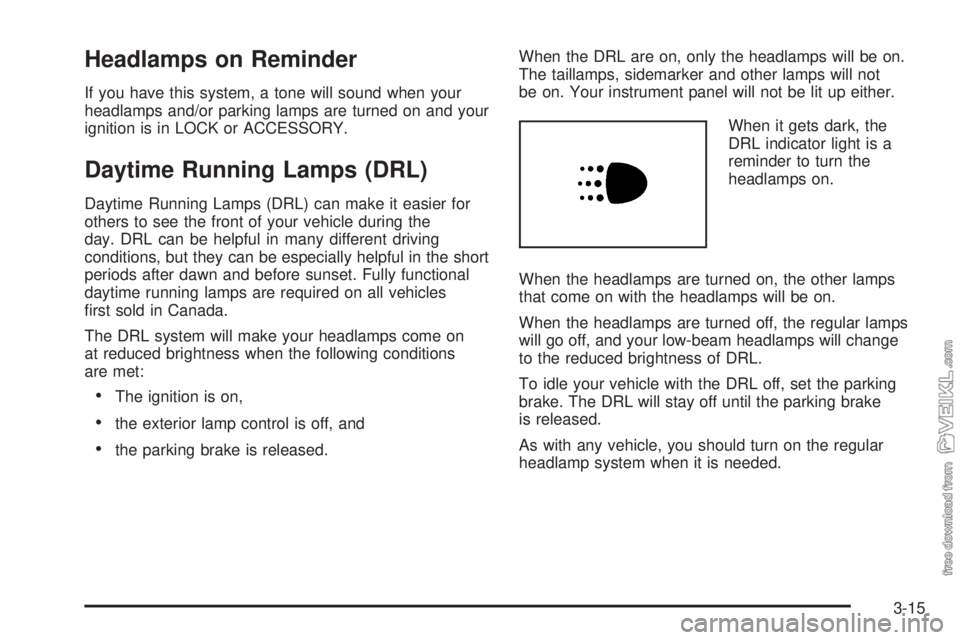
When it gets dark, the
DRL indicator light is a
reminder to turn the
headlamps on.
When the headlamps are turned on, the other lamps
that come on with the headlamps will be on.
When the headlamps are turned off, the regular lamps
will go off, and your low-beam headlamps will change
to the reduced brightness of DRL.
To idle your vehicle with the DRL off, set the parking
brake. The DRL will stay off until the parking brake
is released.
As with any vehicle, you should turn on the regular
headlamp system when it is needed.
3-15
Page 152 of 384
Range Inhibit Warning Indicator
If your vehicle has an Allison 1000/2200/2300/2500 series
automatic transmission, a lighted bar under the current
gear selected will flash.
If your vehicle has an Allison 3000/3500 series
automatic transmission, the current gear selected on
the pushbutton display will flash.
The flashing bar or gear selection indicates that
transmission range shifts may not occur.
For detailed information on shift inhibit limitations, see
the Allison Automatic Transmission Operator’s Manual in
your vehicle for further information.
Brake System Warning Light
Your vehicle has either hydraulic or air brakes.
Each system has different warning lights.
Hydraulic Brake System Warning Lights
Vehicles with hydraulic brake systems have two brake
system warning lights on the instrument panel.
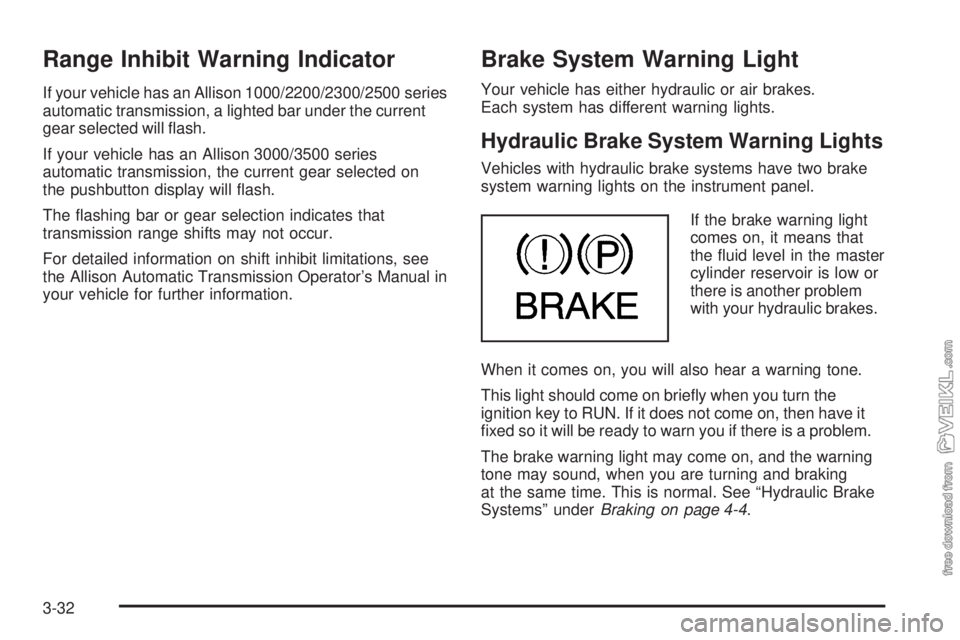
If the brake warning light
comes on, it means that
the fluid level in the master
cylinder reservoir is low or
there is another problem
with your hydraulic brakes.
When it comes on, you will also hear a warning tone.
This light should come on briefly when you turn the
ignition key to RUN. If it does not come on, then have it
fixed so it will be ready to warn you if there is a problem.
The brake warning light may come on, and the warning
tone may sound, when you are turning and braking
at the same time. This is normal. See “Hydraulic Brake
Systems” underBraking on page 4-4.
3-32
Page 153 of 384
Parking Brake Warning Light
Your vehicle has a brake warning light. When the
ignition is on, this light will come on when you set your
parking brake. The light will stay on if your parking
brake does not release fully.
This light should also come on when you turn the
ignition key to START. If it does not come on then, have
it fixed so it will be ready to remind you if the parking
brake is applied or has not released fully.
Air Brake System Warning Light
Vehicles with air brake systems have a brake system
warning light on the instrument panel.
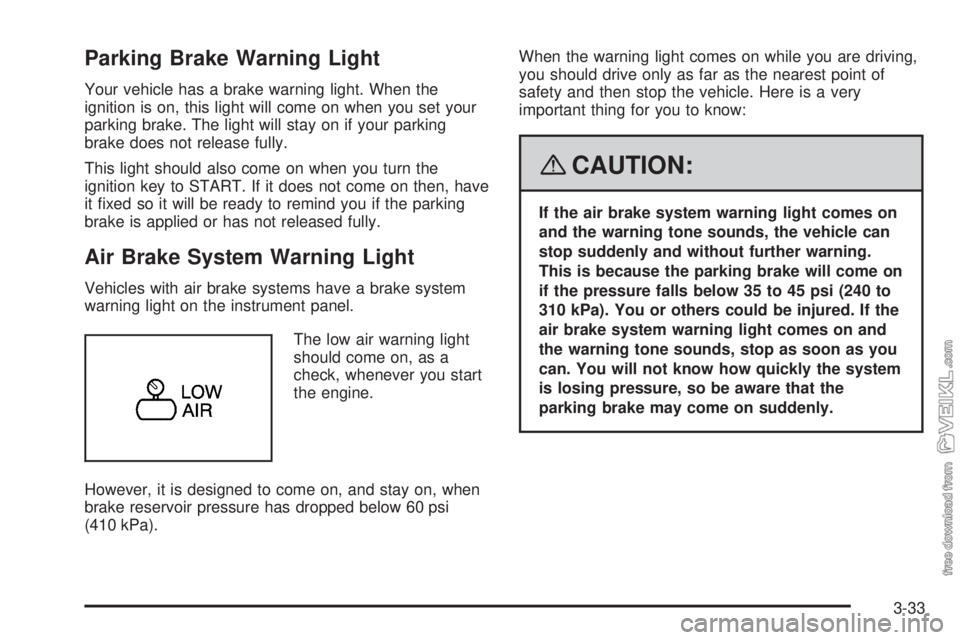
The low air warning light
should come on, as a
check, whenever you start
the engine.
However, it is designed to come on, and stay on, when
brake reservoir pressure has dropped below 60 psi
(410 kPa).When the warning light comes on while you are driving,
you should drive only as far as the nearest point of
safety and then stop the vehicle. Here is a very
important thing for you to know:
{CAUTION:
If the air brake system warning light comes on
and the warning tone sounds, the vehicle can
stop suddenly and without further warning.
This is because the parking brake will come on
if the pressure falls below 35 to 45 psi (240 to
310 kPa). You or others could be injured. If the
air brake system warning light comes on and
the warning tone sounds, stop as soon as you
can. You will not know how quickly the system
is losing pressure, so be aware that the
parking brake may come on suddenly.
3-33